Problems
Filters
2 problems found
2021 Paper 2 Q6
D: 1500.0
B: 1500.0
coordinate geometry
cosine rule
circular arc
concentric circles
approximation
trigonometric identities
optimisation
A plane circular road is bounded by two concentric circles with centres at point~\(O\). The inner circle has radius \(R\) and the outer circle has radius \(R + w\). The points \(A\) and \(B\) lie on the outer circle, as shown in the diagram, with \(\angle AOB = 2\alpha\), \(\tfrac{1}{3}\pi \leqslant \alpha \leqslant \tfrac{1}{2}\pi\) and \(0 < w < R\).
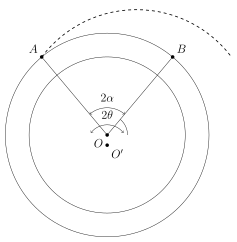
- Show that I cannot cycle from \(A\) to \(B\) in a straight line, while remaining on the road.
- I take a path from \(A\) to \(B\) that is an arc of a circle. This circle is tangent to the inner edge of the road, and has radius \(R + d\) (where \(d > w\)) and centre~\(O'\).
My path is represented by the dashed arc in the above diagram.
Let \(\angle AO'B = 2\theta\).
- Use the cosine rule to find \(d\) in terms of \(w\), \(R\) and \(\cos\alpha\).
- Find also an expression for \(\sin(\alpha - \theta)\) in terms of \(R\), \(d\) and \(\sin\alpha\).
- Show that \(\dfrac{d}{R}\) and \(\alpha - \theta\) are also both much less than \(1\).
- My friend cycles from \(A\) to \(B\) along the outer edge of the road. Let my path be shorter than my friend's path by distance~\(S\). Show that \[ S = 2(R+d)(\alpha - \theta) + 2\alpha(w - d). \] Hence show that \(S\) is approximately a fraction \[ \frac{\sin\alpha - \alpha\cos\alpha}{\alpha(1 - \cos\alpha)} \cdot \frac{w}{R} \] of the length of my friend's path.
1988 Paper 1 Q11
D: 1484.0
B: 1500.0
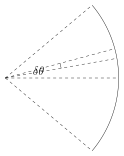
Derive a formula for the position of the centre of mass of a uniform circular arc of radius \(r\) which subtends an angle \(2\theta\) at the centre.

Solution: