Problems
Filters
17 problems found
2021 Paper 3 Q6
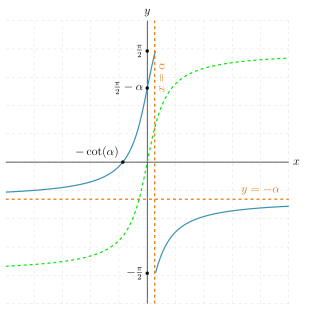
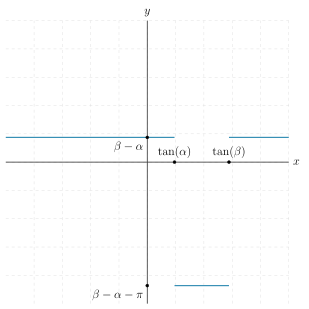
- For \(x \neq \tan\alpha\), the function \(f_\alpha\) is defined by \[ f_\alpha(x) = \tan^{-1}\!\left(\frac{x\tan\alpha + 1}{\tan\alpha - x}\right) \] where \(0 < \alpha < \tfrac{1}{2}\pi\). Show that \(f_\alpha'(x) = \dfrac{1}{1 + x^2}\). Hence sketch \(y = f_\alpha(x)\). On a separate diagram, sketch \(y = f_\alpha(x) - f_\beta(x)\) where \(0 < \alpha < \beta < \tfrac{1}{2}\pi\).
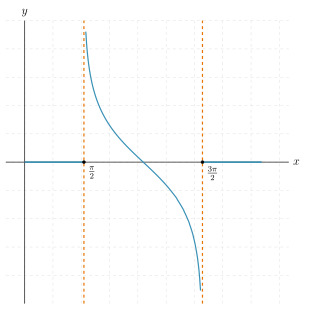
- For \(0 \leqslant x \leqslant 2\pi\) and \(x \neq \tfrac{1}{2}\pi,\, \tfrac{3}{2}\pi\), the function \(g(x)\) is defined by \[ g(x) = \tanh^{-1}(\sin x) - \sinh^{-1}(\tan x). \] For \(\tfrac{1}{2}\pi < x < \tfrac{3}{2}\pi\), show that \(g'(x) = 2\sec x\). Use this result to sketch \(y = g(x)\) for \(0 \leqslant x \leqslant 2\pi\).
Solution:
- \(\,\) \begin{align*}
&& f_\alpha(x) &= \tan^{-1}\!\left(\frac{x\tan\alpha + 1}{\tan\alpha - x}\right) \\
&& f'_\alpha(x) &= \frac{1}{1 + \left(\frac{x\tan\alpha + 1}{\tan\alpha - x}\right) ^2} \cdot \frac{\tan \alpha \cdot (\tan \alpha - x) - (x \tan \alpha + 1) \cdot (-1)}{(\tan \alpha - x)^2} \\
&&&= \frac{\tan^2 \alpha -1}{(\tan \alpha - x)^2 + (x \tan \alpha +1)^2} \\
&&&= \frac{\tan^2 \alpha +1}{\tan^2 \alpha - 2x \tan \alpha + x^2 + x^2 \tan^2 \alpha + 2 x \tan \alpha + 1} \\
&&&= \frac{1+\tan^2 \alpha}{(1+\tan^2 \alpha(x^2 + 1)} = \frac{1}{1+x^2}
\end{align*}
- Let \(g(x) = \tanh^{-1}(\sin x) - \sinh^{-1}(\tan x)\) then
\begin{align*}
&& g'(x) &= \frac{1}{1-\sin^2 x} \cdot \cos x - \frac{1}{\sqrt{\tan^2 +1}} \cdot \sec^2 x \\
&&&= \sec x - \frac{\sec^2 x}{|\sec x|} \\
&&& = \begin{cases} 0 &\text{if } \sec x \geq 0 \\
2 \sec x &\text{ otherwise}
\end{cases}
\end{align*}
Therefore \(g'(x) = 2\sec x\) if \(\tfrac12 \pi < x < \tfrac32\pi\)
Therefore $\displaystyle g(x) = \begin{cases} 0 & \text{if } x \in [0, \frac{\pi}{2}] \cup [\frac{3\pi}{2}, 2\pi] \\
\ln( (\tan x + \sec x)^2) + C &\text{otherwise} \end{cases}$
2016 Paper 1 Q2
Differentiate, with respect to \(x\), \[ (ax^2+bx+c)\,\ln \big( x+\sqrt{1+x^2}\big) +\big(dx+e\big)\sqrt{1+x^2} \,, \] where \(a\), \(b\), \(c\), \(d\) and \(e\) are constants. You should simplify your answer as far as possible. Hence integrate:
- \( \ln \big( x+\sqrt{1+x^2}\,\big) \,;\)
- \(\sqrt{1+x^2} \,; \)
- \( x\ln \big( x+\sqrt{1+x^2}\,\big) \,.\)
Solution: \begin{align*} && y &= (ax^2+bx+c)\,\ln \big( x+\sqrt{1+x^2}\big) +\big(dx+e\big)\sqrt{1+x^2} \\ && y' &= (2ax+b)\,\ln \big( x+\sqrt{1+x^2}\big) + (ax^2+bx+c) \frac{1}{x + \sqrt{1+x^2}} \cdot \left(1 + \frac{x}{\sqrt{1+x^2}} \right) + d\sqrt{1+x^2} + \frac{x(dx+e)}{\sqrt{1+x^2}} \\ &&&= (2ax+b)\,\ln \big( x+\sqrt{1+x^2}\big) + \frac{1}{\sqrt{1+x^2}} \left ( (ax^2+bx+c) + d(1+x^2) + x(dx+e) \right) \\ &&&= (2ax+b)\,\ln \big( x+\sqrt{1+x^2}\big) + \frac{1}{\sqrt{1+x^2}} \left ( (a+2d)x^2+(b+e)x+(d+c) \right) \\ \end{align*}
- We want \(a = 0, b = 1, d = 0, e = -1, c =0\), so \begin{align*} I &= \int \ln \big( x+\sqrt{1+x^2}\,\big) \,\d x \\ &= x\ln(x+\sqrt{1+x^2})-\sqrt{1+x^2}+C \end{align*}
- We want \(a = b =0, e = 0, d = \frac12, c = \frac12\), so \begin{align*} I &= \int \sqrt{1+x^2}\, \d x \\ &= \frac12\ln(x+\sqrt{1+x^2}) + \frac12x\sqrt{1+x^2}+C \end{align*}
- We want \(a = \frac12, b = 0, d = -\frac14, e = 0, c = \frac14\), so \begin{align*} I &= \int x \ln (x+\sqrt{1+x^2}) \, \d x \\ &= \left (\frac12 x^2+\frac14 \right)\ln(x+\sqrt{1+x^2}) -\frac14x\sqrt{1+x^2}+C \end{align*}
2016 Paper 1 Q4
- Differentiate $\displaystyle \; \frac z {(1+z^2)^{\frac12}} \;$ with respect to \(z\).
- The {\em signed curvature} \(\kappa\) of the curve \(y=\f(x)\) is defined by \[ \kappa = \frac {\f''(x)}{\big({1+ (\f'(x))^2\big)^{\frac32}}} \,.\] Use this definition to determine all curves for which the signed curvature is a non-zero constant. For these curves, what is the geometrical significance of \(\kappa\)?
Solution:
- Let \(\displaystyle y = \frac z {(1+z^2)^{\frac12}}\) then \(\frac{d y}{d x} = \frac{(1+z^2)^{\frac12} - z^2(1+z^2)^{-\frac12}}{1+z^2} = \frac{(1+z^2)-z^2}{(1+z^2)^\frac32} = \frac{1}{(1+z^2)^\frac32}\)
- \(\kappa = \frac {f''(x)}{\big({1+ (f'(x))^2\big)^{\frac32}}}\) then \begin{align*} && \int \kappa \, dx &= \int \frac{f''(x)}{( 1 + (f'(x))^2)^{\frac32}} \, dx \\ && \kappa x &= \frac{f'(x)}{(1 + (f'(x))^2)^\frac12} + C \\ \Rightarrow && (\kappa x-C)^2 &= \frac{f'(x)^2}{1 + (f'(x))^2} \\ \Rightarrow && f'(x)^2((\kappa x - C)^2 - 1) &= -(\kappa x-C)^2 \\ \Rightarrow && f'(x) &= \frac{\kappa x - C}{\sqrt{1-(\kappa x - C)^2 }} \\ \Rightarrow && f(x) &= \frac{1}{\kappa} \sqrt{1 - (\kappa x - C)^2} \\ \Rightarrow && (\kappa y)^2 + (\kappa x - C)^2 &= 1 \\ \Rightarrow && y^2 + (x - C')^2 &= \frac{1}{\kappa^2} \end{align*} Therefore all the curves are circles and \(\kappa\) is the reciprocal of the radius.
2016 Paper 2 Q6
This question concerns solutions of the differential equation \[ (1-x^2) \left(\frac{\d y}{\d x}\right)^2 + k^2 y^2 = k^2\, \tag{\(*\)} \] where \(k\) is a positive integer. For each value of \(k\), let \(y_k(x)\) be the solution of \((*)\) that satisfies \(y_k(1)=1\); you may assume that there is only one such solution for each value of \(k\).
- Write down the differential equation satisfied by \(y_1(x)\) and verify that \(y_1(x) = x\,\).
- Write down the differential equation satisfied by \(y_2(x)\) and verify that \(y_2(x) = 2x^2-1\,\).
- Let \(z(x) = 2\big(y_n(x)\big)^2 -1\). Show that \[ (1-x^2) \left(\frac{\d z}{\d x}\right)^2 +4n^2 z^2 = 4n^2\, \] and hence obtain an expression for \(y_{2n}(x)\) in terms of \(y_n(x)\).
- Let \(v(x) = y_n\big(y_m(x)\big)\,\). Show that \(v(x) = y_{mn}(x)\,\).
Solution:
- When \(k =1\), we have \((1-x^2)(y')^2 + y^2 = 1\). Notice that if \(y_1 = x\) we have \(y_1' = 1\) and \((1-x^2) \cdot 1 + x^2 = 1\) so \(y_1\) is a solution, and we are allowed to assume this is the only solution. And notice that \(y_1(1) = 1\).
- When \(k = 2\) we have \((1-x^2)(y')^2 + 4y^2 = 4\). Trying \(y_2 = 2x^2-1\) we see that \(y_2' = 4x\) and \((1-x^2)(4x)^2 + 4(2x^2-1)^2 = 16x^2-16x^4+16x^4-16x^2+4 = 4\). We can also check that \(y(1) = 2 \cdot 1^2 - 1 = 1\)
- Let \(z(x) = 2(y_n(x))^2-1\), then \begin{align*} && \frac{\d z}{\d x} &= 4y'_n(x)y_n(x) \\ \Rightarrow && LHS &= (1-x^2)\left ( \frac{\d z}{\d x} \right)^2 + 4n^2 z^2 \\ &&&= (1-x^2)16(y'_n(x))^2(y_n(x))^2 + 4n^2(2(y_n(x))^2-1)^2 \\ &&&= 16y_n^2(1-x^2) \left [\frac{n^2-n^2y_n^2}{(1-x^2)} \right] + 16n^2y_n^4-16n^2y_n^2+4n^2 \\ &&&= 4n^2 = RHS \end{align*} Therefore \(y_{2n}(x) = 2(y_n(x))^2-1 = y_2(y_n(x))\) (notice also that \(z(1) = 2(y_n(1))^2-1 = 2-1 = 1\)).
- Let \(v(x) = y_n(y_m(x))\) so \begin{align*} && (y_m')^2 &= \frac{m^2(1-y_m^2)}{1-x^2} \\ && (y_n')^2 &= \frac{n^2(1-y_n^2)}{1-x^2} \\ \\ && \frac{\d v}{\d x} &= y_n'(y_m(x)) \cdot y_m'(x) \\ && (1-x^2)(v')^2 &= (1-x^2) \cdot (y_n'(y_m(x)))^2 (y_m')^2 \\ &&&= (1-x^2) \cdot (y_n'(y_m(x)))^2 \left ( \frac{m^2(1-y_m^2)}{1-x^2} \right) \\ &&&= (y_n'(y_m(x)))^2 m^2(1-y_m^2) \\ &&&= \frac{n^2(1-(y_n(y_m(x)))^2)}{1-y_m^2}m^2(1-y_m^2) \\ &&&= n^2m^2(1-v^2) \end{align*} Therefore \(v\) satisfies our differential equation and \(v(1) = y_n(y_m(1)) = y_n(1) = 1\) so it must be our desired solution.
2014 Paper 1 Q4
An accurate clock has an hour hand of length \(a\) and a minute hand of length \(b\) (where \(b>a\)), both measured from the pivot at the centre of the clock face. Let \(x\) be the distance between the ends of the hands when the angle between the hands is \(\theta\), where \(0\le\theta < \pi\). Show that the rate of increase of \(x\) is greatest when \(x=(b^2-a^2)^\frac12\). In the case when \(b=2a\) and the clock starts at mid-day (with both hands pointing vertically upwards), show that this occurs for the first time a little less than 11 minutes later.
Solution: The position of the hands are \(\begin{pmatrix} a\sin(-t) \\ a \cos(-t) \end{pmatrix}\) and \(\begin{pmatrix} b\sin(-60t) \\ b \cos(-60t) \end{pmatrix}\), the distance between the hands is \begin{align*} x &= \sqrt{\left ( a \sin t - b \sin 60t\right)^2+\left ( a \cos t - b \cos 60t\right)^2} \\ &= \sqrt{a^2+b^2-2ab\left (\sin t \sin 60t+\cos t \cos 60t \right)} \\ &= \sqrt{a^2+b^2-2ab \cos(59t)} = \sqrt{a^2+b^2-2ab \cos \theta} \\ \\ \frac{\d x}{\d \theta} &= \frac{ab \sin \theta}{ \sqrt{a^2+b^2-2ab \cos \theta}} \\ \frac{\d^2 x}{\d \theta^2} &= \frac{ab \cos \theta\sqrt{a^2+b^2-2ab \cos \theta} - \frac{a^2b^2 \sin^2 \theta}{\sqrt{a^2+b^2-2ab \cos \theta}} }{a^2+b^2-2ab \cos \theta} \\ &= \frac{ab \cos \theta(a^2+b^2-2ab \cos \theta) - a^2b^2 \sin^2 \theta }{(a^2+b^2-2ab \cos \theta)^{3/2}} \\ &= \frac{ab \cos \theta(a^2+b^2-2ab \cos \theta) - a^2b^2(1-\cos^2 \theta)}{(a^2+b^2-2ab \cos \theta)^{3/2}} \\ &= \frac{ab(a^2+b^2) \cos \theta-a^2b^2 \cos \theta- a^2b^2}{(a^2+b^2-2ab \cos \theta)^{3/2}} \\ &= \frac{-ab(a\cos \theta -b)(b \cos \theta - a)}{(a^2+b^2-2ab \cos \theta)^{3/2}} \\ \end{align*} So the rate of increase is largest when \(\cos \theta = \frac{a}{b}\) (since \(\frac{b}{a}\) is impossible. Therefore when \(x = \sqrt{a^2+b^2-2ab \frac{a}{b}} = \sqrt{a^2+b^2-2a^2} = \sqrt{b^2-a^2}\) If \(b = 2a\) then \(\cos \theta = \frac{a}{2a} = \frac12 = \frac{\pi}{3} = 60^\circ\) The relative speed of the hands is \(5.5^\circ\) per minute, so \(\frac{60}{5.5} = \frac{120}{11} \approx 11\) but clearly also less than since \(121 = 11^2\).
2013 Paper 2 Q5
- A function \(\f(x)\) satisfies \(\f(x) = \f(1-x)\) for all \(x\). Show, by differentiating with respect to \(x\), that \(\f'(\frac12) =0\,\). If, in addition, \(\f(x) = \f(\frac1x)\) for all (non-zero) \(x\), show that \(\f'(-1)=0\) and that \(\f'(2)=0\).
- The function \(\f\) is defined, for \(x\ne0\) and \(x\ne1\), by \[ \f(x) = \frac {(x^2-x+1)^3}{(x^2-x)^2} \,. \] Show that \(\f(x)= \f(\frac 1 x)\) and \(\f(x) = \f(1-x)\). Given that it has exactly three stationary points, sketch the curve \(y=\f(x)\).
- Hence, or otherwise, find all the roots of the equation \(\f(x) = \dfrac {27} 4\,\) and state the ranges of values of \(x\) for which \(\f(x) > \dfrac{27} 4\,\). Find also all the roots of the equation \(\f(x) = \dfrac{343}{36}\,\) and state the ranges of values of \(x\) for which \(\f(x) > \dfrac{343}{36}\).
Solution:
- \(\,\) \begin{align*} && f(x) &= f(1-x) \\ \Rightarrow && f'(x) &= -f'(1-x) \\ \Rightarrow && f'(\tfrac12) &= -f'(\tfrac12) \\ \Rightarrow && f'(\tfrac12) &= 0 \\ \\ && f(x) &= f(\tfrac1x) \\ \Rightarrow && f'(x) &= f'(\tfrac1x) \cdot \frac{-1}{x^2} \\ \Rightarrow && f'(-1) &= -f'(-1) \\ \Rightarrow && f'(-1) &= 0 \\ \\ && f'(2) &= -\frac{1}{4}f'(\tfrac12) \\ &&&= 0 \end{align*}
- Suppose \begin{align*}
&& f(x) &= \frac{(x^2-x+1)^3}{(x^2-x)^2} \\
&& f(1/x) &= \frac{(x^{-2}-x^{-1}+1)^3}{(x^{-2}-x^{-1})^2} \\
&&&= \frac{(1-x+x^2)^3/x^6}{((x-x^2)^2/x^6} \\
&&&= f(x) \\
\\
&& f(1-x) &= \frac{((1-x)^2-(1-x)+1)^3}{((1-x)^2-(1-x))^2} \\
&&&= \frac{(1-x+x^2)^3}{(x^2-x)^2} = f(x)
\end{align*}
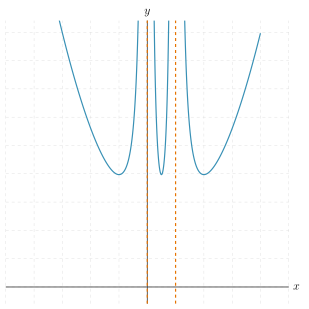
- Clearly \(x = -1\) is a root of \(f(x) = \frac{27}{4}\), so we must also have \(x=2\) and \(x = \frac12\), therefore \(f(x) > \frac{27}{4}\) if \(x \in \mathbb{R} \setminus \{-1, 2, \tfrac12, 0, 1 \}\). Clearly \(x = 3\) and \(x = -2\) are solutions so we also have: \(\frac13, -\frac12, \frac32, \frac23\) and these must be all solutions so we must have: \(f(x) > \frac{343}{36} \Leftrightarrow x \in (-\infty, -2) \cup (-\frac12, 0) \cup (0, \frac13) \cup (\frac23, 1) \cup (1, \frac32) \cup (3, \infty)\)
2012 Paper 3 Q1
Given that \(\displaystyle z = y^n \left( \frac{\d y}{\d x}\right)^{\!2}\), show that \[ \frac{\d z}{\d x} = y^{n-1} \frac{\d y}{\d x} \left( n \left(\frac{\d y}{\d x}\right)^{\!2} + 2y \frac{\d^2y}{\d x^2}\right) . \]
- Use the above result to show that the solution to the equation \[ \left(\frac{\d y}{\d x}\right)^{\!2} + 2y \frac{\d^2y}{\d x^2} = \sqrt y \ \ \ \ \ \ \ \ \ \ (y>0) \] that satisfies \(y=1\) and \(\dfrac{\d y}{\d x}=0\) when \(x=0\) is \(y= \big ( \frac38 x^2+1\big)^{\frac23}\).
- Find the solution to the equation \[ \left(\frac{\d y}{\d x}\right)^{\!2} -y \frac{\d^2y}{\d x^2} + y^2=0 \] that satisfies \(y=1\) and \(\dfrac{\d y}{\d x}=0\) when \(x=0\).
Solution: \begin{align*} &&z &= y^n \left( \frac{\d y}{\d x}\right)^{2} \\ \Rightarrow && \frac{\d z}{\d x} &= ny^{n-1}\left( \frac{\d y}{\d x}\right)^{3} + y^{n} \cdot 2 \left( \frac{\d y}{\d x}\right) \left( \frac{\d^2 y}{\d x^2}\right) \\ &&&= y^{n-1} \left( \frac{\d y}{\d x}\right) \left (n \left( \frac{\d y}{\d x}\right)^2 + 2y \frac{\d^2 y}{\d x^2} \right) \end{align*}
- Let \(z = y (y')^2\), then \begin{align*} && \frac{\d z}{\d x} &= y' \sqrt{y} \\ &&&= \sqrt{z} \\ \Rightarrow && \int z^{-1/2} \d z &= x+C \\ \Rightarrow && 2\sqrt{z} &= x + C \\ x = 0, z=0: && C &= 0 \\ \Rightarrow && y(y')^2 &= \frac14 x^2 \\ \Rightarrow &&\sqrt{y} \frac{\d y}{\d x} &= \frac{1}{2}x\\ \Rightarrow && \int \sqrt{y} \d y &= \int \frac{1}{2}x\d x \\ \Rightarrow && \frac23y^{3/2} &=\frac14x^2 + K \\ x = 0, y = 1: && K &= \frac23 \\ \Rightarrow && y &= \left (\frac38 x^2 + 1 \right)^{2/3} \end{align*}
- Let \(z = y^{-2} (y')^2\) \begin{align*} && \frac{\d z}{\d x} &= y^{-3} \frac{\d y}{\d x} \left (-2 \left( \frac{\d y}{\d x}\right) + 2y \frac{\d^2 y}{\d x^2} \right) \\ &&&= y^{-3} \frac{\d y}{\d x} 2y^2 \\ &&&= 2y^{-1}(y') = 2 \sqrt{z} \\ \Rightarrow && 2\sqrt{z} &= 2x + C \\ x = 0, z = 0: && C&= 0 \\ \Rightarrow && z &= x^2 \\ \Rightarrow && \frac{\d y}{\d x} &= xy \\ \Rightarrow && \ln |y| &= \frac12 x^2 + K \\ x =0 , y =1; && K &= 0 \\ \Rightarrow && y &= e^{\frac12 x^2} \end{align*}
2007 Paper 2 Q6
- Differentiate \(\ln\big (x+\sqrt{3+x^2}\,\big)\) and \(x\sqrt{3+x^2}\) and simplify your answers. Hence find \(\int \! \sqrt{3+x^2}\, \d x\).
- Find the two solutions of the differential equation \[ 3\left(\frac{\d y}{\d x}\right)^{\!2} + 2 x \frac {\d y}{\d x} =1 \] that satisfy \(y=0\) when \(x=1\).
Solution:
- \(\,\) \begin{align*} && y &= \ln (x + \sqrt{3+x^2}) \\ \Rightarrow && y' &= \frac{1}{x + \sqrt{3+x^2}} \cdot \left (1 + \frac{x}{\sqrt{3+x^2}} \right) \\ &&&= \frac{1}{\sqrt{3+x^2}} \\ \\ && y &= x\sqrt{3+x^2} \\ && y' &= \sqrt{3+x^2} + \frac{x^2}{\sqrt{3+x^2}} \\ &&&= 2\sqrt{3+x^2} - \frac{3}{\sqrt{3+x^2}} \\ \\ \Rightarrow && \sqrt{3+x^2} &= \frac12(x \sqrt{3+x^2})' + \frac32(\ln(x+\sqrt{3+x^2})' \\ \Rightarrow && \int \sqrt{3+x^2}\, \d x &= \frac12x\sqrt{3+x^2} + \frac32 \ln (x+\sqrt{3+x^2}) + C \end{align*}
- \(\,\) \begin{align*} && 3 \left ( \frac{\d y}{\d x} \right)^2 + 2x \frac{\d y}{\d x} &= 1 \\ && \frac{\d y}{\d x} &= \frac{-x \pm \sqrt{x^2+3} }3 \\ \Rightarrow && y &= -\frac{x^2}{6} \pm \frac16x\sqrt{3+x^2} \pm \frac12 \ln (x+\sqrt{3+x^2}) + C \\ y = 0, x = 1: && 0 &= -\frac16 \pm \frac13 \pm \frac12 \ln 3 \\ \Rightarrow && y &= -\frac{x^2}{6} \pm \frac12x\sqrt{3+x^2} \pm \frac32 \ln (x+\sqrt{3+x^2}) + \frac16 \mp \frac13 \mp \frac12 \ln 3 \end{align*}
2003 Paper 3 Q1
Given that \(x+a>0\) and \(x+b>0\,\), and that \(b>a\,\), show that \[ \frac{\mathrm{d} \ }{\mathrm{d} x} \arcsin \left ( \frac{x + a }{ \ x + b} \right) = \frac{ \sqrt{\;b - a\;}} {( x + b ) \sqrt{ a + b + 2x} \ \ } \] and find $\displaystyle \frac{\mathrm{d} \ }{ \mathrm{d} x} \; \mathrm{arcosh} \left ( \frac{x + b }{ \ x + a} \right)$. Hence, or otherwise, integrate, for \(x > -1\,\),
- \[ \int \frac{1}{ ( x + 1) \sqrt{x + 3} } \mathrm{d} x \]
- \[ \int \frac{1} {( x + 3 ) \sqrt{x + 1} } \mathrm{d} x \] .
Solution: \begin{align*} \frac{\mathrm{d} \ }{\mathrm{d} x} \arcsin \left ( \frac{x + a }{ \ x + b} \right ) &= \frac{1}{\sqrt{1-\left ( \frac{x + a }{ \ x + b} \right )^2}} \left ( \frac{b-a}{(x+b)^2} \right) \\ &= \frac{b-a}{(x+b)\sqrt{(x+b)^2-(x+a)^2}} \\ &= \frac{b-a}{(x+b)\sqrt{(b-a)(2x+b+a)}} \\ &= \frac{\sqrt{b-a}}{(x+b)\sqrt{a+b+2x}} \\ \\ \frac{\mathrm{d} \ }{ \mathrm{d} x} \; \mathrm{arcosh} \left ( \frac{x + b }{ \ x + a} \right) &= \frac{1}{\sqrt{\left ( \frac{x + b }{ \ x + a} \right)^2-1}} \left ( -\frac{b-a}{(x+a)^2} \right) \\ &= -\frac{b-a}{(x+a)\sqrt{(x+b)^2-(x+a)^2}} \\ &= -\frac{b-a}{(x+a)\sqrt{(b-a)(a+b+2x)}} \\ &= -\frac{\sqrt{b-a}}{(x+a)\sqrt{a+b+2x}} \end{align*}
- \begin{align*} \int \frac{1}{ ( x + 1) \sqrt{x + 3} } \mathrm{d} x &= \int \frac{1}{(x+1)\sqrt{\frac12 (2x+6)}} \d x\\ &= \int \frac{\sqrt{2}}{(x+1)\sqrt{2x+1+5}} \d x \\ &= \frac{\sqrt{2}}{2}\int \frac{\sqrt{5-1}}{(x+1)\sqrt{2x+1+5}} \d x \\ &= - \frac{\sqrt{2}}{2}\textrm{arcosh} \left ( \frac{x+5}{x+1} \right) + C \end{align*}
- \begin{align*} \int \frac{1}{(x+3)\sqrt{x+1}} \d x &= \int \frac{1}{(x+3)\sqrt{\tfrac12(2x+2)}} \d x + C \\ &= \int \frac{\sqrt{3-1}}{(x+3)\sqrt{2x+3-1}} \d x \\ &= \textrm{arcsin} \left ( \frac{x-1}{x+3} \right) \end{align*}
1999 Paper 1 Q7
Show that \(\sin(k\sin^{-1} x)\), where \(k\) is a constant, satisfies the differential equation $$(1-x^{2})\frac {\d^2 y}{\d x^2} -x\frac{\d y}{\d x} +k^{2}y=0. \tag{*}$$ In the particular case when \(k=3\), find the solution of equation \((*)\) of the form \[ y=Ax^{3}+Bx^{2}+Cx+D, \] that satisfies \(y=0\) and \(\displaystyle \frac{\d y}{\d x}=3\) at \(x=0\). Use this result to express \(\sin 3\theta\) in terms of powers of \(\sin\theta\).
Solution: \begin{align*} && y &= \sin(k \sin^{-1} x ) \\ &&y' &= \cos (k \sin^{-1} x) \cdot k \frac{1}{\sqrt{1-x^2}} \\ && y'' &= -\sin (k \sin^{-1} x) \cdot k^2 \frac{1}{(1-x^2)} - \cos(k \sin^{-1} x) \cdot k \frac{x}{(1-x^2)\sqrt{1-x^2}} \\ && (1-x^2)y'' &= -k^2y -xy' \\ \Rightarrow && 0 &= (1-x^2)y''+xy' + k^2y \end{align*} \begin{align*} && y &= Ax^3 + Bx^2 + Cx + D \\ && y' &= 3Ax^2 + 2Bx + C \\ && y'' &= 6Ax+2B \\ && 0 &= (1-x^2)(6Ax+2B) - x( 3Ax^2 + 2Bx + C) + 9(Ax^3 + Bx^2 + Cx + D ) \\ &&&= x^3(-6A-3A+9A) + x^2(-2B-2B+9B) + x(6A-C+9C) + (2B +9D) \\ \Rightarrow && B &= 0 \\ \Rightarrow && D &= 0 \\ \Rightarrow && C &= -\frac34 A \\ \\ x = 0, y = 0, y' = 0: && y &= 3x-4x^3 \\ \end{align*} And so \(\sin 3 x = 3 \sin x - 4\sin^3 x\)
1998 Paper 3 Q1
Let $$ {\rm f}(x)=\sin^2x + 2 \cos x + 1 $$ for \(0 \le x \le 2\pi\). Sketch the curve \(y={\rm f}(x)\), giving the coordinates of the stationary points. Now let $$ \hspace{0.6in}{\rm g}(x)={a{\rm f}(x)+b \over c{\rm f}(x)+d} \hspace{0.8in} ad\neq bc\,,\; d\neq -3c\,,\; d\neq c\;. $$ Show that the stationary points of \(y={\rm g}(x)\) occur at the same values of \(x\) as those of \(y={\rm f}(x)\), and find the corresponding values of \({\rm g}(x)\). Explain why, if \(d/c <-3\) or \(d/c>1\), \(|{\rm g}(x)|\) cannot be arbitrarily large.
1997 Paper 1 Q2
- If \[{\mathrm f}(x)=\tan^{-1}x+\tan^{-1}\left(\frac{1-x}{1+x}\right),\] find \({\mathrm f}'(x)\). Hence, or otherwise, find a simple expression for \({\mathrm f}(x)\).
- Suppose that \(y\) is a function of \(x\) with \(0 < y < (\pi/2)^{1/2}\) and \[x=y\sin y^{2}\] for \(0 < x < (\pi/2)^{1/2}\). Show that (for this range of \(x\)) \[\frac{{\mathrm d}y}{{\mathrm d}x}= \frac{y}{x+2y^2\sqrt{y^{2}-x^{2}}}.\]
Solution:
- \begin{align*} && f(x)&=\tan^{-1}x+\tan^{-1}\left(\frac{1-x}{1+x}\right) \\ \Rightarrow && f'(x) &= \frac{1}{1+x^2} + \frac{1}{1+\l \frac{1-x}{1+x} \r^2} \cdot \l \frac{-2}{(1+x)^2}\r \\ &&&= \frac1{1+x^2}- \frac{2}{(1+x)^2+(1-x)^2} \\ &&&= \frac1{1+x^2} - \frac{2}{2+2x^2} \\ &&&= 0 \end{align*} Therefore $f(x) = \begin{cases} c_1 & \text{if } x < -1 \\ c_2 & \text{if } x > -1 \end{cases}$ \(f(0) = \tan^{-1} 0 + \tan^{-1} 1 = \frac{\pi}{4}\) \(\lim_{x \to \infty} f(x) = -\frac{\pi}{2} + \tan^{-1} -1 = -\frac{3\pi}{4}\) therefore $f(x) = \begin{cases} -\frac{3\pi}{4}& \text{if } x < -1 \\ \frac{\pi}{4} & \text{if } x > -1 \end{cases}$
- \begin{align*} && x &= y \sin y^2 \\ \Rightarrow && \frac{\d x}{\d y} &= \sin y^2 + 2y^2 \cos y^2 \\ \Rightarrow && \frac{\d y}{\d x} &= \frac{1}{\sin y^2+2y^2 \cos y^2} \\ &&&=\frac{1}{\frac{x}{y}+2y^2 \sqrt{1-\sin^2y^2}} \\ &&&= \frac{y}{x + 2y^3 \sqrt{1-\frac{x^2}{y^2}}} \\ &&&= \frac{y}{x+2y^2 \sqrt{y^2-x^2}} \end{align*}
1994 Paper 1 Q2
Given that \(a\) is constant, differentiate the following expressions with respect to \(x\):
- \(x^{a}\);
- \(a^{x}\);
- \(x^{x}\);
- \(x^{(x^{x})}\);
- \((x^{x})^{x}.\)
Solution: \begin{align*} && y &= x^a \\ && \frac{\d y}{\d x} &= \begin{cases} ax^{a-1} & a \neq 0 \\ 0 & a = 0 \end{cases} \\ \\ && y &= a^x \\ &&&= e^{(\ln a) \cdot x} \\ && \frac{\d y}{\d x} &= \ln a e^{(\ln a) x} \\ &&&= \ln a \cdot a^ x \\ \\ && y &= x^x \\ &&&= e^{x \ln x}\\ && \frac{\d y}{\d x} &= e^{x \ln x} \cdot \left ( \ln x + x \cdot \frac1x \right) \\ &&&= x^x \left (1 + \ln x \right) \\ \\ && y&= x^{(x^x)} \\ &&&= e^{x^ x \cdot \ln x} \\ && \frac{\d y}{\d x} &= e^{x^x \cdot \ln x} \left ( x^x \left (1 + \ln x \right) \cdot \ln x + x^x \cdot \frac1x\right) \\ &&&= x^{x^x} \left (x^x (1+ \ln x) \ln x +x^{x-1} \right) \\ &&&= x^{x^x+x-1} \left (1 + x \ln x + x (\ln x)^2 \right) \\ \\ && y &= (x^x)^x \\ &&&= x^{2x} \\ &&&= e^{2x \ln x} \\ && \frac{\d y}{\d x} &= e^{2 x \ln x} \left (2 \ln x + 2 \right) \\ &&&= 2(x^x)^x(1 + \ln x) \end{align*}
1991 Paper 1 Q6
Criticise each step of the following arguments. You should correct the arguments where necessary and possible, and say (with justification) whether you think the conclusion are true even though the argument is incorrect.
- The function \(g\) defined by \[ \mathrm{g}(x)=\frac{2x^{3}+3}{x^{4}+4} \] satisfies \(\mathrm{g}'(x)=0\) only for \(x=0\) or \(x=\pm1.\) Hence the stationary values are given by \(x=0\), \(\mathrm{g}(x)=\frac{3}{4}\) and \(x=\pm1,\) \(\mathrm{g}(x)=1.\) Since \(\frac{3}{4}<1,\) there is a minimum at \(x=0\) and maxima at \(x=\pm1.\) Thus we must have \(\frac{3}{4}\leqslant\mathrm{g}(x)\leqslant1\) for all \(x\).
- \({\displaystyle \int(1-x)^{-3}\,\mathrm{d}x=-3(1-x)^{-4}}\quad\) and so \(\quad{\displaystyle \int_{-1}^{3}(1-x)^{-3}\,\mathrm{d}x=0.}\)
Solution:
- \begin{align*} && g(x) &= \frac{2x^3+3}{x^4+4} \\ \Rightarrow && g'(x) &= \frac{6x^2(x^4+4) - (2x^3+3)(4x^3)}{(x^4+4)^2} \\ &&&= \frac{-2x^6-12x^3+24x^2}{(x^4+4)} \\ &&&= \frac{-2x^2(x^4+6x-12)}{(x^4+4)} \end{align*} So \(g'(x)\) is not \(0\) for \(x = \pm 1\). We can also note that \(g(-1) = \frac1{5} \neq 1\) Even if the other turning point was \(1\), we would also need to check the behaviour as \(x \to \pm \infty\). We can also note that \(g(-1) = \frac{1}{5} < \frac34\) so the conclusion is also not true.
- There are several errors. \[ \int (1-x)^{-3} \d x = \underbrace{\frac{1}{4}}_{\text{correct constant}}(1-x)^{-4} + \underbrace{C}_{\text{constant of integration}} \] We cannot integrate through the asymptote at \(1\). There is a sense in which we could argue \(\displaystyle \int_{-1}^3 (1-x)^{-3} \d x = 0\), specifically using Cauchy principal value \begin{align*} \mathrm {p.v.} \int_{-1}^3 (1-x)^{-3} &=\lim_{\epsilon \to 0} \left [ \int_{-1}^{1-\epsilon} (1-x)^{-3} \d x+ \int_{1+\epsilon}^{3} (1-x)^{-3} \d x\right] \\ &=\lim_{\epsilon \to 0} \left [ \left[ \frac14 (1-x)^{-4}\right]_{-1}^{1-\epsilon}+ \left[ \frac14 (1-x)^{-4}\right]_{1+\epsilon}^3\right] \\ &=\lim_{\epsilon \to 0} \left [ \frac14 \epsilon^{-4}-\frac14 \frac1{2^4} + \frac14 \frac1{2^4} - \frac14 \epsilon^{-4} \right] \\ &= \lim_{\epsilon \to 0} 0 \\ &= 0 \end{align*} However, in many normal ways of treating this integral it would be undefined.
1991 Paper 2 Q7
The function \(\mathrm{g}\) satisfies, for all positive \(x\) and \(y\), \[ \mathrm{g}(x)+\mathrm{g}(y)=\mathrm{g}(z),\tag{*} \] where \(z=xy/(x+y+1).\) By treating \(y\) as a constant, show that \[ \mathrm{g}'(x)=\frac{y^{2}+y}{(x+y+1)^{2}}\mathrm{g}'(z)=\frac{z(z+1)}{x(x+1)}\mathrm{g}'(z), \] and deduce that \(2\mathrm{g}'(1)=(u^{2}+u)\mathrm{g}'(u)\) for all \(u\) satisfying \(0 < u < 1.\) Now by treating \(u\) as a variable, show that \[ \mathrm{g}(u)=A\ln\left(\frac{u}{u+1}\right)+B, \] where \(A\) and \(B\) are constants. Verify that \(\mathrm{g}\) satisfies \((*)\) for a suitable value of \(B\). Can \(A\) be determined from \((*)\)? The function \(\mathrm{f}\) satisfies, for all positive \(x\) and \(y\), \[ \mathrm{f}(x)+\mathrm{f}(y)=\mathrm{f}(z) \] where \(z=xy.\) Show that \(\mathrm{f}(x)=C\ln x\) where \(C\) is a constant.
Solution: Note that \(z = xy/(x+y+1) \Rightarrow y(x-z) = z(x+1)\) \begin{align*} && g(x) + g(y) &= g(z) \\ \Rightarrow && g'(x) &= g'(z) \cdot \frac{y(x+y+1) - xy \cdot 1} {(x+y+1)^2} \\ &&&= g'(z) \frac{y^2+y}{(x+y+1)^2} \\ &&&= g'(z) \frac{z^2(y^2+y)}{x^2y^2} \\ &&&= g'(z) \frac{z^2(y+1)}{x^2y} \\ &&&= g'(z) \frac{z^2}{x^2} \left (1 + \frac{x-z}{z(x+1)} \right) \\ &&&= g'(z) \frac{z}{x^2} \frac{zx+x}{x+1} \\ &&&= g'(z) \frac{z(z+1)}{x(x+1)} \end{align*} If \(x = 1\) then as \(y\) ranges from \(0\) to \(\infty\), \(z\) ranges from \(0\) to \(1\), so \(g'(1) = \frac{z(z+1)}{1(1+1)}g'(z)\), ie \(2g'(1) = (u^2+u)g'(u)\). \begin{align*} && g'(u) &= \frac{A}{u(u+1)} \\ \Rightarrow && g(u) &= A\int \left ( \frac{1}{u} - \frac{1}{u+1} \right) \d u \\ &&&= A \left ( \ln u - \ln(u+1) \right) + B \\ &&&= A \ln \left ( \frac{u}{u+1} \right) + B \\ \\ && A \ln \left ( \frac{x}{x+1} \right) + B+A \ln \left ( \frac{y}{y+1} \right) + B &=A \ln \left ( \frac{z}{z+1} \right) + B \\ \Rightarrow && B &= A \ln \left ( \frac{z}{z+1} \frac{y+1}{y} \frac{x+1}{x} \right) \\ &&&= A \ln \left ( \frac{1}{1+\frac{x+y+1}{xy}} \frac{(y+1)(x+1)}{xy} \right) \\ &&&= A \ln 1 \\ &&& = 0 \end{align*} Therefore \(B = 0\). \(A\) cannot be determined from \((*)\). Suppose \(f(x) + f(y) = f(z)\), then \(f'(x) = yf'(z)\). Letting \(x = 1\) we find \(f'(1) = uf'(u) \Rightarrow f(u) = C \ln u + D\), but \(D = 0\) so \(f(x) = C \ln x\)