Problems
Filters
2 problems found
2017 Paper 3 Q5
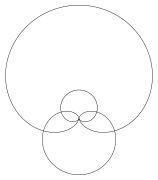
The point with cartesian coordinates \((x,y)\) lies on a curve with polar equation \(r=\f(\theta)\,\). Find an expression for \(\dfrac{\d y}{\d x}\) in terms of \(\f(\theta)\), \(\f'(\theta)\) and \(\tan\theta\,\). Two curves, with polar equations \(r=\f(\theta)\) and \(r=\g(\theta)\), meet at right angles. Show that where they meet \[ \f'(\theta) \g'(\theta) +\f(\theta)\g(\theta) = 0 \,. \] The curve \(C\) has polar equation \(r=\f(\theta)\) and passes through the point given by \(r=4\), \(\theta = - \frac12\pi\). For each positive value of \(a\), the curve with polar equation \(r= a(1+\sin\theta)\) meets~\(C\) at right angles. Find \(\f(\theta)\,\). Sketch on a single diagram the three curves with polar equations \(r= 1+\sin\theta\,\), \ \(r= 4(1+\sin\theta)\) and \(r=\f(\theta)\,\).
Solution: \((x, y) = (f(\theta)\cos(\theta), f(\theta)\sin(\theta))\) so \begin{align*} \frac{dy}{d\theta} &= -f(\theta)\sin(\theta) + f'(\theta)\cos(\theta) \\ \frac{dx}{d\theta} &= f(\theta)\cos(\theta) + f'(\theta)\sin(\theta) \\ \frac{dy}{dx} &= \frac{-f(\theta)\sin(\theta) + f'(\theta)\cos(\theta)}{f(\theta)\cos(\theta) + f'(\theta)\sin(\theta) } \\ &= \frac{-f(\theta)\tan(\theta) + f'(\theta)}{f(\theta) + f'(\theta)\tan(\theta) } \end{align*} If the curves meet at right angles then the product of their gradients is \(-1\), ie \begin{align*} \frac{-f(\theta)\tan(\theta) + f'(\theta)}{f(\theta) + f'(\theta)\tan(\theta) } \cdot \frac{-g(\theta)\tan(\theta) + g'(\theta)}{g(\theta) + g'(\theta)\tan(\theta) } &= -1 \\ f(\theta)g(\theta)\tan^2 \theta - f(\theta)g'(\theta)\tan \theta - f'(\theta)g(\theta)\tan \theta + f'(\theta)g'(\theta) &= \\ \quad - \l f(\theta)g(\theta) + f(\theta)g'(\theta)\tan(\theta) + f'(\theta)g(\theta)\tan(\theta) + f'(\theta)g'(\theta)\tan^2 \theta \r \\ \tan^2\theta \l f(\theta)g(\theta) + f'(\theta)g'(\theta) \r + f'(\theta)g'(\theta) + f(\theta)g(\theta) &= 0 \\ (\tan^2\theta + 1) \l f(\theta)g(\theta) + f'(\theta)g'(\theta) \r &= 0 \\ f(\theta)g(\theta) + f'(\theta)g'(\theta) &= 0 \end{align*} \(g(\theta) = a(1+\sin\theta), g'(\theta) = a\cos\theta\) Therefore \(f'(\theta)a\cos \theta+f(\theta)a(1+\sin(\theta)) = 0\) \begin{align*} && \frac{f'(\theta)}{f(\theta)} &= -\sec(\theta) - \tan(\theta) \\ \Rightarrow && \ln(f(\theta)) &= -\ln |\tan(\theta) + \sec(\theta)| + \ln |\cos(\theta)| + C \\ \Rightarrow && f(\theta) &= A \frac{\cos \theta}{\tan \theta + \sec \theta} \\ &&&= A \frac{\cos^2 \theta}{\sin \theta + 1} \\ &&&= A \frac{1-\sin^2 \theta}{\sin \theta + 1} \\ &&&= A (1-\sin \theta) \end{align*} When \(\theta = -\frac12 \pi, r = 4\), so \(A = 2\).
1990 Paper 2 Q9
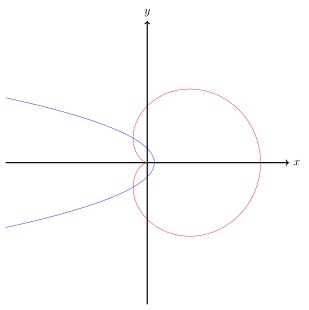
Show by means of a sketch that the parabola \(r(1+\cos\theta)=1\) cuts the interior of the cardioid \(r=4(1+\cos\theta)\) into two parts. Show that the total length of the boundary of the part that includes the point \(r=1,\theta=0\) is \(18\sqrt{3}+\ln(2+\sqrt{3}).\)
Solution: