Problems
Filters
11 problems found
2021 Paper 2 Q10
A train moves westwards on a straight horizontal track with constant acceleration \(a\), where \(a > 0\). Axes are chosen as follows: the origin is fixed in the train; the \(x\)-axis is in the direction of the track with the positive \(x\)-axis pointing to the East; and the positive \(y\)-axis points vertically upwards. A smooth wire is fixed in the train. It lies in the \(x\)--\(y\) plane and is bent in the shape given by \(ky = x^2\), where \(k\) is a positive constant. A small bead is threaded onto the wire. Initially, the bead is held at the origin. It is then released.
- Explain why the bead cannot remain stationary relative to the train at the origin.
- Show that, in the subsequent motion, the coordinates \((x, y)\) of the bead satisfy \[ \dot{x}(\ddot{x} - a) + \dot{y}(\ddot{y} + g) = 0 \] and deduce that \(\tfrac{1}{2}(\dot{x}^2 + \dot{y}^2) - ax + gy\) is constant during the motion.
- Find an expression for the maximum vertical displacement, \(b\), of the bead from its initial position in terms of \(a\), \(k\) and \(g\).
- Find the value of \(x\) for which the speed of the bead relative to the train is greatest and give this maximum speed in terms of \(a\), \(k\) and \(g\).
2012 Paper 3 Q10
A small ring of mass \(m\) is free to slide without friction on a hoop of radius \(a\). The hoop is fixed in a vertical plane. The ring is connected by a light elastic string of natural length \(a\) to the highest point of the hoop. The ring is initially at rest at the lowest point of the hoop and is then slightly displaced. In the subsequent motion the angle of the string to the downward vertical is \(\phi\). Given that the ring first comes to rest just as the string becomes slack, find an expression for the modulus of elasticity of the string in terms of \(m\) and \(g\). Show that, throughout the motion, the magnitude \(R\) of the reaction between the ring and the hoop is given by \[ R = ( 12\cos^2\phi -15\cos\phi +5) mg \] and that \(R\) is non-zero throughout the motion.
2010 Paper 3 Q10
A small bead \(B\), of mass \(m\), slides without friction on a fixed horizontal ring of radius \(a\). The centre of the ring is at \(O\). The bead is attached by a light elastic string to a fixed point \(P\) in the plane of the ring such that \(OP = b\), where \(b > a\). The natural length of the elastic string is \(c\), where \(c < b - a\), and its modulus of elasticity is \(\lambda\). Show that the equation of motion of the bead is \[ ma\ddot \phi = -\lambda\left( \frac{a\sin\phi}{c\sin\theta}-1\right)\sin(\theta+\phi) \,, \] where \(\theta=\angle BPO\) and \(\phi=\angle BOP\). Given that \(\theta\) and \(\phi\) are small, show that $a(\theta+\phi)\approx b\theta$. Hence find the period of small oscillations about the equilibrium position \(\theta=\phi =0\).
2007 Paper 3 Q9
Two small beads, \(A\) and \(B\), each of mass \(m\), are threaded on a smooth horizontal circular hoop of radius \(a\) and centre \(O\). The angle \(\theta\) is the acute angle determined by \(2\theta = \angle AOB\). The beads are connected by a light straight spring. The energy stored in the spring is \[ mk^2 a^2(\theta - \alpha)^2, \] where \(k\) and \(\alpha\) are constants satisfying \(k>0\) and \(\frac \pi 4< \alpha<\frac\pi2\). The spring is held in compression with \(\theta =\beta\) and then released. Find the period of oscillations in the two cases that arise according to the value of \(\beta\) and state the value of \(\beta\) for which oscillations do not occur.
2006 Paper 3 Q9
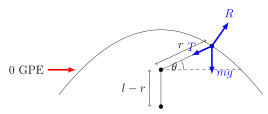
A long, light, inextensible string passes through a small, smooth ring fixed at the point \(O\). One end of the string is attached to a particle \(P\) of mass \(m\) which hangs freely below \(O\). The other end is attached to a bead, \(B\), also of mass \(m\), which is threaded on a smooth rigid wire fixed in the same vertical plane as \(O\). The distance \(OB\) is \(r\), the distance \(OH\) is \(h\) and the height of the bead above the horizontal plane through~\(O\) is \(y\), as shown in the diagram.
2003 Paper 2 Q10
A bead \(B\) of mass \(m\) can slide along a rough horizontal wire. A light inextensible string of length \(2\ell\) has one end attached to a fixed point \(A\) of the wire and the other to \(B\,\). A particle \(P\) of mass \(3m\) is attached to the mid-point of the string and \(B\) is held at a distance \(\ell\) from~\(A\,\). The bead is released from rest. Let \(a_1\) and \(a_2\) be the magnitudes of the horizontal and vertical components of the initial acceleration of \(P\,\). Show by considering the motion of \(P\) relative to \(A\,\), or otherwise, that \(a_1= \sqrt 3 a_2\,\). Show also that the magnitude of the initial acceleration of \(B\) is \(2a_1\,\). Given that the frictional force opposing the motion of \(B\) is equal to \(({\sqrt{3}}/6)R\), where \(R\) is the normal reaction between \(B\) and the wire, show that the magnitude of the initial acceleration of \(P\) is~\(g/18\,\).
2003 Paper 3 Q9
A particle \(P\) of mass \(m\) is constrained to move on a vertical circle of smooth wire with centre~\(O\) and of radius \(a\). \(L\) is the lowest point of the circle and \(H\) the highest and \(\angle LOP = \theta\,\). The particle is attached to \(H\) by an elastic string of natural length \(a\) and modulus of elasticity~\(\alpha mg\,\), where \(\alpha > 1\,\). Show that, if \(\alpha>2\,\), there is an equilibrium position with \(0<\theta<\pi\,\). Given that \(\alpha =2+\sqrt 2\,\), and that \(\displaystyle \theta = \tfrac{1}{2}\pi + \phi\,\), show that \[ \ddot{\phi} \approx -\frac{g (\sqrt2+1)}{2a }\, \phi \] when \(\phi\) is small. For this value of \(\alpha\), explain briefly what happens to the particle if it is given a small displacement when \( \theta = \frac{1}{2}\pi\).
1996 Paper 3 Q11
A smooth circular wire of radius \(a\) is held fixed in a vertical plane with light elastic strings of natural length \(a\) and modulus \(\lambda\) attached to the upper and lower extremities, \(A\) and \(C\) respectively, of the vertical diameter. The other ends of the two strings are attached to a small ring \(B\) which is free to slide on the wire. Show that, while both strings remain taut, the equation for the motion of the ring is $$2ma \ddot\theta=\lambda(\cos\theta-\sin\theta)-mg\sin\theta,$$ where \(\theta\) is the angle \( \angle{CAB}\). Initially the system is at rest in equilibrium with \(\sin\theta=\frac{3}{5}\). Deduce that \(5\lambda=24mg\). The ring is now displaced slightly. Show that, in the ensuing motion, it will oscillate with period approximately $$10\pi\sqrt{a\over91g}\,.$$
1993 Paper 2 Q13
The force \(F\) of repulsion between two particles with positive charges \(Q\) and \(Q'\) is given by \(F=kQQ'/r^{2},\) where \(k\) is a positive constant and \(r\) is the distance between the particles. Two small beads \(P_{1}\) and \(P_{2}\) are fixed to a straight horizontal smooth wire, a distance \(d\) apart. A third bead \(P_{3}\) of mass \(m\) is free to move along the wire between \(P_{1}\) and \(P_{3}.\) The beads carry positive electrical charges \(Q_{1},Q_{2}\) and \(Q_{3}.\) If \(P_{3}\) is in equilibrium at a distance \(a\) from \(P_{1},\) show that \[ a=\frac{d\sqrt{Q_{1}}}{\sqrt{Q_{1}}+\sqrt{Q_{2}}}. \] Suppose that \(P_{3}\) is displaced slightly from its equilibrium position and released from rest. Show that it performs approximate simple harmonic motion with period \[ \frac{\pi d}{(\sqrt{Q_{1}}+\sqrt{Q_{2}})^{2}}\sqrt{\frac{2md\sqrt{Q_{1}Q_{2}}}{kQ_{3}}.} \] {[}You may use the fact that \(\dfrac{1}{(a+y)^{2}}\approx\dfrac{1}{a^{2}}-\dfrac{2y}{a^{3}}\) for small \(y.\){]}
1988 Paper 3 Q14
A small heavy bead can slide smoothly in a vertical plane on a fixed wire with equation \[ y=x-\frac{x^{2}}{4a}, \] where the \(y\)-axis points vertically upwards and \(a\) is a positive constant. The bead is projected from the origin with initial speed \(V\) along the wire.
- Show that for a suitable value of \(V\), to be determined, a motion is possible throughout which the bead exerts no pressure on the wire.
- Show that \(\theta,\) the angle between the particle's velocity at time \(t\) and the \(x\)-axis, satisfies \[ \frac{4a^{2}\dot{\theta}^{2}}{\cos^{6}\theta}+2ga(1-\tan^{2}\theta)=V^{2}. \]
Solution:
- The condition that the bead exerts no pressure on the wire is equivalent to the condition that the wire exerts no force on the bead. (Newton's Third Law). This is equivalent to the bead being projected under gravity. Notice that the initial projection is at \(45^{\circ}\) since \(\frac{dy}{dx}|_{x=0} = 1\). The position of the particle (under gravity) at time \(t\) is \(x = \frac{1}{\sqrt{2}}Vt\) and \(y = \frac{1}{\sqrt{2}}Vt - \frac12 gt^2 = x - \frac{1}{2}g \frac{2x^2}{V^2} = x - \frac{g}{V^2}x^2\). Therefore they follow the same trajectory if \(\frac{g}{V^2} = \frac{1}{4a} \Leftrightarrow V = 2\sqrt{ag}\)
- First note that the wire does no work as it is perpendicular to the velocity, so it is fine to use conservation of momentum. If we take our \(0\) GPE level to be be \(x = 0\), then we notice the initial energy is \(\frac12mV^2\). Secondly, notice that \(\tan \theta = \frac{\d y}{\d x} = 1- \frac{x}{2a} \Rightarrow x = 2a - 2a \tan \theta\) \begin{align*} y &= 2a(1-\tan \theta) - \frac{4a^2(1-\tan \theta)^2}{4a}\\ &= (1-\tan \theta)(2a-a(1-\tan \theta)) \\ &= a(1-\tan \theta)(1+\tan \theta) \\ &= a(1-\tan^2 \theta) \end{align*} GPE \(mga(1-\tan^2 \theta)\). To calculate the kinetic energy, notice that \(\dot{x} = v \cos \theta \dot{\theta}\) and \(\dot{x} = -2a\sec^2 \theta\dot{\theta} \Rightarrow v = -\frac{2a\dot{\theta} }{\cos^{3} \theta}\). Therefore, energy at time \(t\) is: \begin{align*} && \frac12 m V^2 &= \frac12 m \l - \frac{2a\dot{\theta}}{\cos^3 \theta} \r^2 + mga(1-\tan^2 \theta) \\ \Rightarrow && V^2 &= \frac{4a^2\dot{\theta}^2}{\cos^6 \theta} + 2ag(1-\tan^2 \theta) \end{align*}
1987 Paper 2 Q12
A long, inextensible string passes through a small fixed ring. One end of the string is attached to a particle of mass \(m,\) which hangs freely. The other end is attached to a bead also of mass \(m\) which is threaded on a smooth rigid wire fixed in the same vertical plane as the ring. The curve of the wire is such that the system can be in static equilibrium for all positions of the bead. The shortest distance between the wire and the ring is \(d(>0).\) Using plane polar coordinates centred on the ring, find the equation of the curve. The bead is set in motion. Assuming that the string remains taut, show that the speed of the bead when it is a distance \(r\) from the ring is \[ \left(\frac{r}{2r-d}\right)^{\frac{1}{2}}v, \] where \(v\) is the speed of the bead when \(r=d.\)
Solution: