Problems
Filters
7 problems found
2015 Paper 1 Q4
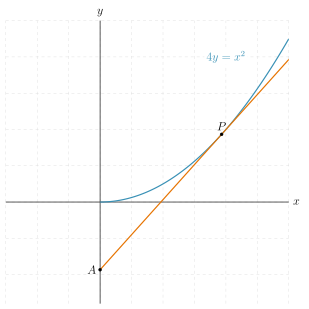
The midpoint of a rod of length \(2b\) slides on the curve \(y =\frac14 x^2\), \(x\ge0\), in such a way that the rod is always tangent, at its midpoint, to the curve. Show that the curve traced out by one end of the rod can be written in the form \begin{align*} x& = 2 \tan\theta - b \cos\theta \\ y& = \tan^2\theta - b \sin\theta \end{align*} for some suitably chosen angle \(\theta\) which satisfies \(0\le \theta < \frac12\pi\,\). When one end of the rod is at a point \(A\) on the \(y\)-axis, the midpoint is at point \(P\) and \(\theta = \alpha\). Let \(R\) be the region bounded by the following:
- the curve \(y=\frac14x^2\) between the origin and \(P\);
- the \(y\)-axis between \(A\) and the origin;
- the half-rod \(AP\).
Solution: At the point \((2t, t^2)\) the gradient is \(t\). Suppose \(\tan \theta = t\), then the point \(b\) away in each direction is \(\binom{2t}{t^2} \pm b \binom{\cos \theta}{\sin \theta}\), ie one end can be written in the form \((x,y) = (2\tan \theta - b \cos \theta, \tan^2 \theta - b \sin \theta)\). Notice we must have \(2\tan \alpha- b \cos \alpha= 0 \Rightarrow b = 2 \frac{\sin \alpha}{\cos ^2 \alpha}\), therefore the coordinates are \((2 \tan \alpha - 2 \tan \alpha, \tan^2 \alpha - 2\tan^2 \alpha) = (0, -\tan^2 \alpha)\) and \((4 \tan \alpha, 3\tan^2 \alpha)\)
2013 Paper 2 Q8
The function \(\f\) satisfies \(\f(x)>0\) for \(x\ge0\) and is strictly decreasing (which means that \(\f(b)<\f(a)\) for \(b>a\)).
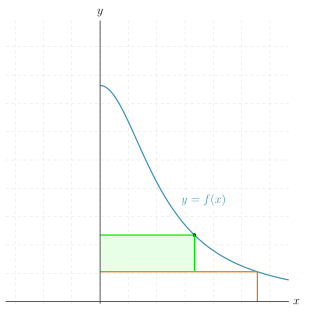
- For \(t\ge0\), let \(A_0(t)\) be the area of the largest rectangle with sides parallel to the coordinate axes that can fit in the region bounded by the curve \(y=\f(x)\), the \(y\)-axis and the line \(y=\f(t)\). Show that \(A_0(t)\) can be written in the form \[ A_0(t) =x_0\left( \f(x_0) -\f(t)\right), \] where \(x_0\) satisfies \(x_0 \f'(x_0) +\f(x_0) = \f(t)\,\).
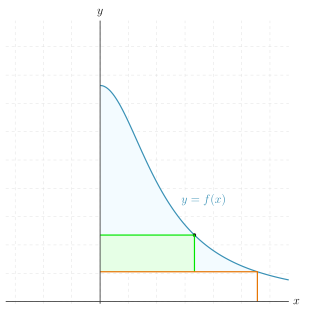
- The function g is defined, for \(t> 0\), by \[ \g(t) =\frac 1t \int_0^t \f(x) \d x\,. \] Show that \(t \g'(t) = \f(t) -\g(t)\,\). Making use of a sketch show that, for \(t>0\), \[ \int_0^t \left( \f(x) - \f(t)\right) \d x > A_0(t) \] and deduce that \(-t^2 \g'(t)> A_0(t)\).
- In the case \(\f(x)= \dfrac 1 {1+x}\,\), use the above to establish the inequality \[ \ln \sqrt{1+t} > 1 - \frac 1 {\sqrt{1+t}} \,, \] for \(t>0\).
Solution:
- First, not that the point must be ony the curve:
Since otherwise it's pretty clear we could make the area of the rectangle larger by moving the point onto the curve. Therefore \(A = x(f(x)-f(t))\). To maximise this we need \(xf'(x) + f(x)-f(t) = 0\), ie \(x_0f'(x_0) + f(x_0) = f(t)\)
- Suppose \(\displaystyle \g(t) =\frac 1t \int_0^t \f(x) \d x\) then
\begin{align*}
&& \g(t) &=\frac 1t \int_0^t \f(x) \d x\\
\Rightarrow && tg(t) &= \int_0^t \f(x) \d x \\
\Rightarrow && tg'(t) +g(t) &= f(t) \\
\Rightarrow && tg'(t) &= f(t) - g(t)
\end{align*}
Clearly the blue area + green area is larger than the green area. So \(\displaystyle \int_0^t (f(x) - f(t))\d x > A_0(t)\). Notice that \(f(t) = \frac1{t} \int_0^t f(t) \d x \) so \(-t^2g'(t) = \int_0^t f(x) \d x > A_0(t)\)
- Not that if \(f(x) = \dfrac{1}{1+x}\), the \(f'(x) = -\frac{1}{(1+x)^2}\) and so \begin{align*} && -\frac{x_0}{(1+x_0)^2} + \frac{1}{1+x_0} &= \frac{1}{1+t} \\ && \frac{1}{(1+x_0)^2} &= \frac{1}{1+t} \\ \Rightarrow && x_0 &= \sqrt{1+t} - 1 \\ && A_0(t) &= (\sqrt{1+t} - 1) \left ( \frac{1}{\sqrt{1+t}} - \frac{1}{t+1} \right) \\ &&&= 1 - \frac{1}{\sqrt{1+t}} - \frac{1}{\sqrt{1+t}} + \frac{1}{1+t} \\ &&&= \frac{2+t}{1+t} - \frac{2}{\sqrt{1+t}} \\ && g(t) &= \frac{1}{t} \int_0^t \frac{1}{1+x} \d x \\ &&&= \frac{\ln(1+t)}{t} \\ \Rightarrow && g'(t) &= \frac{\frac{t}{1+t} - \ln(1+t)}{t^2} \\ \Rightarrow && -t^2g(t) &= \ln(1+t) - \frac{t}{1+t} \\ \Rightarrow && \ln(1+t) - \frac{t}{1+t} &> \frac{2+t}{1+t} - \frac{2}{\sqrt{1+t}} \\ \Rightarrow && \ln \sqrt{1+t} & > 1 - \frac{1}{\sqrt{1+t}} \end{align*}
2002 Paper 1 Q4
Give a sketch of the curve \( \;\displaystyle y= \frac1 {1+x^2}\;\), for \(x\ge0\). Find the equation of the line that intersects the curve at \(x=0\) and is tangent to the curve at some point with \(x>0\,\). Prove that there are no further intersections between the line and the curve. Draw the line on your sketch. By considering the area under the curve for \(0\le x\le1\), show that \(\pi>3\,\). Show also, by considering the volume formed by rotating the curve about the \(y\) axis, that \(\ln 2 >2/3\,\). [Note: \(\displaystyle \int_0^ 1 \frac1 {1+x^2}\, \d x = \frac\pi 4\,.\;\)]
Solution:

2002 Paper 3 Q1
Find the area of the region between the curve \(\displaystyle y = {\ln x \over x}\,\) and the \(x\)-axis, for \(1 \le x \le a\). What happens to this area as \(a\) tends to infinity? Find the volume of the solid obtained when the region between the curve \(\displaystyle y = {\ln x \over x}\,\) and the \(x\)-axis, for \(1 \le x\le a\), is rotated through \(2 \pi\) radians about the \(x\)-axis. What happens to this volume as \(a\) tends to infinity?
Solution: \begin{align*} && \int_1^a \frac{\ln x}{x} \d x &= \left [ \ln x \cdot \ln x\right ]_1^a - \int_1^a \frac{\ln x}{x} \d x \\ \Rightarrow && \int_1^a \frac{\ln x}{x} \d x &= \frac12 \left ( \ln a \right) ^2 \\ && \int_1^\infty \frac{\ln x}{x} \d x &= \lim_{a \to \infty} \frac12 (\ln a)^2 \\ &&&= \infty \end{align*} \begin{align*} && \pi \int_1^a \left ( \frac{\ln x}{x} \right)^2 \d x &= \pi \int_{u=0}^{u=\ln a} \left ( \frac{u}{e^u} \right)^2 e^u \d u \\ &&&= \pi \int_0^{\ln a} u^2 e^{-u} \d u \\ &&&= \pi \left [-u^2e^{-u} \right]_0^{\ln a} +\pi \int_0^{\ln a} 2u e^{-u} \d u \\ &&&= -\frac{\pi}{a} (\ln a)^2 + \pi \left [-2u e^{-u} \right]_0^{\ln a} + \pi \int_0^{\ln a} e^{-u} \d u \\ &&&= -\frac{\pi}{a} (\ln a)^2- \frac{2 \pi}{a}\ln a+\pi \left (1 - \frac{1}{a} \right) \\ \\ && \pi \int_1^{\infty} \left ( \frac{\ln x}{x} \right)^2 \d x &= \lim_{a \to \infty} \left ( -\frac{\pi}{a} (\ln a)^2- \frac{2 \pi}{a}\ln a+\pi \left (1 - \frac{1}{a} \right) \right) \\ &&&= \pi \end{align*}
1994 Paper 2 Q4
By considering the area of the region defined in terms of Cartesian coordinates \((x,y)\) by \[ \{(x,y):\ x^{2}+y^{2}=1,\ 0\leqslant y,\ 0\leqslant x\leqslant c\}, \] show that \[ \int_{0}^{c}(1-x^{2})^{\frac{1}{2}}\,\mathrm{d}x=\tfrac{1}{2}[c(1-c^{2})^{\frac{1}{2}}+\sin^{-1}c], \] if \(0 < c\leqslant1.\) Show that the area of the region defined by \[ \left\{ (x,y):\ \frac{x^{2}}{a^{2}}+\frac{y^{2}}{b^{2}}=1,\ 0\leqslant y,\ 0\leqslant x\leqslant c\right\} , \] is \[ \frac{ab}{2}\left[\frac{c}{a}\left(1-\frac{c^{2}}{a^{2}}\right)^{\frac{1}{2}}+\sin^{-1}\left(\frac{c}{a}\right)\right], \] if \(0 < c\leqslant a\) and \(0 < b.\) Suppose that \(0 < b\leqslant a.\) Show that the area of intersection \(E\cap F\) of the two regions defined by \[ E=\left\{ (x,y):\ \frac{x^{2}}{a^{2}}+\frac{y^{2}}{b^{2}}\leqslant1\right\} \qquad\mbox{ and }\qquad F=\left\{ (x,y):\ \frac{x^{2}}{b^{2}}+\frac{y^{2}}{a^{2}}\leqslant1\right\} \] is \[ 4ab\sin^{-1}\left(\frac{b}{\sqrt{a^{2}+b^{2}}}\right). \]
1992 Paper 3 Q6
Given that \({\displaystyle I_{n}=\int_{0}^{\pi}\frac{x\sin^{2}(nx)}{\sin^{2}x}\,\mathrm{d}x,}\) where \(n\) is a positive integer, show that \(I_{n}-I_{n-1}=J_{n},\) where \[ J_{n}=\int_{0}^{\pi}\frac{x\sin(2n-1)x}{\sin x}\,\mathrm{d}x. \] Obtain also a reduction formula for \(J_{n}.\) The curve \(C\) is given by the cartesian equation \[ y=\dfrac{x\sin^{2}(nx)}{\sin^{2}x}, \] where \(n\) is a positive integer and \(0\leqslant x\leqslant\pi.\) Show that the area under the curve \(C\) is \(\frac{1}{2}n\pi^{2}.\)
Solution: \begin{align*} I_n - I_{n-1} &= \int_0^{\pi} \frac{x \sin^2(nx)}{\sin ^2 x} \d x-\int_0^{\pi} \frac{x \sin^2((n-1)x)}{\sin ^2 x} \d x \\ &= \int_0^{\pi} \frac{x}{\sin^2 x} \left ( \sin^2 (nx) - \sin^2((n-1)x) \right) \d x \\ &= \int_0^{\pi} \frac{x}{\sin^2 x}\frac12 \left ( \cos (2(n-1)x) - \cos(2nx) \right) \d x \\ &= \int_0^{\pi} \frac{x}{\sin^2 x}\frac12 2 \sin ((2n-1)x )\sin x \d x \\ &= \int_0^{\pi} \frac{x\sin ((2n-1)x )}{\sin x}d x \\ &= J_n \\ \\ J_{n+1} - J_{n} &= \int_0^{\pi} \frac{x \left (\sin ((2n+1)x )-\sin ((2n-1)x )\right)}{\sin x} \d x \\ &= \int_0^{\pi} \frac{x \left ( 2 \cos (\frac{4n x}{2}) \sin \frac{2x}{2} \right)}{\sin x} \d x \\ &= \int_0^{\pi}2x \cos (2n x) \d x \\ &= \left [ \frac{x}{2n} \sin (2n x) \right]_0^{\pi} - \int_0^{\pi} \frac{1}{2n} \sin (2n x) \d x \\ &= \left [ \frac{1}{4n^2} \cos (2n x)\right]_0^{\pi} \\ &= 0 \\ \\ J_1 &= \int_0^\pi x \d x \\ &= \frac{\pi^2}{2} \\ \Rightarrow J_n &= \frac{\pi^2}{2} \\ \end{align*} And so \(I_n = I_1 + (n-1) \frac{\pi^2}{2}\) and \(I_1 = \frac{\pi^2}{2}\) so \(I_n = \frac12 n \pi^2\). But \(I_n\) is exactly the area under the curve described.
1990 Paper 1 Q9
Let \(A\) and \(B\) be the points \((1,1)\) and \((b,1/b)\) respectively, where \(b>1\). The tangents at \(A\) and \(B\) to the curve \(y=1/x\) intersect at \(C\). Find the coordinates of \(C\). Let \(A',B'\) and \(C'\) denote the projections of \(A,B\) and \(C\), respectively, to the \(x\)-axis. Obtain an expression for the sum of the areas of the quadrilaterals \(ACC'A'\) and \(CBB'C'\). Hence or otherwise prove that, for \(z>0\), \[ \frac{2z}{2+z}\leqslant\ln\left(1+z\right)\leqslant z. \]
Solution: