Problems
Filters
4 problems found
2002 Paper 1 Q12
Harry the Calculating Horse will do any mathematical problem I set him, providing the answer is 1, 2, 3 or 4. When I set him a problem, he places a hoof on a large grid consisting of unit squares and his answer is the number of squares partly covered by his hoof. Harry has circular hoofs, of radius \(1/4\) unit. After many years of collaboration, I suspect that Harry no longer bothers to do the calculations, instead merely placing his hoof on the grid completely at random. I often ask him to divide 4 by 4, but only about \(1/4\) of his answers are right; I often ask him to add 2 and 2, but disappointingly only about \(\pi/16\) of his answers are right. Is this consistent with my suspicions? I decide to investigate further by setting Harry many problems, the answers to which are 1, 2, 3, or 4 with equal frequency. If Harry is placing his hoof at random, find the expected value of his answers. The average of Harry's answers turns out to be 2. Should I get a new horse?
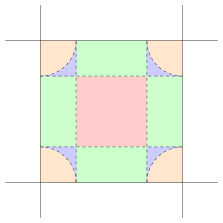
Solution: Without loss of generality, let's assume that Harry is putting the center of his hoof within one square.
1992 Paper 2 Q3
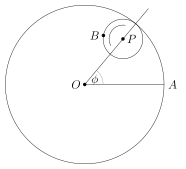
In the figure, the large circle with centre \(O\) has radius \(4\) and the small circle with centre \(P\) has radius \(1\). The small circle rolls around the inside of the larger one. When \(P\) was on the line \(OA\) (before the small circle began to roll), the point \(B\) was in contact with the point \(A\) on the large circle.
1992 Paper 3 Q15
A goat \(G\) lies in a square field \(OABC\) of side \(a\). It wanders randomly round its field, so that at any time the probability of its being in any given region is proportional to the area of this region. Write down the probability that its distance, \(R\), from \(O\) is less than \(r\) if \(0 < r\leqslant a,\) and show that if \(r\geqslant a\) the probability is \[ \left(\frac{r^{2}}{a^{2}}-1\right)^{\frac{1}{2}}+\frac{\pi r^{2}}{4a^{2}}-\frac{r^{2}}{a^{2}}\cos^{-1}\left(\frac{a}{r}\right). \] Find the median of \(R\) and probability density function of \(R\). The goat is then tethered to the corner \(O\) by a chain of length \(a\). Find the conditional probability that its distance from the fence \(OC\) is more than \(a/2\).
1987 Paper 2 Q15
A train of length \(l_{1}\) and a lorry of length \(l_{2}\) are heading for a level crossing at speeds \(u_{1}\) and \(u_{2}\) respectively. Initially the front of the train and the front of the lorry are at distances \(d_{1}\) and \(d_{2}\) from the crossing. Find conditions on \(u_{1}\) and \(u_{2}\) under which a collision will occur. On a diagram with \(u_{1}\) and \(u_{2}\) measured along the \(x\) and \(y\) axes respectively, shade in the region which represents collision. Hence show that if \(u_{1}\) and \(u_{2}\) are two independent random variables, both uniformly distributed on \((0,V)\), then the probability of a collision in the case when initially the back of the train is nearer to the crossing than the front of the lorry is \[ \frac{l_{1}l_{2}+l_{2}d_{1}+l_{1}d_{2}}{2d_{2}\left(l_{2}+d_{2}\right)}. \] Find the probability of a collision in each of the other two possible cases.