Problems
Filters
7 problems found
2005 Paper 3 Q11
A horizontal spindle rotates freely in a fixed bearing. Three light rods are each attached by one end to the spindle so that they rotate in a vertical plane. A particle of mass \(m\) is fixed to the other end of each of the three rods. The rods have lengths \(a\), \(b\) and \(c\), with \(a > b > c\,\) and the angle between any pair of rods is \(\frac23 \pi\). The angle between the rod of length \(a\) and the vertical is \(\theta\), as shown in the diagram. \vspace*{-0.1in}
2001 Paper 3 Q11
A uniform cylinder of radius \(a\) rotates freely about its axis, which is fixed and horizontal. The moment of inertia of the cylinder about its axis is \(I\,\). A light string is wrapped around the cylinder and supports a mass \(m\) which hangs freely. A particle of mass \(M\) is fixed to the surface of the cylinder. The system is held at rest with the particle vertically below the axis of the cylinder, and then released. Find, in terms of \(I\), \(a\), \(M\), \(m\), \(g\) and \(\theta\), the angular velocity of the cylinder when it has rotated through angle \(\theta\,\). Show that the cylinder will rotate without coming to a halt if \(m/M>\sin\alpha\,\), where \(\alpha\) satisifes \(\alpha=\tan \frac12\alpha\) and \(0<\alpha<\pi\,\).
1999 Paper 1 Q11
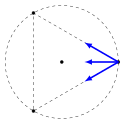
The force of attraction between two stars of masses \(m_{1}\) and \(m_{2}\) a distance \(r\) apart is \(\gamma m_{1}m_{2}/r^{2}\). The Starmakers of Kryton place three stars of equal mass \(m\) at the corners of an equilateral triangle of side \(a\). Show that it is possible for each star to revolve round the centre of mass of the system with angular velocity \((3\gamma m/a^{3})^{1/2}\). Find a corresponding result if the Starmakers place a fourth star, of mass \(\lambda m\), at the centre of mass of the system.
Solution: The net force on the planets will always be towards the centre of mass (by symmetry or similar arguments). Therefore it suffices to check whether we can find a speed where the planets follow uniform circular motion, ie \(F = mr \omega^2\). (But clearly this is possible, we just need to find the speed)

1996 Paper 2 Q10
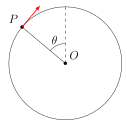
The plot of `Rhode Island Red and the Henhouse of Doom' calls for the heroine to cling on to the circumference of a fairground wheel of radius \(a\) rotating with constant angular velocity \(\omega\) about its horizontal axis and then let go. Let \(\omega_{0}\) be the largest value of \(\omega\) for which it is not possible for her subsequent path to carry her higher than the top of the wheel. Find \(\omega_{0}\) in terms of \(a\) and \(g\). If \(\omega>\omega_{0}\) show that the greatest height above the top of the wheel to which she can rise is \[\frac{a}{2}\left(\frac{\omega}{\omega_{0}} -\frac{\omega_{0}}{\omega}\right)^{\!\!2}.\]
Solution:
1994 Paper 1 Q10
One end \(A\) of a light elastic string of natural length \(l\) and modulus of elasticity \(\lambda\) is fixed and a particle of mass \(m\) is attached to the other end \(B\). The particle moves in a horizontal circle with centre on the vertical through \(A\) with angular velocity \(\omega.\) If \(\theta\) is the angle \(AB\) makes with the downward vertical, find an expression for \(\cos\theta\) in terms of \(m,g,l,\lambda\) and \(\omega.\) Show that the motion described is possible only if \[ \frac{g\lambda}{l(\lambda+mg)}<\omega^{2}<\frac{\lambda}{ml}. \]
1989 Paper 3 Q12
A smooth horizontal plane rotates with constant angular velocity \(\Omega\) about a fixed vertical axis through a fixed point \(O\) of the plane. The point \(A\) is fixed in the plane and \(OA=a.\) A particle \(P\) lies on the plane and is joined to \(A\) by a light rod of length \(b(>a)\) freely pivoted at \(A\). Initially \(OAP\) is a straight line and \(P\) is moving with speed \((a+2\sqrt{ab})\Omega\) perpendicular to \(OP\) in the same sense as \(\Omega.\) At time \(t,\) \(AP\) makes an angle \(\phi\) with \(OA\) produced. Obtain an expression for the component of the acceleration of \(P\) perpendicular to \(AP\) in terms of \(\dfrac{\mathrm{d}^{2}\phi}{\mathrm{d}t^{2}},\phi,a,b\) and \(\Omega.\) Hence find \(\dfrac{\mathrm{d}\phi}{\mathrm{d}t}\), in terms of \(\phi,a,b\) and \(\Omega,\) and show that \(P\) never crosses \(OA.\)
Solution: Set up coordinate axes so that at time \(t\) \(OA\) is the \(x\)-axis, and all rotations are counter-clockwise. Then if \(OA = \mathbf{a}\), \(AP = \mathbf{x}\) and \(OP = \mathbf{p}\) we have: \begin{align*} \mathbf{a} &= \binom{a}{0} \\ \dot{\mathbf{a}} &= \binom{0}{-a \Omega} \\ \ddot{\mathbf{a}} &= \binom{-a \Omega^2}{0} \\ \\ \mathbf{x} &= \binom{b \cos \phi }{b \sin \phi } \\ \dot{\mathbf{x}} &= b \dot{\phi} \binom{-\sin \phi}{\cos \phi} \\ \ddot{\mathbf{x}} &= \binom{-b \ddot{\phi} \sin \phi-b \dot{\phi}^2 \cos \phi }{b \ddot{\phi} \cos \phi-b \dot{\phi}^2 \sin \phi} \\ \\ \ddot{\mathbf{p}} &= \binom{-a \Omega^2 +-b \ddot{\phi} \sin \phi-b \dot{\phi}^2 \cos \phi }{b \ddot{\phi} \cos \phi-b \dot{\phi}^2 \sin \phi} \end{align*} We can take a dot product with \(\mathbf{n} = \binom{-\sin \phi}{\cos \phi}\) to obtain the component perpendicular to \(AP\), which is: \begin{align*} && \binom{-\sin \phi}{\cos \phi} \cdot \ddot{x} &= a \Omega^2 \sin \phi + b \ddot{\phi} \end{align*} Noticing that this component must be \(0\) (since the only force acting on \(P\) is the rod), this must be equal to zero. \begin{align*} && 0 &= a \Omega^2 \sin \phi + b \ddot{\phi} \\ \Rightarrow && 0 &= a \Omega^2 \dot{\phi} \sin \phi + b\dot{\phi} \ddot{\phi} \\ \Rightarrow && C &= -a \Omega^2 \cos \phi + \tfrac12 b \dot{\phi}^2 \end{align*} Noticing that the initial conditions are \(\phi = 0\) and \(\dot{\phi} = 2\sqrt{\frac{a}{b}} \Omega\), so \begin{align*} && C &= -a \Omega^2+ \tfrac12 b \left ( 2\sqrt{\frac{a}{b}} \Omega \right)^2 \\ &&&= -a \Omega^2 + 2a \Omega^2 \\ &&&= a \Omega^2\\ \Rightarrow && \dot{\phi} &=\sqrt{\frac{2}{b} \left ( a \Omega^2 + a \Omega^2 \cos \phi \right)} \\ &&&= \Omega \sqrt{\frac{2a}{b}} \sqrt{1+ \cos \phi} \\ &&& = \Omega \sqrt{\frac{2a}{b}}\sqrt{2} \cos \tfrac{\phi}{2} \\ \Rightarrow && \int \sec \tfrac{\phi}{2} \d \phi &= 2 \Omega \sqrt{\frac{a}{b}}t \\ \Rightarrow && \tfrac12 \ln | \sec \tfrac{\phi}{2}+\tan \tfrac{\phi}{2} | &= 2 \Omega \sqrt{\frac{a}{b}}t + C \\ t = 0, \phi = 0: && C = 0 \\ \Rightarrow && \sec \tfrac{\phi}{2}+\tan \tfrac{\phi}{2} &= e^{4 \Omega \sqrt{\frac{a}{b}}t} \end{align*} Since when \(t > 0\) this is positive and larger than \(1\) we cannot have \(\phi = 0\) and since it remains below infinite \(\phi\) cannot reach \(\pi\). Therefore it cannot cross \(OA\)
1988 Paper 2 Q14
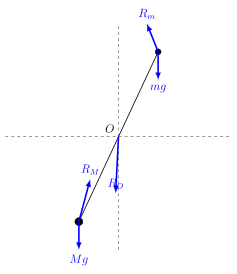
Two particles of mass \(M\) and \(m\) \((M>m)\) are attached to the ends of a light rod of length \(2l.\) The rod is fixed at its midpoint to a point \(O\) on a horizontal axle so that the rod can swing freely about \(O\) in a vertical plane normal to the axle. The axle rotates about a vertical axis through \(O\) at a constant angular speed \(\omega\) such that the rod makes a constant angle \(\alpha\) \((0<\alpha<\frac{1}{2}\pi)\) with the vertical. Show that \[ \omega^{2}=\left(\frac{M-m}{M+m}\right)\frac{g}{l\cos\alpha}. \] Show also that the force of reaction of the rod on the axle is inclined at an angle \[ \tan^{-1}\left[\left(\frac{M-m}{M+m}\right)^{2}\tan\alpha\right] \] with the downward vertical.
Solution: