Problems
Filters
6 problems found
2013 Paper 3 Q10
A uniform rod \(AB\) has mass \(M\) and length \(2a\). The point \(P\) lies on the rod a distance \(a-x\) from~\(A\). Show that the moment of inertia of the rod about an axis through \(P\) and perpendicular to the rod is \[ \tfrac13 M(a^2 +3x^2)\,. \] The rod is free to rotate, in a horizontal plane, about a fixed vertical axis through \(P\). Initially the rod is at rest. The end \(B\) is struck by a particle of mass \(m\) moving horizontally with speed \(u\) in a direction perpendicular to the rod. The coefficient of restitution between the rod and the particle is \(e\). Show that the angular velocity of the rod immediately after impact is \[ \frac{3mu(1+e)(a+x)}{M(a^2+3x^2) +3m(a+x)^2}\,. \] In the case \(m=2M\), find the value of \(x\) for which the angular velocity is greatest and show that this angular velocity is \(u(1+e)/a\,\).
2007 Paper 3 Q11
- A wheel consists of a thin
light circular rim attached by light spokes of length \(a\)
to a small hub of mass
\(m\). The wheel rolls without slipping
on a rough horizontal table
directly towards a straight edge of the table.
The plane of the wheel is vertical throughout the motion.
The speed of the wheel is \(u\), where
\(u^2
- Two particles, each of mass \(m/2\), are attached to a light circular hoop of radius \(a\), at the ends of a diameter. The hoop rolls without slipping on a rough horizontal table directly towards a straight edge of the table. The plane of the hoop is vertical throughout the motion. When the centre of the hoop is vertically above the edge of the table it has speed \(u\), where \(u^2
- Two particles, each of mass \(m/2\), are attached to a light circular hoop of radius \(a\), at the ends of a diameter. The hoop rolls without slipping on a rough horizontal table directly towards a straight edge of the table. The plane of the hoop is vertical throughout the motion. When the centre of the hoop is vertically above the edge of the table it has speed \(u\), where \(u^2
1997 Paper 3 Q10
By pressing a finger down on it, a uniform spherical marble of radius \(a\) is made to slide along a horizontal table top with an initial linear velocity \(v_0\) and an initial {\em backward} angular velocity \(\omega_0\) about the horizontal axis perpendicular to \(v_0\). The frictional force between the marble and the table is constant (independent of speed). For what value of \(v_0/(a\omega_0)\) does the marble
- slide to a complete stop,
- come to a stop and then roll back towards its initial position with linear speed \(v_0/7\).
Solution:
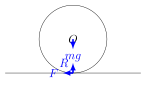
- If the ball completely stops, then \(\omega = v = 0 \Rightarrow \frac{2}{5}a \omega_0 - v_0 = 0 \Rightarrow \frac{v_0}{a \omega_0} = \frac25\).
- If the ball rolls backwards with linear speed \(v_0/7\), \(v = - \frac{v_0}{7}\) and \(a \omega = \frac{v_0}{7}\), \begin{align*} && \frac{2}{5}a \omega_0 - v_0 &= \frac{2}{5} \frac{v_0}{7} + \frac{v_0}{7} \\ && &= \frac{1}{5} v_0 \\ \Rightarrow && \frac{v_0}{a \omega_0} &= \frac{1}{3} \end{align*}
1997 Paper 3 Q11
\(\,\)
1990 Paper 3 Q11
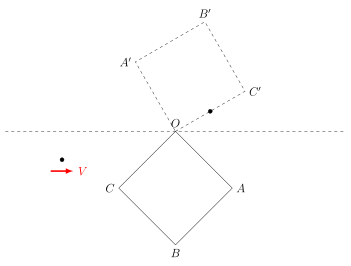
The points \(O,A,B\) and \(C\) are the vertices of a uniform square lamina of mass \(M.\) The lamina can turn freely under gravity about a horizontal axis perpendicular to the plane of the lamina through \(O\). The sides of the lamina are of length \(2a.\) When the lamina is haning at rest with the diagonal \(OB\) vertically downwards it is struck at the midpoint of \(OC\) by a particle of mass \(6M\) moving horizontally in the plane of the lamina with speed \(V\). The particle adheres to the lamina. Find, in terms of \(a,M\) and \(g\), the value which \(V^{2}\) must exceed for the lamina and particle to make complete revolutions about the axis.
Solution:
1987 Paper 3 Q12
A firework consists of a uniform rod of mass \(M\) and length \(2a\), pivoted smoothly at one end so that it can rotate in a fixed horizontal plane, and a rocket attached to the other end. The rocket is a uniform rod of mass \(m(t)\) and length \(2l(t)\), with \(m(t)=2\alpha l(t)\) and \(\alpha\) constant. It is attached to the rod by its front end and it lies at right angles to the rod in the rod's plane of rotation. The rocket burns fuel in such a way that \(\mathrm{d}m/\mathrm{d}t=-\alpha\beta,\) with \(\beta\) constant. The burnt fuel is ejected from the back of the rocket, with speed \(u\) and directly backwards relative to the rocket. Show that, until the fuel is exhausted, the firework's angular velocity \(\omega\) at time \(t\) satisfies \[ \frac{\mathrm{d}\omega}{\mathrm{d}t}=\frac{3\alpha\beta au}{2[Ma^{2}+2\alpha l(3a^{2}+l^{2})]}. \]
Solution: