Problems
Filters
8 problems found
2022 Paper 2 Q8
Let \(\mathbf{M} = \begin{pmatrix} a & b \\ c & d \end{pmatrix}\) be a real matrix with \(a \neq d\). The transformation represented by \(\mathbf{M}\) has exactly two distinct invariant lines through the origin.
- Show that, if neither invariant line is the \(y\)-axis, then the gradients of the invariant lines are the roots of the equation \[bm^2 + (a-d)m - c = 0.\] If one invariant line is the \(y\)-axis, what is the gradient of the other?
- Show that, if the angle between the two invariant lines is \(45^\circ\), then \[(a-d)^2 = (b-c)^2 - 4bc.\]
- Find a necessary and sufficient condition, on some or all of \(a\), \(b\), \(c\) and \(d\), for the two invariant lines to make equal angles with the line \(y = x\).
- Give an example of a matrix which satisfies both the conditions in parts (ii) and (iii).
2010 Paper 2 Q5
The points \(A\) and \(B\) have position vectors \(\bf i +j+k\) and \(5{\bf i} - {\bf j} -{\bf k}\), respectively, relative to the origin \(O\). Find \(\cos2\alpha\), where \(2\alpha\) is the angle \(\angle AOB\).
- The line \(L _1\) has equation \({\bf r} =\lambda(m{\bf i}+n {\bf j} + p{\bf k})\). Given that \(L _1\) is inclined equally to \(OA\) and to \(OB\), determine a relationship between \(m\), \(n\) and~\(p\). Find also values of \(m\), \(n\) and~\(p\) for which \(L _1\) is the angle bisector of \(\angle AOB\).
- The line \(L _2\) has equation \({\bf r} =\mu(u{\bf i}+v {\bf j} + w{\bf k})\). Given that \( L _2\) is inclined at an angle \(\alpha\) to \(OA\), where \(2\alpha = \angle AOB\), determine a relationship between \(u\), \(v\) and \(w\). Hence describe the surface with Cartesian equation \(x^2+y^2+z^2 =2(yz+zx+xy)\).
2008 Paper 2 Q4
A curve is given by \[x^2+y^2 +2axy = 1,\] where \(a\) is a constant satisfying \(0 < a < 1\). Show that the gradient of the curve at the point \(P\) with coordinates \((x,y)\) is \[\displaystyle - \frac {x+ay}{ax+y}\,,\] provided \(ax+y \ne0\). Show that \(\theta\), the acute angle between \(OP\) and the normal to the curve at \(P\), satisfies \[ \tan\theta = a\vert y^2-x^2\vert\;. \] Show further that, if \(\ \displaystyle \frac{\d \theta}{\d x}=0\) at \(P\), then:
- \(a(x^2+y^2)+2xy=0\,\);
- \((1+a)(x^2+y^2+2xy)=1\,\);
- \(\displaystyle \tan\theta = \frac a{\sqrt{1-a^2}}\,\).
Solution: \begin{align*} && 1 &= x^2 + y^2 + 2axy \\ \frac{\d}{\d x}: && 0 &= 2x + 2y \frac{\d y}{\d x} + 2ay + 2ax \frac{\d y}{\d x} \\ &&&= (2x+2ay) + \frac{\d y}{\d x} \left (2ax + 2y \right) \\ \Rightarrow && \frac{\d y}{\d x} &= -\frac{x+ay}{ax+y} \end{align*}
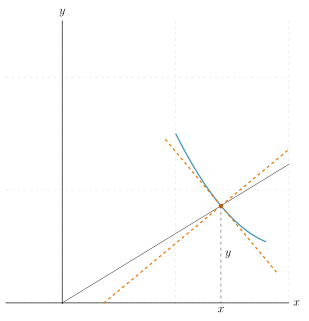
- \(\,\) \begin{align*} && \sec^2 \theta \frac{\d \theta}{\d x} &= \pm a \left (2y \frac{\d y}{\d x} - 2 x\right) \\ \Rightarrow && 0 &= a \left (y \cdot \frac{x+ay}{ax+y} + x \right) \\ &&&=a \left ( \frac{xy+ay^2+ax^2+xy}{ax+y} \right) \\ \Rightarrow && 0 &= a(x^2+y^2)+2xy \end{align*}
- \(\,\) \begin{align*} && 0 &=a(x^2+y^2)+2xy \\ && 1 &= x^2+y^2 + 2axy \\ \Rightarrow && 1 &= (a+1)(x^2+y^2) + (a+1)(2xy) \\ &&&= (a+1)(x^2+y^2+2xy) \end{align*}
- \(\,\) \begin{align*} && 1 &= (a+1)(x+y)^2 \\ \Rightarrow && x +y &= \pm \frac{1}{\sqrt{1+a}} \\ && 0 &=a(x^2+y^2)+2xy \\ && 1 &= x^2+y^2 + 2axy \\ \Rightarrow && 1 &= (1-a)(x^2+y^2) + (a-1)(2xy) \\ &&&= (1-a)(x^2+y^2-2xy)\\ \Rightarrow && x-y &= \pm \frac{1}{\sqrt{1-a}} \\ \Rightarrow && \frac{\d \theta}{\d x} &= a|y^2-x^2| \\ &&&= a|(y-x)(x+y)| \\ &&&= \frac{a}{\sqrt{1-a^2}} \end{align*}
2002 Paper 2 Q6
The lines \(l_1\), \(l_2\) and \(l_3\) lie in an inclined plane \(P\) and pass through a common point \(A\). The line \(l_2\) is a line of greatest slope in \(P\). The line \(l_1\) is perpendicular to \(l_3\) and makes an acute angle \(\alpha\) with \(l_2\). The angles between the horizontal and \(l_1\), \(l_2\) and \(l_3\) are \(\pi/6\), \(\beta\) and \(\pi/4\), respectively. Show that \(\cos\alpha\sin\beta = \frac12\,\) and find the value of \(\sin\alpha \sin\beta\,\). Deduce that \(\beta = \pi/3\,\). The lines \(l_1\) and \(l_3\) are rotated in \(P\) about \(A\) so that \(l_1\) and \(l_3\) remain perpendicular to each other. The new acute angle between \(l_1\) and \(l_2\) is \(\theta\). The new angles which \(l_1\) and \(l_3\) make with the horizontal are \(\phi\) and \(2\phi\), respectively. Show that \[ \tan^2\theta = \frac{3+\sqrt{13}}2\;. \]
2002 Paper 2 Q7
In 3-dimensional space, the lines \(m_1\) and \(m_2\) pass through the origin and have directions \(\bf i + j\) and \(\bf i +k \), respectively. Find the directions of the two lines \(m_3\) and \(m_4\) that pass through the origin and make angles of \(\pi/4\) with both \(m_1\) and \(m_2\). Find also the cosine of the acute angle between \(m_3\) and \(m_4\). The points \(A\) and \(B\) lie on \(m_1\) and \(m_2\) respectively, and are each at distance \(\lambda \surd2\) units from~\(O\). The points \(P\) and \(Q\) lie on \(m_3\) and \(m_4\) respectively, and are each at distance \(1\) unit from~\(O\). If all the coordinates (with respect to axes \(\bf i\), \(\bf j\) and \(\bf k\)) of \(A\), \(B\), \(P\) and \(Q\) are non-negative, prove that:
- there are only two values of \(\lambda\) for which \(AQ\) is perpendicular to \(BP\,\);
- there are no non-zero values of \(\lambda\) for which \(AQ\) and \(BP\) intersect.
2000 Paper 1 Q5
Arthur and Bertha stand at a point \(O\) on an inclined plane. The steepest line in the plane through \(O\) makes an angle \(\theta\) with the horizontal. Arthur walks uphill at a steady pace in a straight line which makes an angle \(\alpha\) with the steepest line. Bertha walks uphill at the same speed in a straight line which makes an angle \(\beta\) with the steepest line (and is on the same side of the steepest line as Arthur). Show that, when Arthur has walked a distance \(d\), the distance between Arthur and Bertha is \(2d \vert\sin\frac12(\alpha-\beta)\vert\). Show also that, if \(\alpha\ne\beta\), the line joining Arthur and Bertha makes an angle \(\phi\) with the vertical, where \[ \cos\phi = \sin\theta \sin \frac12(\alpha+\beta). \]
2000 Paper 2 Q7
The line \(l\) has vector equation \({\bf r} = \lambda {\bf s}\), where \[ {\bf s} = (\cos\theta+\sqrt3\,) \; {\bf i} +(\surd2\;\sin\theta)\;{\bf j} +(\cos\theta-\sqrt3\,)\;{\bf k} \] and \(\lambda\) is a scalar parameter. Find an expression for the angle between \(l\) and the line \mbox{\({\bf r} = \mu(a\, {\bf i} + b\,{\bf j} +c\, {\bf k})\)}. Show that there is a line \(m\) through the origin such that, whatever the value of \(\theta\), the acute angle between \(l\) and \(m\) is \(\pi/6\). A plane has equation \(x-z=4\sqrt3\). The line \(l\) meets this plane at \(P\). Show that, as \(\theta\) varies, \(P\) describes a circle, with its centre on \(m\). Find the radius of this circle.
1990 Paper 3 Q2
The distinct points \(O\,(0,0,0),\) \(A\,(a^{3},a^{2},a),\) \(B\,(b^{3},b^{2},b)\) and \(C\,(c^{3},c^{2},c)\) lie in 3-dimensional space.
- Prove that the lines \(OA\) and \(BC\) do not intersect.
- Given that \(a\) and \(b\) can vary with \(ab=1,\) show that \(\angle AOB\) can take any value in the interval \(0<\angle AOB<\frac{1}{2}\pi\), but no others.
Solution:
- The line \(OA\) is \(\lambda \begin{pmatrix} a^3 \\ a^2 \\ a \end{pmatrix}\). The line \(BC\) is \(\begin{pmatrix} b^3 \\ b^2 \\ b \end{pmatrix} + \mu \begin{pmatrix} c^3-b^3 \\ c^2-b^2 \\ c-b \end{pmatrix}\). If these lies are concurrent then there would be \(\mu\) and \(\lambda\) such that they are equal, and in particular, \begin{align*} && \frac{b^2 + \mu(c^2-b^2)}{b + \mu (c-b)} &= \frac{b^3 + \mu(c^3-b^3)}{b^2 + \mu (c^2-b^2)} \\ \Leftrightarrow && (b^2 + \mu(c^2-b^2))^2 &= (b+\mu(c-b))(b^3+\mu(c^3-b^3)) \\ && b^4 +2\mu b^2 (c^2-b^2) + \mu^2 (c^2-b^2) &= b^4 + \mu(c-b)b^3 + \mu b(c^3-b^3) + \mu^2 (c-b)(c^3-b^3) \\ \Leftrightarrow && 2\mu b^2 (c+b) + \mu^2(c-b)(c+b)^2 &= \mu (b^3 + b(c^2+bc+b^2)) + \mu^2 (c^3-b^3) \\ && \mu = 0 & \Rightarrow a = b \\ \Leftrightarrow && b^2c - bc^2 &= \mu (c^3-b^3-(c-b)(c+b)^2) \\ \Leftrightarrow && bc(b-c) &= \mu (c-b)(c^2+bc+b^2-c^2-2bc-b^2) \\ \Leftrightarrow && bc &= \mu (bc) \\ \Leftrightarrow && \mu &= 1 \\ && \mu = -1 & \Rightarrow a = c \end{align*} Therefore there are no solutions.
- \begin{align*} \cos \angle AOB &= \frac{ab+a^2b^2+a^3b^3}{\sqrt{a^2+a^4+a^6}\sqrt{b^2+b^4+b^6}} \\ &= \frac{3}{\sqrt{1 + a^2 + a^4} \sqrt{1 + b^2 + b^4}} \\ &> 0 \end{align*} Therefore the angle satisfies \(\angle AOB < \tfrac12 \pi\). We cannot achieve \(0\), since that would require \(a = b = 1\), therefore it falls in the range \(0 < \angle AOB < \tfrac12 \pi\)