Problems
Filters
17 problems found
2025 Paper 3 Q3
Let \(f(x)\) be defined and positive for \(x > 0\). Let \(a\) and \(b\) be real numbers with \(0 < a < b\) and define the points \(A = (a, f(a))\) and \(B = (b, -f(b))\). Let \(X = (m,0)\) be the point of intersection of line \(AB\) with the \(x\)-axis.
- Find an expression for \(m\) in terms of \(a\), \(b\), \(f(a)\) and \(f(b)\).
- Show that, if \(f(x) = \sqrt{x}\), then \(m = \sqrt{ab}\). Find, in terms of \(n\), \(a\) function \(f(x)\) such that \(m = \frac{a^{n+1} + b^{n+1}}{a^n + b^n}\).
- Let \(g_1(x)\) and \(g_2(x)\) be defined and positive for \(x > 0\). Let \(m = M_1\) when \(f(x) = g_1(x)\) and let \(m = M_2\) when \(f(x) = g_2(x)\). Show that if \(\frac{g_1(x)}{g_2(x)}\) is a decreasing function then \(M_1 > M_2\). Hence show that $$\frac{a+b}{2} > \sqrt{ab} > \frac{2ab}{a+b}$$
- Let \(p\) and \(c\) be chosen so that the curve \(y = p(c-x)^3\) passes through both \(A\) and \(B\). Show that $$\frac{c-a}{b-c} = \left(\frac{f(a)}{f(b)}\right)^{1/3}$$ and hence determine \(c\) in terms of \(a\), \(b\), \(f(a)\) and \(f(b)\). Show that if \(f\) is a decreasing function, then \(c < m\).
Solution:
- The line \(AB\) has equation: \begin{align*} && \frac{y+f(b)}{x-b} &= \frac{f(a)+f(b)}{a-b} \\ \Rightarrow && \frac{f(b)}{m-b} &= \frac{f(a)+f(b)}{a-b} \\ \Rightarrow && m &= \frac{a-b}{f(a)+f(b)}f(b) + b \\ &&&= \frac{af(b)+bf(a)}{f(a)+f(b)} \end{align*}
- Suppose \(f(x) = \sqrt{x}\) then \begin{align*} m &= \frac{a\sqrt{b}+b\sqrt{a}}{\sqrt{a}+\sqrt{b}} \\ &= \frac{\sqrt{ab}(\sqrt{a}+\sqrt{b})}{\sqrt{a}+\sqrt{b}} \\ &= \sqrt{ab} \end{align*} Suppose \(f(x) = x^{-n}\) then \begin{align*} m &= \frac{a b^{-n}+ba^{-n}}{a^{-n}+b^{-n}} \\ &= \frac{a^{n+1}+b^{n+1}}{b^n + a^n} \\ \end{align*}
- Without loss of generality, we can scale \(g_1(x)\) and \(g_2(x)\) so that \(g_1(a) = g_2(a)\) and \(m\) won't change for either of them. Then since \(\frac{g_1(b)}{g_2(b)} < 1\) (this function is decreasing) our line connecting \((a,g_i(a))\) and \((b,-g_i(b))\) must interect the axis first for \(g_2\), in particular \(M_1 > M_2\). Suppose \(g_1(x) =1, g_2(x) = \sqrt{x}, g_3(x) = x^{-1}\), the notice that \(\frac{g_1(x)}{g_2(x)} =\frac{g_2(x)}{g_3(x)}= x^{-1/2}\) are decreasing, therefore: \begin{align*} \frac{a+b}{1+1} &> \sqrt{ab} > \frac{1+1}{a^{-1}+b^{-1}} \\ \frac{a+b}{2} &> \sqrt{ab} > \frac{2ab}{a+b} \\ \end{align*}
- We must have: \begin{align*} && p(c-a)^3 &= f(a) \\ && p(c-b)^3 &= -f(b) \\ \Rightarrow &&\left ( \frac{c-a}{c-b} \right)^3 &= -\frac{f(a)}{f(b)} \\ \Rightarrow && \frac{c-a}{b-c} &= \left (\frac{f(a)}{f(b)} \right)^{\tfrac13} \\ \Rightarrow && c-a &= \left (\frac{f(a)}{f(b)} \right)^{\tfrac13}(b-c)\\ \Rightarrow && c \left (1 + \left (\frac{f(a)}{f(b)} \right)^{\tfrac13} \right) &= \left (\frac{f(a)}{f(b)} \right)^{\tfrac13}b + a \\ \Rightarrow && c &= \frac{\left (\frac{f(a)}{f(b)} \right)^{\tfrac13}b + a}{1 + \left (\frac{f(a)}{f(b)} \right)^{\tfrac13}} \\ &&&= \frac{b[f(a)]^\tfrac13+a[f(b)]^\tfrac13}{[f(a)]^\tfrac13+[f(b)]^\tfrac13} \end{align*} We have that \(\frac{c-a}{b-c} = \left (\frac{f(a)}{f(b)} \right)^{\tfrac13} \) and \(\frac{m-a}{b-c} = \frac{f(a)}{f(b)}\). Since \(f\) is decreasing, \(\frac{f(a)}{f(b)} > 1\) and so \(\left (\frac{f(a)}{f(b)} \right)^{\tfrac13} < \frac{f(a)}{f(b)}\), therefore \(m > c\).
2021 Paper 3 Q2
- Let \[ x = \frac{a}{b - c}, \qquad y = \frac{b}{c - a} \qquad \text{and} \qquad z = \frac{c}{a - b}, \] where \(a\), \(b\) and \(c\) are distinct real numbers. Show that \[ \begin{pmatrix} 1 & -x & x \\ y & 1 & -y \\ -z & z & 1 \end{pmatrix} \begin{pmatrix} a \\ b \\ c \end{pmatrix} = \begin{pmatrix} 0 \\ 0 \\ 0 \end{pmatrix} \] and use this result to deduce that \(yz + zx + xy = -1\). Hence show that \[ \frac{a^2}{(b-c)^2} + \frac{b^2}{(c-a)^2} + \frac{c^2}{(a-b)^2} \geqslant 2. \]
- Let \[ x = \frac{2a}{b+c}, \qquad y = \frac{2b}{c+a} \qquad \text{and} \qquad z = \frac{2c}{a+b}, \] where \(a\), \(b\) and \(c\) are positive real numbers. Using a suitable matrix, show that \(xyz + yz + zx + xy = 4\). Hence show that \[ (2a + b + c)(a + 2b + c)(a + b + 2c) > 5(b+c)(c+a)(a+b). \] Show further that \[ (2a + b + c)(a + 2b + c)(a + b + 2c) > 7(b+c)(c+a)(a+b). \]
Solution:
- \(\,\) \begin{align*} && \begin{pmatrix} 1 & -x & x \\ y & 1 & -y \\ -z & z & 1 \end{pmatrix} \begin{pmatrix} a \\ b \\ c \end{pmatrix} &= \begin{pmatrix} a-xb+xc \\ ay+b-yc \\ -za+zb+c \end{pmatrix} \\ &&&= \begin{pmatrix} a-x(b-c) \\ b-y(c-a) \\ c-z(a-b) \end{pmatrix} \\ &&&= \begin{pmatrix} 0 \\ 0 \\ 0 \end{pmatrix} \end{align*} Notice since \(a,b\) and \(c\) are distinct real numbers the vector \(\langle a,b,c \rangle\) cannot be the zero vector, so the determinant of the matrix is zero, ie \(0= 1(1+yz)+x(y-yz)+x(yz+z) = 1 +yz+yx+zx\). Notice also then that \begin{align*} && \frac{a^2}{(b-c)^2} + \frac{b^2}{(c-a)^2} + \frac{c^2}{(a-b)^2} &= x^2+y^2+z^2 \\ &&&= (x+y+z)^2 - 2(xy+yz+zx) \\ &&&= 2 + (x+y+z)^2 \geq 2 \end{align*}
- \(\,\) \begin{align*} && \begin{pmatrix} 2 & -x & -x \\ -y & 2 & -y \\ -z & -z & 2 \end{pmatrix} \begin{pmatrix} a \\ b \\ c \end{pmatrix} &= \begin{pmatrix} 2a-xb-xc \\ -ay+2b-yc \\ -za-zb+2c \end{pmatrix} \\ &&&= \begin{pmatrix} 2a-x(b+c) \\ 2b-y(c+a) \\ 2c-z(a+b) \end{pmatrix} \\ &&&= \begin{pmatrix} 0 \\ 0 \\ 0 \end{pmatrix} \\ \Rightarrow && 0 &= \det \begin{pmatrix} 2 & -x & -x \\ -y & 2 & -y \\ -z & -z & 2 \end{pmatrix} \\ &&&= 2(4 -yz)+x(-2y-yz)-x(yz+2z) \\ &&&= 8 - 2yz-2yx-2xyz-2zx\\ \Rightarrow && 4 &= xyz+xy+yz+zx \end{align*} \begin{align*} && (2a + b + c)(a + 2b + c)(a + b + 2c) &> 5(b+c)(c+a)(a+b) \\ \Leftrightarrow && \left ( \frac{2a}{b+c}+1 \right)\left ( \frac{2b}{c+a}+1 \right)\left ( \frac{2c}{a+b}+1 \right) &> 5 \\ \Leftrightarrow && \left ( x+1 \right)\left ( y+1 \right)\left ( x+1 \right) &> 5 \\ \Leftrightarrow && xyz+xy+yz+zx+x+y+z+1 &> 5 \\ \Leftrightarrow && 5+x+y+z&> 5 \\ \end{align*} Which is clearly true since if \(a,b,c\) are positve real numbers so are \(x,y,z\). This final inequality is equivalent to showing \(x+y+z > 2\) ie \begin{align*} && x+y+z &> 2 \\ \Leftrightarrow && \frac{a}{b+c} + \frac{b}{c+a} + \frac{c}{a+b} &> 1 \\ \\ && \frac{a}{b+c} + \frac{b}{c+a} + \frac{c}{a+b} & > \frac{a}{a+b+c} + \frac{b}{a+b+c} + \frac{c}{a+b+c} = 1 \end{align*} So we're done.
2018 Paper 3 Q5
The real numbers \(a_1\), \(a_2\), \(a_3\), \(\ldots\) are all positive. For each positive integer \(n\), \(A_n\) and \(G_n\) are defined by \[ A_n = \frac{a_1+a_2 + \cdots + a_n}n \ \ \ \ \ \text{and } \ \ \ \ \ G_n = \big( a_1a_2\cdots a_n\big) ^{1/n} \,. \]
- Show that, for any given positive integer \(k\), \[ (k+1) ( A_{k+1} - G_{k+1}) \ge k (A_k-G_k) \] if and only if \[\lambda^{k+1}_k -(k+1)\lambda_{{k}} +k \ge 0\,, \] where \( \lambda_{{k}} = \left(\dfrac{a_{k+1}}{G_{k}}\right)^{\frac1 {k+1}}\,\).
- Let \[ \f(x)=x^{k+1} -(k+1)x +k \,, \] where \(x > 0\) and \(k\) is a positive integer. Show that \(\f(x)\ge0\) and that \(\f(x)=0\) if and only if \(x = 1\,\).
- Deduce that:
- \(A_n \ge G_n\) for all \(n\); \\
- if \(A_n=G_n\) for some \(n\), then \(a_1=a_2 = \cdots = a_n\,\).
Solution:
- \begin{align*} && (k+1) (A_{k+1} - G_{k+1}) & \geq k(A_k - G_k) \\ \Leftrightarrow && \sum_{i=1}^{k+1} a_i - (k+1)G_{k+1} &\geq \sum_{i=1}^k a_i - kG_k \\ \Leftrightarrow && a_{k+1} -(k+1)G_k^{k/(k+1)}a_{k+1}^{1/(k+1)} & \geq - k G_k \\ \Leftrightarrow && a_{k+1} -(k+1)G_k^{k/(k+1)}a_{k+1}^{1/(k+1)} + k G_k& \geq 0\\ \Leftrightarrow && \frac{a_{k+1}}{G_k} -(k+1)G_k^{k/(k+1)-1}a_{k+1}^{1/(k+1)} + k & \geq 0\\ \Leftrightarrow && \lambda_k^{k+1} -(k+1)\lambda_k+ k & \geq 0\\ \end{align*} as required.
- \begin{align*} && f'(x) &= (k+1)x^k - (k+1) \\ &&&= (k+1)(x^k-1) \end{align*} Therefore \(f(x)\) is strictly decreasing on \((0,1)\) and strictly increasing on \((1,\infty)\) and so the minimum will be \(f(1) = 1 - (k+1) + k = 0\), so \(f(x) \geq 0\) with equality only at \(x = 1\).
- We can proceed by induction to show since the inequality holds for \(n=1\) and since if it holds for \(n=k\) it will hold for \(n=k+1\) as \(A_{k+1}-G_{k+1}\) must have the same sign as \(A_k - G_k\).
- The only way for equality to hold is if \(\lambda_k = 1\) for \(k = 1, \cdots n\), ie \(a_{k+1} = G_k\), but this means \(a_2 = a_1, a_3 = a_1\) etc. Therefore all values are equal.
2014 Paper 1 Q5
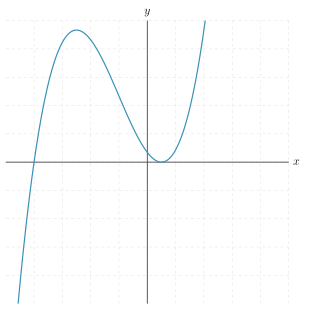
- Let \(f(x) = (x+2a)^3 -27 a^2 x\), where \(a\ge 0\). By sketching \(f(x)\), show that \(f(x)\ge 0\) for \(x \ge0\).
- Use part (i) to find the greatest value of \(xy^2\) in the region of the \(x\)-\(y\) plane given by \(x\ge0\), \(y\ge0\) and \(x+2y\le 3\,\). For what values of \(x\) and \(y\) is this greatest value achieved?
- Use part (i) to show that \((p+q+r)^3 \ge 27pqr\) for any non-negative numbers \(p\), \(q\) and \(r\). If \((p+q+r)^3 = 27pqr\), what relationship must \(p\), \(q\) and \(r\) satisfy?
Solution:
- Note that \(f(x) = (x+2a)^3 - 27a^2x\) so \(f'(x) = 3(x+2a)^2-27a^2 = 3x^2+12ax-15a^2 = (x-a)(3x+15a)\) so the turning points are at \(x = a, x = -5a\). But \(f(a) = 0\), so the curve just touches the \(x\)-axis. Note also that \(f(0) = 8a^3 \geq 0\) so:
- \(\,\) \begin{align*} && 0 &\leq (x+2y)^3 - 27y^2 x \\ &&& \leq 3^3 - 27 y^2 x \\ &&&= 27(1-y^2x) \\ \Rightarrow && xy^2 &\leq1 \end{align*} with equality when \(x = y = 1\)
- Notice that \begin{align*} && 0 &\leq (p+q+r)^3 - 27\left (\frac{q+r}{2}\right)^2 p \\ \Rightarrow && (p+q+r)^3 &\geq 27\left (\frac{q+r}{2}\right)^2 p \\ &&&\underbrace{\geq}_{AM-GM} 27\left (\sqrt{qr}\right)^2 p \\ &&&= 27pqr \end{align*} Equality can only hold if \(p = \frac{q+r}{2}\), but by symmetry we must also have \(q = \frac{r+p}{2}, r = \frac{p+q}{2}\) ie \(p = q = r\). And indeed equality does hold in this case.
2014 Paper 1 Q11
The diagrams below show two separate systems of particles, strings and pulleys.In both systems, the pulleys are smooth and light, the strings are light and inextensible, the particles move vertically and the pulleys labelled with \(P\) are fixed. The masses of the particles are as indicated on the diagrams.
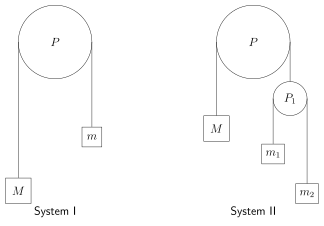
- For system I show that the acceleration, \(a_1\), of the particle of mass \(M\), measured in the downwards direction, is given by \[ a_1= \frac{M-m}{M+m} \, g \,, \] where \(g\) is the acceleration due to gravity. Give an expression for the force on the pulley due to the tension in the string.
- For system II show that the acceleration, \(a_2\), of the particle of mass \(M\), measured in the downwards direction, is given by \[ a_2= \frac{ M - 4\mu}{M+4\mu}\,g \,, \] where \(\mu = \dfrac{m_1m_2}{m_1+m_2}\). In the case \(m= m_1+m_2\), show that \(a_1= a_2\) if and only if \(m_1=m_2\).
Solution:
- \(\,\)
\begin{align*} \text{N2}(\uparrow, m): && T - mg &= ma_1 \\ \text{N2}(\uparrow, M): && T-Mg &= -Ma_1 \\ \Rightarrow && (M-m)g &= a_1(m+M) \\ \Rightarrow && a_1 &= \frac{M-m}{M+m}g \\ && T &= mg + ma_1 \\ &&&= \frac{2mM}{M+m}g \end{align*}
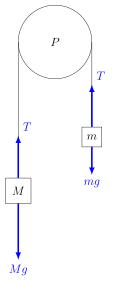
- System II is the same as system I, but with \(m\) replaced with \(2\frac{T}{g} = \frac{4mM}{M+m}\). In particular, this means that: \begin{align*} && a_2 &= \frac{M - \frac{4m_1m_2}{m_1+m_2}}{M + \frac{4m_1m_2}{m_1+m_2}} g \\ &&&= \frac{M-4\mu}{M+4\mu}g \end{align*} If \(m = m_1 + m_2\) then \begin{align*} && a_1 &= a_2 \\ \Leftrightarrow && \frac{M-m_1-m_2}{M+m_1+m_2} &= \frac{M - \frac{4m_1m_2}{m_1+m_2}}{M + \frac{4m_1m_2}{m_1+m_2}} \\ \Leftrightarrow && \frac{M-m_1-m_2}{M+m_1+m_2} &= \frac{M(m_1+m_2) -4m_1m_2}{M(m_1+m_2) + 4m_1m_2} \\ \Leftrightarrow && M^2(m_1+m_2)+4m_1m_2M &- M(m_1+m_2)^2 - 4m_1m_2(m_1+m_2) \\ &&\quad \quad = M^2(m_1+m_2) - 4m_1m_2M &+M(m_1+m_2)^2-4m_1m_2(m_1+m_2) \\ \Leftrightarrow && 8m_1m_2M&= 2M(m_1+m_2)^2 \\ \Leftrightarrow && 0 &= (m_1-m_2)^2 \\ \Leftrightarrow && m_1 &= m_2 \end{align*}
2012 Paper 1 Q1
The line \(L\) has equation \(y=c-mx\), with \(m>0\) and \(c>0\). It passes through the point \(R(a,b)\) and cuts the axes at the points \(P(p,0)\) and \(Q(0,q)\), where \(a\), \(b\), \(p\) and \(q\) are all positive. Find \(p\) and \(q\) in terms of \(a\), \(b\) and \(m\). As \(L\) varies with \(R\) remaining fixed, show that the minimum value of the sum of the distances of \(P\) and \(Q\) from the origin is \((a^{\frac12} + b^{\frac12})^2\), and find in a similar form the minimum distance between \(P\) and \(Q\). (You may assume that any stationary values of these distances are minima.)
Solution: \begin{align*} && b &= c - ma \\ \Rightarrow && c &= b+ma \\ \Rightarrow && y &= m(a-x)+b \\ \Rightarrow && q &= ma+b \\ && p &= \frac{ma+b}{m} \\ \\ && d &= p+q \\ &&&= a + \frac{b}{m} + ma + b \\ \Rightarrow && d' &= -bm^{-2}+a \\ \Rightarrow && m &= \sqrt{b/a} \\ \\ \Rightarrow &&d &= a + \sqrt{ba}+\sqrt{ba} + b \\ &&&= (\sqrt{a}+\sqrt{b})^2 \\ \\ && |PQ|^2 &= p^2 + q^2 \\ &&&= a^2 + \frac{2ab}{m} + \frac{b^2}{m^2} + m^2a^2 + 2mab + b^2 \\ &&&= a^2+b^2 + \frac{b^2}{m^2} + \frac{2ab}{m}+ 2abm + a^2m^2 \\ && \frac{\d}{\d m}&= -2b^2m^{-3}-2abm^{-2}+2ab + 2a^2m \\ && 0 &=2a^2m^4+2abm^3-2abm-2b^2 \\ &&&= 2(am^3-b)(am+b) \\ \Rightarrow && m &= \sqrt[3]{\frac{b}{a}} \\ \\ &&|PQ|^2 &= \left[ a^{1/3}(a^{2/3} + b^{2/3}) \right]^2 + \left[ b^{1/3}(a^{2/3} + b^{2/3}) \right]^2 \\ &&&= a^{2/3}(a^{2/3} + b^{2/3})^2 + b^{2/3}(a^{2/3} + b^{2/3})^2 \\ &&&= (a^{2/3} + b^{2/3})^2 \cdot (a^{2/3} + b^{2/3}) \\ &&&= (a^{2/3} + b^{2/3})^3 \\ \Rightarrow && |PQ| &= (a^{2/3} + b^{2/3})^{3/2} \end{align*} We can also do this with AM-GM instead: \begin{align*} && d &= a + b + \frac{b}{m} + am \\ &&&\geq a+b + 2 \sqrt{\frac{b}{m} \cdot am} \\ &&&= a+2\sqrt{ab}+b \\ \\ && |PQ|^2 &= a^2+b^2 + \frac{b^2}{m^2} + \frac{2ab}{m}+ 2abm + a^2m^2 \\ &&&= a^2+b^2 + \frac{b^2}{m} + abm + abm + a^2m^2 + \frac{ab}{m} + \frac{ab}{m} \\ &&&= a^2+b^2 + 3\sqrt[3]{ \frac{b^2}{m} \cdot abm \cdot abm} + 3 \sqrt[3]{ a^2m^2 \cdot \frac{ab}{m} \cdot \frac{ab}{m} } \\ &&&= a^2 + 3b^{4/3}a^{2/3}+3b^{2/3}a^{4/3}+b^2 \\ &&&= (a^{2/3}+b^{2/3})^3 \end{align*}
2009 Paper 1 Q12
Prove that, for any real numbers \(x\) and \(y\), \(x^2+y^2\ge2xy\,\).
- Carol has two bags of sweets. The first bag contains \(a\) red sweets and \(b\) blue sweets, whereas the second bag contains \(b\) red sweets and \(a\) blue sweets, where \(a\) and \(b\) are positive integers. Carol shakes the bags and picks one sweet from each bag without looking. Prove that the probability that the sweets are of the same colour cannot exceed the probability that they are of different colours.
- Simon has three bags of sweets. The first bag contains \(a\) red sweets, \(b\) white sweets and \(c\) yellow sweets, where \(a\), \(b\) and \(c\) are positive integers. The second bag contains \(b\) red sweets, \(c\) white sweets and \(a\) yellow sweets. The third bag contains \(c\) red sweets, \(a\) white sweets and \(b\) yellow sweets. Simon shakes the bags and picks one sweet from each bag without looking. Show that the probability that exactly two of the sweets are of the same colour is \[ \frac {3(a^2b+b^2c+c^2a+ab^2 + bc^2 +ca^2)}{(a+b+c)^3}\,, \] and find the probability that the sweets are all of the same colour. Deduce that the probability that exactly two of the sweets are of the same colour is at least 6 times the probability that the sweets are all of the same colour.
2008 Paper 1 Q3
Prove that, if \(c\ge a\) and \(d\ge b\), then \[ ab+cd\ge bc+ad\,. \tag{\(*\)} \]
- If \(x\ge y\), use \((*)\) to show that \(x^2+y^2\ge 2xy\,\). If, further, \(x\ge z\) and \(y\ge z\), use \((*)\) to show that \(z^2+xy\ge xz+yz\) and deduce that \(x^2+y^2+z^2\ge xy+yz+zx\,\). Prove that the inequality \(x^2+y^2+z^2\ge xy+yz+zx\,\) holds for all \(x\), \(y\) and \(z\).
- Show similarly that the inequality \[\frac st +\frac tr +\frac rs +\frac ts +\frac rt +\frac sr \ge 6\] holds for all positive \(r\), \(s\) and \(t\).
Solution: \begin{align*} && \underbrace{(c-a)}_{\geq 0}\underbrace{(d-b)}_{\geq 0} & \geq 0 \\ \Leftrightarrow && cd -bc -ad + ab &\geq 0 \\ \Leftrightarrow && ab +cd &\geq bc+ad \\ \end{align*}
- Applying \((*)\) with \(c=d=x\) and \(a=b=y\) we obtain: \(x^2 + y^2 \geq xy + xy = 2xy\) Similarly, applying \((*)\) with \(c=x, d=y, a=b=z\) we obtain: \(z^2 + xy \geq zx+zy\) so \(x^2+y^2+z^2 \geq 2xy + z^2 \geq xy + zx+zy\) There was nothing special about our choice of ordering \(x,y,z\) so it is true for all \(x,y,z\)
- \begin{align*} \frac st +\frac tr +\frac rs +\frac ts +\frac rt +\frac sr &=\left ( \frac st+\frac ts \right)+\left ( \frac tr +\frac rt \right)+\left ( \frac rs +\frac sr \right) \\ & \geq 2 \sqrt{\frac st \frac ts} + 2 \sqrt{\frac tr \frac rt} + 2 \sqrt{\frac rs \frac sr} \\ & = 2 + 2 + 2 \\ &= 6 \end{align*}
2007 Paper 2 Q7
A function \(\f(x)\) is said to be concave on some interval if \(\f''(x)<0\) in that interval. Show that \(\sin x\) is concave for \(0< x < \pi\) and that \(\ln x\) is concave for \(x > 0\). Let \(\f(x)\) be concave on a given interval and let \(x_1\), \(x_2\), \(\ldots\), \(x_n\) lie in the interval. Jensen's inequality states that \[ \frac1 n \sum_{k=1}^n\f(x_k) \le \f \bigg (\frac1 n \sum_{k=1}^n x_k\bigg) \] and that equality holds if and only if \(x_1=x_2= \cdots =x_n\). You may use this result without proving it.
- Given that \(A\), \(B\) and \(C\) are angles of a triangle, show that \[ \sin A + \sin B + \sin C \le \frac{3\sqrt3}2 \,. \]
- By choosing a suitable function \(\f\), prove that
\[
\sqrt[n]{t_1t_2\cdots t_n}\; \le \; \frac{t_1+t_2+\cdots+t_n}n
\]
for any positive integer \(n\) and for any positive numbers \(t_1\), \(t_2\), \(\ldots\), \(t_n\).
Hence:
- show that \(x^4+y^4+z^4 +16 \ge 8xyz\), where \(x\), \(y\) and \(z\) are any positive numbers;
- find the minimum value of \(x^5+y^5+z^5 -5xyz\), where \(x\), \(y\) and \(z\) are any positive numbers.
Solution: \begin{align*} && f(x) &= \sin x \\ \Rightarrow && f''(x) &= -\sin x \end{align*} which is clearly negative on \((0,\pi)\) since \(\sin\) is positive on this interval. \begin{align*} && f(x) &= \ln x \\ \Rightarrow && f''(x) &= -1/x^2 \end{align*} which is clearly negative for \(x > 0\)
- Since \(A,B,C\) are angles in a triangle, we must have \(0 < A,B,C< \pi\) and so we can apply Jensen with \(f = \sin\) to obtain: \begin{align*} &&\frac13( \sin A + \sin B + \sin C) &\leq \sin \left ( \frac{A+B+C}{3}\right) \\ &&&= \sin \frac{\pi}{3} = \frac{\sqrt{3}}2 \\ \Rightarrow && \sin A + \sin B + \sin C &\leq\frac{3\sqrt{3}}2 \end{align*}
- Suppose \(f(x) = \ln x\), then applying Jensen on the positive numbers \(t_1, \ldots, t_n\) we obtain
\begin{align*}
&& \frac1n \left ( \sum_{i=1}^n \ln t_n \right) &\leq \ln \left ( \frac1n\sum_{i=1}^n t_n \right) \\
\Rightarrow && \frac1n \ln\left (\prod_{i=1} t_n\right)&\leq \ln \left ( \frac1n\sum_{i=1}^n t_n \right) \\
\Rightarrow && \ln\left (\left (\prod_{i=1} t_n\right)^{1/n}\right)&\leq \ln \left ( \frac1n\sum_{i=1}^n t_n \right) \\
\Rightarrow && \left (\prod_{i=1} t_n\right)^{1/n}&\leq\frac1n\sum_{i=1}^n t_n \\
\Rightarrow && \sqrt[n]{t_1t_2 \cdots t_n}&\leq\frac1n(t_1 + t_2 + \cdots + t_n) \tag{AM-GM}\\
\end{align*}
- Applying AM-GM with \(t_1 = x^4, t_2 = y^4, t_3 = z^4, t_4 = 2^4\) we have \begin{align*} && \frac{x^4+y^4+z^4+16}{4} & \geq \sqrt[4]{x^4y^4z^42^4} \\ \Rightarrow && x^4+y^4+z^4+16 &\geq 8xyz \end{align*}
- Applying AM-GM with \(t_1 = x^5, t_2 = y^5, t_3 = z^5, t_4 = 1^5, t_5 = 1^5\) we have \begin{align*} && \frac{x^5+y^5+z^5+1+1}{5} & \geq \sqrt[5]{x^5y^5z^5} \\ \Rightarrow && x^5+y^5+z^5+2 &\geq 5xyz \\ \Rightarrow && x^5+y^5+z^5 - 5xyz &\geq -2 \end{align*} Therefore the minimum is \(-2\)
2000 Paper 3 Q7
Given that $$\e = 1 + {1 \over 1 !} + {1 \over 2 !} + {1 \over 3 !} + \cdots + {1 \over r !} + \cdots \; ,$$ use the binomial theorem to show that $$ {\left( 1 + {1 \over n} \right)}^{\!n} < \e $$ for any positive integer \(n\). The product \({\rm P }( n )\) is defined, for any positive integer \(n\), by $$ {\rm P} ( n ) = {3 \over 2} \cdot {5 \over 4} \cdot {9 \over 8} \cdot \ldots \cdot {2^n + 1 \over 2^n} . $$ Use the arithmetic-geometric mean inequality, $$ {a_1 + a_2 + \cdots + a_n \over n} \ge \ {\left( a_1 \cdot a_2 \cdot \ldots \cdot a_n \right)}^{1 \over n}\,, $$ to show that \({\rm P }( n ) < \e\) for all \(n\) . Explain briefly why \({\rm P} ( n )\) tends to a limit as \(n\to\infty\). Show that this limit, \(L\), satisfies \(2 < L\le\e\).
1999 Paper 1 Q12
- Prove that if \(x>0\) then \(x+x^{-1}\ge2.\;\) I have a pair of six-faced dice, each with faces numbered from 1 to 6. The probability of throwing \(i\) with the first die is \(q_{i}\) and the probability of throwing \(j\) with the second die is \(r_{j}\) (\(1\le i,j \le 6\)). The two dice are thrown independently and the sum noted. By considering the probabilities of throwing 2, 12 and 7, show the sums \(2, 3, \dots, 12\) are not equally likely.
- The first die described above is thrown twice and the two numbers on the die noted. Is it possible to find values of \(q_{j}\) so that the probability that the numbers are the same is less than \(1/36\)?
Solution:
- Notice that if \(x > 0\) we must have \begin{align*} && \left ( \sqrt{x} - \frac{1}{\sqrt{x}} \right)^2 &\geq 0 \\ \Leftrightarrow && x - 2 + x^{-1} & \geq 0 \\ \Leftrightarrow && x + x^{-1} & \geq 2 \end{align*} Let \(S\) be the sum, and assume all probabilities are equal \begin{align*} && \mathbb{P}(S = 2) &= q_1 r_1 \\ && \mathbb{P}(S = 12) &= q_6 r_6 \\ && \mathbb{P}(S = 7) &= \sum_{i=1}^6 q_i r_{7-i} \\ \Rightarrow && q_1r_1 &= q_6r_6 \\ \Rightarrow && q_1r_6+q_6r_1 &\leq q_1r_1 \\ \Rightarrow && \frac{r_6}{r_1} + \frac{q_6}{q_1} &\leq 1 \\ \Rightarrow && q_1r_6+q_6r_1 &\leq q_6r_6 \\ \Rightarrow && \frac{q_1}{q_6} + \frac{r_1}{r_6} &\leq 1 \\ \Rightarrow && \frac{r_6}{r_1} + \frac{q_6}{q_1}+\frac{q_1}{q_6} + \frac{r_1}{r_6} &\leq 2\\ \text{but} && \frac{r_6}{r_1} + \frac{q_6}{q_1}+\frac{q_1}{q_6} + \frac{r_1}{r_6} &\geq 4 \end{align*} Since we have a contradiction they cannot all be equal.
- We would like \(\displaystyle \sum q_i^2 \leq 1/36\) (subject to \(\displaystyle \sum q_i = 1\), clearly this cannot be true since: \begin{align*} && 1 &= \left ( \sum_{i=1}^6 q_i \right)^2 \\ &&&= \sum_{i=1}^6 q_i^2 + \sum_{i \neq j} 2q_i q_j \\ &&&\leq \sum_{i=1}^6 q_i^2 + 5\sum_{i=1}^6 q_i^2 \\ &&&=6 \sum_{i=1}^6 q_i^2 \\ \Rightarrow && \sum_{i=1}^6 q_i^2 &\geq 1/6 > 1/36 \end{align*} [For a weaker solution to the last part, notice that the largest value of \(q_i\) is \(\geq 1/6\) and therefore \(q_{max}^2 \geq 1/36\), but if equality holds then the other values must also be non-zero, and therefore the inequality cannot hold]
1998 Paper 1 Q3
Which of the following statements are true and which are false? Justify your answers.
- \(a^{\ln b}=b^{\ln a}\) for all \(a,b>0\).
- \(\cos(\sin\theta)=\sin(\cos\theta)\) for all real \(\theta\).
- There exists a polynomial \(\mathrm{P}\) such that \(|\mathrm{P}(\theta)-\cos\theta|\leqslant 10^{-6}\) for all real \(\theta\).
- \(x^{4}+3+x^{-4}\geqslant 5\) for all \(x>0\).
Solution:
- True. \begin{align*} && \ln a \cdot \ln b &= \ln b \cdot \ln a \\ \Leftrightarrow && \exp ( \ln a \cdot \ln b) &= \exp ( \ln b \cdot \ln a) \\ \Leftrightarrow && \exp ( \ln a )^{\ln b} &= \exp ( \ln b )^{\ln a} \\ \Leftrightarrow && a^{\ln b} &= b^{\ln a} \\ \end{align*}
- False. Consider \(\theta = 0\). We'd need \(\cos 0 = 1 = \sin 1\), but \(0 < 1 < \frac{\pi}{2}\) so \(\sin 1 \neq 1\)
- False. If the polynomial has positive degree, then as \(n \to \infty\), \(\P(x) \to \pm \infty\), in particular it must be well outside the interval \([-1,1]\). Therefore it can't be within \(10^{-6}\) of \(\cos \theta\) which is confined to that interval. The only polynomial which is restricted to that range are constants, but then \(|\cos 0 - c| \leq 10^{-6}\) and \(|\cos \pi - c| \leq 10^{-6}\) \(2 = |1-(-1)| \leq |1-c| + |-1-c| \leq 2\cdot 10^{-6}\) contradiction.
- True. \begin{align*} && (x^2-x^{-2})^2 &\geq 0 \\ \Leftrightarrow && x^4-2+x^{-4} &\geq0 \\ \Leftrightarrow && x^4+3+x^{-4} &\geq 5 \\ \end{align*}
1997 Paper 3 Q4
In this question, you may assume that if \(k_1,\dots,k_n\) are distinct positive real numbers, then \[\frac1n\sum_{r=1}^nk_r>\left({\prod\limits_{r=1}^n} k_r\right )^{\!\! \frac1n},\] i.e. their arithmetic mean is greater than their geometric mean. Suppose that \(a\), \(b\), \(c\) and \(d\) are positive real numbers such that the polynomial \[{\rm f}(x)=x^4-4ax^3+6b^2x^2-4c^3x+d^4\] has four distinct positive roots.
- Show that \(pqr,qrs,rsp\) and \(spq\) are distinct, where \(p,q,r\) and \(s\) are the roots of the polynomial \(\mathrm{f}\).
- By considering the relationship between the coefficients of \(\mathrm{f}\) and its roots, show that \(c > d\).
- Explain why the polynomial \(\mathrm{f}'(x)\) must have three distinct roots.
- By differentiating \(\mathrm{f}\), show that \(b > c\).
- Show that \(a > b\).
Solution:
- Suppose \(pqr = qrs\), since the roots are positive, we can divide by \(qr\) to obtain \(p=s\) (a contradiction. Therefore all those terms are distinct.
- \(4c^3 = pqr+qrs+rsp+spq\), \(d^4 = pqrs\). Applying AM-GM, we obtain: \begin{align*} && c^3 = \frac{ pqr+qrs+rsp+spq}{4} & > \sqrt[4]{p^3q^3r^3s^3} = d^{3} \\ \Rightarrow && c &> d \end{align*}
- There must be a turning point between each root (since there are no repeated roots).
- \(f'(x) = 4x^3-12ax^2+12b^2-4c^3 = 4(x^3-3ax^2+3b^2-c^3)\). Letting the roots of this polynomial be \(\alpha, \beta, \gamma\) and again applying AM-GM, we must have: \begin{align*} && b^2 = \frac{\alpha\beta + \beta \gamma+\gamma \alpha}{3} &> \sqrt[3]{\alpha^2\beta^2\gamma^2} = c^2 \\ \Rightarrow && b &> c \end{align*}
- Again, since there are turning points between the roots of \(f'(x)\) we must have distinct roots for \(f''(x)\), ie: \(f''(x) = 3x^2-6ax+6b^2 = 3(x^2-2ax+b^2)\) has distinct real roots. But for this to occur we must have that \((2a)^2-4b^2 = 4(a^2-b^2) > 0\), ie \(a>b\)
1996 Paper 1 Q1
A cylindrical biscuit tin has volume \(V\) and surface area \(S\) (including the ends). Show that the minimum possible surface area for a given value of \(V\) is \(S=3(2\pi V^{2})^{1/3}.\) For this value of \(S\) show that the volume of the largest sphere which can fit inside the tin is \(\frac{2}{3}V\), and find the volume of the smallest sphere into which the tin fits.
Solution: Suppose we have height \(h\) and radius \(r\), then: \(V = \pi r^2 h\) and \(S = 2\pi r^2 + 2\pi r h\). \(h = \frac{V}{\pi r^2}\), so \begin{align*} S &= 2 \pi r^2 + 2 \pi r\frac{V}{\pi r^2} \\ &= 2\pi r^2 +V \frac1{r}+V \frac1{r} \\ &\underbrace{ \geq }_{\text{AM-GM}} 3 \sqrt[3]{2\pi r^2 \frac{V^2}{r^2} } = 3 (2 \pi V^2)^{1/3} \end{align*} Equality holds when \(r = \sqrt[3]{\frac{V}{2 \pi}}, h = \frac{V}{\pi (V/2\pi)^{2/3}} = \sqrt[3]{\frac{4V}{\pi}}\) Since \(h > r\) the sphere has a maximum radius of \(r\) and so it's largest volume is \(\frac43 \pi r^3 = \frac43 \pi \frac{V}{2 \pi} = \frac23 V\).

1993 Paper 2 Q8
Suppose that \(a_{i}>0\) for all \(i>0\). Show that \[ a_{1}a_{2}\leqslant\left(\frac{a_{1}+a_{2}}{2}\right)^{2}. \] Prove by induction that for all positive integers \(m\) \[ a_{1}\cdots a_{2^{m}}\leqslant\left(\frac{a_{1}+\cdots+a_{2^{m}}}{2^{m}}\right)^{2^{m}}.\tag{*} \] If \(n<2^{m}\), put \(b_{1}=a_{2},\) \(b_{2}=a_{2},\cdots,b_{n}=a_{n}\) and \(b_{n+1}=\cdots=b_{2^{m}}=A\), where \[ A=\frac{a_{1}+\cdots+a_{n}}{n}. \] By applying \((*)\) to the \(b_{i},\) show that \[ a_{1}\cdots a_{n}A^{(2^{m}-n)}\leqslant A^{2^{m}} \] (notice that \(b_{1}+\cdots+b_{n}=nA).\) Deduce the (arithmetic mean)/(geometric mean) inequality \[ \left(a_{1}\cdots a_{n}\right)^{1/n}\leqslant\frac{a_{1}+\cdots+a_{n}}{n}. \]
Solution: \begin{align*} && 0 &\leqslant (a_1 - a_2)^2 \\ &&&= a_1^2 -2a_1a_2 + a_2^2 \\ &&&= (a_1+a_2)^2 -4a_1a_2 \\ \Leftrightarrow && a_1a_2 &\leqslant \left ( \frac{a_1+a_2}2 \right)^2 \end{align*} Claim: \((*)\) is true Proof: (By induction) We have already proven the base case. Suppose it is true for some \(m\), then consider \(m+1\) \begin{align*} && a_1 \cdots a_{2^m} &\leqslant \left ( \frac{a_1 + \cdots + a_{2^m}}{2^m} \right)^{2^m} \tag{by (*)} \\ && a_{2^m+1} \cdots a_{2^{m+1}} &\leqslant \left ( \frac{a_{2^m+1} + \cdots + a_{2^{m+1}}}{2^m} \right)^{2^m} \tag{by (*)} \\ \Rightarrow && (a_1 \cdots a_{2^m})^{1/2^m} &\leqslant \left ( \frac{a_1 + \cdots + a_{2^m}}{2^m} \right) \\ && (a_{2^m+1} \cdots a_{2^{m+1}})^{1/2^m} &\leqslant \left ( \frac{a_{2^m+1} + \cdots + a_{2^{m+1}}}{2^m} \right) \\ \Rightarrow && (a_1 \cdots a_{2^m})^{1/2^m} \cdot (a_{2^m+1} \cdots a_{2^{m+1}})^{1/2^m} &\leqslant \left ( \frac{ (a_1 \cdots a_{2^m})^{1/2^m} +(a_{2^m+1} \cdots a_{2^{m+1}})^{1/2^m} }{2} \right )^2 \\ &&&\leqslant \left ( \frac{ \frac{a_1 + \cdots + a_{2^m}}{2^m}+\frac{a_{2^m+1} + \cdots + a_{2^{m+1}}}{2^m} }{2} \right )^2 \\ &&&\leqslant \left ( \frac{ a_1 + \cdots + a_{2^m}+a_{2^m+1} + \cdots + a_{2^{m+1}} }{2^{m+1}} \right )^2 \\ \Rightarrow && a_1 \cdots a_{2^{m+1}} &\leqslant \left ( \frac{a_1 + \cdots + a_{2^{m+1}}}{2^{m+1}} \right)^{2^{m+1}} \end{align*} Which is precisely \((*)\) for \(m+1\). Therefore our statement is true by induction. Suppose \(n < 2^m\) and \(b_1 = a_1, b_2 = a_2, \cdots b_n = a_n\) and \(b_{n+1} = \cdots = b_{2^m} = A\) where \(A = \frac{a_1 + \cdots + a_n}{n}\) then \begin{align*} && b_1 \cdots b_n \cdot b_{n+1} \cdots b_{2^m} &\leq \left ( \frac{b_1 + \cdots + b_n + b_{n+1} + \cdots + b_{2^m}}{2^{m}} \right)^{2^m} \\ \Leftrightarrow && a_1 \cdots a_n \cdot A^{2^m-n} &\leq \left ( \frac{a_1 + \cdots + a_n + (2^m-n)A}{2^m} \right)^{2^m} \\ &&&= \left ( \frac{nA + (2^m - n)A}{2^m} \right)^{2^m} \\ &&&= A^{2^m} \\ \Rightarrow && a_1 \cdots a_n &\leq A^n \\ \Rightarrow && (a_1 \cdots a_n)^{1/n} &\leq A = \frac{a_1 + \cdots + a_n}{n} \end{align*}