Problems
Filters
13 problems found
2011 Paper 3 Q1
- Find the general solution of the differential equation \[ \frac{\d u}{\d x} - \left(\frac { x +2}{x+1}\right)u =0\,. \]
- Show that substituting\(y=z\e^{-x}\) (where \(z\) is a function of \(x\)) into the second order differential equation \[ (x+1) \frac{\d ^2 y}{\d x^2} + x \frac{\d y}{\d x} -y = 0 \tag{\(*\)} \] leads to a first order differential equation for \(\dfrac{\d z}{\d x}\,\). Find \(z\) and hence show that the general solution of \((*)\) is \[ y= Ax + B\e^{-x}\,, \] where \(A\) and \(B\) are arbitrary constants.
- Find the general solution of the differential equation \[ (x+1) \frac{\d ^2 y}{\d x^2} + x \frac{\d y}{\d x} -y = (x+1)^2 . \]
Solution:
- \begin{align*} && 0 &= \frac{\d u}{\d x} - \left ( \frac{x+2}{x+1} \right)u \\ \Rightarrow && \int \frac1u \d u &= \int 1 + \frac1{x+1} \d x \\ \Rightarrow && \ln |u| &= x + \ln |x+1| + C \\ \Rightarrow && u &= A(x+1)e^x \end{align*}
- If \(y = ze^{-x}\), \(y' = (z'-z)e^{-x}\), \(y'' = (z''-2z'+z)e^{-x}\) \begin{align*} && 0 &= (x+1) \frac{\d ^2 y}{\d x^2} + x \frac{\d y}{\d x} -y \\ y = ze^{-x}: && 0 &= (x+1) \left ( \frac{\d^2 z}{\d x^2} - 2\frac{\d z}{\d x} +z\right)e^{-x} +x \left ( \frac{\d z}{\d x} -z\right)e^{-x} - ze^{-x} \\ &&&= (x+1) \frac{\d^2 z}{\d x^2} -(x+2)\frac{\d z}{\d x} \\ \Rightarrow && \frac{\d}{\d x} \left ( \frac{\d z}{\d x}\right) &= \left ( \frac{x+2}{x+1}\right) \frac{\d z}{\d x} \end{align*} Therefore \(\frac{\d z}{\d x} = A(x+1)e^x \) and so \begin{align*} z &= A \int (x+1)e^{x} \d x \\ &= A \left ( \left [ (x+1)e^x\right] - \int e^x \d x \right) \\ &= A(x+1)e^x - Ae^x + B \\ y &= Ax + Be^{-x} \end{align*}
- We have found the complementary solution. To find a particular integral consider \(y = ax^2 + bx + c\), then \(y' = 2ax+b, y'' = 2a\) and we have \begin{align*} && x^2+2x+1 &= 2a(x+1) + x(2ax+b) - (ax^2+bx+c) \\ \Rightarrow && x^2+2x+1 &= ax^2+ 2ax + 2a-c \\ \Rightarrow && a = 1, &c=1 \end{align*} so the general solution should be \[ y = Ax + Be^{-x} + x^2+1 \]
2011 Paper 3 Q2
The polynomial \(\f(x)\) is defined by \[ \f(x) = x^n + a_{{n-1}}x^{n-1} + \cdots + a_{2} x^2+ a_{1} x + a_{0}\,, \] where \(n\ge2\) and the coefficients \(a_{0}\), \(\ldots,\) \(a_{{n-1}}\) are integers, with \(a_0\ne0\). Suppose that the equation \(\f(x)=0\) has a rational root \(p/q\), where \(p\) and \(q\) are integers with no common factor greater than \(1\), and \(q>0\). By considering \(q^{n-1}\f(p/q)\), find the value of \(q\) and deduce that any rational root of the equation \(\f(x)=0\) must be an integer.
- Show that the \(n\)th root of \(2\) is irrational for \(n\ge2\).
- Show that the cubic equation \[ x^3- x +1 =0 \] has no rational roots.
- Show that the polynomial equation \[ x^n- 5x +7 =0 \] has no rational roots for \(n\ge2\).
Solution: Let \(\f(x) = x^n + a_{{n-1}}x^{n-1}+ \cdots + a_{2} x^2+ a_{1} x + a_{0}\), and suppose \(f(p/q) = 0\) with \((p,q) = 1\), the consider \begin{align*} && 0 &= q^{n-1}f(p/q) \\ &&&= \frac{p^n}{q} + \underbrace{a_{n-1}p^{n-1} + a_{n-2}p^{n-2}q + \cdots + a_0q^{n-1}}_{\in \mathbb{Z}} \\ \end{align*} But \(p^n/q \not \in \mathbb{Z}\) unless \(q = 1\) therefore \(p/q\) must be an integer, ie all rational roots are integers.
- Note that \(\sqrt[n]2\) is a root of \(x^n - 2 =0\), but this has no integer solutions. (We can try all factors of \(2\)). Therefore all its roots must be irrational, ie \(\sqrt[n]2\) is irrational for \(n \geq 2\)
- If \(n\) is a root of \(x^3 - x+1\) then it must be \(1\) or \(-1\) by the rational root theorem, ie \(1-1+1 \neq 0\) and \(-1 + 1 +1 \neq 0\), therefore no integer roots, therefore no rational roots.
- Suppose \(m\) is an integer root of \(x^n - 5x + 7 = 0\) then by considering parity we must have \(m^n - 5m + 7 \equiv 1 \pmod{2}\) therefore we cannot have any rational roots.
2011 Paper 3 Q3
Show that, provided \(q^2\ne 4p^3\), the polynomial \[ \hphantom{(p\ne0, \ q\ne0)\hspace{2cm}} x^3-3px +q \hspace {2cm} (p\ne0, \ q\ne0) \] can be written in the form \[ a(x-\alpha)^3 + b(x-\beta)^3\,, \] where \(\alpha\) and \(\beta\) are the roots of the quadratic equation \(pt^2 -qt +p^2=0\), and \(a\) and \(b\) are constants which you should express in terms of \(\alpha\) and \(\beta\). Hence show that one solution of the equation \(x^3-24x+48=0\,\) is \[ x= \frac{2 (2-2^{\frac13})}{1-2^{\frac13}} \] and obtain similar expressions for the other two solutions in terms of \(\omega\), where \(\omega = \mathrm{e}^{2\pi\mathrm{i}/3}\,\). Find also the roots of \(x^3-3px +q=0\) when \(p=r^2\) and \(q= 2r^3\) for some non-zero constant \(r\).
2011 Paper 3 Q4
The following result applies to any function \(\f\) which is continuous, has positive gradient and satisfies \(\f(0)=0\,\): \[ ab\le \int_0^a\f(x)\, \d x + \int_0^b \f^{-1}(y)\, \d y\,, \tag{\(*\)}\] where \(\f^{-1}\) denotes the inverse function of \(\f\), and \(a\ge 0\) and \(b\ge 0\).
- By considering the graph of \(y=\f(x)\), explain briefly why the inequality \((*)\) holds. In the case \(a>0\) and \(b>0\), state a condition on \(a\) and \(b\) under which equality holds.
- By taking \(\f(x) = x^{p-1}\) in \((*)\), where \(p>1\), show that if \(\displaystyle \frac 1p + \frac 1q =1\) then \[ ab \le \frac{a^p}p + \frac{b^q}q\,. \] Verify that equality holds under the condition you stated above.
- Show that, for \(0\le a \le \frac12 \pi\) and \(0\le b \le 1\), \[ ab \le b\arcsin b + \sqrt{1-b^2} \, - \cos a\,. \] Deduce that, for \(t\ge1\), \[ \arcsin (t^{-1}) \ge t - \sqrt{t^2-1}\,. \]
2011 Paper 3 Q5
A movable point \(P\) has cartesian coordinates \((x,y)\), where \(x\) and \(y\) are functions of \(t\). The polar coordinates of \(P\) with respect to the origin \(O\) are \(r\) and \(\theta\). Starting with the expression \[ \tfrac12 \int r^2 \, \d \theta \] for the area swept out by \(OP\), obtain the equivalent expression \[ \tfrac12 \int \left( x\frac{\d y}{\d t} - y \frac{\d x}{\d t}\right)\d t \,. \tag{\(*\)} \] The ends of a thin straight rod \(AB\) lie on a closed convex curve \(\cal C\). The point \(P\) on the rod is a fixed distance \(a\) from \(A\) and a fixed distance \(b\) from \(B\). The angle between \(AB\) and the positive \(x\) direction is \(t\). As \(A\) and \(B\) move anticlockwise round \(\cal C\), the angle \(t\) increases from \(0\) to \(2\pi\) and \(P\) traces a closed convex curve \(\cal D\) inside \(\cal C\), with the origin \(O\) lying inside \(\cal D\), as shown in the diagram.
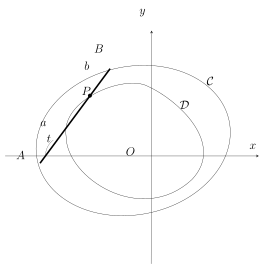
Solution: \begin{align*} && \tan \theta &= y/x \\ \Rightarrow && \sec^2 \theta \frac{\d \theta}{\d t} &= \frac{x \frac{\d y}{\d t} - y \frac{\d x}{\d t}}{x^2} \\ \Rightarrow && \frac{\d \theta}{\d t} &=\left (x \frac{\d y}{\d t} - y \frac{\d x}{\d t} \right) \frac{\cos^2 \theta}{x^2} \\ &&&=\left (x \frac{\d y}{\d t} - y \frac{\d x}{\d t} \right) \frac{\cos^2 \theta}{r^2 \cos^2 \theta } \\ &&&=\left (x \frac{\d y}{\d t} - y \frac{\d x}{\d t} \right) \frac{1}{r^2 } \\ && \tfrac12 \int r^2 \, \d \theta &= \tfrac12 \int \left (x \frac{\d y}{\d t} - y \frac{\d x}{\d t} \right) \d t \end{align*} \(A = (x - a \cos t, y - a \sin t), B = (x + b \cos t , y + b \sin t)\) \begin{align*} && [A] &= \tfrac12 \int_0^{2\pi} \left ((x-a \cos t) \frac{\d (y-a \sin t)}{\d t} - (y-a \sin t) \frac{\d (x-a \cos t)}{\d t} \right) \d t \\ &&&= \tfrac12 \int_0^{2\pi} \left ((x - a \cos t) \left ( \frac{\d y}{\d t} - a \cos t \right) - (y - a \sin t) \left ( \frac{\d x}{\d t} + a \sin t \right)\right) \d t \\ &&&= \tfrac12 \int_0^{2\pi} \left ( x \frac{\d y}{\d t} - y \frac{\d x}{\d t} - a \cos t \frac{\d y}{\d t}-ax \cos t +a^2 \cos^2 t + a \sin t \frac{\d x}{\d t}-y a \sin t + a^2 \sin^2 t \right) \d t \\ &&&= \tfrac12 \int_0^{2\pi} \left ( \underbrace{x \frac{\d y}{\d t} - y \frac{\d x}{\d t}}_{[P]}-a\left ((x + \frac{\d y}{\d x}) \cos t + (y - \frac{\d x}{\d t}) \sin t \right) + \underbrace{a^2}_{\pi a^2} \right) \d t \\ &&&= [P] + \pi a^2 - af \end{align*} \begin{align*} && [B] &= \tfrac12 \int_0^{2\pi} \left ((x+b \cos t) \frac{\d (y+b \sin t)}{\d t} - (y+b \sin t) \frac{\d (x+b \cos t)}{\d t} \right) \d t \\ &&&= \tfrac12 \int_0^{2\pi} \left ((x+b \cos t) (\frac{\d y}{\d t} + b \cos t) - (y+b \sin t)(\frac{\d x}{\d t} - b \sin t) \right) \d t \\ &&&= \tfrac12 \int_0^{2\pi} \left (x \frac{\d y}{\d t} - y \frac{\d x}{\d t} + b^2 + b(\cos t (x + \frac{\d y}{\d t}) +(y - \frac{\d x}{\d t})\sin t\right) \d t \\ &&&= [P] + \pi b^2 + b f \end{align*} Since \(A\) and \(B\) trace out the same area, we must have \(\pi a^2 - af = \pi b^2 + bf \Rightarrow \pi (a^2-b^2) = f(b+a) \Rightarrow f = \pi (a-b)\). In particular the area inbetween is \([A] - [P] = \pi a^2 - a \pi (a-b)\)
2011 Paper 3 Q6
The definite integrals \(T\), \(U\), \(V\) and \(X\) are defined by \begin{align*} T&= \int_{\frac13}^{\frac12} \frac{{\rm artanh}\, t}t \,\d t\,, & U&= \int _{\ln 2 }^{\ln 3 } \frac{u}{2\sinh u}\, \d u \,, \\[3mm] V&= - \int_{\frac13}^{\frac12} \frac{\ln v}{1-v^2} \,\d v \,, & X&= \int _{\frac12\ln2}^{\frac12\ln3} \ln ({\coth x})\, \d x\,. \end{align*} Show, without evaluating any of them, that \(T\), \(U\), \(V\) and \(X\) are all equal.
Solution: \begin{align*} && T &= \int_{\frac13}^{\frac12} \frac{{\rm artanh}\, t}t \,\d t \\ && &=\int_{\frac13}^{\frac12} \frac{1}{2t}\ln \left ( \frac{1+t}{1-t} \right) \,\d t \\ u = \tfrac{1+t}{1-t}, t= \tfrac{u-1}{u+1}, \d t = \tfrac{2}{(u+1)^2} \d t &&&= \int_{u=2}^{u=3} \frac{1}{2t} \ln u \frac{2}{(u+1)^2} \d u \\ &&&= \int_2^3 \frac{u+1}{u-1} \ln u \frac{1}{(u+1)^2} \d u \\ &&&= \int_2^3 \frac{1}{u^2-1} \ln u \d u \end{align*} \begin{align*} && U&= \int _{\ln 2 }^{\ln 3 } \frac{u}{2\sinh u}\, \d u \\ v = e^u, \d v = e^u \d u &&&= \int_{v=2}^{v=3} \frac{\ln v}{v - \frac{1}{v}} \frac{1}{v} \d v \\ &&&= \int_2^3 \frac{1}{v^2-1} \ln v \d v \end{align*} \begin{align*} &&V &= - \int_{\frac13}^{\frac12} \frac{\ln v}{1-v^2} \,\d v \\ u = \tfrac1v, \d u = -\tfrac1{v^2} \d v &&&= -\int_{u=3}^{u=2} \frac{-\ln u}{1 - \frac{1}{u^2}} \frac{-1}{u^2} \d u \\ &&&= -\int_3^2 \frac{\ln u}{u^2-1} \d u \\ &&&= \int_2^3 \frac{1}{u^2-1} \ln u \d u \end{align*} \begin{align*} &&X&= \int _{\frac12\ln2}^{\frac12\ln3} \ln ({\coth x})\, \d x \\ u = \coth x, \d u =(1-u^2) \d x &&&= \int_{u = 3}^{u=2} \ln u \frac{1}{1-u^2} \d u \\ &&&= \int_2^3 \frac{\ln u}{u^2-1} \d u \end{align*} Therefore all integrals are equal to the same integral, namely \(\displaystyle \int_2^3 \frac{\ln u}{u^2-1} \d u\)
2011 Paper 3 Q7
Let \[ T _n = \left( \sqrt{a+1} + \sqrt a\right)^n\,, \] where \(n\) is a positive integer and \(a\) is any given positive integer.
- In the case when \(n\) is even, show by induction that \(T_n\) can be written in the form \[ A_n +B_n \sqrt{a(a+1)}\,, \] where \(A_n\) and \(B_n\) are integers (depending on \(a\) and \(n\)) and \(A_n^2 =a(a+1)B_n^2 +1\).
- In the case when \(n\) is odd, show by considering \((\sqrt{a+1} +\sqrt a)T_m\) where \(m\) is even, or otherwise, that \(T_n\) can be written in the form \[ C_n \sqrt {a+1} + D_n \sqrt a \,, \] where \(C_n\) and \(D_n\) are integers (depending on \(a\) and \(n\)) and \( (a+1)C_n^2 = a D_n^2 +1\,\).
- Deduce that, for each \(n\), \(T_n\) can be written as the sum of the square roots of two consecutive integers.
Solution:
- Claim: For all \(n \geq 1\) \(T_{2n} = A_{2n} + B_{2n}\sqrt{a(a+1)}\) where \(A_{2n}, B_{2n}\) are integers and \(A_{2n}^2 = a(a+1)B_{2n}^2+1\) Proof: (By induction) Base case: \(n =1\). \begin{align*} && T_2 &= (\sqrt{a+1}+\sqrt{a})^2 \\ &&&= a+1+2\sqrt{a(a+1)}+a \\ &&&=2a+1+2\sqrt{a(a+1)} \\ \Rightarrow && A_2 &= 2a+1 \\ && B_2 &= 2 \\ && A_2^2 &= 4a^2+4a+1 \\ && a(a+1)B_1^2 + 1 &= 4a^2+4a+1 \end{align*} Therefore our base case is true. Suppose it is true for some \(n = k\) then consider \(n = k+1\) we must have \(T_{2k} = A_{2k}+B_{2k}\sqrt{a(a+1)}\) \begin{align*} && T_{2(k+1)} &= T_{2k} (\sqrt{a+1}+\sqrt{a})^2 \\ &&&= \left (A_{2k}+B_{2k}\sqrt{a(a+1)} \right)\left (2a+1+2\sqrt{a(a+1)} \right) \\ &&&= (2a+1)A_{2k}+2a(a+1)B_{2k} + (2A_{2k}+(2a+1)B_{2k})\sqrt{a(a+1)} \\ \Rightarrow && A_{2(k+1)} &= (2a+1)A_{2k}+2a(a+1)B_{2k} \in \mathbb{Z} \\ && B_{2(k+1)} &= 2A_{2k}+(2a+1)B_{2k} \in \mathbb{Z} \\ && A_{2(k+1)}^2 &= \left ( (2a+1)A_{2k}+2a(a+1)B_{2k} \right)^2 \\ &&&= (2a+1)^2A_{2k}^2+4a^2(a+1)^2B_{2k}^2+4a(a+1)(2a+1)A_{2k}B_{2k} \\ &&&= a^2(a+1)^2(2a+1)^2B_{2k}^2+(2a+1)^2\\ &&&\quad\quad+4a^2(a+1)^2B_{2k}^2+4a(a+1)(2a+1)A_{2k}B_{2k}\\ && a(a+1)B_{2(k+1)}^2 + 1 &= a(a+1)\left ( 2A_{2k}+(2a+1)B_{2k} \right)^2 \\ &&&= 4a(a+1)A_{2k}^2 + 4a(a+1)(2a+1)A_{2k}B_{2k} + a(a+1)(2a+1)^2B_{2k}^2 + 1\\ &&&= 4a^2(a+1)^2B_{2k}^2+4a(a+1) + \\ &&&\quad\quad+ 4a(a+1)(2a+1)A_{2k}B_{2k} + a(a+1)(2a+1)^2B_{2k}^2 + 1 \end{align*} So our relation holds ad therefore by induction we're done.
- When \(n\) is odd, notice that \begin{align*} && T_n &= (\sqrt{a+1}+\sqrt{a})(A_m+B_m\sqrt{a(a+1)})\\ &&&= \sqrt{a+1}(\underbrace{A_m+aB_m}_{C_n})+\sqrt{a}(\underbrace{(a+1)B_m+A_m}_{D_n}) \\ \\ && (a+1)C_n^2 &= (a+1)(A_m+aB_m)^2 \\ &&&= (a+1)(A_m^2+2aA_mB_m+B_m^2) \\ &&&= (a+1)(a(a+1)B_m^2+1+2aA_mB_m+B_m^2) \\ &&&= a(a+1)^2B_m^2 + 2a(a+1)A_mB_m+(a+1)B_m^2+a+1 \\ && aD_n^2+1 &= a((a+1)^2B_m + 2(a+1)A_mB_m + A_m^2)+1 \\ &&&= a(a+1)^2B_m + 2a(a+1)A_mB_m + aB_{m}^2+a+1 \end{align*}
- For even \(n\) \(T_n = \sqrt{a(a+1)B_{2n}^2+1} + \sqrt{a(a+1)B_{2n}^2}\) For odd \(n\), \(T_n = \sqrt{aD_n^2+1}+ \sqrt{aD_n^2}\) therefore it is always the sum of the square root of two consecutive integers.
2011 Paper 3 Q8
The complex numbers \(z\) and \(w\) are related by \[ w= \frac{1+\mathrm{i}z}{\mathrm{i}+z}\,. \] Let \(z=x+\mathrm{i}y\) and \(w=u+\mathrm{i}v\), where \(x\), \(y\), \(u\) and \(v\) are real. Express \(u\) and \(v\) in terms of \(x\) and \(y\).
- By setting \(x=\tan(\theta/2)\), or otherwise, show that if the locus of \(z\) is the real axis \(y=0\), \(-\infty < x < \infty\), then the locus of \(w\) is the circle \(u^2+v^2=1\) with one point omitted.
- Find the locus of \(w\) when the locus of \(z\) is the line segment \(y=0\), \(-1 < x < 1\,\).
- Find the locus of \(w\) when the locus of \(z\) is the line segment \(x=0\), \(-1 < y < 1\,\).
- Find the locus of \(w\) when the locus of \(z\) is the line \(y=1\), \(-\infty < x < \infty\,\).
Solution: \begin{align*} w &= \frac{1+iz}{i+z} \\ &= \frac{1-y+ix}{x+i(1+y)} \\ &= \frac{((1-y)+ix)(x-i(1+y))}{x^2+(1+y)^2} \\ &= \frac{x(1-y)+x(1+y)}{x^2+(1+y)^2}+\frac{x^2+y^2-1}{x^2+(1+y)^2}i \\ &= \frac{2x}{x^2+(y+1)^2}+\frac{x^2+y^2-1}{x^2+(1+y)^2}i \end{align*} Therefore \(u = \frac{2x}{x^2+(y+1)^2}, v = \frac{x^2+y^2-1}{x^2+(1+y)^2}\)
- Suppose \(z = \tan(\theta/2) = t\) then \(u = \frac{2t}{t^2+1} = \sin \theta, v = \frac{t^2-1}{t^2+1} = \cos \theta\), ie \(u+iv\) is the unit circle, where \(-\frac{\pi}{2} < \theta/2 < \frac{\pi}{2}\) or \(-\pi < \theta < \pi\), ie excluding the point \((\sin \pi, \cos \pi) = (0,1)\).
- When \(-1 < x < 1\) we have \(-\frac{\pi}{4} < \frac{\theta}{2} < \frac{\pi}{4}\) ie \(-\frac{\pi}{2} < \theta < \frac{\pi}{2}\), ie the lower half of the unit circle.
- When \(x = 0, -1 < y < 1\) we have \(u = 0, v = \frac{y^2-1}{(1+y)^2}\) which is the negative imaginary axis.
- We have \(u = \frac{2t}{t^2+4}, v = \frac{t^2}{t^2+4}\), ie \(u^2 + v^2 = v\), ie \(u^2+(v-\frac12)^2 = \frac12^2\), so a circle centre \(\frac12i\) radius \(\frac12\), missing out \((0,1)\)
2011 Paper 3 Q9
Particles \(P\) and \(Q\) have masses \(3m\) and \(4m\), respectively. They lie on the outer curved surface of a~smooth circular cylinder of radius~\(a\) which is fixed with its axis horizontal. They are connected by a light inextensible string of length \(\frac12 \pi a\), which passes over the surface of the cylinder. The particles and the string all lie in a vertical plane perpendicular to the axis of the cylinder, and the axis intersects this plane at \(O\). Initially, the particles are in equilibrium. Equilibrium is slightly disturbed and \(Q\) begins to move downwards. Show that while the two particles are still in contact with the cylinder the angle \(\theta\) between \(OQ\) and the vertical satisfies \[ 7a\dot\theta^2 +8g \cos\theta + 6 g\sin\theta = 10g\,. \]
- Given that \(Q\) loses contact with the cylinder first, show that it does so when~\(\theta=\beta\), where \(\beta\) satisfies \[ 15\cos\beta +6\sin\beta =10. \]
- Show also that while \(P\) and \(Q\) are still in contact with the cylinder the tension in the string is $\frac {12}7 mg(\sin\theta +\cos\theta)\,$.
2011 Paper 3 Q10
Particles \(P\) and \(Q\), each of mass \(m\), lie initially at rest a distance \(a\) apart on a smooth horizontal plane. They are connected by a light elastic string of natural length \(a\) and modulus of elasticity \(\frac12 m a \omega^2\), where \(\omega\) is a constant. Then \(P\) receives an impulse which gives it a velocity \(u\) directly away from \(Q\). Show that when the string next returns to length \(a\), the particles have travelled a distance \(\frac12 \pi u/\omega\,\), and find the speed of each particle. Find also the total time between the impulse and the subsequent collision of the particles.
2011 Paper 3 Q11
A thin uniform circular disc of radius \(a\) and mass \(m\) is held in equilibrium in a horizontal plane a distance \(b\) below a horizontal ceiling, where \(b>2a\). It is held in this way by \(n\) light inextensible vertical strings, each of length \(b\); one end of each string is attached to the edge of the disc and the other end is attached to a point on the ceiling. The strings are equally spaced around the edge of the disc. One of the strings is attached to the point \(P\) on the disc which has coordinates \((a,0,-b)\) with respect to cartesian axes with origin on the ceiling directly above the centre of the disc. The disc is then rotated through an angle \(\theta\) (where \(\theta<\pi\)) about its vertical axis of symmetry and held at rest by a couple acting in the plane of the disc. Show that the string attached to~\(P\) now makes an angle \(\phi\) with the vertical, where \[ b\sin\phi = 2a \sin\tfrac12 \theta\,. \] Show further that the magnitude of the couple is \[ \frac {mga^2\sin\theta}{\sqrt{b^2-4a^2\sin^2 \frac12\theta \ } \ }\,. \] The disc is now released from rest. Show that its angular speed, \(\omega\), when the strings are vertical is given by \[ \frac{a^2\omega^2}{4g} = b-\sqrt{b^2 - 4a^2\sin^2 \tfrac12\theta \;}\,. \]
2011 Paper 3 Q12
The random variable \(N\) takes positive integer values and has pgf (probability generating function) \(\G(t)\). The random variables \(X_i\), where \(i=1\), \(2\), \(3\), \(\ldots,\) are independently and identically distributed, each with pgf \({H}(t)\). The random variables \(X_i\) are also independent of \(N\). The random variable \(Y\) is defined by \[ Y= \sum_{i=1}^N X_i \;. \] Given that the pgf of \(Y\) is \(\G(H(t))\), show that \[ \E(Y) = \E(N)\E(X_i) \text{ and } \var(Y) = \var(N)\big(\E(X_i)\big)^2 + \E(N) \var(X_i) \,.\] A fair coin is tossed until a head occurs. The total number of tosses is \(N\). The coin is then tossed a further \(N\) times and the total number of heads in these \(N\) tosses is \(Y\). Find in this particular case the pgf of \(Y\), \(\E(Y)\), \(\var(Y)\) and \(\P(Y=r)\).
Solution: Recall that for a random variable \(Z\) with pgf \(F(t)\) we have \(F(1) = 1\), \(\E[Z] = F'(1)\) and \(\E[Z^2] = F''(1) +F'(1)\) so \begin{align*} && \E[Y] &= G'(H(1))H'(1) \\ &&&= G'(1)H'(1) \\ &&&= \E[N]\E[X_i] \\ \\ && \E[Y^2] &= G''(H(1))(H'(1))^2+G'(H(1))H''(1) + G'(H(1))H'(1) \\ &&&= G''(1)(H'(1))^2+G'(1)H''(1) + G'(1)H'(1) \\ &&&= (\E[N^2]-\E[N])(\E[X_i])^2 + \E[N](\E[X_i^2]-\E[X_i]) + \E[N]\E[X_i] \\ &&&= (\E[N^2]-\E[N])(\E[X_i])^2 + \E[N]\E[X_i^2] \\ && \var[Y] &= (\E[N^2]-\E[N])(\E[X_i])^2 + \E[N]\E[X_i^2] - (\E[N])^2(\E[X_i])^2\\ &&&= (\var[N]+(\E[N])^2-\E[N])(\E[X_i])^2 + \E[N](\var[X_i]+\E[X_i]^2) - (\E[N])^2(\E[X_i])^2\\ &&&= \var[N](\E[X_i])^2 + \E[N]\var[X_i] \end{align*} Notice that \(N \sim Geo(\tfrac12)\) and \(Y = \sum_{i=1}^N X_i\) where \(X_i\) are Bernoulli. We have that \(G(t) = \frac{\frac12}{1-\frac12z}\) and \(H(t) = \frac12+\frac12p\) so the pgf of \(Y\) is \(G(H(t) = \frac{\frac12}{1 - \frac14-\frac14p} = \frac{2}{3-p}\). \begin{align*} && \E[X_i] &= \frac12\\ && \var[X_i] &= \frac14 \\ && \E[N] &= 2 \\ && \var[N] &= 2 \\ \\ && \E[Y] &= 2 \cdot \frac12 = 1 \\ && \var[Y] &= 2 \cdot \frac14 + 2 \frac14 = 1 \\ && \mathbb{P}(Y=r) &= \tfrac23 \left ( \tfrac13 \right)^r \end{align*}
2011 Paper 3 Q13
In this question, the notation \(\lfloor x \rfloor\) denotes the greatest integer less than or equal to \(x\), so for example \(\lfloor \pi\rfloor = 3\) and \(\lfloor 3 \rfloor =3\).
- A bag contains \(n\) balls, of which \(b\) are black. A sample of \(k\) balls is drawn, one after another, at random with replacement. The random variable \(X\) denotes the number of black balls in the sample. By considering \[ \frac{\P(X=r+1)}{\P(X=r)}\,, \] show that, in the case that it is unique, the most probable number of black balls in the sample is \[ \left\lfloor \frac{(k+1)b}{n}\right\rfloor. \] Under what circumstances is the answer not unique?
- A bag contains \(n\) balls, of which \(b\) are black. A sample of \(k\) balls (where \(k\le b\)) is drawn, one after another, at random without replacement. Find, in the case that it is unique, the most probable number of black balls in the sample. Under what circumstances is the answer not unique?
Solution:
- \(\mathbb{P}(X = r) = \binom{k}{r}p^rq^{k-r}\) where \(p = \frac{b}{n}, q = 1-p\). Therefore \begin{align*} && \frac{\mathbb{P}(X=r+1)}{\mathbb{P}(X=r)} &= \frac{\binom{k}{r+1}p^{r+1}q^{k-r-1}}{\binom{k}{r}p^rq^{k-r}} \\ &&&= \frac{(k-r)p}{(r+1)q} \\ &&&= \frac{(k-r)b}{(r+1)(n-b)} \end{align*} Comparing this to \(1\) we find: \begin{align*} && 1 & < \frac{\mathbb{P}(X=r+1)}{\mathbb{P}(X=r)} \\ \Leftrightarrow && 1 &< \frac{(k-r)b}{(r+1)(n-b)} \\ \Leftrightarrow && (r+1)(n-b) &<(k-r)b \\ \Leftrightarrow && rn& < (k+1)b - n \\ \Leftrightarrow && r &< \frac{(k+1)b}{n} - 1\\ \end{align*} If this equation is true, then \(\mathbb{P}(X=r+1)\) is larger, so \(r_{max} = \left \lfloor \frac{(k+1)b}{n} \right \rfloor\)
- Let \(Y\) be the number of black balls in our sample, ie \(\mathbb{P}(Y = r) = \binom{b}{r}\binom{n-b}{k-r}/\binom{n}{k}\), so \begin{align*} && \frac{\mathbb{P}(Y = r+1)}{\mathbb{P}(Y=r)} &= \frac{\binom{b}{r+1}\binom{n-b}{k-(r+1)}/\binom{n}{k}}{\binom{b}{r}\binom{n-b}{k-r}/\binom{n}{k}} \\ &&&= \frac{b-r}{r+1} \frac{k-r}{n-b-k+r+1} \\ && 1 &< \frac{\mathbb{P}(Y = r+1)}{\mathbb{P}(Y=r)} \\ \Leftrightarrow && (r+1)(n-b-k+r+1) &< (b-r)(k-r) \\ \Leftrightarrow &&r(n-b-k+1)+(n-b-k+1) &< -r(b+k)+bk \\ \Leftrightarrow &&r(n+1) &< bk+b+k+1-n \\ \Leftrightarrow && r &< \frac{(b+1)(k+1)}{n+1} - \frac{n}{n+1} \end{align*} Therefore \(r = \left \lfloor \frac{ (b+1)(k+1)}{n+1}\right \rfloor\), it is not unique if \(n+1\) divides \((b+1)(k+1)\)