Problems
Filters
13 problems found
2017 Paper 2 Q1
Note: In this question you may use without proof the result \( \dfrac{\d \ }{\d x}\big(\!\arctan x \big) = \dfrac 1 {1+x^2}\,\). Let \[ I_n = \int_0^1 x^n \arctan x \, \d x \;, \] where \(n=0\), 1, 2, 3, \(\ldots\) .
- Show that, for \(n\ge0\,\), \[ (n+1) I_n = \frac \pi 4 - \int _0^1 \frac {x^{n+1}}{1+x^2} \, \d x \, \] and evaluate \(I_0\).
- Find an expression, in terms of \(n\), for \((n+3)I_{n+2}+(n+1)I_{n}\,\). Use this result to evaluate \(I_4\).
- Prove by induction that, for \(n\ge1\), \[ (4n+1) I_{4n} =A - \frac12 \sum_{r=1}^{2n} (-1)^r \frac 1 {r} \,, \] where \(A\) is a constant to be determined.
Solution:
- \(\,\) \begin{align*} && I_n &= \int_0^1 x^n \arctan x \d x \\ &&&= \left [ \frac{x^{n+1}}{n+1} \arctan x\right]_0^1 - \int_0^1 \frac{x^{n+1}}{n+1} \frac{1}{1+x^2} \d x \\ &&&= \frac{1}{n+1} \frac{\pi}{4} - \frac{1}{n+1} \int_0^1 \frac{x^{n+1}}{1+x^2}\d x \\ \Rightarrow && (n+1)I_n &= \frac{\pi}{4} - \int_0^1 \frac{x^{n+1}}{1+x^2}\d x \\ && I_0 &= \frac{\pi}{4} - \int_0^1 \frac{x}{1+x^2} \d x \\ &&&= \frac{\pi}{4} - \left [\frac12 \ln(1+x^2) \right]_0^1 \\ &&&= \frac{\pi}{4} - \frac12 \ln 2 \end{align*}
- \(\,\) \begin{align*} && (n+3)I_{n+2} + (n+1)I_n &=\left ( \frac{\pi}{4} - \int_0^1 \frac{x^{n+3}}{1+x^2} \d x \right)+ \left (\frac{\pi}{4} - \int_0^1 \frac{x^{n+1}}{1+x^2} \d x \right) \\ &&&=\frac{\pi}{2}+ \int_0^1 \frac{x^{n+1}+x^{n+3}}{1+x^2} \d x \\ &&&=\frac{\pi}{2}+ \int_0^1 x^{n+1} \d x \\ &&&= \frac{\pi}{2} + \frac{1}{n+2} \\ && 3I_2 + I_0 &= \frac{\pi}{2} + \frac{1}{2} \\ \Rightarrow && 3I_2 &=\frac{\pi}{4} + \frac12 \ln 2 + \frac12 \\ && 5I_4 + 3I_2 &= \frac{\pi}{2} + \frac14 \\ \Rightarrow && 5I_4 &= \frac{\pi}{2} + \frac14 - \left ( \frac{\pi}{4} + \frac12 \ln 2 + \frac12\right) \\ &&&= \frac{\pi}4-\frac12 \ln 2-\frac14 \\ \Rightarrow && I_4 &= \frac15 \left (\frac{\pi}4-\frac12 \ln 2-\frac14 \right) \\ &&&= \frac1{20} \left (\pi - 2\ln 2 -1 \right) \end{align*}
- Claim: \[ (4n+1) I_{4n} =\frac{\pi}4-\frac12 \ln 2 - \frac12 \sum_{r=1}^{2n} (-1)^r \frac 1 {r} \,, \] Proof: Base case we have just shown above Assume true for \(n = k\), consider \(n = k+1\), then \begin{align*} && (4(k+1)+1) I_{4(k+1)} &= \frac{\pi}{2} + \frac{1}{4(k+1)} - (4k+3)I_{4k+2} \\ &&&= \frac{\pi}{2} + \frac{1}{4(k+1)} - \left (\frac{\pi}{2} + \frac{1}{2(2k+1)} - (4k+1)I_{4k} \right)\\ &&&= (4k+1)I_{4k} - \frac12 \left ( \frac{1}{2k+2} - \frac{1}{2k+1}\right) \\ &&&= \frac{\pi}4-\frac12 \ln 2 - \frac12 \sum_{r=1}^{2k} (-1)^r \frac 1 {r} - \frac12 \left ( \frac{1}{2k+2} - \frac{1}{2k+1}\right)\\ &&&= \frac{\pi}4-\frac12 \ln 2 - \frac12 \sum_{r=1}^{2(k+1)} (-1)^r \frac 1 {r} \\ \end{align*} as required.
2017 Paper 2 Q2
The sequence of numbers \(x_0\), \(x_1\), \(x_2\), \(\ldots\) satisfies \[ x_{n+1} = \frac{ax_n-1}{x_n+b} \,. \] (You may assume that \(a\), \(b\) and \(x_0\) are such that \(x_n+b\ne0\,\).) Find an expression for \(x_{n+2}\) in terms of \(a\), \(b\) and \(x_n\).
- Show that \(a+b=0\) is a necessary condition for the sequence to be periodic with period 2. Note: The sequence is said to be periodic with period \(k\) if \(x_{n+k} = x_n\) for all \(n\), and there is no integer \(m\) with \(0 < m < k\) such that \(x_{n+m} = x_n\) for all \(n\).
- Find necessary and sufficient conditions for the sequence to have period 4.
Solution: \begin{align*} x_{n+2} &= \frac{ax_{n+1}-1}{x_{n+1}+b} \\ &= \frac{a \frac{ax_n - 1}{x_n+b}-1}{\frac{ax_n - 1}{x_n+b}+b} \\ &= \frac{a(ax_n-1)-(x_n+b)}{ax_n-1+b(x_n+b)} \\ &= \frac{(a^2-1)x_n-(a+b)}{(a+b)x_n+b^2-1} \end{align*}
- If \(x_{n+2} = x_n\) then \begin{align*} && x_n &= \frac{(a^2-1)x_n-(a+b)}{(a+b)x_n+b^2-1} \\ \Rightarrow && 0 &=(a+b)x_n^2+(b^2-a^2)x_n+(a+b) \\ &&&= (a+b)(x_n^2+(a-b)x_n + 1) \end{align*} If \(x_{n+1} = x_n\) then \(x_n^2+(a-b)x_n + 1\) and since our sequence has period \(2\) rather than \(1\) it must be the case this is non-zero. Therefore \(a+b =0\).
- \begin{align*} x_{n+4} &= \frac{(a^2-1)x_{n+2}-(a+b)}{(a+b)x_{n+2}+b^2-1} \\ &= \frac{(a^2-1)\frac{(a^2-1)x_{n}-(a+b)}{(a+b)x_{n}+b^2-1} -(a+b)}{(a+b)\frac{(a^2-1)x_{n}-(a+b)}{(a+b)x_{n}+b^2-1} +b^2-1} \\ &= \frac{((a^2-1)^2-(a+b)^2)x_n -(a^2+b^2-2)(a+b)}{(a^2+b^2-2)(a+b)x_n + (b^2-1)^2-(a+b)^2} \end{align*} If \(x_{n+4} = x_n\) then \begin{align*} x_n &=\frac{((a^2-1)^2-(a+b)^2)x_n -(a^2+b^2-2)(a+b)}{(a^2+b^2-2)(a+b)x_n + (b^2-1)^2-(a+b)^2} \\ 0 &= (a^2+b^2-2)(a+b)x_n^2 + \l (b^2-1)^2-(a^2-1)^2 \r x_n+(a^2+b^2-2)(a+b) \\ &= (a^2+b^2-2)(a+b)x_n^2+(b^2-a^2)(a^2+b^2-2)x_n + (a^2+b^2-2)(a+b) \\ &= (a^2+b^2-2)(a+b)(x_n^2+(b-a)x_n + 1) \end{align*} Since we do not want \(x_n\) to be periodic with period \(1\) we must have the quadratic in \(x_n\) \(\neq 0\). If \(a+b = 0\) then \(x_n\) is periodic with period \(2\) since \(x_{n+2} = \frac{(a^2-1)x_n}{((-a)^2-1)} = x_n\). Therefore it is necessary that \(a^2+b^2-2 = 0\). If \(a^2+b^2-2= 0\) then \begin{align*} x_{n+4} &= \frac{((a^2-1)^2-(a+b)^2)x_n}{(b^2-1)^2-(a+b)^2} \\ &=\frac{((a^2-1)^2-(a+b)^2)x_n}{((2-a^2)-1)^2-(a+b)^2} \\ &=\frac{((a^2-1)^2-(a+b)^2)x_n}{((1-a^2)^2-(a+b)^2} \\ &= x_n \end{align*} Therefore it is sufficient too. So our conditions are \(a+b \neq 0, \, \, x_n^2+(a-b)x_n + 1 \neq 0\) and \(a^2+b^2-2 = 0\)
2017 Paper 2 Q3
- Sketch, on \(x\)-\(y\) axes, the set of all points satisfying \(\sin y = \sin x\), for \(-\pi \le x \le \pi\) and \(-\pi \le y \le \pi\). You should give the equations of all the lines on your sketch.
- Given that \[ \sin y = \tfrac12 \sin x \] obtain an expression, in terms of \(x\), for \(y'\) when \(0\le x \le \frac12 \pi\) and \(0\le y \le \frac12 \pi\), and show that \[ y'' = - \frac {3\sin x}{(4-\sin^2 x)^{\frac32}} \;. \] Use these results to sketch the set of all points satisfying \(\sin y = \tfrac12 \sin x\) for \(0 \le x \le \frac12 \pi\) and \(0 \le y \le \frac12 \pi\). Hence sketch the set of all points satisfying \(\sin y = \tfrac12 \sin x\) for \(-\pi\! \le \! x \! \le \! \pi\) and \mbox{\( -\pi \, \le\, y\, \le\, \pi\,\)}.
- Without further calculation, sketch the set of all points satisfying \(\cos y = \tfrac12 \sin x\) for \(- \pi \le x \le \pi\) and \( -\pi \le y \le \pi\).
Solution:
- \(\,\)
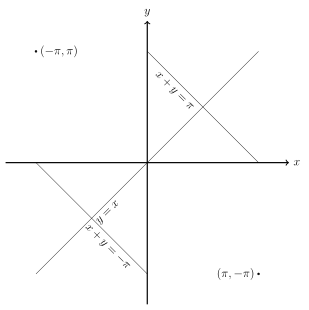
- \(\,\) \begin{align*}
&& \sin y &= \tfrac12 \sin x \\
\Rightarrow && \frac{\d y}{\d x} \cos y &= \tfrac12 \cos x \\
\Rightarrow && \frac{\d y}{\d x} &= \frac{\cos x}{2 \cos y} \\
&&&= \frac{\cos x}{2 \sqrt{1-\sin^2 y}} \\
&&&= \frac{\cos x}{2 \sqrt{1-\frac14 \sin^2 x}} \\
&&&= \frac{\cos x}{\sqrt{4-\sin^2 x}} \\
\\
&& y'' &= \frac{-\sin x \cdot (4-\sin^2 x)^{\frac12} - \cos x \cdot (4-\sin^2 x)^{-\frac12} \cdot 2 \sin x \cos x}{(4-\sin^2 x)} \\
&&&= \frac{-\sin x \cdot (4-\sin^2 x) - \cos x \cdot 2 \sin x \cos x}{(4-\sin^2x)^{\frac32}} \\
&&&= \frac{-\sin x \cdot (4-\sin^2 x) - \sin x (1-\sin^2x)}{(4-\sin^2x)^{\frac32}} \\
&&&= \frac{-3\sin x }{(4-\sin^2x)^{\frac32}} \\
\end{align*}
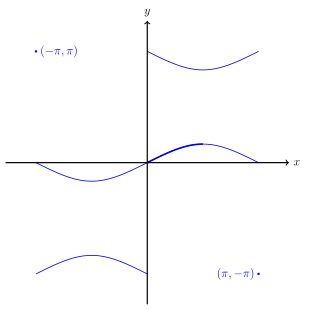
- \(\,\)
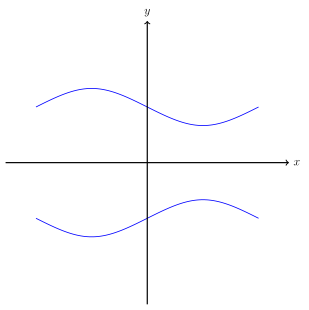
2017 Paper 2 Q4
The Schwarz inequality is \[ \left( \int_a^b \f(x)\, \g(x)\,\d x\right)^{\!\!2} \le \left( \int_a^b \big( \f(x)\big)^2 \d x \right) \left( \int_a^b \big( \g(x)\big)^2 \d x \right) . \tag{\(*\)} \]
- By setting \( \f(x)=1\) in \((*)\), and choosing \(\g(x)\), \(a\) and \(b\) suitably, show that for \(t> 0\,\), \[ \frac {\e^t -1}{\e^t+1} \le \frac t 2 \,. \]
- By setting \( \f(x)= x\) in \((*)\), and choosing \( \g(x)\) suitably, show that \[ \int_0^1\e^{-\frac12 x^2}\d x \ge 12 \big(1-\e^{-\frac14})^2 \,. \]
- Use \((*)\) to show that \[ \frac {64}{25\pi} \le \int_0^{\frac12\pi} \!\! {\textstyle \sqrt{\, \sin x\, } } \, \d x \le \sqrt{\frac \pi 2 } \,. \]
Solution:
- Let \(f(x) = 1, g(x) = e^x, a = 0, b = t\), so \begin{align*} && \left ( \int_0^t e^x \d x \right)^2 &\leq \left (\int_0^t 1^2 \d x \right) \cdot \left (\int_0^t (e^x)^2 \d x \right) \\ \Rightarrow && (e^t-1)^2 &\leq t \cdot (\frac12e^{2t} - \frac12) \\ \Rightarrow && \frac{e^t-1}{e^t+1} & \leq \frac{t}{2} \end{align*}
- Let \(f(x) = x, g(x) = e^{-\frac14 x^2}, a = 0, b = 1\) \begin{align*} && \left ( \int_0^1 xe^{-\frac14 x^2} \d x \right)^2 &\leq \left (\int_0^1 x^2 \d x \right) \cdot \left (\int_0^1 (e^{-\frac14x^2})^2 \d x \right) \\ \Rightarrow && \left ( \left [-2e^{-\frac14x^2} \right]_0^1 \right)^2 & \leq \frac{1}{3} \int_0^1 e^{-\frac12 x^2} \d x \\ \Rightarrow && \int_0^1 e^{-\frac12 x^2} \d x & \geq 12(1-e^{-\frac14})^2 \end{align*}
- Let \(f(x) = 1, g(x) = \sqrt{\sin x}, a = 0, b = \tfrac12 \pi\), then \begin{align*} && \left ( \int_0^{\frac12 \pi} \sqrt{\sin x} \d x \right)^2 &\leq \left (\int_0^{\frac12 \pi} 1^2 \d x \right) \cdot \left (\int_0^{\frac12 \pi}|\sin x| \d x \right) \\ &&&= \frac{\pi}{2} \cdot 1 \\ \Rightarrow && \int_0^{\frac12 \pi} \sqrt{\sin x} \d x & \leq \sqrt{\frac{\pi}{2}} \end{align*} Let \(f(x) =(\sin x)^{\frac14}, g(x) = \cos x, a = 0, b = \tfrac12 \pi\), so \begin{align*} && \left ( \int_0^{\frac12 \pi} (\sin x)^{\frac14} \cos x \d x \right)^2 &\leq \left (\int_0^{\frac12 \pi} \cos^2 x \d x \right) \cdot \left (\int_0^{\frac12 \pi}\sqrt{\sin x} \d x \right) \\ \Rightarrow &&\left ( \left [\frac45 (\sin x)^{\frac54} \right]_0^{\frac12 \pi} \right)^2 & \leq \frac{\pi}{4} \int_0^{\frac12 \pi}\sqrt{\sin x} \d x \\ \Rightarrow && \frac{64}{25\pi} &\leq \int_0^{\frac12 \pi}\sqrt{\sin x} \d x \end{align*}
2017 Paper 2 Q5
A curve \(C\) is determined by the parametric equations \[ x=at^2 \, , \; y = 2at\,, \] where \(a > 0\).
- Show that the normal to \(C\) at a point \(P\), with non-zero parameter \(p\), meets \(C\) again at a point \(N\), with parameter \(n\), where \[ n= - \left( p + \frac{2}{p} \right). \]
- Show that the distance \(\left| PN \right|\) is given by \[ \vert PN\vert^2 = 16a^2\frac{(p^2+1)^3}{p^4} \] and that this is minimised when \(p^2=2\,\).
- The point \(Q\), with parameter \(q\), is the point at which the circle with diameter \(PN\) cuts \(C\) again. By considering the gradients of \(QP\) and \(QN\), show that \[ 2 = p^2-q^2 + \frac{2q}p. \] Deduce that \(\left| PN \right|\) is at its minimum when \(Q\) is at the origin.
Solution:
- \(\,\) \begin{align*} && \frac{\d x}{\d t} &= 2at \\ && \frac{\d y}{\d t} &= 2a \\ \Rightarrow && \frac{\d y}{\d x} &= \frac1t \\ && -p &= \text{grad of normal} \\ &&&= \frac{y-2ap}{x-ap^2} \\ \Rightarrow && y &= -px + ap^3+2ap \\ && 2an &= -pan^2 + ap^3 + 2ap \\ \Rightarrow && 0 &= pan^2+2an-ap(2+p^2) \\ \Rightarrow && n &= p, -\left ( p + \frac2{p}\right) \\ \Rightarrow && n &= -\left ( p + \frac2{p}\right) \end{align*}
- \(\,\) \begin{align*} && |PN|^2 &= (ap^2-an^2)^2 +(2ap-2an)^2 \\ &&&= a^2(p-n)^2(p+n)^2+4a^2(p-n)^2 \\ &&&= a^2(p-n)^2((p+n)^2+4) \\ &&&= a^2\left(p+p+\frac2p \right)^2 \left ( \left ( -\frac2p\right)^2+4\right)\\ &&&= a^2\left(\frac{2p^2+2}p \right)^2 \left ( \frac{4}{p^2}+4\right)\\ &&&= 16a^2 \frac{(p^2+1)^3}{p^4} \\ \\ && \frac{\d |PN|^2}{\d p^2} &= 16a^2\frac{3(p^2+1)^2p^4-2(p^2+1)^3p^2}{p^8} \\ &&&= 16a^2(p^2+1)^2 \frac{3p^2-2(p^2+1)}{p^6} \\ &&&= 16a^2(p^2+1)^2 \frac{p^2-2}{p^6} \end{align*} Therefore minimized when \(p^2=2\) (clearly a minimum by considering behaviour as \(p^2 \to 0, \infty\))
- If \(PN\) is the diameter of \(PNQ\) then \(QP\) and \(QN\) are perpendicular, ie \begin{align*} && -1 &= \frac{2ap-2aq}{ap^2-aq^2} \cdot \frac{2aq-2an}{aq^2-an^2} \\ &&&= \frac{2}{p+q} \cdot \frac{2}{q+n} \\ &&&= \frac{2}{p+q} \cdot \frac{2}{q - p -\frac{2}{p}} \\ \Rightarrow && 4 &= (p+q)(p+\frac2{p}-q) \\ &&&= p^2-q^2 + \frac{2q}{p} + 2 \\ \Rightarrow && 2 &= p^2 - q^2 + \frac{2q}{p} \end{align*} Therefore \(q = 0 \Rightarrow p^2 = 2 \Rightarrow |PN|\) is at it's minimum.
2017 Paper 2 Q6
Let \[ S_n = \sum_{r=1}^n \frac 1 {\sqrt r \ } \,, \] where \(n\) is a positive integer.
- Prove by induction that \[ S_n \le 2\sqrt n -1\, . \]
- Show that \((4k+1)\sqrt{k+1} > (4k+3)\sqrt k\,\) for \(k\ge0\,\). Determine the smallest number \(C\) such that \[ S_n \ge 2\sqrt n + \frac 1 {2\sqrt n} -C \,.\]
Solution:
- Claim: \(S_n \leq 2\sqrt{n} -1\). Proof: (By induction) (Base case: \(n = 1\)). \(\frac{1}{\sqrt{1}} \leq 1 = 2 \cdot \sqrt1 - 1\). Therefore the base case is true. (Inductive step): Suppose our result is true for \(n = k\). Then consider \(n = k+1\). \begin{align*} && \sum_{r=1}^{k+1} \frac{1}{\sqrt{r}} &=\sum_{r=1}^{k} \frac{1}{\sqrt{r}} + \frac{1}{\sqrt{k+1}} \\ &&&\leq 2\sqrt{k} - 1 + \frac{1}{\sqrt{k+1}} \\ &&&= \frac{2 \sqrt{k}\sqrt{k+1}+1}{\sqrt{k+1}} - 1 \\ &&&\underbrace{\leq}_{AM-GM} \frac{(k+k+1)+1}{\sqrt{k+1}} - 1 \\ &&&=\frac{2(k+1)}{\sqrt{k+1}} - 1 \\ &&&= 2\sqrt{k+1}-1 \end{align*} Therefore, since if our statement is true for \(n = k\), it is also true for \(n = k+1\). By the principle of mathematical induction we can say that it is true for all \(n \geq 1, n \in \mathbb{Z}\)
- Claim: \((4k+1)\sqrt{k+1} > (4k+3)\sqrt k\,\) for \(k\ge0\,\) Proof: \begin{align*} && (4k+1)\sqrt{k+1} &> (4k+3)\sqrt k \\ \Leftrightarrow && (4k+1)^2(k+1) &> (4k+3)^2k \\ \Leftrightarrow && (16k^2+8k+1)(k+1) &> (16k^2 + 24k+9)k \\ \Leftrightarrow && 16 k^3 + 24 k^2 + 9 k +1&> 16k^3 + 24k^2+9k \end{align*} But this last inequality is clearly true, hence our original inequality is true. Suppose \(S_n \geq 2\sqrt{n} + \frac{1}{2 \sqrt{n}} - C\), then adding \(\frac{1}{\sqrt{n+1}}\) to both sides we have: \begin{align*} S_{n+1} &\geq 2\sqrt{n} + \frac{1}{2 \sqrt{n}} - C + \frac{1}{\sqrt{n+1}} \\ &= 2\sqrt{n+1} + \frac{1}{2\sqrt{n+1}} - C + \frac{1}{2\sqrt{n+1}} +\frac{1}{2 \sqrt{n}} +2(\sqrt{n} - \sqrt{n+1})\\ &= 2\sqrt{n+1} + \frac{1}{2\sqrt{n+1}} - C + \frac{1}{2\sqrt{n+1}} +\frac{1}{2 \sqrt{n}} -\frac{2}{\sqrt{n+1} + \sqrt{n}}\\ \end{align*} Therefore as long as the inequality is satisfied for \(n=1\), ie \(1 \geq 2\sqrt{1} + \frac{1}{2 \sqrt{1}} - C = \frac52 - C \Rightarrow C \geq \frac32\)
2017 Paper 2 Q7
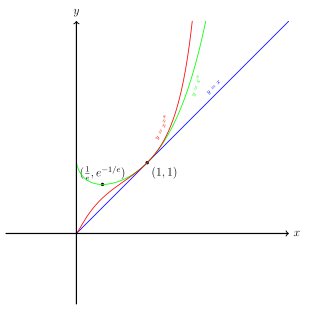
The functions \(\f\) and \(\g\) are defined, for \(x>0\), by \[ \f(x) = x^x\,, \ \ \ \ \ \g(x) = x^{\f(x)}\,. \]
- By taking logarithms, or otherwise, show that \(\f(x) > x\) for \(0 < x < 1\,\). Show further that \(x < \g(x) < \f(x)\) for \(0 < x < 1\,\). Write down the corresponding results for \(x > 1 \,\).
- Find the value of \(x\) for which \(\f'(x)=0\,\).
- Use the result \(x\ln x \to 0\) as \(x\to 0\) to find \(\lim\limits_{x\to0}\f(x)\), and write down \(\lim\limits_{x\to0}\g(x)\,\).
- Show that \( x^{-1}+\, \ln x \ge 1\,\) for \(x>0\). Using this result, or otherwise, show that \(\g'(x) > 0\,\).
Solution:
- \(\,\) \begin{align*} && \ln f(x) &= x \ln x \\ &&&> \ln x \quad (\text{if } 0 < x < 1)\\ \Rightarrow && f(x) &> x\quad\quad (\text{if } 0 < x < 1)\\ \Rightarrow && x^{f(x)} &< x^x \\ && g(x) &< f(x) \\ && 1&>f(x) \\ \Rightarrow && x &< x^{f(x)} = g(x) \end{align*}
- \(\,\) \begin{align*} && f(x) &= e^{x \ln x} \\ \Rightarrow && f'(x) &= (\ln x + 1)e^{x \ln x} \\ \Rightarrow && f'(x) = 0 &\Leftrightarrow x = \frac1e \end{align*}
- \(\,\) \begin{align*} && \lim_{x \to 0} f(x) &= \lim_{x \to 0} \exp \left ( x \ln x \right ) \\ &&&= \exp \left ( \lim_{x \to 0} \left ( x \ln x \right )\right) \\ &&&= \exp \left ( 0 \right) = 1\\ \\ && \lim_{x \to 0} g(x) &= \lim_{x \to 0} \exp \left ( f(x) \ln x\right) \\ &&&= \exp \left (\lim_{x \to 0} \ln x f(x)\right) \\ &&&= \exp \left (\lim_{x \to 0} \ln x \lim_{x \to 0}f(x)\right) \\ &&&= \exp \left (\lim_{x \to 0} \ln x\right) \\ &&&= 0 \end{align*}
- \(y = x^{-1} + \ln x \Rightarrow y' = -x^{-2} + x^{-1}\) which has roots at \(x =1\), therefore the minimum value is \(1\). (We can see it's a minimum by considering \(x \to 0, x \to \infty\). So \begin{align*} && g'(x) &= x^{f(x)} \cdot (f'(x) \ln x + f(x) x^{-1})\\ &&&= x^{f(x)} \cdot f(x) \cdot ((1+\ln x) \ln x + x^{-1}) \\ &&&= x^{f(x)} \cdot f(x) \cdot (\ln x + x^{-1} + (\ln x)^2) \\ &&&\geq x^{f(x)} \cdot f(x) > 0 \end{align*}
2017 Paper 2 Q8
All vectors in this question lie in the same plane. The vertices of the non-right-angled triangle \(ABC\) have position vectors \(\bf a\), \(\bf b\) and \(\bf c\), respectively. The non-zero vectors \(\bf u\) and \(\bf v\) are perpendicular to \(BC\) and \(CA\), respectively. Write down the vector equation of the line through \(A\) perpendicular to \(BC\), in terms of \(\bf u\), \(\bf a\) and a parameter \(\lambda \). The line through \(A\) perpendicular to \(BC\) intersects the line through \(B\) perpendicular to \(CA\) at \(P\). Find the position vector of \(P\) in terms of \(\bf a\), \(\bf b\), \(\bf c\) and \(\bf u\). Hence show that the line \(CP\) is perpendicular to the line \(AB\).
Solution: The line through \(A\) perpendicular to \(BC\) is \(\mathbf{a} + \lambda\mathbf{u}\). The line through \(B\) perpendicular to \(CA\) is \(\mathbf{b} + \mu \mathbf{v}\). They intersect when \(\mathbf{a} + \lambda\mathbf{u} = \mathbf{b} + \mu \mathbf{v}\). Since \(\mathbf{v}\) is perpendicular to \(CA\), we must have \begin{align*} && \mathbf{a} + \lambda\mathbf{u} &= \mathbf{b} + \mu \mathbf{v} \\ \Rightarrow && \mathbf{a}\cdot(\mathbf{c}-\mathbf{a}) + \lambda\mathbf{u}\cdot(\mathbf{c}-\mathbf{a}) &= \mathbf{b}\cdot(\mathbf{c}-\mathbf{a}) + \mu \mathbf{v}\cdot(\mathbf{c}-\mathbf{a}) \\ \\ \Rightarrow && \lambda &= \frac{\mathbf{b}\cdot(\mathbf{c}-\mathbf{a}) -\mathbf{a}\cdot(\mathbf{c}-\mathbf{a})}{\mathbf{u}\cdot(\mathbf{c}-\mathbf{a})} \\ &&&= \frac{(\mathbf{b}-\mathbf{a})\cdot(\mathbf{c}-\mathbf{a})}{\mathbf{u} \cdot(\mathbf{c}-\mathbf{a})} \end{align*} Therefore the point is \(\mathbf{a} + \frac{(\mathbf{b}-\mathbf{a})\cdot(\mathbf{c}-\mathbf{a})}{\mathbf{u} \cdot(\mathbf{c}-\mathbf{a})} \mathbf{u}\). The line \(CP\) is \(\mathbf{c} + \nu \left (\mathbf{p} - \mathbf{c} \right)\), to check this is perpendicular with \(AB\) we should dot \(\mathbf{p}-\mathbf{c}\) with \(\mathbf{a}-\mathbf{b}\), ie \begin{align*} && (\mathbf{p}-\mathbf{c}) \cdot (\mathbf{a}-\mathbf{b}) &= \left ( \mathbf{a} + \frac{(\mathbf{b}-\mathbf{a})\cdot(\mathbf{c}-\mathbf{a})}{\mathbf{u} \cdot(\mathbf{c}-\mathbf{a})} \mathbf{u} - \mathbf{c}\right) \cdot ( \mathbf{a}-\mathbf{b}) \\ &&&= \left ( \mathbf{a}- \mathbf{c} + \frac{(\mathbf{b}-\mathbf{a})\cdot(\mathbf{c}-\mathbf{a})}{\mathbf{u} \cdot(\mathbf{c}-\mathbf{a})} \mathbf{u} \right) \cdot ( \mathbf{a}-\mathbf{c}+(\mathbf{c}-\mathbf{b})) \\ &&&= (\mathbf{a}-\mathbf{c})\cdot(\mathbf{a}-\mathbf{c}) + \frac{(\mathbf{b}-\mathbf{a})\cdot(\mathbf{c}-\mathbf{a})}{\mathbf{u} \cdot(\mathbf{c}-\mathbf{a})}\mathbf{u} \cdot (\mathbf{a}-\mathbf{c}) + \\ &&&\quad (\mathbf{a}-\mathbf{c})\cdot(\mathbf{c}-\mathbf{b}) + \lambda \underbrace{\mathbf{u} \cdot (\mathbf{c}-\mathbf{b})}_{=0} \\ &&&=(\mathbf{a}-\mathbf{c})\cdot(\mathbf{a}-\mathbf{c}) -(\mathbf{b}-\mathbf{a})\cdot(\mathbf{c}-\mathbf{a})+ (\mathbf{a}-\mathbf{c})\cdot(\mathbf{c}-\mathbf{b}) \\ &&&= (\mathbf{a}-\mathbf{c})\cdot(\mathbf{a}-\mathbf{c}+\mathbf{b}-\mathbf{a}+\mathbf{c}-\mathbf{b}) \\ &&&= 0 \end{align*} as required.
2017 Paper 2 Q9
Two identical rough cylinders of radius \(r\) and weight \(W\) rest, not touching each other but a negligible distance apart, on a horizontal floor. A thin flat rough plank of width \(2a\), where \(a < r\), and weight \(kW\) rests symmetrically and horizontally on the cylinders, with its length parallel to the axes of the cylinders and its faces horizontal. A vertical cross-section is shown in the diagram below.
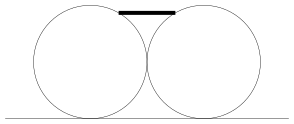
- Let \(F\) be the frictional force between one cylinder and the floor, and let \(R\) be the normal reaction between the plank and one cylinder. Show that \[ R\sin\theta = F(1+\cos\theta)\,, \] where \(\theta\) is the acute angle between the plank and the tangent to the cylinder at the point of contact. Deduce that \(2\sin\theta \le 1+\cos\theta\,\).
- Show that \[ N= \left( 1+\frac2 k\right)\left(\frac{1+\cos\theta}{\sin\theta} \right) F \,, \] where \(N\) is the normal reaction between the floor and one cylinder. Write down the condition that the cylinder does not slip on the floor and show that it is satisfied with no extra restrictions on \(\theta\).
- Show that \(\sin\theta\le\frac45\,\) and hence that \(r\le5a\,\).
Solution:
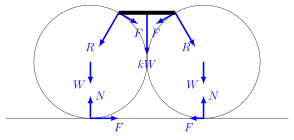
- \(\,\) \begin{align*} \text{N2}(\rightarrow, \text{ one cylinder}): && F\cos \theta + F - R \sin \theta &= 0 \\ \Rightarrow && F(1+\cos \theta) &= R \sin \theta \\ && F \leq \tfrac12 R \\ \Rightarrow && R \sin \theta &\leq \frac12 R(1+\cos \theta) \\ \Rightarrow && 2 \sin \theta &\leq 1 + \cos \theta \end{align*}
- \(\,\) \begin{align*} \text{N2}(\uparrow, \text{system}): && 2N-(k+2)W &= 0 \\ \Rightarrow && W &= \left ( \frac{2}{k+2} \right)N \\ \text{N2}(\uparrow, \text{one cylinder}): && N - W - R\cos \theta -F\sin \theta &= 0 \\ \Rightarrow && N - \left ( \frac{2}{k+2} \right)N - F \left ( \frac{1+\cos \theta}{\sin \theta} \right) \cos \theta - F \sin \theta &= 0 \\ \Rightarrow && \left ( \frac{k}{k+2} \right)N &= \left ( \frac{\cos \theta + \cos^2 \theta + \sin^2 \theta}{\sin \theta} \right) F\\ \Rightarrow && N &= \left ( 1 + \frac2{k} \right) \left ( \frac{\cos \theta + 1}{\sin \theta} \right) F \end{align*} The cylinder does not slip if \(F \leq \tfrac12 N\), ie \begin{align*} && N &\leq \left ( 1 + \frac2{k} \right) \left ( \frac{\cos \theta + 1}{\sin \theta} \right) \frac12 N \\ \Rightarrow && 2\sin \theta &\leq \left ( 1 + \frac2{k} \right) \left ( \cos \theta + 1 \right) \end{align*} but since \(2 \sin \theta \leq (1 + \cos \theta)\) and \((1+\frac2k) > 1\) this inequality is obviously satisfied.
- We can notice that \(2\sin \theta = 1 + \cos \theta\) is satisfied by a \(3-4-5\) triangle, where \(\sin \theta = 4/5, \cos \theta = 3/5\) and hence if \(\sin \theta \leq \frac45\) the condition must hold.
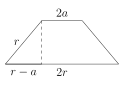
So \(\sin \theta = \frac{r-a}{r} \leq \frac45 \Rightarrow 5r-5a \leq 4r \Rightarrow r \leq 5a\)
2017 Paper 2 Q10
A car of mass \(m\) makes a journey of distance \(2d\) in a straight line. It experiences air resistance and rolling resistance so that the total resistance to motion when it is moving with speed \(v\) is \(Av^2 +R\), where \(A\) and \(R\) are constants. The car starts from rest and moves with constant acceleration \(a\) for a distance \(d\). Show that the work done by the engine for this half of the journey is \[ \int_0^d (ma+R+Av^2) \, \d x \] and that it can be written in the form \[ \int_0^w \frac {(ma+R+Av^2)v}a\; \d v \,, \] where \(w =\sqrt {2ad\,}\,\). For the second half of the journey, the acceleration of the car is \(-a\).
- In the case \(R>ma\), show that the work done by the engine for the whole journey is \[ 2Aad^2 + 2Rd \,. \]
- In the case \(ma-2Aad< R< ma\), show that at a certain speed the driving force required to maintain the constant acceleration falls to zero. Thereafter, the engine does no work (and the driver applies the brakes to maintain the constant acceleration). Show that the work done by the engine for the whole journey is \[ 2Aad^2 + 2 Rd + \frac{(ma-R)^2}{4Aa} \, .\]
Solution: The force delivered by the engine must be \(ma + R + Av^2\), (so the net force is \(ma\)). Therefore the work done is \(\displaystyle \int_0^d F \d x = \int_0^d (ma + R + Av^2) \d x\) Notice that \(a = v \frac{\d v}{\d x} \Rightarrow \frac{a}{v} = \frac{\d v}{\d x}\) and so \begin{align*} && WD &= \int_0^d (ma + R + Av^2) \d x \\ &&&= \int_{x=0}^{x=d} (ma + R + Av^2) \frac{v}{a} \frac{\d v}{\d x} \d x \\ &&&= \int_{x=0}^{x=d} \frac{ (ma + R + Av^2)v}{a} \d v \\ \end{align*} Also notice that if we move with constant acceleration from rest for a distance \(d\) the final speed is \(v^2 = 2ad \Rightarrow v = \sqrt{2ad}\)
- For the second part of the journey, the engine will be putting out a force of \(-ma+R+Av^2>0\), and the car will have a final speed of \(0\) \begin{align*} WD &= \int_0^{w} \frac{(ma+R+Av^2)v}{a} \d v + \int_w^0 \frac{(-ma+R+Av^2)v}{-a} \d v \\ &= \int_0^w \frac{2(Rv+Av^3)}{a} \d v \\ &= \frac{Rw^2+\frac12Aw^4}{a} \\ &= \frac{R2ad+\frac12A4a^2d^2}{a} \\ &= 2Rd + 2Aad^2 \end{align*}
- If \(ma - 2Aad < R < ma\) then the driving force is still \(-ma+R+Av^2\) which is positive when \(v = \sqrt{2as}\) but negative when \(v = 0\), and therefore at some point in-between the driving force must be \(0\). The engine will stop working when \(-ma+R+Av^2 =0 \Rightarrow v = \sqrt{\frac{ma-R}{A}}\) so \begin{align*} WD &= \int_0^w \frac{(ma+R+Av^2)v}{a} \d v + \int_w^{ \sqrt{\frac{ma-R}{A}}} \frac{(-ma+R+Av^2)v}{-a} \d v \\ &= \int_0^w \frac{2(R+Av^2)v}{a} \d v - \int_0^{\sqrt{\frac{ma-R}{A}}} \frac{(-ma+R+Av^2)v}{a}\d v \\ &= 2Aad^2+2Rd + \frac1a\left (\frac12(R-ma)\frac{ma-R}{A} + \frac{A}{4}\left ( \frac{ma-R}{A}\right)^2 \right) \\ &= 2Aad^2+2Rd - \frac{(ma-R)^2}{Aa}\left (-\frac12+ \frac14 \right) \\ &= 2Aad^2+2Rd - \frac{(ma-R)^2}{4Aa} \end{align*}
2017 Paper 2 Q11
Two thin vertical parallel walls, each of height \(2a\), stand a distance \(a\) apart on horizontal ground. The projectiles in this question move in a plane perpendicular to the walls.
- A particle is projected with speed \(\sqrt{5ag}\) towards the two walls from a point \( A\) at ground level. It just clears the first wall. By considering the energy of the particle, find its speed when it passes over the first wall. Given that it just clears the second wall, show that the angle its trajectory makes with the horizontal when it passes over the first wall is \(45^\circ\,\). Find the distance of \(A\) from the foot of the first wall.
- A second particle is projected with speed \(\sqrt{5ag}\) from a point \(B\) at ground level towards the two walls. It passes a distance \(h\) above the first wall, where \(h>0\). Show that it does not clear the second wall.
Solution:
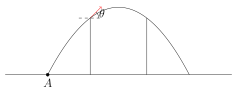
- \(\,\) \begin{align*} \bf{COE}: && \frac12 m \cdot 5ag &= mg\cdot 2a + \frac12 m v^2 \\ \Rightarrow && v^2 &= ag \\ && v &= \sqrt{ag} \end{align*} If it just clears the second wall, we must have: \begin{align*} && 0 &= \sqrt{ag} \sin \theta t - \frac12 gt^2 \\ \Rightarrow && t &= \frac{2\sqrt{ag}\sin \theta}{g} \\ && a &= \sqrt{ag} \cos \theta t \\ &&&=\sqrt{ag} \cos \theta \frac{2\sqrt{ag}\sin \theta}{g} \\ &&&= a \sin 2 \theta \\ \Rightarrow && \theta &= 45^{\circ} \end{align*} Imagine firing the particle backwards from the top of the wall at \(45^\circ\) then \begin{align*} && -2a &= \sqrt{ag}\cdot \left ( -\frac1{\sqrt{2}} \right) t - \frac12 g t^2 \\ \Rightarrow && 0 &= gt^2+\sqrt{2ag} t -4a \\ &&&= (\sqrt{g}t -\sqrt{2} \sqrt{a})(\sqrt{g}t +2\sqrt{2} \sqrt{a}) \\ \Rightarrow && t &= \sqrt{\frac{2a}{g}} \\ \Rightarrow && s &= \left ( -\frac1{\sqrt{2}} \right) \sqrt{ag} \sqrt{\frac{2a}{g}} \\ &&&= -a \end{align*} Therefore the \(A\) is \(a\) from the wall.
- When it passes over the first wall, \begin{align*} \bf{COE}: && \frac52amg &= (2a+h)mg + \frac12 m v^2 \\ \Rightarrow && v^2 &= (a-2h)g \end{align*} Now imagine firing a particle with this speed in any direction. The question is asking whether we can ever travel \(2a\) without descending more than \(h\). \begin{align*} && a &= \sqrt{(a-2h)g} \cos \beta t \\ \Rightarrow && t &= \frac{a}{\sqrt{(a-2h)g} \cos \beta}\\ && -h &= \sqrt{(a-2h)g} \sin \beta t - \frac12 g t^2 \\ &&&= a \tan \beta - \frac12 \frac{a^2}{(a-2h)} \sec^2 \beta \\ &&&= a \tan \beta - \frac{a^2}{2(a-2h)}(1+ \tan^2 \beta )\\ \Rightarrow && 0 &= \frac{a^2}{2(a-2h)} \tan^2 \beta-a \tan \beta + \frac{a^2-2ah+4h^2}{2(a-2h)} \\ && \Delta &= a^2 - \frac{a^2}{a-2h} \frac{a^2-2ah+4h^2}{a-2h} \\ &&&= \frac{a^2}{(a-2h)^2}\left ( a^2-4ah+4h^2-a^2+2ah-4h^2\right) \\ &&&= \frac{a^2}{(a-2h)^2}\left ( -2ah\right) < 0 \\ \end{align*} So there are no solutions if \(h > 0\)
2017 Paper 2 Q12
Adam and Eve are catching fish. The number of fish, \(X\), that Adam catches in any time interval is Poisson distributed with parameter \(\lambda t\), where \(\lambda\) is a constant and \(t\) is the length of the time interval. The number of fish, \(Y\), that Eve catches in any time interval is Poisson distributed with parameter \(\mu t\), where \(\mu\) is a constant and \(t\) is the length of the time interval The two Poisson variables are independent. You may assume that the expected time between Adam catching a fish and Adam catching his next fish is \(\lambda^{-1}\), and similarly for Eve.
- By considering \(\P( X + Y = r)\), show that the total number of fish caught by Adam and Eve in time \(T\) also has a Poisson distribution.
- Given that Adam and Eve catch a total of \(k\) fish in time \(T\), where \(k\) is fixed, show that the number caught by Adam has a binomial distribution.
- Given that Adam and Eve start fishing at the same time, find the probability that the first fish is caught by Adam.
- Find the expected time from the moment Adam and Eve start fishing until they have each caught at least one fish.
Solution:
- \(\,\) \begin{align*} && \mathbb{P}(X+Y=r) &= \sum_{k=0}^r \mathbb{P}(X = k, Y = r-k) \\ &&&= \sum_{k=0}^r \mathbb{P}(X = k)\mathbb{P}( Y = r-k) \\ &&&= \sum_{k=0}^r \frac{e^{-\lambda T} (\lambda T)^k}{k!}\frac{e^{-\mu T} (\mu T)^{r-k}}{(r-k)!}\\ &&&= \frac{e^{-(\mu+\lambda)T}}{r!}\sum_{k=0}^r \binom{r}{k}(\lambda T)^k (\mu T)^{r-k}\\ &&&= \frac{e^{-(\mu+\lambda)T}((\mu+\lambda)T)^r}{r!} \end{align*} Therefore \(X+Y \sim Po \left ( (\mu+\lambda)T \right)\)
- \(\,\) \begin{align*} && \mathbb{P}(X = r | X+Y = k) &= \frac{\mathbb{P}(X=r, Y = k-r)}{\mathbb{P}(X+Y=k)} \\ &&&= \frac{\frac{e^{-\lambda T} (\lambda T)^r}{r!}\frac{e^{-\mu T} (\mu T)^{k-r}}{(k-r)!}}{\frac{e^{-(\mu+\lambda)T}((\mu+\lambda)T)^k}{k!}} \\ &&&= \binom{k}{r} \left ( \frac{\lambda}{\lambda + \mu} \right)^r \left ( \frac{\mu}{\lambda + \mu} \right)^{k-r} \end{align*} Therefore \(X|X+Y=k \sim B(k, \frac{\lambda}{\lambda + \mu})\)
- \(P(X=1|X+Y = 1) = \frac{\lambda}{\lambda + \mu}\)
- Let \(X_1, Y_1\) be the time to the first fish are caught by Adam and Eve, then \begin{align*} && \mathbb{P}(X_1, Y_1 > t) &= \mathbb{P}(X_1> t) \mathbb{P}( Y_1 > t) \\ &&&= e^{-\lambda t}e^{-\mu t} \\ &&&= e^{-(\lambda+\mu)t} \\ \Rightarrow && f_{\max(X_1,Y_1)}(t) &= (\lambda+\mu)e^{-(\lambda+\mu)} \end{align*} Therefore the expected time is \(\frac1{\mu+\lambda}\)
2017 Paper 2 Q13
In a television game show, a contestant has to open a door using a key. The contestant is given a bag containing \(n\) keys, where \(n\ge2\). Only one key in the bag will open the door. There are three versions of the game. In each version, the contestant starts by choosing a key at random from the bag.
- In version 1, after each failed attempt at opening the door the key that has been tried is put back into the bag and the contestant again selects a key at random from the bag. By considering the binomial expansion of \(( 1 - q)^{-2}\), or otherwise, find the expected number of attempts required to open the door.
- In version 2, after each failed attempt at opening the door the key that has been tried is put aside and the contestant selects another key at random from the bag. Find the expected number of attempts required to open the door.
- In version 3, after each failed attempt at opening the door the key that has been tried is put back into the bag and another incorrect key is added to the bag. The contestant then selects a key at random from the bag. Show that the probability that the contestant draws the correct key at the \(k\)th attempt is \[ \frac{n-1}{(n+k-1)(n+k-2)} \,.\] Show also, using partial fractions, that the expected number of attempts required to open the door is infinite. You may use without proof the result that \(\displaystyle\sum_{m=1}^N \dfrac 1 m \to \infty \,\) as \(N\to \infty\,\).
Solution:
- The probability they pull the key out on the \(k\)th attempt will be \(\left ( \frac{n-1}{n} \right)^{k-1} \frac1n\), so we want: \begin{align*} \E[G_1] &= \sum_{k=1}^{\infty} k \cdot \left ( \frac{n-1}{n} \right)^{k-1} \frac1n \\ &= \frac{1}n \sum_{k=1}^{\infty} k \cdot \left ( \frac{n-1}{n} \right)^{k-1} \\ &= \frac1n \frac{1}{\left (1 - \frac{n-1}{n} \right)^2} \\ &= \frac{1}{n} \frac{n^2}{1^2} = n \end{align*}
- In version 2, the probability the correct key comes out at the \(k\)th attempt is \(\frac1n\) (assume we take out all the keys, then the correct key is equally likely to appear in all of the space). Therefore \(\E[G_2] = \frac1n (1 + 2 + \cdots + n) = \frac{n+1}{2}\)
- The probability the key comes out on the correct attempt is: \begin{align*} && \mathbb{P}(G_3 = k) &= \frac{n-1}{n} \cdot \frac{n}{n+1} \cdot \frac{n+1}{n+2} \cdots \frac{n+k-3}{n+k-2} \cdot \frac{1}{n+k-1} \\ &&&= \frac{n-1}{(n+k-2)(n+k-1)} \\ \\ &&k \cdot \mathbb{P}(G_3 = k) &= \frac{k(n-1)}{(n+k-2)(n+k-1)} \\ &&&= \frac{(n-1)(2-n)}{n+k-2} + \frac{(n-1)^2}{n+k-1} \\ &&&= \frac{(n-1)^2}{n+k-1} - \frac{(n-1)^2}{n+k-2} + \frac{n-1}{n-k+2} \\ \Rightarrow && \E[G_3] &= \sum_{k=1}^{\infty} k \cdot \mathbb{P}(G_3 = k) \\ &&&= \sum_{k=1}^{\infty} \left ( \frac{(n-1)^2}{n+k-1} - \frac{(n-1)^2}{n+k-2} + \frac{n-1}{n+k-2} \right) \\ &&&= \sum_{k=1}^{\infty} \left ( \frac{(n-1)^2}{n+k-1} - \frac{(n-1)^2}{n+k-2} \right) +\underbrace{\sum_{k=1}^{\infty} \frac{n-1}{n-k+2}}_{\to \infty} \\ \end{align*}