Problems
Filters
13 problems found
2008 Paper 2 Q1
A sequence of points \((x_1,y_1)\), \((x_2,y_2)\), \(\ldots\) in the cartesian plane is generated by first choosing \((x_1,y_1)\) then applying the rule, for \(n=1\), \(2\), \(\ldots\), \[ (x_{n+1}, y_{n+1}) = (x_n^2-y_n^2 +a, \; 2x_ny_n+b+2)\,, \] where \(a\) and \(b\) are given real constants.
- In the case \(a=1\) and \(b=-1\), find the values of \((x_1,y_1)\) for which the sequence is constant.
- Given that \((x_1,y_1) = (-1,1)\), find the values of \(a\) and \(b\) for which the sequence has period 2.
2008 Paper 2 Q2
Let \(a_n\) be the coefficient of \(x^n\) in the series expansion, in ascending powers of \(x\), of \[\displaystyle \frac{1+x}{(1-x)^2(1+x^2)} \,, \] where \(\vert x \vert <1\,\). Show, using partial fractions, that either \(a_n =n+1\) or \(a_n = n+2\) according to the value of \(n\). Hence find a decimal approximation, to nine significant figures, for the fraction \( \displaystyle \frac{11\,000}{8181}\). \newline [You are not required to justify the accuracy of your approximation.]
Solution: \begin{align*} && \frac{1+x}{(1-x)^2(1+x^2)} &= \frac{A}{1-x} + \frac{B}{(1-x)^2} + \frac{Cx+D}{1+x^2} \\ \Rightarrow && 1 + x &= A(1-x)(1+x^2) + B(1+x^2) + Cx(1-x)^2 + D(1-x)^2 \\ \Rightarrow && 2 &= 2B \tag{\(x = 1\)} \\ \Rightarrow && 1 &= B \\ \Rightarrow && 1 &= A+B+D \tag{\(x = 0\)}\\ \Rightarrow && A &= -D \\ \Rightarrow && 0 &= 4A+2B-4C+4D \tag{\(x = -1\)}\\ \Rightarrow && C &= \frac12\\ \Rightarrow && 3 &= -5A+5B+2C+D \tag{\(x=2\)} \\ \Rightarrow && 3 &= -6A+6 \\ \Rightarrow && A,D &=-\frac12,\frac12 \\ \Rightarrow && \frac{1+x}{(1-x)^2(1+x^2)} &= \frac{1}{(1-x)^2} +\frac{1}{2(1-x)}+ \frac{x-1}{2(1+x^2)} \\ &&&=\sum_{k=0}^{\infty}(k+1)x^k + \sum_{k=0}^{\infty}\frac12 x^k + \sum_{k=0}^{\infty}\frac12 (-1)^kx^{2k+1} - \sum_{k=0}^{\infty}\frac12 (-1)^kx^{2k} \end{align*} Therefore the coefficient of \(x^n\) is \(n+1\) or \(n+2\) depending on whether the coefficients from the final series add constructively \(n \equiv 1, 2 \pmod{4}\) or destructively. \begin{align*} \frac{11\, 000}{8181} &= \frac{(10+1) \cdot 1000}{(10-1)^2 \cdot (100+1)} \\ &= \frac{(1+\frac{1}{10})}{(1-\frac{1}{10})^2 \cdot (1+\frac1{10})} \\ &= 1 + \frac3{10} + \frac4{10^2} + \frac{4}{10^3}+\frac{5}{10^4} + \frac{7}{10^5} + \frac{8}{10^6} + \cdots \\ & \quad \quad \cdots + \frac{8}{10^7} + \frac{9}{10^8} + \frac{11}{10^9} + \frac{12}{10^{10}} + \cdots \\ &= 1.34457890 + \frac{12}{10^{10}} + \cdots \end{align*} \begin{align*} && \sum_{k=m}^{\infty} (k+2)x^k &= x^m \sum_{k=0}^{\infty} (k+m+2)x^{k} \\ && &= \frac{x^k}{(1-x)^2} + \frac{(m+2)x^k}{1-x} \\ \Rightarrow && |\sum_{k=m}^{\infty} a_k \left ( \frac1{10} \right )^k | &\leq \frac{1}{10^m}\left ( \frac{1}{(1-\frac1{10})^2} + \frac{m+2}{1-\frac1{10}} \right) \\ &&&= \frac{1}{10^{m-1}} \left ( \frac{9m+28}{81}\right ) \end{align*} Therefore for this will be less than \(10^{-9}\), when \(m = 11\), so our approximation is valid to 9sf
2008 Paper 2 Q3
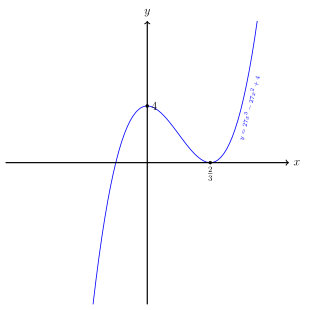
- Find the coordinates of the turning points of the curve \(y=27x^3-27x^2+4\). Sketch the curve and deduce that \(x^2(1-x)\le 4/27\) for all \(x\ge0\,\). Given that each of the numbers \(a\), \(b\) and \(c\) lies between \(0\) and \(1\), prove by contradiction that at least one of the numbers \(bc(1-a)\), \(ca(1-b)\) and \(ab(1-c)\) is less than or equal to \(4/27\).
- Given that each of the numbers \(p\) and \(q\) lies between \(0\) and \(1\), prove that at least one of the numbers \(p(1-q)\) and \(q(1-p)\) is less than or equal to \(1/4\).
Solution:
- \(\,\)
\begin{align*}
&& y & = 27x^3 - 27x^2 + 4 \\
\Rightarrow && \frac{\d y}{\d x} &= 81x^2 - 54x \\
\Rightarrow && x &= 0, \frac23 \\
\Rightarrow && (x,y) &= (0, 4), \left (\frac23, 0 \right)
\end{align*}
Since \(f(x) \geq 0\) for \(x \geq 0\) we must have \(27x^2(1-x) \leq 4 \Rightarrow x^2(1-x) \leq \frac{4}{27}\) Suppose for contradiction that \(bc(1-a) > \frac{4}{27}, ca(1-b) > \frac{4}{27}, ab(1-c) > \frac{4}{27}\) then taking the product we see \begin{align*} && \left ( \frac{4}{27} \right)^3 &< bc(1-a) \cdot ca(1-b) \cdot ab(1-c) \\ &&&= a^2(1-c) \cdot b^2(1-b) \cdot c^2(1-c) \leq \left ( \frac{4}{27}\right)^3 \end{align*} which is a contradiction.
- Notice that \(f(x) = x(1-x)\) has a turning point at \((\frac12, \frac14)\), and so \(f(x) \leq \frac14\). Suppose for contradiction that both \(p(1-q)\) and \(q(1-p)\) are larger than \(1/4\) \begin{align*} && \left ( \frac14 \right)^2 &< p(1-q) \cdot q(1-p) \\ &&&= p(1-p) \cdot q(1-q) \\ &&&\leq \left ( \frac14 \right)^2 \end{align*} which is a contradiction.
2008 Paper 2 Q4
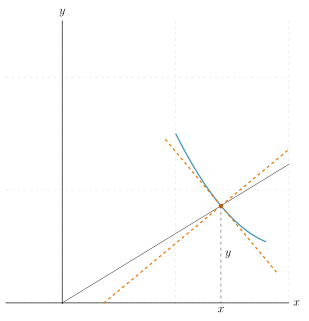
A curve is given by \[x^2+y^2 +2axy = 1,\] where \(a\) is a constant satisfying \(0 < a < 1\). Show that the gradient of the curve at the point \(P\) with coordinates \((x,y)\) is \[\displaystyle - \frac {x+ay}{ax+y}\,,\] provided \(ax+y \ne0\). Show that \(\theta\), the acute angle between \(OP\) and the normal to the curve at \(P\), satisfies \[ \tan\theta = a\vert y^2-x^2\vert\;. \] Show further that, if \(\ \displaystyle \frac{\d \theta}{\d x}=0\) at \(P\), then:
- \(a(x^2+y^2)+2xy=0\,\);
- \((1+a)(x^2+y^2+2xy)=1\,\);
- \(\displaystyle \tan\theta = \frac a{\sqrt{1-a^2}}\,\).
Solution: \begin{align*} && 1 &= x^2 + y^2 + 2axy \\ \frac{\d}{\d x}: && 0 &= 2x + 2y \frac{\d y}{\d x} + 2ay + 2ax \frac{\d y}{\d x} \\ &&&= (2x+2ay) + \frac{\d y}{\d x} \left (2ax + 2y \right) \\ \Rightarrow && \frac{\d y}{\d x} &= -\frac{x+ay}{ax+y} \end{align*}
- \(\,\) \begin{align*} && \sec^2 \theta \frac{\d \theta}{\d x} &= \pm a \left (2y \frac{\d y}{\d x} - 2 x\right) \\ \Rightarrow && 0 &= a \left (y \cdot \frac{x+ay}{ax+y} + x \right) \\ &&&=a \left ( \frac{xy+ay^2+ax^2+xy}{ax+y} \right) \\ \Rightarrow && 0 &= a(x^2+y^2)+2xy \end{align*}
- \(\,\) \begin{align*} && 0 &=a(x^2+y^2)+2xy \\ && 1 &= x^2+y^2 + 2axy \\ \Rightarrow && 1 &= (a+1)(x^2+y^2) + (a+1)(2xy) \\ &&&= (a+1)(x^2+y^2+2xy) \end{align*}
- \(\,\) \begin{align*} && 1 &= (a+1)(x+y)^2 \\ \Rightarrow && x +y &= \pm \frac{1}{\sqrt{1+a}} \\ && 0 &=a(x^2+y^2)+2xy \\ && 1 &= x^2+y^2 + 2axy \\ \Rightarrow && 1 &= (1-a)(x^2+y^2) + (a-1)(2xy) \\ &&&= (1-a)(x^2+y^2-2xy)\\ \Rightarrow && x-y &= \pm \frac{1}{\sqrt{1-a}} \\ \Rightarrow && \frac{\d \theta}{\d x} &= a|y^2-x^2| \\ &&&= a|(y-x)(x+y)| \\ &&&= \frac{a}{\sqrt{1-a^2}} \end{align*}
2008 Paper 2 Q5
Evaluate the integrals \[\int_0^{\frac{1}{2}\pi} \frac{\sin 2x}{1+\sin^2x} \d x \text{ and } \int_0^{\frac{1}{2}\pi} \frac{\sin x}{1+\sin^2x} \d x\] Show, using the binomial expansion, that \((1+\sqrt2\,)^5<99\). Show also that \(\sqrt 2 > 1.4\). Deduce that \(2^{\sqrt2} > 1+ \sqrt2\,\). Use this result to determine which of the above integrals is greater.
Solution: \begin{align*} && I &= \int_0^{\frac{1}{2}\pi} \frac{\sin 2x}{1+\sin^2x} \d x \\ &&&= \int_0^{\frac{1}{2}\pi} \frac{2 \sin x \cos x}{1+\sin^2x} \d x \\ &&&= \left [\ln (1 + \sin^2 x) \right]_0^{\pi/2} \\ &&&= \ln 2 \\ \\ && J &= \int_0^{\frac{1}{2}\pi} \frac{\sin x}{1+\sin^2x} \d x \\ &&&= \int_0^{\frac{1}{2}\pi} \frac{\sin x}{2-\cos^2x} \d x \\ &&&= \frac{1}{2\sqrt{2}}\int_0^{\frac{1}{2}\pi} \left ( \frac{\sin x}{\sqrt{2}-\cos x}+ \frac{\sin x}{\sqrt{2}+\cos x} \right) \d x \\ &&&= \frac{1}{2\sqrt{2}} \left [\ln (\sqrt{2}-\cos x) - \ln (\sqrt{2}+\cos x) \right]_0^{\pi/2} \\ &&&= \frac{1}{2\sqrt{2}} \left (-\ln(\sqrt{2}-1)+\ln(\sqrt{2}+1) \right) \\ &&&= \frac1{2\sqrt{2}} \ln \left (\frac{\sqrt{2}+1}{\sqrt{2}-1} \right)\\ &&&= \frac1{\sqrt{2}} \ln (\sqrt{2}+1) \end{align*} \begin{align*} && (1+\sqrt{2})^5 + (1-\sqrt{2})^5 &= 2(1+10\cdot2+5\cdot2^2) \\ &&&= 82 \\ && |(1-\sqrt{2})^5| & < 1 \\ && (1+\sqrt{2})^5 &< 83 < 99 \\ \\ && 1.4^2 &= 1.96 \\ &&&< 2 \\ \Rightarrow && 1.4 &<\sqrt{2} \\ \\ \Rightarrow && 2^{\sqrt{2}} &> 2^{1.4} \\ &&&=2^{7/5} \\ &&&= {128}^{1/5} \\ &&&>99^{1/5} \\ &&&>1+\sqrt{2} \end{align*} \begin{align*} && \ln 2 & > \frac{1}{\sqrt{2}} \ln(\sqrt{2}+1) \\ \Leftrightarrow && \sqrt{2} \ln 2 &> \ln(\sqrt{2}+1) \\ \Leftrightarrow && 2^{\sqrt{2}} &> 1+\sqrt{2} \end{align*} which we have already shown, so the first integral is larger.
2008 Paper 2 Q6
A curve has the equation \(y=\f(x)\), where \[ \f(x) = \cos \Big( 2x+ \frac \pi 3\Big) + \sin \Big ( \frac{3x}2 - \frac \pi 4\Big). \]
- Find the period of \(\f(x)\).
- Determine all values of \(x\) in the interval \(-\pi\le x \le \pi\) for which \(\f(x)=0\). Find a value of \(x\) in this interval at which the curve touches the \(x\)-axis without crossing it.
- Find the value or values of \(x\) in the interval \(0\le x \le 2\pi\) for which \(\f(x)=2\,\).
Solution: \begin{align*} && f(x) &= \cos \left( 2x+ \frac \pi 3\right) + \sin \left ( \frac{3x}2 - \frac\pi 4\right) \\ &&&= \cos \left( 2x+ \frac \pi 3\right) + \cos\left (\frac{\pi}{2} - \left ( \frac{3x}2 - \frac\pi 4\right) \right)\\ &&&= \cos \left( 2x+ \frac \pi 3\right) + \cos\left (\frac{3\pi}{4} - \frac{3x}2 \right)\\ &&&= 2 \cos \left (\frac{2x+ \frac \pi 3+\frac{3\pi}{4} - \frac{3x}2}{2} \right) \cos \left ( \frac{\left (2x+ \frac \pi 3 \right) - \left (\frac{3\pi}{4} - \frac{3x}2 \right)}{2} \right)\\ &&&= 2 \cos \left (\frac{\frac{x}{2}+ \frac {13\pi}{12}}{2} \right) \cos \left ( \frac{\frac{7x}{2}- \frac {5\pi}{12}}{2} \right)\\ &&&= 2 \cos \left (\frac{x}{4}+ \frac {13\pi}{24} \right) \cos \left ( \frac{7x}{4}- \frac {5\pi}{24} \right)\\ \end{align*}
- The period of \(f\) will be the LCM of \(\frac{2\pi}{\pi}\) and \(\frac{2\pi}{\frac32} = \frac{4\pi}{3}\) which is \(4\pi\). (This is also clear from the factorised form).
- \(f(x) = 0\) means one of those two factors is zero, ie \begin{align*} \text{first factor}: && 0 &= \cos \left (\frac{x}{4}+ \frac {13\pi}{24} \right) \\ &&n\pi + \frac{\pi}{2}&= \frac{x}{4}+ \frac {13\pi}{24} \\ \Rightarrow && x &= 4n\pi - \frac{\pi}{6} \\ \Rightarrow && x &= -\frac{\pi}{6} \\ \\ \text{second factor}: && 0 &= \cos \left ( \frac{7x}{4}- \frac {5\pi}{24} \right) \\ && n\pi + \frac{\pi}{2} &= \frac{7x}{4}- \frac {5\pi}{24} \\ \Rightarrow && 7x &= 4n\pi + \frac{17}{6}\pi \\ \Rightarrow && x &= \frac{4n}7\pi + \frac{17}{42}\pi \\ \Rightarrow && x &= -\frac{31}{42} \pi, -\frac16\pi, \frac{17}{42}\pi, \frac{41}{42}\pi \end{align*} Therefore all solutions are \(-\frac{31}{42} \pi, -\frac16\pi, \frac{17}{42}\pi, \frac{41}{42}\pi\) We can see that \(-\frac{\pi}{6}\) is a repeated root, therefore it touches the axis and does not cross.
- \(f(x) = 2\) requires both factors to be \(1\) or \(-1\). \begin{align*} \text{first factor}: && \pm1 &= \cos \left (\frac{x}{4}+ \frac {13\pi}{24} \right) \\ &&n\pi &= \frac{x}{4}+ \frac {13\pi}{24} \\ \Rightarrow && x &= 4n\pi - \frac{13\pi}{6} \\ \Rightarrow && x &= \frac{11}{6}\pi \\ \end{align*} We only need to test this value, where it's \(-1\), so we look at \( \cos \left ( \frac{77\pi}{24}- \frac {5\pi}{24} \right) = \cos (3\pi) = -1\), so the only value is \(\frac{11}{6}\pi\)
2008 Paper 2 Q7
- By writing \(y=u{(1+x^2)\vphantom{\dot A}}^{\frac12}\), where \(u\) is a function of \(x\), find the solution of the equation \[ \frac 1 y \frac{\d y} {\d x} = xy + \frac x {1+x^2} \] for which \(y=1\) when \(x=0\).
- Find the solution of the equation \[ \frac 1 y \frac{\d y} {\d x} = x^2y + \frac {x^2 } {1+x^3} \] for which \(y=1\) when \(x=0\).
- Give, without proof, a conjecture for the solution of the equation \[ \frac 1 y \frac{\d y} {\d x} = x^{n-1}y + \frac {x^{n-1} } {1+x^n} \] for which \(y=1\) when \(x=0\), where \(n\) is an integer greater than 1.
2008 Paper 2 Q8
The points \(A\) and \(B\) have position vectors \(\bf a\) and \(\bf b\), respectively, relative to the origin \(O\). The points \(A\), \(B\) and \(O\) are not collinear. The point \(P\) lies on \(AB\) between \(A\) and \(B\) such that \[ AP : PB = (1-\lambda):\lambda\,. \] Write down the position vector of \(P\) in terms of \(\bf a\), \(\bf b\) and \(\lambda\). Given that \(OP\) bisects \(\angle AOB\), determine \(\lambda\) in terms of \(a\) and \(b\), where \(a=\vert \bf a\vert\) and $b=\vert \mathbf{b}\vert\(. The point \)Q\( also lies on \)AB\( between \)A\( and \)B\(, and is such that \)AP=BQ$. Prove that $$OQ^2-OP^2=(b-a)^2\,.$$
Solution:

2008 Paper 2 Q9
In this question, use \(g=10\,\)m\,s\(^{-2}\). In cricket, a fast bowler projects a ball at \(40\,\)m\,s\(^{-1}\) from a point \(h\,\)m above the ground, which is horizontal, and at an angle \(\alpha\) above the horizontal. The trajectory is such that the ball will strike the stumps at ground level a horizontal distance of \(20\,\)m from the point of projection.
- Determine, in terms of \(h\), the two possible values of \(\tan\alpha\). Explain which of these two values is the more appropriate one, and deduce that the ball hits the stumps after approximately half a second.
- State the range of values of \(h\) for which the bowler projects the ball below the horizontal.
- In the case \(h=2.5\), give an approximate value in degrees, correct to two significant figures, for \(\alpha\). You need not justify the accuracy of your approximation.
2008 Paper 2 Q10
The lengths of the sides of a rectangular billiards table \(ABCD\) are given by \(AB = DC = a\) and \(AD=BC = 2b\). There are small pockets at the midpoints \(M\) and \(N\) of the sides \(AD\) and \(BC\), respectively. The sides of the table may be taken as smooth vertical walls. A small ball is projected along the table from the corner \(A\). It strikes the side \(BC\) at \(X\), then the side \(DC\) at \(Y\) and then goes directly into the pocket at \(M\). The angles \(BAX\), \(CXY\) and \(DY\!M\) are \(\alpha\), \(\beta\) and \(\gamma\) respectively. On each stage of its path, the ball moves with constant speed in a straight line, the speeds being \(u\), \(v\) and \(w\) respectively. The coefficient of restitution between the ball and the sides is \(e\), where \(e>0\).
- Show that \(\tan\alpha \tan \beta = e\) and find \(\gamma\) in terms of \(\alpha\).
- Show that \(\displaystyle \tan\alpha = \frac {(1+2e)b} {(1+e)a}\) and deduce that the shot is possible whatever the value of \(e\).
- Find an expression in terms of \(e\) for the fraction of the kinetic energy of the ball that is lost during the motion.
Solution:
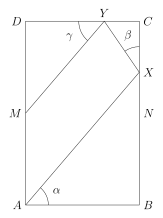
- The initial velocity is \(u = \binom{u \cos\alpha}{u \sin \alpha}\), therefore \(v = \binom{v_x}{u \sin \alpha}\). Newton's experimental law tells us \(v_x = -e u_x = -eu \cos\alpha\), therefore \(v = \binom{-eu \cos \alpha}{u \sin \alpha} = \binom{-v \sin \beta}{v\cos \beta} \Rightarrow -\tan \beta = -e \cot \alpha \Rightarrow \tan \alpha \tan \beta = e\). There is nothing special about the result here, and so it must also be the case that \(\tan \beta \tan \gamma = e \Rightarrow \tan \gamma = \tan \alpha\)
- \(\tan \alpha = \frac{XB}{BA}\) so the point \(X\) is at \((a, \tan \alpha a)\). The point \(Y\) satisfies \(\tan \beta = \frac{CY}{CX} = \frac{CY}{2b - \tan \alpha a}\) so the point \(Y\) is \((a-(2b - a \tan \alpha)\tan \beta,2b) = (a - 2b\tan \beta + ea, 2b) = ((1+e)a-2b\tan \beta, 2b)\). Finally, the point \(M\) is the midpoint, so \(\tan \gamma = \frac{DM}{DY}\) so \(M\) is the point \((0, 2b - ((1+e)a-2b\tan \beta)\tan \gamma) = (0, 2b - (1+e)a \tan \gamma - 2b e) = (0, (2b(1-e) - (1+e)a \tan \gamma)\), but \(M\) is the point \((0, b)\), ie \begin{align*} && b &= 2b(1-e) - (1+e)a \tan \gamma \\ \Rightarrow && b+2eb &= (1+e)a \tan \gamma \\ \Rightarrow && \tan \gamma &= \frac{(1+2e)b}{(1+e)a} \\ \Rightarrow && \tan \alpha &= \frac{(1+2e)b}{(1+e)a} \end{align*} Since \( \frac{(1+2e)b}{(1+e)a} = \frac{b}{a} + \frac{e}{1+e}b\) which is clearly an increasing function of \(e\) on \([0,1]\), so \(\tan \alpha \in \left [\frac{b}{a}, \frac{3b}{2a} \right]\) which are all all angles which place \(X\) in sensible places, therefore we can always hit the middle pocket. (Except \(e = 0\), where we would put the ball in \(N\), but we are given \(e > 0\)).
- After the first collision the velocity is \(\binom{-eu \cos \alpha}{u \sin \alpha}\) after the second collision the velocity is \(\binom{-eu \cos \alpha}{-eu \sin \alpha}\). Initial kinetic energy is therefore \(\frac12 m u^2\) and final kinetic energy is \(\frac12 m e^2u^2\) therefore the fraction lost is \(\frac{\frac12 m u^2 - \frac12 m e^2u^2}{\frac12 m u^2} = 1-e^2\)
2008 Paper 2 Q11
A wedge of mass \(km\) has the shape (in cross-section) of a right-angled triangle. It stands on a smooth horizontal surface with one face vertical. The inclined face makes an angle \(\theta\) with the horizontal surface. A particle \(P\), of mass \(m\), is placed on the inclined face and released from rest. The horizontal face of the wedge is smooth, but the inclined face is rough and the coefficient of friction between \(P\) and this face is \(\mu\).
- When \(P\) is released, it slides down the inclined plane at an acceleration \(a\) relative to the wedge. Show that the acceleration of the wedge is \[ \frac {a \cos\theta}{k+1}\,. \] To a stationary observer, \(P\) appears to descend along a straight line inclined at an angle~\(45^\circ\) to the horizontal. Show that \[ \tan\theta = \frac k {k+1}\,. \] In the case \(k=3\), find an expression for \(a\) in terms of \(g\) and \(\mu\).
- What happens when \(P\) is released if \(\tan\theta \le \mu\)?
2008 Paper 2 Q12
In the High Court of Farnia, the outcome of each case is determined by three judges: the ass, the beaver and the centaur. Each judge decides its verdict independently. Being simple creatures, they make their decisions entirely at random. Past verdicts show that the ass gives a guilty verdict with probability \(p\), the beaver gives a guilty verdict with probability \(p/3\) and the centaur gives a guilty verdict with probability \(p^2\). Let \(X\) be the number of guilty verdicts given by the three judges in a case. Given that \(\E(X)= 4/3\), find the value of \(p\). The probability that a defendant brought to trial is guilty is \(t\). The King pronounces that the defendant is guilty if at least two of the judges give a guilty verdict; otherwise, he pronounces the defendant not guilty. Find the value of \(t\) such that the probability that the King pronounces correctly is \(1/2\).
Solution: \begin{align*} && \mathbb{E}(X) &= p + \frac{p}{3} + p^2 = \frac43p+p^2 \\ \Rightarrow && \frac43 &= \frac43p+p^2 \\ \Rightarrow && 0 &= 3p^2+4p-4 \\ &&&= (3p-2)(p+2) \\ \Rightarrow && p &= \frac23, -2 \end{align*} Since \(p \in [0,1]\) we must have \(p = \frac23\). \begin{align*} && \mathbb{P}(\text{correct verdict}) &= t p+ (1-t) (1-p) \\ &&&= t(2p-1)+(1-p)\\ \Rightarrow && \frac12 &= t(2p-1)+(1-p) \\ \Rightarrow && t &= \frac{\frac12-(1-p)}{2p-1} \\ &&&= \frac{2p-1}{2(2p-1)} = \frac12 \end{align*} (so it doesn't depend at all on what the judges are doing, the only way to be fair is if the trials happen at random!)
2008 Paper 2 Q13
Bag \(P\) and bag \(Q\) each contain \(n\) counters, where \(n\ge2\). The counters are identical in shape and size, but coloured either black or white. First, \(k\) counters (\(0\le k\le n\)) are drawn at random from bag \(P\) and placed in bag \(Q\). Then, \(k\) counters are drawn at random from bag \(Q\) and placed in bag \(P\).
- If initially \(n-1\) counters in bag \(P\) are white and one is black, and all \(n\) counters in bag \(Q\) are white, find the probability in terms of \(n\) and \(k\) that the black counter ends up in bag \(P\). Find the value or values of \(k\) for which this probability is maximised.
- If initially \(n-1\) counters in bag \(P\) are white and one is black, and \(n-1\) counters in bag \(Q\) are white and one is black, find the probability in terms of \(n\) and \(k\) that the black counters end up in the same bag. Find the value or values of \(k\) for which this probability is maximised.
Solution:
- \(\,\) \begin{align*} \mathbb{P}(\text{black counter in }P) &= \mathbb{P}(\text{black counter moves twice})+\mathbb{P}(\text{black counter doesn't move}) \\ &= \mathbb{P}(\text{black counter moves out})\mathbb{P}(\text{black counter moves back}) + (1-\mathbb{P}(\text{black counter moves out})) \\ &= \frac{k}n\cdot \frac{k}{n+k}+\frac{n-k}{n} \\ &= \frac{k^2+n^2-k^2}{n(n+k)} \\ &= \frac{n^2}{n(n+k)} = \frac{n}{n+k} \end{align*} This is maximised if \(k\) is as small as possibe, ie \(k = 0\) (ie it doesn't leave it's bag)
- \(\,\) \begin{align*} && \mathbb{P}(\text{both counters in same bag}) &= \mathbb{P}(\text{both in }P)+ \mathbb{P}(\text{both in }Q) \\ &&&= \mathbb{P}(B_P \to Q \to P, B_Q \to P)+\mathbb{P}(B_P \text{ stays}, B_Q \to P)+\mathbb{P}(B_P \to Q, \text{both stay}) \\ &&&= \frac{k}{n} \cdot \frac{k(k-1)}{(n+k)(n+k-1)} + \frac{n-k}{n} \frac{k}{n+k} + \frac{k}{n} \frac{n(n-1)}{(n+k)(n+k-1)} \\ &&&= \frac{(k^3-k^2)+(n-k)k(n+k-1)+kn(n-1)}{n(n+k)(n+k-1)}\\ &&&= \frac{2kn(n-1)}{n(n+k)(n+k-1)}\\ &&&= \frac{2k(n-1)}{(n+k)(n+k-1)} \end{align*} \begin{align*} && \frac{P_{k+1}}{P_k} &= \frac{2(k+1)(n-1)}{(n+k+1)(n+k)} \frac{(n+k)(n+k-1)}{2k(n-1)} \\ &&&= \frac{(k+1)(n+k-1)}{k(n+k+1)} \\ &&& \geq 1 \\ \Leftrightarrow && (k+1)(n+k-1) &\geq k(n+k+1) \\ \Leftrightarrow && n-1 &\geq k \\ \end{align*} Therefore this probability is increasing while \(k \leq n-1\), ie it's maximised \(k = n-1\) or \(k=n\)