Problems
Filters
2 problems found
2006 Paper 3 Q11
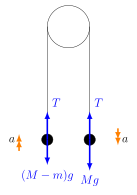
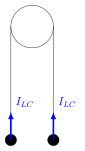
A lift of mass \(M\) and its counterweight of mass \(M\) are connected by a light inextensible cable which passes over a fixed frictionless pulley. The lift is constrained to move vertically between smooth guides. The distance between the floor and the ceiling of the lift is \(h\). Initially, the lift is at rest, and the distance between the top of the lift and the pulley is greater than \(h\). A small tile of mass \(m\) becomes detached from the ceiling of the lift and falls to the floor of the lift. Show that the speed of the tile just before the impact is \[ \sqrt{\frac{(2M-m)gh \;}{M}}\;. \] The coefficient of restitution between the tile and the floor of the lift is \(e\). Given that the magnitude of the impulsive force on the lift due to tension in the cable is equal to the magnitude of the impulsive force on the counterweight due to tension in the cable, show that the loss of energy of the system due to the impact is \(mgh(1-e^2)\). Comment on this result.
1989 Paper 2 Q11
A lift of mass \(M\) and its counterweight of mass \(M\) are connected by a light inextensible cable which passes over a light frictionless pulley. The lift is constrained to move vertically between smooth guides. The distance between the floor and the ceiling of the lift is \(h\). Initially, the lift is at rest, and the distance between the top of the lift and the pulley is greater than \(h\). A small tile of mass \(m\) becomes detached from the ceiling of the lift. Show that the time taken for it to fall to the floor is \[ t=\sqrt{\frac{\left(2M-m\right)h}{Mg}}. \] The collision between the tile and the lift floor is perfectly inelastic. Show that the lift is reduced to rest by the collision, and that the loss of energy of the system is \(mgh\). Note: the question on the STEP database is \[ t=\sqrt{\frac{2\left(M-m\right)h}{Mg}}. \]
Solution: