Problems
Filters
2 problems found
2012 Paper 2 Q11
A small block of mass \(km\) is initially at rest on a smooth horizontal surface. Particles \(P_1\), \(P_2\), \(P_3\), \(\ldots\) are fired, in order, along the surface from a fixed point towards the block. The mass of the \(i\)th particle is \(im\) (\(i = 1, 2, \ldots\))and the speed at which it is fired is \(u/i\,\). Each particle that collides with the block is embedded in it. Show that, if the \(n\)th particle collides with the block, the speed of the block after the collision is \[ \frac{2nu}{2k +n(n+1)}\,. \] In the case \(2k = N(N+1)\), where \(N\) is a positive integer, determine the number of collisions that occur. Show that the total kinetic energy lost in all the collisions is \[ \tfrac12 mu^2\bigg( \sum_{n=2}^{N+1} \frac 1 n \bigg)\,. \]
Solution: \begin{align*} \text{COM}: && \sum_{i=1}^n im \cdot \frac{u}{i} &= \left ( km + \sum_{i=1}^n im \right) v \\ \Rightarrow && nu &= \left ( k + \frac{n(n+1)}{2} \right) v \\ \Rightarrow && v &= \frac{2nu}{2k + n(n+1)} \end{align*} If \(2k = N(N+1)\), there will be no more collisions when \(v_n > \frac{u}{n+1}\), ie \begin{align*} && \frac{u}{n+1} &<\frac{2nu}{2k + n(n+1)} \\ \Leftrightarrow && N(N+1) + n(n+1) &< 2n(n+1) \\ \Leftrightarrow && N(N+1) &< n(n+1) \\ \end{align*} Therefore \(n = N+1\) and there will be \(N+1\) collisions. The loss of kinetic energy is: \begin{align*} && \text{initial k.e.} &= \sum_{k=1}^{N+1} \frac12 im \cdot \frac{u^2}{i^2} \\ &&&= \frac12 m u^2 \left ( \sum_{k=1}^{N+1} \frac{1}{i}\right) \\ && \text{final k.e.} &= \frac12 \left ( k + \frac{(N+1)(N+2)}{2}\right)m \left ( \frac{2(N+1)u}{N(N+1)+(N+1)(N+2)} \right)^2 \\ &&&= \frac12 m u^2 \frac{2(N+1)^2}{(N+1)(2N+2)} \\ &&&= \frac12 mu^2 \\ \Rightarrow && \Delta \text{ k.e.} &= \frac12 m u^2 \left ( \sum_{k=2}^{N+1} \frac{1}{i}\right) \end{align*}
1989 Paper 2 Q11
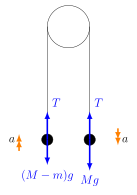
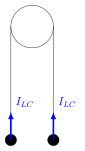
A lift of mass \(M\) and its counterweight of mass \(M\) are connected by a light inextensible cable which passes over a light frictionless pulley. The lift is constrained to move vertically between smooth guides. The distance between the floor and the ceiling of the lift is \(h\). Initially, the lift is at rest, and the distance between the top of the lift and the pulley is greater than \(h\). A small tile of mass \(m\) becomes detached from the ceiling of the lift. Show that the time taken for it to fall to the floor is \[ t=\sqrt{\frac{\left(2M-m\right)h}{Mg}}. \] The collision between the tile and the lift floor is perfectly inelastic. Show that the lift is reduced to rest by the collision, and that the loss of energy of the system is \(mgh\). Note: the question on the STEP database is \[ t=\sqrt{\frac{2\left(M-m\right)h}{Mg}}. \]
Solution: