Problems
Filters
2 problems found
2001 Paper 3 Q9
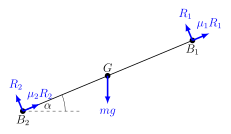
\(B_1\) and \(B_2\) are parallel, thin, horizontal fixed beams. \(B_1\) is a vertical distance \(d \sin \alpha \) above \(B_2\), and a horizontal distance \(d\cos\alpha \) from \(B_2\,\), where \(0<\alpha<\pi/2\,\). A long heavy plank is held so that it rests on the two beams, perpendicular to each, with its centre of gravity at \(B_1\,\). The coefficients of friction between the plank and \(B_1\) and \(B_2\) are \(\mu_1\) and \(\mu_2\,\), respectively, where \(\mu_1<\mu_2\) and \(\mu_1+\mu_2=2\tan\alpha\,\). The plank is released and slips over the beams experiencing a force of resistance from each beam equal to the limiting frictional force (i.e. the product of the appropriate coefficient of friction and the normal reaction). Show that it will come to rest with its centre of gravity over \(B_2\) in a time \[ \pi \left(\frac{d}{g(\mu_2-\mu_1)\cos\alpha }\right)^{\!\frac12}\;. \]
Solution:
2000 Paper 2 Q11
The string \(AP\) has a natural length of \(1\!\cdot5\!\) metres and modulus of elasticity equal to \(5g\) newtons. The end \(A\) is attached to the ceiling of a room of height \(2\!\cdot\!5\) metres and a particle of mass \mbox{\(0\!\cdot\!5\) kg} is attached to the end \(P\). The end \(P\) is released from rest at a point \(0\!\cdot\!5\) metres above the floor and vertically below \(A\). Show that the string becomes slack, but that \(P\) does not reach the ceiling. Show also that while the string is in tension, \(P\) executes simple harmonic motion, and that the time in seconds that elapses from the instant when \(P\) is released to the instant when \(P\) first returns to its original position is $$ \left(\frac8{3g}\right)^{\!\frac12}+ \left(\frac3 {5g}\right)^{\!\frac12} {\Big(\pi - \arccos (3/7)\Big)}. $$ \noindent [Note that \(\arccos x\) is another notation for \(\cos^{-1} x\).]