Problems
Filters
21 problems found
2025 Paper 2 Q9
Points \(A\) and \(B\) are at the same height and a distance \(\sqrt{2}r\) apart. Two small, spherical particles of equal mass, \(P\) and \(Q\), are suspended from \(A\) and \(B\), respectively, by light inextensible strings of length \(r\). Each particle individually may move freely around and inside a circle centred at the point of suspension. The particles are projected simultaneously from points which are a distance \(r\) vertically below their points of suspension, directly towards each other and each with speed \(u\). When the particles collide, the coefficient of restitution in the collision is \(e\).
- Show that, immediately after the collision, the horizontal component of each particle's velocity has magnitude \(\frac{1}{2}ev\sqrt{2}\), where \(v^2 = u^2 - gr(2 - \sqrt{2})\) and write down the vertical component in terms of \(v\).
- Show that the strings will become taut again at a time \(t\) after the collision, where \(t\) is a non-zero root of the equation \[(r - evt)^2 + \left(-r + vt - \frac{1}{2}\sqrt{2}gt^2\right)^2 = 2r^2.\]
- Show that, in terms of the dimensionless variables \[z = \frac{vt}{r} \quad \text{and} \quad c = \frac{\sqrt{2}v^2}{rg}\] this equation becomes \[\left(\frac{z}{c}\right)^3 - 2\left(\frac{z}{c}\right)^2 + \left(\frac{2}{c} + 1 + e^2\right)\left(\frac{z}{c}\right) - \frac{2}{c}(1 + e) = 0.\]
- Show that, if this equation has three equal non-zero roots, \(e = \frac{1}{3}\) and \(v^2 = \frac{9}{2}\sqrt{2}rg\). Explain briefly why, in this case, no energy is lost when the string becomes taut.
- In the case described in (iv), the particles have speed \(U\) when they again reach the points of their motion vertically below their points of suspension. Find \(U^2\) in terms of \(r\) and \(g\).
Solution:

- Assuming the particles have mass \(m\), and speed \(v\) just before collision, then \begin{align*} \text{COE}: && \underbrace{\frac12 m u^2}_{\text{initial kinetic energy}} + \underbrace{0}_{\text{initial GPE}} &= \underbrace{\frac12m v^2}_{\text{kinetic energy just before collision}} + \underbrace{mgr\left(1-\frac1{\sqrt{2}}\right)}_{\text{GPE just before collision}} \\ \Rightarrow && v^2 &= u^2 - gr(2-\sqrt{2}) \end{align*} Therefore the particles has velocity \(\frac{\sqrt{2}}2v \binom{\pm 1}{1}\) before the collision. By symmetry, the impulse between the particles will be horizontal, so the vertical velocities will be unchanged at \(\frac{\sqrt{2}}{2}v\). By conservation of momentum (or symmetry) the particles will have equal but opposite velocities after the collision (say \(w\)) satisfying: \[ e = \frac{2w}{2\frac{\sqrt{2}}{2}v} \] ie \(w = \frac{\sqrt{2}}2 e v\) as required.
- Once the particles have rebounded, they will be projectiles whilst the strings are slack. If we consider the left-most point \(A = (0,0)\) then the particles colide at \(\left ( \frac{\sqrt{2}}{2}, -\frac{\sqrt{2}}{2} \right)\) and the position at time \(t\) after the collision (before the string goes slack) will be: \begin{align*} \mathbf{x}_t &= \frac{\sqrt{2}}{2}r\binom{1}{-1} + \frac{\sqrt{2}}{2} vt \binom{-e}{1} + \frac12 gt^2 \binom{0}{-1} \end{align*} The string will go taught when \(|\mathbf{x}_t|^2 = r^2\), ie \begin{align*} && r^2 &= \left ( \frac{\sqrt{2}}{2} r - \frac{\sqrt{2}}{2}evt \right)^2 + \left (-\frac{\sqrt{2}}{2} r + \frac{\sqrt{2}}{2}vt -\frac12 gt^2 \right)^2 \\ \Rightarrow && r^2 &= \frac12 \left (r - evt \right)^2 + \frac12 \left (-r+vt - \frac{\sqrt{2}}{2}gt^2 \right)^2 \\ \Rightarrow && 2r^2 &= \left (r - evt \right)^2 + \left (-r+vt - \frac{\sqrt{2}}{2}gt^2 \right)^2 \\ \end{align*} as required.
- Suppose \(z = \frac{vt}{r}\), \(c = \frac{\sqrt{2}v^2}{rg}\), then \begin{align*} && 2r^2 &= \left (r - evt \right)^2 + \left (-r+vt - \frac{\sqrt{2}}{2}gt^2 \right)^2 \\ \Leftrightarrow && 2 &= \left (1 - e\frac{vt}{r} \right)^2 + \left (-1 + \frac{vt}{r}- \frac{\sqrt{2}}{2} \frac{gt^2}{r} \right)^2 \\ \Leftrightarrow && 2 &= \left (1 - ez \right)^2 + \left (-1 +z- \frac{v^2t^2}{r^2} \frac{gr}{\sqrt{2}v^2}\right)^2 \\ \Leftrightarrow && 2 &= \left (1 - ez \right)^2 + \left (-1 +z- \frac{z^2}{c} \right)^2 \\ \Leftrightarrow && 2 &= 1-2ez + e^2z^2 + 1 + z^2 +\frac{z^4}{c^2} - 2z-2\frac{z^3}{c}+2\frac{z^2}{c} \\ \Leftrightarrow && 0 &= z(-2e-2) + z^2(e^2+1 + \frac{2}{c}) + z^3(-\frac{2}{c}) + z^4 \frac{1}{c^2} \\ \underbrace{\Leftrightarrow}_{z \neq 0} && 0 &= \left ( \frac{z}{c} \right)^3 - 2\left ( \frac{z}{c} \right)^2 + \left ( \frac{z}{c} \right) (1 + e^2 + \frac{2}{c} ) - \frac{2}{c}(1+e) \end{align*} as required, (where on the last step we divide by \(z/c\)).
- If a cubic has \(3\) equal, non-zero roots then it must have the form \((z-a)^3 = z^3 -3az^2 + 3a^2 z -a^3 = 0\), so \(3a = 2\), and so the expansion must be \(\left ( \frac{z}{c} \right)^3 - 2\left ( \frac{z}{c} \right)^2 + \frac{4}{3}\left ( \frac{z}{c} \right) - \frac{8}{27} = 0\) \begin{align*} && \frac{2}{c}(1+e) &= \frac{8}{27} \\ \Rightarrow && \frac{2}{c} &= \frac{8}{27} \frac{1}{1+e} \\ && 1 + e^2 + \frac{2}{c} &= \frac43 \\ \Rightarrow && e^2 + \frac{8}{27(1+e)} &= \frac{1}{3} \\ \Rightarrow && 27(1+e)e^2+8 &= 9(1+e) \\ \Rightarrow && 27e^3 + 27e^2-9e-1 &= 0 \\ \Rightarrow && (3e-1)(9e^2+12e+1) &= 0 \end{align*} The only (positive) root is \(e = \frac13\), therefore \(e = \frac13\). We must also have \begin{align*} && \frac{2}{c} \frac43 &= \frac{8}{27} \\ \Rightarrow && c &= 9 \\ \Rightarrow && \frac{\sqrt{2}v^2}{rg} &= 9 \\ \Rightarrow && v^2 &= \frac{9\sqrt{2}rg}{2} \end{align*} as required. If we consider the path of the particle acting as a projectile, iff the path is tangent to the circle then there will be exactly one solution for \(z/c\) and (importantly) it will be a repeated root. Therefore the particle rejoins the circle at a tangent and the tension is acting perpendicularly to the direction of motion (ie no energy loss).
- Since the only energy lost is lost in the collision, we can apply conservation of energy again: \begin{align*} \text{COE:} && \frac12 m U^2 &= \frac12 m \frac12v^2(1+e^2) + mgr\left (1 - \frac1{\sqrt{2}} \right) \\ \Rightarrow && U^2 &= \frac12 \frac{9 \sqrt{2}}{2}gr(1+\frac19) + gr(2 - \sqrt{2}) \\ &&&= \left (\frac{5\sqrt{2}}{2}+2 - \sqrt{2} \right)gr \\ &&&= \left (\frac{4+3\sqrt{2}}{2} \right)gr \end{align*}
2019 Paper 3 Q9
In this question, \(\mathbf{i}\) and \(\mathbf{j}\) are perpendicular unit vectors and \(\mathbf{j}\) is vertically upwards. A smooth hemisphere of mass \(M\) and radius \(a\) rests on a smooth horizontal table with its plane face in contact with the table. The point \(A\) is at the top of the hemisphere and the point \(O\) is at the centre of its plane face. Initially, a particle \(P\) of mass \(m\) rests at \(A\). It is then given a small displacement in the positive \(\mathbf{i}\) direction. At a later time \(t\), when the particle is still in contact with the hemisphere, the hemisphere has been displaced by \(-s\mathbf{i}\) and \(\angle AOP = \theta\).
- Let \(\mathbf{r}\) be the position vector of the particle at time \(t\) with respect to the initial position of \(O\). Write down an expression for \(\mathbf{r}\) in terms of \(a\), \(\theta\) and \(s\) and show that $$\dot{\mathbf{r}} = (a\dot{\theta} \cos \theta - \dot{s})\mathbf{i} - a\dot{\theta} \sin \theta \mathbf{j}.$$ Show also that $$\dot{s} = (1 - k)a\dot{\theta} \cos \theta,$$ where \(k = \frac{M}{m + M}\), and deduce that $$\dot{\mathbf{r}} = a\dot{\theta}(k \cos \theta \mathbf{i} - \sin \theta \mathbf{j}).$$
- Show that $$a\dot{\theta}^2 \left(k \cos^2 \theta + \sin^2 \theta\right) = 2g(1 - \cos \theta).$$
- At time \(T\), when \(\theta = \alpha\), the particle leaves the hemisphere. By considering the component of \(\ddot{\mathbf{r}}\) parallel to the vector \(\sin \theta \mathbf{i} + k \cos \theta \mathbf{j}\), or otherwise, show that at time \(T\) $$a\dot{\theta}^2 = g \cos \alpha.$$ Find a cubic equation for \(\cos \alpha\) and deduce that \(\cos \alpha > \frac{2}{3}\).
Solution:
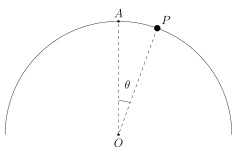
- \(\mathbf{r} = (a \sin \theta - s) \mathbf{i}+a\cos \theta\mathbf{j}\), so \begin{align*} && \dot{\mathbf{r}} &=(a \dot{\theta} \cos \theta - \dot{s}) \mathbf{i}- a\dot{\theta} \sin \theta \mathbf{j}\\ \\ \text{COM}(\rightarrow): && 0 &= M(-\dot{s}) + m(a \dot{\theta} \cos \theta - \dot{s}) \\ \Rightarrow && \dot{s} &= \frac{ma \dot{\theta} \cos \theta}{m+M} \\ &&&= \left ( 1- \frac{M}{m+M} \right) a\dot{\theta} \cos \theta \\ &&&= (1 - k) a\dot{\theta} \cos \theta \\ \\ \Rightarrow && \dot{\mathbf{r}} &=(a \dot{\theta} \cos \theta - \dot{s}) \mathbf{i}- a\dot{\theta} \sin \theta \mathbf{j} \\ &&&= (a \dot{\theta} \cos \theta - (1 - k) a\dot{\theta} \cos \theta) \mathbf{i}- a\dot{\theta} \sin \theta \mathbf{j} \\ &&&= a\dot{\theta} \left ( k \cos \theta \mathbf{i} - \sin \theta \mathbf{j} \right) \end{align*}
- \(\,\) \begin{align*} COE: &&\underbrace{0}_{\text{k.e.}}+ \underbrace{mga}_{\text{GPE}} &= \underbrace{\frac12 m \mathbf{\dot{r}}\cdot\mathbf{\dot{r}}}_{\text{k.e. }P} + \underbrace{mg a\cos \theta}_{\text{GPE}} + \underbrace{\frac12 M \dot{s}^2}_{\text{k.e. hemisphere}} \\ \Rightarrow && 2amg(1-\cos \theta) &= a^2m \dot{\theta}^2(k^2 \cos^2 \theta + \sin^2 \theta)+ M(1 - k)^2 a^2\dot{\theta}^2 \cos^2 \theta \\ \Rightarrow && 2mg(1-\cos \theta) &= a \dot{\theta}^2 \left (m\sin^2 \theta + (mk^2 + M(1-k)^2)\cos^2 \theta \right) \\ &&&= a \dot{\theta}^2 \left (m\sin^2 \theta + mk\cos^2 \theta \right) \\ \Rightarrow && 2g(1-\cos \theta) &= a \dot{\theta}^2 \left (\sin^2 \theta + k\cos^2 \theta \right) \\ \end{align*}
- The equation of motion is \(m \ddot{\mathbf{r}} = \mathbf{R} - mg\mathbf{j}\) and the particle will leave the surface when \(\mathbf{R} = 0\). If we take the component in the directions suggested: \begin{align*} && \ddot{\mathbf{r}} &= a\ddot{\theta}(k \cos \theta \mathbf{i}- \sin \theta \mathbf{j}) + a \dot{\theta}(-k\dot{\theta} \sin \theta \mathbf{i}- \dot{\theta} \cos \theta \mathbf{j}) \\ &&&= ak (\ddot{\theta} \cos \theta - \dot{\theta}^2 \sin \theta) \mathbf{i} -a(\ddot{\theta} \sin \theta + \dot{\theta}^2 \cos \theta) \mathbf{j} \\ \Rightarrow && \mathbf{\ddot{r}} \cdot (\sin \theta \mathbf{i} + k \cos \theta \mathbf{j}) &= ak (\ddot{\theta} \cos \theta - \dot{\theta}^2 \sin \theta) \sin \theta -ak(\ddot{\theta} \sin \theta + \dot{\theta}^2 \cos \theta)\cos \theta \\ &&&= - ak \dot{\theta}^2 \\ && (-g\mathbf{j}) \cdot (\sin \theta \mathbf{i} + k \cos \theta \mathbf{j}) &= -gk \cos \theta \\ \mathbf{R} = 0: && gk \cos \theta &= ak \dot{\theta}^2 \\ \Rightarrow && g \cos \theta &= a \dot{\theta}^2 \end{align*}
- \(\,\) \begin{align*} && 2g(1-\cos \theta) &= a \dot{\theta}^2(k \cos^2 \theta + \sin^2 \theta) \\ && a \dot{\theta}^2 &= g \cos \alpha \\ \Rightarrow && 2g(1-\cos \alpha) &= g \cos \alpha(k \cos^2 \alpha + (1-\cos^2 \alpha)) \\ \Rightarrow && 0 &= g(k-1)c^3+3gc-2g \\ \Rightarrow && 0 &= (k-1)c^3+3c - 2 \end{align*} When \(c =1, f(c) = k > 0\) when \(c = \frac23, f(c) = k-1 < 0\). Therefore there is a root with \(\cos \alpha > \frac23\)
2018 Paper 1 Q7
- In the cubic equation \(x^3-3pqx+pq(p+q)=0\,\), where \(p\) and \(q\) are distinct real numbers, use the substitution \[ x=\frac{pz+q}{z+1} \] to show that the equation reduces to \(az^3+b = 0\,\), where \(a\) and \(b\) are to be expressed in terms of \(p\) and \(q\).
- Show further that the equation \(x^3 - 3cx + d = 0\,\), where \(c\) and \(d\) are non-zero real numbers, can be written in the form \(x^3-3pqx+pq(p+q)=0\,\), where \(p\) and \(q\) are distinct real numbers, provided \(d^2 > 4c^3\,\).
- Find the real root of the cubic equation \(x^3+6x-2=0\,\).
- Find the roots of the equation \(x^3 - 3p^2x +2p^3=0\,\), and hence show how the equation \(x^3 - 3cx + d = 0\) can be solved in the case \(d^2 = 4c^3\,\).
Solution:
- Let \(x = \frac{pz+q}{z+1}\) then \begin{align*} && 0 &= x^3-3pqx+pq(p+q) \\ &&&= \left ( \frac{pz+q}{z+1} \right)^3 - 3pq \left ( \frac{pz+q}{z+1} \right) + pq(p+q) \\ &&&= \frac{(pz+q)^3-3pq(pz+q)(z+1)^2+pq(p+q)(z+1)^3}{(z+1)^3} \\ &&&= \frac{1}{(z+1)^3} \Big ((p^3+pq(p+q)-3p^2q)z^3 + (3p^2q-6p^2q+3pq^2+3p^2q+3pq^2)z^2 + \\ &&&\qquad \qquad\quad\quad +(3pq^2-3p^2q-6pq^2+3p^2q+3qp^2)z+(q^3-3pq^2+p^2q+pq^2) \Big ) \\ &&&= \frac{(p^3+pq^2-2p^2q)z^3+(q^3+p^2q-2pq^2)}{(z+1)^3} \\ \Rightarrow && 0 &= (p^3+pq^2-2p^2q)z^3+(q^3+p^2q-2pq^2) \\ &&&= p(p-q)^2z^3 + q(p-q)^2 \\ \Rightarrow && 0 &= pz^3 + q \end{align*}
- We would like to find \(pq = c\) and \(pq(p+q) = d\), so \(p\) and \(q\) are roots of the quadratic \(x^2-\frac{d}{c}x + c = 0\), which has distinct real roots if \(\Delta = \frac{d^2}{c^2}-4c > 0 \Rightarrow d^2>4c^3\)
- Note that \(c = -2, d = -2\) so \begin{align*} && 0 &= x^3+6x-2 \\ \text{consider} && 0 &= X^2-X-2 \\ && &= (X+1)(X-2) \\ \Rightarrow && p = -1, &q = 2\\ \Rightarrow && 0 &= x^3-3\cdot 2 \cdot(-1) x + 2\cdot(-1) \cdot(-2+1) \\ \Rightarrow && 0 &= -z^3+2 \\ \Rightarrow && z &= \sqrt[3]{2} \\ \Rightarrow && \frac{-z+2}{z+1} &= \sqrt[3]{2} \\ \Rightarrow && -z+2 &= \sqrt[3]{2} z + \sqrt[3]{2} \\ \Rightarrow && z &= \frac{2-\sqrt[3]{2}}{\sqrt[3]{2}+1} \end{align*}
- \(\,\) \begin{align*} && 0 &= x^3 - 3p^2x + 2p^3 \\ &&&= (x-p)(x^2+px-2p^2) \\ &&&=(x-p)^2(x+2p)\\ \Rightarrow && x &= p, p, -2p \end{align*} Therefore if we have a repeated root to our associated quadratic we can find a cubic of the form \(x^3-3p^2x+2p^3\), but we know this has roots we can find.
2017 Paper 3 Q3
Let \(\alpha\), \(\beta\), \(\gamma\) and \(\delta\) be the roots of the quartic equation \[ x^4 +px^3 +qx^2 +r x +s =0 \,. \] You are given that, for any such equation, \(\,\alpha \beta + \gamma\delta\,\), \(\alpha\gamma+\beta\delta\,\) and \(\,\alpha \delta + \beta\gamma\,\) satisfy a cubic equation of the form \[ y^3+Ay^2+ (pr-4s)y+ (4qs-p^2s -r^2) =0 \,. \] Determine \(A\). Now consider the quartic equation given by \(p=0\,\), \(q= 3\,\), \(r=-6\,\) and \(s=10\,\).
- Find the value of \(\alpha\beta + \gamma \delta\), given that it is the largest root of the corresponding cubic equation.
- Hence, using the values of \(q\) and \(s\), find the value of \((\alpha +\beta)(\gamma+\delta)\,\) and the value of \(\alpha\beta\) given that \(\alpha\beta >\gamma\delta\,\).
- Using these results, and the values of \(p\) and \(r\), solve the quartic equation.
Solution: \begin{align*} A &= -(\alpha \beta + \gamma\delta + \alpha\gamma+\beta\delta+\alpha \delta + \beta\gamma) \\ &= -q \end{align*}
- The corresponding cubic equation is: \begin{align*} && 0 &= y^3 - 3y^2-40y+(120-36) \\ &&&= y^3 -3y^2 - 40y + 84 \\ &&&= (y-7)(y-2)(y+6) \end{align*} Therefore \(\alpha\beta + \gamma \delta = 7\)
- \begin{align*}(\alpha+\beta)(\gamma+\delta) &= \alpha \gamma + \alpha \delta + \beta \gamma + \beta \delta \\ &= 3 -(\alpha\beta + \gamma\delta) \\ &=3-7 = -4 \end{align*} Let \(\alpha\beta\) and \(\gamma\delta\) be the roots of a quadratic; then the quadratic will be \(t^2-7t+10 = 0 \Rightarrow t = 2,5\) so \(\alpha\beta = 5\)
- \(\alpha\beta = 5, \gamma\delta = 2\) Consider the quadratic with roots \(\alpha+\beta\) and \(\gamma+\delta\), then \(t^2-4 = 0 \Rightarrow t = \pm 2\). Suppose \(\alpha+\beta = 2, \gamma+\delta=-2\) then \(\alpha, \beta = 1 \pm 2i, \gamma,\delta = -1 \pm i\) \(\alpha \beta \gamma + \beta\gamma\delta + \gamma\delta\alpha + \delta\alpha\beta = 5\gamma + 2\beta + 2\alpha + 5\delta = -6 \neq 6\) Suppose \(\alpha+\beta = -2, \gamma+\delta=2\) then \(\alpha, \beta = -1 \pm 2i, \gamma,\delta = 1 \pm i\) \(\alpha \beta \gamma + \beta\gamma\delta + \gamma\delta\alpha + \delta\alpha\beta = 5\gamma + 2\beta + 2\alpha + 5\delta = 6\), therefore these are there roots. (In some order): \(1 \pm i, -1 \pm 2i\)
2016 Paper 2 Q2
Use the factor theorem to show that \(a+b-c\) is a factor of \[ (a+b+c)^3 -6(a+b+c)(a^2+b^2+c^2) +8(a^3+b^3+c^3) \,. \tag{\(*\)} \] Hence factorise (\(*\)) completely.
- Use the result above to solve the equation \[ (x+1)^3 -3 (x+1)(2x^2 +5) +2(4x^3+13)=0\,. \]
- By setting \(d+e=c\), or otherwise, show that \((a+b-d-e)\) is a factor of \[ (a+b+d+e)^3 -6(a+b+d+e)(a^2+b^2+d^2+e^2) +8(a^3+b^3+d^3+e^3) \, \] and factorise this expression completely. Hence solve the equation \[ (x+6)^3 - 6(x+6)(x^2+14) +8(x^3+36)=0\,. \]
Solution: Suppose \(c = a+b\) then \begin{align*} (a+b+c)^3 &-6(a+b+c)(a^2+b^2+c^2) +8(a^3+b^3+c^3) \\ &= (2(a+b))^3-6(2(a+b))(a^2+b^2+(a+b)^2) + 8(a^3+b^3+(a+b)^3) \\ &=16(a+b)^3 - 24(a+b)(a^2+b^2+ab)+8(a^3+b^3) \\ &= 8(a+b)(2(a+b)^2-3(a^2+b^2+ab)+(a^2-ab+b^2)) \\ &= 0 \end{align*} Therefore \(a+b-c\) is a factor. By symmetry \(a-b+c\) and \(-a+b+c\) are also factors. Since our polynomial is degree \(3\) it must be \(K(a+b-c)(b+c-a)(c+a-b)\) for some \(K\). Since the coefficient of \(a^3\) is \(3\), \(K = 3\). so we have: \(3(a+b-c)(b+c-a)(c+a-b)\)
- We want \(x + a + b = x+1\), \(x^2 + a^2 + b^2 = x^3+\frac52, x^3 + a^3 + b^3 = x^3+ \frac{13}{4}\). \(a+b = 1, a^2 + b^2 = 5/2\) so \(a = \frac32, b = -\frac12\) \begin{align*} 0 &= (x+1)^3 - 3(x+1)(2x^2+5)+2(4x^3+13) \\ &= 3(x +\frac{3}{2}+\frac{1}{2})(x - \frac{3}{2} - \frac{1}{2})(-x + \frac{3}{2} - \frac{1}{2}) \\ &= 3(x+2)(x-2)(1-x) \end{align*} and so the roots are \(x = 1, 2, -2\)
- Letting \(c = d+e\) we have \begin{align*} (a+b+d+e)^3 &-6(a+b+d+e)(a^2+b^2+d^2+e^2) +8(a^3+b^3+d^3+e^3) \\ &= (a+b+c)^3 -6(a+b+c)(a^2+b^2+c^2-2de) +8(a^3+b^3+c^3 - 3cde) \\ &= (a+b+c)^3 -6(a+b+c)(a^2+b^2+c^2)+8(a^3+b^3+c^3)+12(a+b+c)de - 24cde \\ &= \underbrace{(a+b+c)^3 -6(a+b+c)(a^2+b^2+c^2)+8(a^3+b^3+c^3)}_{\text{has a factor of }a+b-c} + 12(a+b-c)de \end{align*} Therefore there is a factor of \(a+b-c\) or \(a+b-d-e\). By symmetry we must have the factors: \((a+b-d-e)(a-b-d+e)(a-b+d-e)\) and so the final expression must be: \(K(a+b-d-e)(a-b-d+e)(a-b+d-e)\) The coefficient of \(a^3\) is \(3\), therefore \(K = 3\) We want \(x+a+b+c = x + 6\), \(x^2+a^2+b^2+c^2 = 14\) and \(x^3 + a^3+b^3+c^3 = 36\), ie \(a = 1,b=2,c=3\) would work, so \begin{align*} 0 &= (x+6)^3 - 6(x+6)(x^2+14) +8(x^3+36) \\ &= 3(x+1-2-3)(x-1+2-3)(x-1-2+3) \\ &= 3x(x-4)(x-2) \end{align*} ie the roots are \(x = 0, 2, 4\)
2015 Paper 1 Q2
- Show that \(\cos 15^\circ = \dfrac{\sqrt3 +1}{2\sqrt2}\) and find a similar expression for \(\sin 15^\circ\).
- Show that \(\cos \alpha\) is a root of the equation \[ 4x^3-3 x -\cos 3\alpha =0\,, \] and find the other two roots in terms of \(\cos\alpha\) and \(\sin\alpha\).
- Use parts (i) and (ii) to solve the equation \(y^3-3y -\sqrt2 =0\,\), giving your answers in surd form.
Solution:
- \begin{align*} \cos 15^{\circ} &= \cos (45^{\circ} - 30^{\circ}) \\ &= \cos 45^{\circ} \cos 30^{\circ} + \sin 45^{\circ} \sin 30^{\circ} \\ &= \frac{1}{\sqrt{2}}\frac{\sqrt{3}}{2} + \frac{1}{\sqrt{2}}\frac{1}{2} \\ &= \frac{\sqrt{3}+1}{2\sqrt{2}} \\ \\ \sin15^{\circ} &= \sin(45^{\circ} - 30^{\circ}) \\ &= \sin45^{\circ} \cos 30^{\circ} - \cos 45^{\circ} \sin 30^{\circ} \\ &= \frac{1}{\sqrt{2}}\frac{\sqrt{3}}{2} - \frac{1}{\sqrt{2}}\frac{1}{2} \\ &= \frac{\sqrt{3}-1}{2\sqrt{2}} \\ \end{align*}
- \begin{align*} \cos 3 \alpha &= \cos 2\alpha \cos \alpha - \sin2\alpha \sin \alpha \\ &= (2\cos^2 \alpha -1)\cos \alpha - 2 \cos \alpha \sin^2 \alpha \\ &= 2\cos^3 \alpha - \cos \alpha - 2\cos \alpha (1-\cos^2 \alpha) \\ &= 4\cos^2 \alpha - 3\cos \alpha \end{align*} Therefore if \(x = \cos \alpha\) then \(4x^3 - 3x-\cos3\alpha = 0\). \begin{align*} 0 &= 4x^3 - 3x-\cos3\alpha \\ &= 4x^3 - 3x - 4\cos^3\alpha+ 3\cos \alpha \\ &= 4(x-\cos\alpha)(x^2+x\cos\alpha+\cos^2\alpha)-3(x-\cos\alpha)\\ &= (x - \cos \alpha)(4x^2+4x\cos\alpha+4\cos^2\alpha-3) \end{align*} Therefore the other roots will be solutions to the second quadratic which are: \begin{align*} \frac{-4\cos \alpha \pm \sqrt{16\cos^2\alpha - 16(4\cos^2\alpha-3)}}{8} &= \frac{-\cos \alpha \pm \sqrt{3(1-\cos^2\alpha)}}{2} \\ &= \frac{-\cos \alpha \pm \sqrt{3} \sin \alpha}{2} \end{align*}
- Suppose \(y^3-3y-\sqrt{2} = 0\) then \(4\l \frac{y}{2} \r ^3-3(\frac{y}{2}) -\frac{\sqrt{2}}{2} = 0\) or alternatively, if \(x = \frac{y}{2}\), \(4x^3-3x-\cos 45^{\circ} = 0\). Therefore \(x = \cos 15^{\circ}, \frac{-\cos 15^{\circ} \pm \sqrt{3} \sin 15^{\circ}}{2}\) Therefore \(y =2\cos 15^{\circ}, -\cos 15^{\circ} \pm \sqrt{3} \sin 15^{\circ}\) or \(y = \frac{\sqrt{6}+\sqrt{2}}{2}\), \begin{align*} y &= -\frac{\sqrt{3}+1}{2\sqrt{2}} \pm \frac{3-\sqrt{3}}{2\sqrt{2}} \\ &= \frac{-4}{2\sqrt{2}}, \frac{-2\sqrt{3}}{2\sqrt{2}} \\ &= -\sqrt{2}, -\frac{\sqrt{6}-\sqrt{2}}{2} \end{align*}
2015 Paper 3 Q4
- If \(a\), \(b\) and \(c\) are all real, show that the equation \[ z^3+az^2+bz+c=0 \tag{\(*\)} \] has at least one real root.
- Let \[ S_1= z_1+z_2+z_3, \ \ \ \ S_2= z_1^2 + z_2^2 + z_3^2, \ \ \ \ S_3= z_1^3 + z_2^3 + z_3^3\,, \] where \(z_1\), \(z_2\) and \(z_3\) are the roots of the equation \((*)\). Express \(a\) and \(b\) in terms of \(S_1\) and \(S_2\), and show that \[ 6c =- S_1^3 + 3 S_1S_2 - 2S_3\,. \]
- The six real numbers \(r_k\) and \(\theta_k\) (\(k=1, \ 2, \ 3\)), where \(r_k>0\) and \(-\pi < \theta_k <\pi\), satisfy \[ \textstyle \sum\limits _{k=1}^3 r_k \sin (\theta_k) = 0\,, \ \ \ \ \textstyle \sum\limits _{k=1}^3 r_k^2 \sin (2\theta_k) = 0\,, \ \ \ \ \ \textstyle \sum\limits _{k=1}^3 r_k^3 \sin (3\theta_k) = 0\, . \] Show that \(\theta_k=0\) for at least one value of \(k\). Show further that if \(\theta_1=0\) then \(\theta_2 = - \theta_3\,\).
Solution:
- Let \(z \in \mathbb{R}\) and let \(z \to \pm \infty\) then \(z^3 + az^2 + bz + c\) changes sign, therefore somewhere it must have a real root.
- \begin{align*} &&z^3 + az^2 + bz + c &= (z-z_1)(z-z_2)(z-z_3) \\ && &= z^3 - (z_1+z_2+z_3)z^2 + (z_1z_2 + z_2z_3+z_3z_1)z - (z_1z_2z_3) \\ \\ \Rightarrow && S_1 &= z_1+z_2+z_3 \\ &&&= -a \\ \\ \Rightarrow && S_2 &= z_1^2+z_2^2+z_3^2 \\ &&&= (z_1+z_2+z_3)^2 - 2(z_1z_2 + z_2z_3+z_3z_1) \\ &&&= a^2 - 2b \\ \Rightarrow && a &= -S_1 \\ && b &= \frac12 \l S_1^2 - S_2\r \\ \\ && 0 &= z_i^3 + az_i^2+bz_i+c \\ \Rightarrow && 0 &= S_3 + aS_2+bS_1+3c \\ &&&= S_3 -S_1S_2 + \frac12 \l S_1^2 - S_2\r S_1 + 3c \\ \Rightarrow && 0 &= 2S_3 - 3S_1S_2 + S_1^3 + 6c \end{align*}
- Let \(z_k= r_ke^{i \theta_k}\), then we have \(\textrm{Im}(S_k) = 0\) and so the polynomial with roots \(z_k\) has real coefficients, and therefore at least one root is real. This root will have \(\theta_k = 0\). Moreover, since if \(w\) is a root of a real polynomial \(\overbar{w}\) is also a root, and therefore if \(\theta_1 = 0\), we must have that \(z_2\) and \(z_3\) are complex conjugate, ie \(\theta_2 = - \theta_3\)
2011 Paper 3 Q3
Show that, provided \(q^2\ne 4p^3\), the polynomial \[ \hphantom{(p\ne0, \ q\ne0)\hspace{2cm}} x^3-3px +q \hspace {2cm} (p\ne0, \ q\ne0) \] can be written in the form \[ a(x-\alpha)^3 + b(x-\beta)^3\,, \] where \(\alpha\) and \(\beta\) are the roots of the quadratic equation \(pt^2 -qt +p^2=0\), and \(a\) and \(b\) are constants which you should express in terms of \(\alpha\) and \(\beta\). Hence show that one solution of the equation \(x^3-24x+48=0\,\) is \[ x= \frac{2 (2-2^{\frac13})}{1-2^{\frac13}} \] and obtain similar expressions for the other two solutions in terms of \(\omega\), where \(\omega = \mathrm{e}^{2\pi\mathrm{i}/3}\,\). Find also the roots of \(x^3-3px +q=0\) when \(p=r^2\) and \(q= 2r^3\) for some non-zero constant \(r\).
2010 Paper 2 Q7
- By considering the positions of its turning points, show that the curve with equation \[ y=x^3-3qx-q(1+q)\,, \] where \(q>0\) and \(q\ne1\), crosses the \(x\)-axis once only.
- Given that \(x\) satisfies the cubic equation \[ x^3-3qx-q(1+q)=0\,, \] and that \[ x=u+q/u\,, \] obtain a quadratic equation satisfied by \(u^3\). Hence find the real root of the cubic equation in the case \(q>0\), \(q\ne1\).
- The quadratic equation \[ t^2 -pt +q =0\, \] has roots \(\alpha \) and \(\beta\). Show that \[ \alpha^3+\beta^3 = p^3 -3qp\,. \] It is given that one of these roots is the square of the other. By considering the expression \((\alpha^2 -\beta)(\beta^2-\alpha)\), find a relationship between \(p\) and \(q\). Given further that \(q>0\), \(q\ne1\) and \(p\) is real, determine the value of \(p\) in terms of \(q\).
2005 Paper 1 Q4
- Given that \(\displaystyle \cos \theta = \frac35\) and that \(\displaystyle \frac{3\pi }{ 2} \le \theta \le 2\pi\), show that \(\displaystyle \sin 2 \theta = -\frac{24}{25}\), and evaluate \(\cos 3 \theta\).
- Prove the identity \(\displaystyle \tan 3\theta \equiv \frac {3 \tan \theta - \tan^3 \theta}{1 - 3 \tan^2 \theta}\). Hence evaluate \(\tan \theta\), given that \(\displaystyle \tan 3\theta = \frac{11}{ 2}\) and that \(\displaystyle \frac{\pi}{ 4} \le \theta \le \frac{\pi}{2}\).
Solution:
- Since \(\cos^2 \theta + \sin^2 \theta \equiv 1\), \(\sin \theta = \pm \frac45\) and since \(\displaystyle \frac{3\pi }{ 2} \le \theta \le 2\pi\) it must be the case that \(\sin\) is negative, ie \(\sin \theta = -\frac45\). Therefore \(\sin 2 \theta = 2 \sin \theta \cos \theta = 2 \cdot \frac35 \cdot (-\frac45) = -\frac{24}{25}\). \begin{align*} \cos 3 \theta &= \cos 2 \theta \cos \theta - \sin 2\theta \sin \theta \\ &= (\cos^2 \theta - \sin^2 \theta) \cos \theta - \sin 2 \theta \sin \theta \\ &= (\frac{9}{25} - \frac{16}{25}) \frac35 + \frac{24}{25} \cdot (-\frac{4}{5}) \\ &= -\frac{21}{125} - \frac{96}{125} \\ &= -\frac{117}{125} \end{align*}
- \begin{align*} \tan 3 \theta &\equiv \frac{\tan 2 \theta + \tan \theta}{1 - \tan 2 \theta \tan \theta} \\ &\equiv \frac{\frac{2 \tan \theta}{1- \tan^2 \theta} + \tan \theta}{1 - \frac{2 \tan^2 \theta}{1- \tan^2 \theta}} \\ &\equiv \frac{2\tan \theta + \tan \theta -\tan^3 \theta}{1 - \tan^2 \theta - 2 \tan^2 \theta} \\ &\equiv \frac {3 \tan \theta - \tan^3 \theta}{1 - 3 \tan^2 \theta} \end{align*} Let \(t = \tan \theta\), then \begin{align*} && \frac{11}{2} &= \frac{3t - t^3}{1-3t^2} \\ \Leftrightarrow && 11 - 33t^2 &= 6t -2t^3 \\ \Leftrightarrow && 0 &= 2t^3-33t^2-6t+11 \\ \Leftrightarrow && 0 &= (2t-1)(t^2-16t-11) \end{align*} Therefore \(\tan \theta = \frac12, \tan \theta = \frac{16 \pm \sqrt{16^2+4 \cdot 1 \cdot 11}}{2} = \frac{16\pm10\sqrt{3}}{2} = 8 \pm 5 \sqrt{3}\). Since \(\displaystyle \frac{\pi}{ 4} \le \theta \le \frac{\pi}{2}\) we must have that \(\tan\) is both positive and \(\geq 1\), therefore \(\tan \theta = 8 + 5 \sqrt{3}\)
2005 Paper 3 Q6
In this question, you may use without proof the results \[ 4 \cosh^3 y - 3 \cosh y = \cosh (3y) \ \ \ \ \text{and} \ \ \ \ \mathrm{arcosh} \, y = \ln ( y+\sqrt{y^2-1}). \] \noindent[ {\bf Note: } \(\mathrm{arcosh}y\) is another notation for \(\cosh^{-1}y\,\)] Show that the equation \(x^3 - 3a^2x = 2a^3 \cosh T\) is satisfied by \( 2a \cosh \l \frac13 T \r\) and hence that, if \(c^2\ge b^3>0\), one of the roots of the equation \(x^3-3bx=2c\) is \(\ds u+\frac{b}{u}\), where \(u = (c+\sqrt{c^2-b^3})^{\frac13}\;\). Show that the other two roots of the equation \(x^3-3bx=2c\) are the roots of the quadratic equation \[\ds x^2 + \Big( u+\frac{b}{u}\Big) x + u^2+\frac{b^2}{u^2}-b=0\, ,\] and find these roots in terms of \(u\), \(b\) and \(\omega\), where \(\omega = \frac{1}{2}(-1 + \mathrm{i}\sqrt{3})\). Solve completely the equation \(x^3-6x=6\,\).
2002 Paper 1 Q13
The random variable \(U\) takes the values \(+1\), \(0\) and \(-1\,\), each with probability \(\frac13\,\). The random variable \(V\) takes the values \(+1\) and \(-1\) as follows:
| if \(U=1\,\), | then \(\P(V=1)= \frac13\) and \(\P(V=-1)=\frac23\,\); |
| if \(U=0\,\), | then \(\P(V=1)= \frac12\) and \(\P(V=-1)=\frac12\,\); |
| if \(U=-1\,\), | then \(\P(V=1)= \frac23\) and \(\P(V=-1)=\frac13\,\). |
- Show that the probability that both roots of the equation \(x^2+Ux+V=0\) are real is \(\frac12\;\).
- Find the expected value of the larger root of the equation \(x^2+Ux+V=0\,\), given that both roots are real.
- Find the probability that the roots of the equation $$x^3+(U-2V)x^2+(1-2UV)x + U=0$$ are all positive.
Solution:
- \(\,\) \begin{align*} && \mathbb{P}(\text{both roots real}) &= \mathbb{P}(\Delta \geq 0) \\ &&&= \mathbb{P}(U^2 \geq 4V) \\ &&&= \mathbb{P}(V = -1) \\ &&&= \tfrac13 ( \tfrac23 + \tfrac12 + \tfrac13) \\ &&&= \tfrac13 \cdot \tfrac 32 = \frac12 \end{align*}
- Our equations will be: \(x^2+x-1 = 0\) with larger root \(\frac{-1 + \sqrt{5}}{2}\) \(x^2-1 = 0\) with larger root \(1\) \(x^2-x-1 = 0\) with larger root \(\frac{1 + \sqrt5}{2}\) and the expected value is \begin{align*} && \E[\text{larger root}|\text{both real}] &= \frac23 \left ( \frac23 \cdot \frac{-1+\sqrt5}{2} + \frac12 \cdot 1 + \frac13 \cdot \frac{1+\sqrt5}{2} \right) \\ &&&= \frac23 \left ( \frac{2+3\sqrt5}{6} \right) \\ &&&= \frac{2+3\sqrt5}{9} \end{align*}
- Suppose we have \(x^3+(U-2V)x^2+(1-2UV)x + U = 0\), then for all roots to be positive, we need \(U < 0 \Rightarrow U = -1\) (otherwise there is a root at or below zero). Therefore our two possible cubics are: \(x^3 -3x^2+3x-1 = (x-1)^3\) (all roots positive) \(x^3+x^2-x-1 = (x-1)(x+1)^2\) (not all roots positive!) Therefore the probability is \(\frac13 \cdot \frac23 = \frac29\)
2001 Paper 3 Q5
Show that the equation \(x^3 + px + q=0\) has exactly one real solution if \(p \ge 0\,\). A parabola \(C\) is given parametrically by \[ x = at^2, \: \ \ y = 2at \: \: \: \ \ \ \ \ \ \l a > 0 \r \;. \] Find an equation which must be satisfied by \(t\) at points on \(C\) at which the normal passes through the point \(\l h , \; k \r\,\). Hence show that, if \(h \le 2a \,\), exactly one normal to \(C\) will pass through \(\l h , \; k \r \, \). Find, in Cartesian form, the equation of the locus of the points from which exactly two normals can be drawn to \(C\,\). Sketch the locus.
Solution: If \(p \geq 0\) then the derivative is \(x^2+p \geq 0\) and in particular the function is increasing. Therefore it will have exactly \(1\) real root (as for very large negative \(x\) it is negative, and vice-versa fo positive \(x\)). \begin{align*} && \frac{\d y}{\d x} &= \frac{\dot{y}}{\dot{x}} \\ &&&= \frac{2a}{2at} \\ &&&= \frac{1}{t} \\ \text{eq of normal} && \frac{k-2at}{h-at^2} &= -t \\ \Rightarrow && k-2at &= at^3-th \\ && 0 &= at^3+(2a-h)t-k \end{align*} Since \(a > 0\) this is the same constraint as the first part, in particular \(2a-h \geq 0 \Leftrightarrow 2a \geq h\). If exactly two normals can be drawn to \(C\) we must have that our equation has a repeated root, ie \begin{align*} && 0 &= at^3+(2a-h)t-k\\ && 0 &= 3at^2+2a-h\\ \Rightarrow && 0 &= 3at^3+ 3(2a-h)t-3k \\ && 0 &= 3at^3+(2a-h)t \\ \Rightarrow && 0 &= 2(2a-h)t-3k \\ \Rightarrow && t &= \frac{3k}{2(2a-h)} \\ \Rightarrow && 0 &= 3a \left (\frac{3k}{2(2a-h)} \right)^2+2a-h \\ && 0 &= 27ak^2+4(2a-h)^3 \end{align*}

2000 Paper 3 Q6
Given that \[ x^4 + p x^2 + q x + r = ( x^2 - a x + b ) ( x^2 + a x + c ) , \] express \(p\), \(q\) and \(r\) in terms of \(a\), \(b\) and \(c\). Show also that \( a^2\) is a root of the cubic equation $$ u^3 + 2 p u^2 + ( p^2 - 4 r ) u - q^2 = 0 . $$ Explain why this equation always has a non-negative root, and verify that \(u = 9\) is a root in the case \(p = -1\), \(q = -6\), \(r = 15\) . Hence, or otherwise, express $$y^4 - 8 y^3 + 23 y^2 - 34 y + 39$$ as a product of two quadratic factors.
Solution: \begin{align*} && ( x^2 - a x + b ) ( x^2 + a x + c ) &= x^4 + (b+c-a^2)x^2 + a(b-c)x + bc \\ \Rightarrow && x^4 + p x^2 + q x + r &= x^4 + (b+c-a^2)x^2 + a(b-c)x + bc \\ \Rightarrow && p &= b+c-a^2 \tag{1}\\ && q &= a(b-c) \tag{2}\\ && r &= bc \tag{3} \end{align*} \begin{align*} (1): && p+a^2 &= b+ c \\ (2): && \frac{q}{a} &= b - c \\ \Rightarrow && b &= \frac12 (p+a^2 + \frac{q}{a}) \\ && c &= \frac12 (p+a^2 - \frac{q}{a}) \\ (3): && r &= \frac12 (p+a^2 + \frac{q}{a}) \frac12 (p+a^2 - \frac{q}{a}) \\ \Rightarrow && 4ra^2 &= (pa + a^3 + q)(pa+a^3-q) \\ &&&= (pa+a^3)^2 - q^2 \\ &&&= a^2(p+a^2)^2 -q^2 \\ &&&= a^2(p^2 + 2pa^2 + a^4) - q^2 \\ &&&= pa^2 + 2pa^4 + a^6 - q^2 \\ \end{align*} Therefore \(a^2\) is a root of \(u^3 + 2pu^2 + pu - q^2 = 4ru\), ie the given equation. When \(u = 0\), this equation is \(-q^2\), therefore the cubic is negative. But as \(u \to \infty\) the cubic tends to \(\infty\), therefore it must cross the \(x\)-axis and have a positive root. If \(p=-1, q = -6, r = 15\) then the cubic is: \(u^3 - 2u^2 + (1-60)u -36\) and so when \(u = 9\) we have \begin{align*} 9^3 - 2\cdot 9^2 -59 \cdot 9 -36 &= 9(9^2-2\cdot 9 - 29 -4) \\ &= 9(81 -18-59-4) \\ &= 0 \end{align*} so \(u = 9\) is a root Let \(y=z + 2\) \begin{align*} &&y^4 - 8 y^3 + 23 y^2 - 34 y + 39 &= (z+2)^4-8(z+2)^3 + 23(z+2)^2 - 34(z+2) + 39 \\ &&&= z^4+8z^3+24z^2+32z+16 - \\ &&&\quad -8z^3-48z^2-96z-64 \\ &&&\quad\quad +23z^2+92z+92 \\ &&&\quad\quad -34z-68 + 39 \\ &&&= z^4-z^2-6z+15 \end{align*} So conveniently this is \(p = -1, q = -6, r = 15\), so we know that \(a = 3\) is a sensible thing to true. \(b = \frac12(-1 + 9 + \frac{-6}{3}) = 3\) \(c = \frac12(-1+9-\frac{-6}{3}) = 5\) so \begin{align*} && z^4-z^2-6z+15 &= (z^2-3z+3)(z^2+3z+5) \\ &&y^4 - 8 y^3 + 23 y^2 - 34 y + 39 &= ((y-2)^2-3(y-2)+3)((y-2)^2+3(y-2)+5) \\ &&&= (y^2-4y+4-3y+6+3)(y^2-4y+4+3y-6+5) \\ &&&= (y^2-7y+13)(y^2-y+3) \end{align*}
1999 Paper 3 Q1
Consider the cubic equation \[ x^3-px^2+qx-r=0\;, \] where \(p\ne0\) and \(r\ne 0\).
- If the three roots can be written in the form \(ak^{-1}\), \(a\) and \(ak\) for some constants \(a\) and \(k\), show that one root is \(q/p\) and that \(q^3 -rp^3=0\;.\)
- If \(r=q^3/p^3\;\), show that \(q/p\) is a root and that the product of the other two roots is \((q/p)^2\). Deduce that the roots are in geometric progression.
- Find a necessary and sufficient condition involving \(p\), \(q\) and \(r\) for the roots to be in arithmetic progression.
Solution:
- If the roots are \(ak^{-1}, a, ak\) then we must have that \(p = a(k^{-1}+1+k)\), \(q = a^2(k^{-1}+k+1)\) and \(r = a^3\), therefore \(a = \frac{q}{p}\) (ie one of the roots is \(\frac q p\) and \(r = \left ( \frac{q}{p} \right)^3 \Rightarrow q^3 =rp^3 \Rightarrow q^3-rp^3 = 0\)
- Suppose \(r = q^3/p^3\) then \(\left (\frac{q}{p} \right)^3 - p\left (\frac{q}{p} \right)^2+q\left (\frac{q}{p} \right) - r = \frac{--pq^2+pq^2}{p^2} =0 \), therefore \(q/p\) is a root by the factor theorem. We must also have the product of the three roots is \(q^3/p^3\) but one of the roots is \(q/p\) therefore the product of the other two roots is \(q^2/p^2\), but the condition \(ac = b^2\) is precisely the condition that \(a,b,c\) is a geometric progression.
- If the three roots are \(a-d, a, a+d\) then \(p = 3a\), \(q = a^2-da+a^2+da+a^2-d^2 = 3a^2-d^2\), \(r = a(a^2-q^2)\), therefore \(\frac{p}{3}\left (q-\frac{2p^2}9 \right) = r\) Similarly, suppose \(\frac{p}{3}\) is a root, then the other two roots must sum to twice this and therefore they are in arithmetic progression. The condition \(\frac{p}{3}\) is a root is equivalent to: \(\frac{p^3}{27} - \frac{p^3}{9} + \frac{qp}{3} - r = 0\), ie exactly \(\frac{p}{3}\left (q-\frac{2p^2}9 \right) = r\), therefore this condition is both necessary and sufficient.