Problems
Filters
4 problems found
2011 Paper 1 Q10
A particle, \(A\), is dropped from a point \(P\) which is at a height \(h\) above a horizontal plane. A~second particle, \(B\), is dropped from \(P\) and first collides with \(A\) after \(A\) has bounced on the plane and before \(A\) reaches \(P\) again. The bounce and the collision are both perfectly elastic. Explain why the speeds of \(A\) and \(B\) immediately before the first collision are the same. The masses of \(A\) and \(B\) are \(M\) and \(m\), respectively, where \(M>3m\), and the speed of the particles immediately before the first collision is \(u\). Show that both particles move upwards after their first collision and that the maximum height of \(B\) above the plane after the first collision and before the second collision is \[ h+ \frac{4M(M-m)u^2}{(M+m)^2g}\,. \]
2007 Paper 3 Q10
A particle is projected from a point on a plane that is inclined at an angle~\(\phi\) to the horizontal. The position of the particle at time \(t\) after it is projected is \((x,y)\), where \((0,0)\) is the point of projection, \(x\) measures distance up the line of greatest slope and \(y\) measures perpendicular distance from the plane. Initially, the velocity of the particle is given by \((\dot x, \dot y) = (V\cos\theta, V\sin\theta)\), where \(V>0\) and \(\phi+\theta<\pi/2\,\). Write down expressions for \(x\) and \(y\). The particle bounces on the plane and returns along the same path to the point of projection. Show that \[2\tan\phi\tan\theta =1\] and that \[ R= \frac{V^2\cos^2\theta}{2g\sin\phi}\,, \] where \(R\) is the range along the plane. Show further that \[ \frac{2V^2}{gR} = 3\sin\phi + {\rm cosec}\,\phi \] and deduce that the largest possible value of \(R\) is \(V^2/ (\sqrt{3}\,g)\,\).
1990 Paper 2 Q12
A straight staircase consists of \(N\) smooth horizontal stairs each of height \(h\). A particle slides over the top stair at speed \(U\), with velocity perpendicular to the edge of the stair, and then falls down the staircase, bouncing once on every stair. The coefficient of restitution between the particle and each stair is \(e\), where \(e<1\). Show that the horizontal distance \(d_{n}\) travelled between the \(n\)th and \((n+1)\)th bounces is given by \[ d_{n}=U\left(\frac{2h}{g}\right)^{\frac{1}{2}}\left(e\alpha_{n}+\alpha_{n+1}\right), \] where \({\displaystyle \alpha_{n}=\left(\frac{1-e^{2n}}{1-e^{2}}\right)^{\frac{1}{2}}}\). If \(N\) is very large, show that \(U\) must satisfy \[ U=\left(\frac{L^{2}g}{2h}\right)^{\frac{1}{2}}\left(\frac{1-e}{1+e}\right)^{\frac{1}{2}}, \] where \(L\) is the horizontal distance between the edges of successive stairs.
1987 Paper 1 Q12
\(\,\) \vspace{-1cm}
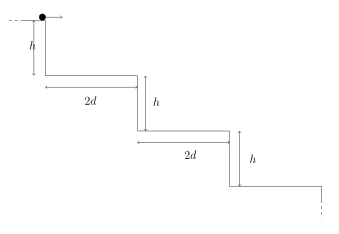
Solution: Considering the horizontal component, this will be constant as there are no forces acting in that direction. The first step will take the particle \(t = \sqrt{\frac{2h}g}\) to reach. At which point it will be travelling with speed \(v = \sqrt{2gh} \) (by energy considerations, \(mgh = \frac12 mv^2\)). To reach the second step must take twice as long (since the ball has to travel \(2d\) horizontally, rather than \(d\)). Since \(t = 2\sqrt{\frac{2h}g}\) we must have that: \begin{align*} && s &= ut + \frac12 gt^2 \\ \Rightarrow && h &= u 2\sqrt{\frac{2h}g} + \frac12 g \frac{8h}g \\ \Rightarrow && u &= -\frac{3}{2} h\sqrt{\frac{g}{2h}} \\ &&&= -\frac{3}{2\sqrt{2}} \sqrt{gh} \end{align*} Therefore, using Newton's experimental law, we must have that \(e = \frac{\frac{3}{2 \sqrt{2}} \sqrt{gh}}{\sqrt{2} \sqrt{gh}} = \frac{3}{4}\). Again by conservation of energy \(mgh + \frac12 \frac{9}{8} mgh = \frac12 mv^2 \Rightarrow v = \frac{5}{2\sqrt{2}} \sqrt{gh}\) when it lands on the next step. Therefore we would need the coefficient of restitution for the second (and subsequent steps) to be: \(\displaystyle \frac{\frac{3}{2\sqrt{2}} \sqrt{gh}}{\frac{5}{2\sqrt{2}} \sqrt{gh}} = \frac35\)