Problems
Filters
21 problems found
2025 Paper 2 Q9
Points \(A\) and \(B\) are at the same height and a distance \(\sqrt{2}r\) apart. Two small, spherical particles of equal mass, \(P\) and \(Q\), are suspended from \(A\) and \(B\), respectively, by light inextensible strings of length \(r\). Each particle individually may move freely around and inside a circle centred at the point of suspension. The particles are projected simultaneously from points which are a distance \(r\) vertically below their points of suspension, directly towards each other and each with speed \(u\). When the particles collide, the coefficient of restitution in the collision is \(e\).
- Show that, immediately after the collision, the horizontal component of each particle's velocity has magnitude \(\frac{1}{2}ev\sqrt{2}\), where \(v^2 = u^2 - gr(2 - \sqrt{2})\) and write down the vertical component in terms of \(v\).
- Show that the strings will become taut again at a time \(t\) after the collision, where \(t\) is a non-zero root of the equation \[(r - evt)^2 + \left(-r + vt - \frac{1}{2}\sqrt{2}gt^2\right)^2 = 2r^2.\]
- Show that, in terms of the dimensionless variables \[z = \frac{vt}{r} \quad \text{and} \quad c = \frac{\sqrt{2}v^2}{rg}\] this equation becomes \[\left(\frac{z}{c}\right)^3 - 2\left(\frac{z}{c}\right)^2 + \left(\frac{2}{c} + 1 + e^2\right)\left(\frac{z}{c}\right) - \frac{2}{c}(1 + e) = 0.\]
- Show that, if this equation has three equal non-zero roots, \(e = \frac{1}{3}\) and \(v^2 = \frac{9}{2}\sqrt{2}rg\). Explain briefly why, in this case, no energy is lost when the string becomes taut.
- In the case described in (iv), the particles have speed \(U\) when they again reach the points of their motion vertically below their points of suspension. Find \(U^2\) in terms of \(r\) and \(g\).
Solution:

- Assuming the particles have mass \(m\), and speed \(v\) just before collision, then \begin{align*} \text{COE}: && \underbrace{\frac12 m u^2}_{\text{initial kinetic energy}} + \underbrace{0}_{\text{initial GPE}} &= \underbrace{\frac12m v^2}_{\text{kinetic energy just before collision}} + \underbrace{mgr\left(1-\frac1{\sqrt{2}}\right)}_{\text{GPE just before collision}} \\ \Rightarrow && v^2 &= u^2 - gr(2-\sqrt{2}) \end{align*} Therefore the particles has velocity \(\frac{\sqrt{2}}2v \binom{\pm 1}{1}\) before the collision. By symmetry, the impulse between the particles will be horizontal, so the vertical velocities will be unchanged at \(\frac{\sqrt{2}}{2}v\). By conservation of momentum (or symmetry) the particles will have equal but opposite velocities after the collision (say \(w\)) satisfying: \[ e = \frac{2w}{2\frac{\sqrt{2}}{2}v} \] ie \(w = \frac{\sqrt{2}}2 e v\) as required.
- Once the particles have rebounded, they will be projectiles whilst the strings are slack. If we consider the left-most point \(A = (0,0)\) then the particles colide at \(\left ( \frac{\sqrt{2}}{2}, -\frac{\sqrt{2}}{2} \right)\) and the position at time \(t\) after the collision (before the string goes slack) will be: \begin{align*} \mathbf{x}_t &= \frac{\sqrt{2}}{2}r\binom{1}{-1} + \frac{\sqrt{2}}{2} vt \binom{-e}{1} + \frac12 gt^2 \binom{0}{-1} \end{align*} The string will go taught when \(|\mathbf{x}_t|^2 = r^2\), ie \begin{align*} && r^2 &= \left ( \frac{\sqrt{2}}{2} r - \frac{\sqrt{2}}{2}evt \right)^2 + \left (-\frac{\sqrt{2}}{2} r + \frac{\sqrt{2}}{2}vt -\frac12 gt^2 \right)^2 \\ \Rightarrow && r^2 &= \frac12 \left (r - evt \right)^2 + \frac12 \left (-r+vt - \frac{\sqrt{2}}{2}gt^2 \right)^2 \\ \Rightarrow && 2r^2 &= \left (r - evt \right)^2 + \left (-r+vt - \frac{\sqrt{2}}{2}gt^2 \right)^2 \\ \end{align*} as required.
- Suppose \(z = \frac{vt}{r}\), \(c = \frac{\sqrt{2}v^2}{rg}\), then \begin{align*} && 2r^2 &= \left (r - evt \right)^2 + \left (-r+vt - \frac{\sqrt{2}}{2}gt^2 \right)^2 \\ \Leftrightarrow && 2 &= \left (1 - e\frac{vt}{r} \right)^2 + \left (-1 + \frac{vt}{r}- \frac{\sqrt{2}}{2} \frac{gt^2}{r} \right)^2 \\ \Leftrightarrow && 2 &= \left (1 - ez \right)^2 + \left (-1 +z- \frac{v^2t^2}{r^2} \frac{gr}{\sqrt{2}v^2}\right)^2 \\ \Leftrightarrow && 2 &= \left (1 - ez \right)^2 + \left (-1 +z- \frac{z^2}{c} \right)^2 \\ \Leftrightarrow && 2 &= 1-2ez + e^2z^2 + 1 + z^2 +\frac{z^4}{c^2} - 2z-2\frac{z^3}{c}+2\frac{z^2}{c} \\ \Leftrightarrow && 0 &= z(-2e-2) + z^2(e^2+1 + \frac{2}{c}) + z^3(-\frac{2}{c}) + z^4 \frac{1}{c^2} \\ \underbrace{\Leftrightarrow}_{z \neq 0} && 0 &= \left ( \frac{z}{c} \right)^3 - 2\left ( \frac{z}{c} \right)^2 + \left ( \frac{z}{c} \right) (1 + e^2 + \frac{2}{c} ) - \frac{2}{c}(1+e) \end{align*} as required, (where on the last step we divide by \(z/c\)).
- If a cubic has \(3\) equal, non-zero roots then it must have the form \((z-a)^3 = z^3 -3az^2 + 3a^2 z -a^3 = 0\), so \(3a = 2\), and so the expansion must be \(\left ( \frac{z}{c} \right)^3 - 2\left ( \frac{z}{c} \right)^2 + \frac{4}{3}\left ( \frac{z}{c} \right) - \frac{8}{27} = 0\) \begin{align*} && \frac{2}{c}(1+e) &= \frac{8}{27} \\ \Rightarrow && \frac{2}{c} &= \frac{8}{27} \frac{1}{1+e} \\ && 1 + e^2 + \frac{2}{c} &= \frac43 \\ \Rightarrow && e^2 + \frac{8}{27(1+e)} &= \frac{1}{3} \\ \Rightarrow && 27(1+e)e^2+8 &= 9(1+e) \\ \Rightarrow && 27e^3 + 27e^2-9e-1 &= 0 \\ \Rightarrow && (3e-1)(9e^2+12e+1) &= 0 \end{align*} The only (positive) root is \(e = \frac13\), therefore \(e = \frac13\). We must also have \begin{align*} && \frac{2}{c} \frac43 &= \frac{8}{27} \\ \Rightarrow && c &= 9 \\ \Rightarrow && \frac{\sqrt{2}v^2}{rg} &= 9 \\ \Rightarrow && v^2 &= \frac{9\sqrt{2}rg}{2} \end{align*} as required. If we consider the path of the particle acting as a projectile, iff the path is tangent to the circle then there will be exactly one solution for \(z/c\) and (importantly) it will be a repeated root. Therefore the particle rejoins the circle at a tangent and the tension is acting perpendicularly to the direction of motion (ie no energy loss).
- Since the only energy lost is lost in the collision, we can apply conservation of energy again: \begin{align*} \text{COE:} && \frac12 m U^2 &= \frac12 m \frac12v^2(1+e^2) + mgr\left (1 - \frac1{\sqrt{2}} \right) \\ \Rightarrow && U^2 &= \frac12 \frac{9 \sqrt{2}}{2}gr(1+\frac19) + gr(2 - \sqrt{2}) \\ &&&= \left (\frac{5\sqrt{2}}{2}+2 - \sqrt{2} \right)gr \\ &&&= \left (\frac{4+3\sqrt{2}}{2} \right)gr \end{align*}
2018 Paper 3 Q11
A particle is attached to one end of a light inextensible string of length \(b\). The other end of the string is attached to a fixed point \(O\). Initially the particle hangs vertically below \(O\). The particle then receives a horizontal impulse. The particle moves in a circular arc with the string taut until the acute angle between the string and the upward vertical is \(\alpha\), at which time it becomes slack. Express \(V\), the speed of the particle when the string becomes slack, in terms of \( b\), \(g\) and \(\alpha\). Show that the string becomes taut again a time \(T\) later, where \[ gT = 4V \sin\alpha \,,\] and that just before this time the trajectory of the particle makes an angle \(\beta \) with the horizontal where \(\tan\beta = 3\tan \alpha \,\). When the string becomes taut, the momentum of the particle in the direction of the string is destroyed. Show that the particle comes instantaneously to rest at this time if and only if \[ \sin^2\alpha = \dfrac {1+\sqrt3}4 \,. \]
Solution:

2017 Paper 3 Q11
A railway truck, initially at rest, can move forwards without friction on a long straight horizontal track. On the truck, \(n\) guns are mounted parallel to the track and facing backwards, where \(n>1\). Each of the guns is loaded with a single projectile of mass \(m\). The mass of the truck and guns (but not including the projectiles) is \(M\). When a gun is fired, the projectile leaves its muzzle horizontally with a speed \(v-V\) relative to the ground, where \(V\) is the speed of the truck immediately before the gun is fired.
- All \(n\) guns are fired simultaneously. Find the speed, \(u\), with which the truck moves, and show that the kinetic energy, \(K\), which is gained by the system (truck, guns and projectiles) is given by \[ K= \tfrac{1}{2}nmv^2\left(1 +\frac{nm}{M} \right) . \]
- Instead, the guns are fired one at a time. Let \(u_r\) be the speed of the truck when \(r\) guns have been fired, so that \(u_0= 0\). Show that, for \(1\le r \le n\,\), \[ u_r - u_{r-1} = \frac{mv}{M+(n-r)m} \tag{\(*\)} \] and hence that \(u_n < u\,\).
- Let \(K_r\) be the total kinetic energy of the system when \(r\) guns have been fired (one at a time), so that \(K_0 = 0\). Using \((*)\), show that, for \(1\le r\le n\,\), \[ K_r -K_{r-1} = \tfrac 12 mv^2 + \tfrac12 mv (u_r-u_{r-1}) \] and hence show that \[ K_n = \tfrac{1}{2}nmv^2 +\tfrac{1}{2}mvu_n \,. \] Deduce that \(K_n < K\).
Solution:
- \(\,\) \begin{align*} \text{COM}: && 0 &= nm(v-0) - Mu \\ \Rightarrow && u &= \frac{nm}{M}v \\ \\ \Rightarrow && \text{K.E.} &= \underbrace{\tfrac12 nmv^2}_{\text{projectiles}} + \underbrace{\tfrac12Mu^2}_{\text{guns and truck}} \\ &&&= \tfrac12nmv^2 + \tfrac12M \frac{n^2m^2}{M^2}v^2 \\ &&&= \tfrac12 nmv^2 \left (1 + \frac{nm}{M} \right) \end{align*}
- \(\,\) \begin{align*} \text{COM}: && ((n-r+1)m+M)u_{r-1} &= -m(v-u_{r-1})+ ((n-r)m+M)u_r \\ \Rightarrow && mv &= -((n-r+1)m+M-m)u_{r-1}+((n-r)m+M)u_r \\ \Rightarrow && u_r-u_{r-1} &= \frac{mv}{M+(n-r)m} \\ \\ && u_n &= \frac{mv}{M+(n-1)m} + \frac{mv}{M+(n-2)m} + \cdots + \frac{mv}{M} \\ &&&< \frac{mv}M + \cdots + \frac{mv}{M} \\ &&&= \frac{mn}{M}v = u \end{align*}
- \(\,\) \begin{align*} && K_r &= \underbrace{K_{r-1}-\frac12(m(n-r+1)+M)u_{r-1}^2}_{\text{energy of already dispersed projectiles}} + \frac12m(v-u_{r-1})^2 + \frac12(m(n-r)+M)u_r^2 \\ \Rightarrow && K_r-K_{r-1} &= \tfrac12(u_r^2-u_{r-1}^2)(M+m(n-r))+\tfrac12mv^2-mvu_{r-1} \\ &&&=\tfrac12mv^2+ \tfrac12(u_r+u_{r-1})mv-mvu_{r-1} \\ &&&= \tfrac12mv^2 + \tfrac12mv(u_r-u_{r-1}) \\ \\ && K_n &= \frac12nmv^2 + \tfrac12mv(u_n - u_0) \\ &&&= \tfrac12nmv^2 + \tfrac12mvu_n \\ &&&< \tfrac12nmv^2 + \tfrac12mvu \\ &&&= \tfrac12nmv^2 + \tfrac12mv \frac{nm}{M}v \\ &&&= \tfrac12nmv^2 \left (1 +\frac{m}{M} \right) \\ &&&\leq K \end{align*}
2015 Paper 3 Q10
A light rod of length \(2a\) has a particle of mass \(m\) attached to each end and it moves in a vertical plane. The midpoint of the rod has coordinates \((x,y)\), where the \(x\)-axis is horizontal (within the plane of motion) and \(y\) is the height above a horizontal table. Initially, the rod is vertical, and at time \(t\) later it is inclined at an angle \(\theta\) to the vertical. Show that the velocity of one particle can be written in the form \[ \begin{pmatrix} \dot x + a \dot\theta \cos\theta \\ \dot y - a \dot\theta \sin\theta \end{pmatrix} \] and that \[ m\begin{pmatrix} \ddot x + a\ddot\theta \cos\theta - a \dot\theta^2 \sin\theta \\ \ddot y- a\ddot\theta \sin\theta - a \dot\theta^2 \cos\theta \end{pmatrix} =-T\begin{pmatrix} \sin\theta \\ \cos\theta \end{pmatrix} -mg \begin{pmatrix} 0 \\ 1 \end{pmatrix} \] where the dots denote differentiation with respect to time \(t\) and \(T\) is the tension in the rod. Obtain the corresponding equations for the other particle. Deduce that \(\ddot x =0\), \(\ddot y = -g\) and \(\ddot\theta =0\). Initially, the midpoint of the rod is a height \(h\) above the table, the velocity of the higher particle is \(\Big(\begin{matrix} \, u \, \\ v \end{matrix}\Big)\), and the velocity of the lower particle is \(\Big(\begin{matrix}\, 0 \, \\ v\end{matrix}\Big)\). Given that the two particles hit the table for the first time simultaneously, when the rod has rotated by \(\frac12\pi\), show that \[ 2hu^2 = \pi^2a^2 g - 2\pi uva \,. \]
2014 Paper 3 Q9
A particle of mass \(m\) is projected with velocity \(\+ u\). It is acted upon by the force \(m\+g\) due to gravity and by a resistive force \(-mk \+v\), where \(\+v\) is its velocity and \(k\) is a positive constant. Given that, at time \(t\) after projection, its position \(\+r\) relative to the point of projection is given by \[ \+r = \frac{kt -1 +\.e^{-kt}} {k^2} \, \+g + \frac{ 1-\.e^{-kt}}{k} \, \+u \,, \] find an expression for \(\+v\) in terms of \(k\), \(t\), \(\+g\) and \(\+u\). Verify that the equation of motion and the initial conditions are satisfied. Let \(\+u = u\cos\alpha \, \+i + u \sin\alpha \, \+j\) and $\+g = -g\, \+j\(, where \)0<\alpha<90^\circ\(, and let \)T$ be the time after projection at which \(\+r \,.\, \+j =0\). Show that \[ uk \sin\alpha = \left(\frac{kT}{1-\.e^{-kT}} -1\right)g\,. \] Let \(\beta\) be the acute angle between \(\+v\) and \(\+i\) at time \(T\). Show that \[ \tan\beta = \frac{(\.e^{kT}-1)g}{uk\cos\alpha}-\tan\alpha \,. \] Show further that \(\tan\beta >\tan\alpha\) (you may assume that \(\sinh kT >kT\)) and deduce that~\(\beta >\alpha\).
2008 Paper 1 Q10
On the (flat) planet Zog, the acceleration due to gravity is \(g\) up to height \(h\) above the surface and \(g'\) at greater heights. A particle is projected from the surface at speed \(V\) and at an angle \(\alpha\) to the surface, where \(V^2 \sin^2\alpha > 2 gh\,\). Sketch, on the same axes, the trajectories in the cases \(g'=g\) and \(g' < g\). Show that the particle lands a distance \(d\) from the point of projection given by \[ d = \left(\frac {V-V'} g + \frac {V'}{ g'} \right) V\sin2\alpha\,, \] where \(V' = \sqrt{V^2-2gh\,\rm{cosec}^2\alpha\,}\,\).
2003 Paper 3 Q11
Point \(B\) is a distance \(d\) due south of point \(A\) on a horizontal plane. Particle \(P\) is at rest at \(B\) at \(t=0\), when it begins to move with constant acceleration \(a\) in a straight line with fixed bearing~\(\beta\,\). Particle \(Q\) is projected from point \(A\) at \(t=0\) and moves in a straight line with constant speed \(v\,\). Show that if the direction of projection of \(Q\) can be chosen so that \(Q\) strikes \(P\), then \[ v^2 \ge ad \l 1 - \cos \beta \r\;. \] Show further that if \(v^2 >ad(1-\cos\beta)\) then the direction of projection of \(Q\) can be chosen so that \(Q\) strikes \(P\) before \(P\) has moved a distance \(d\,\).
2001 Paper 2 Q9
A particle of unit mass is projected vertically upwards with speed \(u\). At height \(x\), while the particle is moving upwards, it is found to experience a total force \(F\), due to gravity and air resistance, given by \(F=\alpha \e^{-\beta x}\), where \(\alpha\) and \(\beta\) are positive constants. Calculate the energy expended in reaching this height. Show that \[ F= {\textstyle \frac12} \beta v^2+ \alpha - {\textstyle \frac12} \beta u^2 \;, \] where \(v\) is the speed of the particle, and explain why \( \alpha = \frac12 \beta u^2 +g\), where \(g\) is the acceleration due to gravity. Determine an expression, in terms of \(y\), \(g\) and \(\beta\), for the air resistance experienced by the particle on its downward journey when it is at a distance \(y\) below its highest point.
Solution: Considering the energy of the particle, we have initial kinetic energy of \(\frac12 u^2\) and final energy is \(\frac12 v^2\), the change in energy is the work done by the force, \begin{align*} &&\text{Work done against resistance} &= \text{loss in kinetic energy} \\ &&\int F \, \d x &= \int \alpha e^{-\beta x} \, \d x \\ &&&= \frac{\alpha}{\beta} \l 1 - e^{-\beta x} \r \\ &&&= \frac{1}{\beta} \l \alpha - F\r \\ &&&= \frac12 u^2 - \frac12 v^2 \\ \Rightarrow && F &= \frac12 \beta v^2 + \alpha - \frac12 \beta u^2 \end{align*} When \(v = 0\) there is no air resistance, ie \(F = g\), but \(g = 0 + \alpha - \frac12 \beta u^2 \Rightarrow \alpha = g + \frac12 \beta u^2\) \(F = \frac12 \beta v^2 + g\), ie air resistance is \(\frac12 \beta v^2\) Looking at forces acting on the particle when it's descending, \begin{align*} && v \frac{dv}{dx} &= g - \frac12 \beta v^2 \\ \Rightarrow && \frac{v}{g - \frac12 \beta v^2} \frac{dv}{dx} &= 1 \\ \Rightarrow && \int \frac{v}{g - \frac12 \beta v^2} \, dv &= \int dx \\ \Rightarrow && \frac1{\beta}\l\ln(g - \frac12\beta v^2) - \ln(g)\r &= y\\ \Rightarrow && \ln \l 1 - \frac12 \frac{\beta}{g}v^2 \r &= \beta y \\ \Rightarrow && \frac{g}{\beta} \l 1-e^{-\beta y} \r = \frac12 v^2 \end{align*} Since force is the rate of change of work, we can say that the force is \(ge^{-\beta y}\) and the air resistance is \(g \l 1-e^{-\beta y} \r\)
1999 Paper 2 Q11
An automated mobile dummy target for gunnery practice is moving anti-clockwise around the circumference of a large circle of radius \(R\) in a horizontal plane at a constant angular speed \(\omega\). A shell is fired from \(O\), the centre of this circle, with initial speed \(V\) and angle of elevation \(\alpha\). Show that if \(V^2 < gR\), then no matter what the value of \(\alpha\), or what vertical plane the shell is fired in, the shell cannot hit the target. Assume now that \(V^2 > gR\) and that the shell hits the target, and let \(\beta\) be the angle through which the target rotates between the time at which the shell is fired and the time of impact. Show that \(\beta\) satisfies the equation $$ g^2{{\beta}^4} - 4{{\omega}^2}{V^2}{{\beta}^2} +4{R^2}{{\omega}^4}=0. $$ Deduce that there are exactly two possible values of \(\beta\). Let \(\beta_1\) and \(\beta_2\) be the possible values of \(\beta\) and let \(P_1\) and \(P_2\) be the corresponding points of impact. By considering the quantities \((\beta_1^2 +\beta_2^2) \) and \(\beta_1^2\beta_2^2\,\), or otherwise, show that the linear distance between \(P_1\) and \(P_2\) is \[ 2R \sin\Big( \frac\omega g \sqrt{V^2-Rg}\Big) \;. \]
Solution: \begin{align*} && 0 &= V\sin \alpha t-\frac12 gt^2 \\ \Rightarrow && t &= \frac{2V \sin \alpha}{g} \\ && R &= V \cos \alpha \, t \\ &&&= \frac{2V^2 \sin \alpha \cos \alpha}{g} \\ &&&= \frac{V^2 \sin 2 \alpha}{g} \end{align*} Therefore the max distance is \(\frac{V^2}{g}\), therefore we cannot hit the target if \(R > \frac{V^2}{g} \Rightarrow gR > V^2\). We have \(\beta = \omega t \Rightarrow t = \frac{\beta}{\omega}\) \begin{align*} && \sin \alpha &= \frac{gt}{2V} \\ && \cos \alpha &= \frac{R}{Vt} \\ \Rightarrow && 1 &= \left (\frac{gt}{2V} \right)^2 + \left ( \frac{R}{Vt} \right)^2 \\ &&&= \left (\frac{g\beta}{2V \omega} \right)^2 + \left ( \frac{R\omega}{V\beta} \right)^2 \\ &&&= \frac{g^2 \beta^2}{4 V^2 \omega^2} + \frac{R^2 \omega^2}{V^2 \beta ^2} \\ \Rightarrow && 4V^2 \omega^2 \beta^2 &= g^2 \beta^4 + 4R^2 \omega^4 \\ \Rightarrow && 0 &= g^2 \beta^4 - 4\omega^2 V^2 \beta^2+4R^2\omega^4 \end{align*} This (quadratic) equation in terms of \(\beta^2\) has two solution if \(\Delta = 16\omega^4V^4-16g^2R^2\omega^4 =16\omega^4(V^4-g^2R^2) > 0\) since \(V^2 > gR\). Since \(\beta > 0\) there are exactly two solutions, once we have values for \(\beta\). First notice, \begin{align*} && \beta_1^2 + \beta_2^2 &= \frac{4\omega^2V^2}{g^2} \\ && \beta_1^2\beta_2^2 &= \frac{4R^2\omega^4}{g^2} \end{align*} Then notice the positions of \(P_1\) and \(P_2\) are \((R\cos \beta_1 , R\sin \beta_1)\) and \((R\cos \beta_2, R\sin \beta_2)\). \begin{align*} && d^2 &= R^2\left ( \cos \beta_1 - \cos \beta_2 \right)^2 + R^2 \left ( \sin \beta_1 - \sin \beta_2 \right)^2 \\ &&&= 2R^2 - 2R^2(\cos \beta_1 \cos \beta_2 + \sin \beta_1 \sin \beta_2) \\ &&&= 2R^2-2R^2\cos(\beta_1 - \beta_2) \\ &&&= 2R^2 \left (1-\cos(\sqrt{(\beta_1-\beta_2)^2} \right ) \\ &&&= 2R^2 \left (1 - \cos\left ( \sqrt{\frac{4\omega^2 V^2}{g^2} - \frac{4R\omega^2}{g}} \right) \right) \\ &&&= 2R^2 \left (1 - \cos\left (\frac{2\omega}{g} \sqrt{V^2 - Rg} \right) \right) \\ &&&= 4 R^2 \sin^2 \left (\frac{\omega}{g} \sqrt{V^2 - Rg} \right) \end{align*} which gives us the required result.
1997 Paper 1 Q11
A particle of unit mass is projected vertically upwards in a medium whose resistance is \(k\) times the square of the velocity of the particle. If the initial velocity is \(u\), prove that the velocity \(v\) after rising through a distance \(s\) satisfies \begin{equation*} v^{2}=u^{2}\e^{-2ks}+\frac{g}{k}(\e^{-2ks}-1). \tag{*} \end{equation*} Find an expression for the maximum height of the particle above he point of projection. Does equation \((*)\) still hold on the downward path? Justify your answer.
Solution: \begin{align*} \text{N2}(\uparrow): && 1 \cdot v\frac{\d v}{\d s} &= -g - kv^2 \\ \Rightarrow && \int \frac{v}{g+kv^2} \d v &= \int -1 \d s \\ \Rightarrow && \frac{1}{2k}\ln(g+kv^2) &= -s + C \\ s =0, v = u: && \frac{1}{2k} \ln(g+ku^2) &= C \\ \Rightarrow && s &= \frac{1}{2k} \ln \frac{g+ku^2}{g+kv^2} \\ \Rightarrow && e^{-2ks} &= \frac{g+kv^2}{g+ku^2} \\ \Rightarrow && v^2 &= u^2e^{-2ks} + \frac{g}{k}(e^{-2ks}-1) \end{align*} The maximum height will be when \(v = 0\), ie \(\displaystyle s = \frac{1}{2k}\ln\left(1 + \frac{k}{g}u^2 \right)\). On the downward path the resistance will be going upwards, ie \begin{align*} \text{N2}(\uparrow): && 1 \cdot v\frac{\d v}{\d s} &= -g + kv^2 \end{align*} but our solution is solving a different differential equation, therefore unless \(k=0\) the equation will be different.
1996 Paper 2 Q10
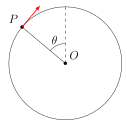
The plot of `Rhode Island Red and the Henhouse of Doom' calls for the heroine to cling on to the circumference of a fairground wheel of radius \(a\) rotating with constant angular velocity \(\omega\) about its horizontal axis and then let go. Let \(\omega_{0}\) be the largest value of \(\omega\) for which it is not possible for her subsequent path to carry her higher than the top of the wheel. Find \(\omega_{0}\) in terms of \(a\) and \(g\). If \(\omega>\omega_{0}\) show that the greatest height above the top of the wheel to which she can rise is \[\frac{a}{2}\left(\frac{\omega}{\omega_{0}} -\frac{\omega_{0}}{\omega}\right)^{\!\!2}.\]
Solution:
1996 Paper 3 Q9
A particle of mass \(m\) is at rest on top of a smooth fixed sphere of radius \(a\). Show that, if the particle is given a small displacement, it reaches the horizontal plane through the centre of the sphere at a distance % at least $$a(5\sqrt5+4\sqrt23)/27$$ from the centre of the sphere. [Air resistance should be neglected.]
1993 Paper 3 Q14
A particle rests at a point \(A\) on a horizontal table and is joined to a point \(O\) on the table by a taut inextensible string of length \(c\). The particle is projected vertically upwards at a speed \(64\surd(6gc)\). It next strikes the table at a point \(B\) and rebounds. The coefficient of restitution for any impact between the particle and the table is \({1\over 2}\). After rebounding at \(B\), the particle will rebound alternately at \(A\) and \(B\) until the string becomes slack. Show that when the string becomes slack the particle is at height \(c/2\) above the table. Determine whether the first rebound between \(A\) and \(B\) is nearer to \(A\) or to \(B\).
Solution: \begin{align*} \text{N2}(radially): && T + mg \cos \theta &= m\frac{v^2}{r} \\ \Rightarrow && v^2-gc \cos \theta &\geq 0 \\ \text{COE}: && \frac12 m u^2 &= \frac12mv^2 + mgc\cos \theta \\ \Rightarrow && u^2 &= v^2 + 2gc\cos \theta \\ && u^2 &\geq gc \cos \theta+2gc\cos \theta \\ \Rightarrow && u^2 &\geq 3gc\cos \theta \end{align*} Therefore it will complete bounces with the string taught if it leaves the table with \(u^2 \geq 3gc\). After \(6\) bounces it will leave the table with speed \(\sqrt{6gc} > \sqrt{3gc}\) and after \(7\) bounces it will leave the table with speed \(\sqrt{\frac{3}{2} gc} < \sqrt{3 gc}\). When it leaves the table with speed \(\sqrt{\tfrac32 gc}\), the string will go slack when \begin{align*} && \tfrac32 gc &= 3gc \cos \theta \\ \Rightarrow && \cos \theta &= \frac{1}{2} \end{align*} ie at a height \(c\cos \theta = \frac12c\) above the table. Once the string goes slack, the particle travels under circular motion, \begin{align*} && u^2 &= \frac12 gc \\ \Rightarrow && u_\rightarrow &= \sqrt{\tfrac12 gc} \cos \theta \\ && u_{\uparrow} &= \sqrt{\tfrac12 gc} \sin \theta \\ \Rightarrow && s &= ut - \tfrac12 gt^2 \\ \Rightarrow && -\frac{c}{2} &= \sqrt{\tfrac12 gc} \frac{\sqrt{3}}{2} t - \tfrac12 g t^2 \\ \Rightarrow && t &= \sqrt{\frac{c}{g}} \left ( \frac{\sqrt{6}+\sqrt{22}}{4} \right) \\ \Rightarrow && s_{\rightarrow} &= \tfrac12 \sqrt{\tfrac12 gc} \sqrt{\frac{c}{g}} \left ( \frac{\sqrt{6}+\sqrt{22}}{4} \right) - \frac{\sqrt{3}}{2}c \\ &&&= \left ( \frac{\sqrt{11}-3\sqrt{3}}{8} \right)c \\ \end{align*} We need to establish whether this position is positive or negative (ie if we cross the centre line. Clearly \(\sqrt{11} < 3\sqrt{3}\) so we haven't crossed the centre line and we land closer to where we took off. Since it's the 7th take off, this is closer to \(B\).
1992 Paper 1 Q10
A projectile of mass \(m\) is fired horizontally from a toy cannon of mass \(M\) which slides freely on a horizontal floor. The length of the barrel is \(l\) and the force exerted on the projectile has the constant value \(P\) for so long as the projectile remains in the barrel. Initially the cannon is at rest. Show that the projectile emerges from the barrel at a speed relative to the ground of \[ \sqrt{\frac{2PMl}{m(M+m)}}. \]
1991 Paper 3 Q13
A smooth particle \(P_{1}\) is projected from a point \(O\) on the horizontal floor of a room with has a horizontal ceiling at a height \(h\) above the floor. The speed of projection is \(\sqrt{8gh}\) and the direction of projection makes an acute angle \(\alpha\) with the horizontal. The particle strikes the ceiling and rebounds, the impact being perfectly elastic. Show that for this to happen \(\alpha\) must be at least \(\frac{1}{6}\pi\) and that the range on the floor is then \[ 8h\cos\alpha\left(2\sin\alpha-\sqrt{4\sin^{2}\alpha-1}\right). \] Another particle \(P_{2}\) is projected from \(O\) with the same velocity as \(P_{1}\) but its impact with the ceiling is perfectly inelastic. Find the difference \(D\) between the ranges of \(P_{1}\) and \(P_{2}\) on the floor and show that, as \(\alpha\) varies, \(D\) has a maximum value when \(\alpha=\frac{1}{4}\pi.\)