Problems
Filters
2 problems found
2013 Paper 1 Q3
For any two points \(X\) and \(Y\), with position vectors \(\bf x\) and \(\bf y\) respectively, \(X*Y\) is defined to be the point with position vector \(\lambda {\bf x}+ (1-\lambda){\bf y}\), where \(\lambda\) is a fixed number.
- If \(X\) and \(Y\) are distinct, show that \(X*Y\) and \(Y*X\) are distinct unless \(\lambda\) takes a certain value (which you should state).
- Under what conditions are \((X*Y)*Z\) and \(X*(Y*Z)\,\) distinct?
- Show that, for any points \(X\), \(Y\) and \(Z\), \[ (X*Y)*Z = (X*Z)*(Y*Z)\, \] and obtain the corresponding result for \(X*(Y*Z)\).
- The points \(P_1\), \(P_2\), \(\ldots\) are defined by \( P_1 = X*Y\) and, for \(n \ge2\), \(P_n= P_{n-1}*Y\,.\) Given that \(X\) and \(Y\) are distinct and that \(0<\lambda<1\), find the ratio in which \(P_n\) divides the line segment \(XY\).
Solution:
- Suppose \(X*Y = Y*X\), then \begin{align*} && X * Y &= \lambda \mathbf{x} + (1-\lambda) \mathbf{y} \\ && Y * X &= \lambda \mathbf{y} + (1-\lambda) \mathbf{x}\\ \Rightarrow && 0 &= (2\lambda - 1)(\mathbf{x} -\mathbf{y}) \end{align*} Therefore, either \(\mathbf{x} = \mathbf{y}\) or \(\lambda = \frac12\). Since we assumed \(X,Y\) were distinct, \(\mathbf{x} \neq \mathbf{y}\) and so \(X*Y\) and \(Y*X\) are distinct unless \(\lambda = \frac12\)
- Suppose \((X*Y)*Z = X*(Y*Z)\) \begin{align*} &&(X*Y)*Z &= (\lambda \mathbf{x} + (1-\lambda) \mathbf{y}) * \mathbf{z} \\ &&&= (\lambda^2 \mathbf{x} + \lambda(1-\lambda)\mathbf{y} + (1-\lambda)\mathbf{z}\\ &&X*(Y*Z) &=\mathbf{x}* (\lambda \mathbf{y} + (1-\lambda) \mathbf{z}) \\ &&&= (\lambda \mathbf{x} + \lambda(1-\lambda)\mathbf{y} + (1-\lambda)^2\mathbf{z}\\ \Rightarrow && 0 &= (\lambda^2 - \lambda)\mathbf{x} + ((1-\lambda) - (1-\lambda)^2)\mathbf{z} \\ &&&=(1-\lambda)(-\lambda \mathbf{x} +\lambda \mathbf{z}) \\ &&&= \lambda(1-\lambda)(\mathbf{z}-\mathbf{x}) \end{align*} Therefore they are distinct unless \(\lambda = 1, 0\) or \(\mathbf{x} = \mathbf{z}\).
- Claim: \((X*Y)*Z = (X*Z)*(Y*Z)\) Proof: \begin{align*} && (X*Y)*Z &= (\lambda \mathbf{x} + \lambda(1-\lambda)\mathbf{y} + (1-\lambda)^2\mathbf{z} \\ && (X*Z)*(Y*Z) &= (\lambda \mathbf{x} + (1-\lambda)\mathbf{z}) * (\lambda \mathbf{y} + (1-\lambda)\mathbf{z}) \\ &&&= \lambda(\lambda \mathbf{x} + (1-\lambda)\mathbf{z}) + (1-\lambda)(\lambda \mathbf{y} + (1-\lambda)\mathbf{z}) \\ &&&= \lambda^2 \mathbf{x} + \lambda(1-\lambda)\mathbf{y} + (1-\lambda) \mathbf{z} \end{align*} Claim: \(X*(Y*Z) = (X*Y)*(X*Z)\) Proof: \begin{align*} X*(Y*Z) &= \lambda \mathbf{x} + \lambda(1-\lambda)\mathbf{y} + (1-\lambda)^2\mathbf{z} \\ (X*Y)*(X*Z) &= (\lambda \mathbf{x} + (1-\lambda)\mathbf{y})*(\lambda \mathbf{x} + (1-\lambda)\mathbf{z}) \\ &= \lambda (\lambda \mathbf{x} + (1-\lambda)\mathbf{y}) + (1-\lambda)(\lambda \mathbf{x} + (1-\lambda)\mathbf{z}) \\ &= \lambda \mathbf{x} + \lambda(1-\lambda)\mathbf{y} + (1-\lambda)^2\mathbf{z} \end{align*}
- \(P_1 = X*Y\) divides the line segment into the ratio \(\lambda:(1-\lambda)\). \(P_n\) divides the line segment \(P_{n-1}Y\) into the ratio \(\lambda:(1-\lambda)\), therefore it divides the line segment \(XY\) in the ratio \(\lambda^n : 1- \lambda^n\) Alternatively, \begin{align*} P_1 &= \lambda \mathbf{x} + (1-\lambda)\mathbf{y} \\ P_2 &= (\lambda \mathbf{x} + (1-\lambda)\mathbf{y} )*\mathbf{y} \\ &= \lambda^2 \mathbf{x} + (1-\lambda^2) \mathbf{y} \end{align*} Suppose \(P_k = \lambda^k\mathbf{x} + (1-\lambda^k)\mathbf{y}\) then \begin{align*}P_{k+1} &= (\lambda^k\mathbf{x} + (1-\lambda^k)\mathbf{y}) * \mathbf{y} \\ &= \lambda^{k+1}\mathbf{x} + \lambda(1-\lambda^k)\mathbf{y} + (1-\lambda)\mathbf{y}\\ & = \lambda^{k+1}\mathbf{x} + (1-\lambda^{k+1})\mathbf{y}\end{align*}
1987 Paper 1 Q9
\(ABC\) is a triangle whose vertices have position vectors \(\mathbf{a,b,c}\)brespectively, relative to an origin in the plane \(ABC\). Show that an arbitrary point \(P\) on the segment \(AB\) has position vector \[ \rho\mathbf{a}+\sigma\mathbf{b}, \] where \(\rho\geqslant0\), \(\sigma\geqslant0\) and \(\rho+\sigma=1\). Give a similar expression for an arbitrary point on the segment \(PC\), and deduce that any point inside \(ABC\) has position vector \[ \lambda\mathbf{a}+\mu\mathbf{b}+\nu\mathbf{c}, \] where \(\lambda\geqslant0\), \(\mu\geqslant0\), \(\nu\geqslant0\) and \(\lambda+\mu+\nu=1\). Sketch the region of the plane in which the point \(\lambda\mathbf{a}+\mu\mathbf{b}+\nu\mathbf{c}\) lies in each of the following cases:
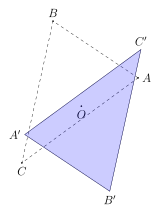
- \(\lambda+\mu+\nu=-1\), \(\lambda\leqslant0\), \(\mu\leqslant0\), \(\nu\leqslant0\);
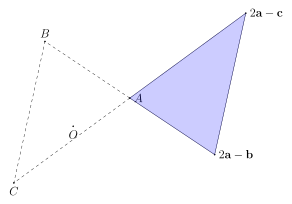
- \(\lambda+\mu+\nu=1\), \(\mu\leqslant0\), \(\nu\leqslant0\).
Solution:

- This is equivalent to the area inside the triangle where every point (\(\mathbf{a}, \mathbf{b}, \mathbf{c}\)) has been send to it's negative (\(-\mathbf{a}, -\mathbf{b}, -\mathbf{c}\)),
ie
- Writing points as:
\begin{align*}
\lambda\mathbf{a}+\mu\mathbf{b}+\nu\mathbf{c} &= (1-\mu - \nu)\mathbf{a}+\mu\mathbf{b}+\nu\mathbf{c} \\
&= \mathbf{a} + (-\mu)(\mathbf{a}-\mathbf{b}) + (-\nu)(\mathbf{a} - \mathbf{c}) \\
&= \mathbf{a} + (-\mu)(\mathbf{a}-\mathbf{b}) + (-\nu)(\mathbf{a} - \mathbf{c}) + (1+\mu+\nu)\mathbf{0}\\
\end{align*}
So this is a translation of \(\mathbf{a}\) of the triangle with vertices at \(\mathbf{0}, \mathbf{a-b}, \mathbf{a-c}\), or a triangle with vertices \(\mathbf{a}, 2\mathbf{a-b}, 2\mathbf{a-c}\).