Problems
Filters
2 problems found
2021 Paper 2 Q9
Two particles, of masses \(m_1\) and \(m_2\) where \(m_1 > m_2\), are attached to the ends of a light, inextensible string. A particle of mass \(M\) is fixed to a point \(P\) on the string. The string passes over two small, smooth pulleys at \(Q\) and \(R\), where \(QR\) is horizontal, so that the particle of mass \(m_1\) hangs vertically below \(Q\) and the particle of mass \(m_2\) hangs vertically below~\(R\). The particle of mass \(M\) hangs between the two pulleys with the section of the string \(PQ\) making an acute angle of \(\theta_1\) with the upward vertical and the section of the string \(PR\) making an acute angle of \(\theta_2\) with the upward vertical. \(S\) is the point on \(QR\) vertically above~\(P\). The system is in equilibrium.
- Using a triangle of forces, or otherwise, show that:
- \(\sqrt{m_1^2 - m_2^2} < M < m_1 + m_2\)\,;
- \(S\) divides \(QR\) in the ratio \(r : 1\), where \[ r = \frac{M^2 - m_1^2 + m_2^2}{M^2 - m_2^2 + m_1^2}. \]
- You are now given that \(M^2 = m_1^2 + m_2^2\). Show that \(\theta_1 + \theta_2 = 90^\circ\) and determine the ratio of \(QR\) to \(SP\) in terms of the masses only.
2014 Paper 1 Q11
The diagrams below show two separate systems of particles, strings and pulleys.In both systems, the pulleys are smooth and light, the strings are light and inextensible, the particles move vertically and the pulleys labelled with \(P\) are fixed. The masses of the particles are as indicated on the diagrams.
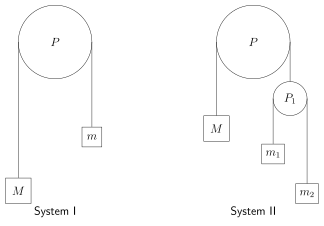
- For system I show that the acceleration, \(a_1\), of the particle of mass \(M\), measured in the downwards direction, is given by \[ a_1= \frac{M-m}{M+m} \, g \,, \] where \(g\) is the acceleration due to gravity. Give an expression for the force on the pulley due to the tension in the string.
- For system II show that the acceleration, \(a_2\), of the particle of mass \(M\), measured in the downwards direction, is given by \[ a_2= \frac{ M - 4\mu}{M+4\mu}\,g \,, \] where \(\mu = \dfrac{m_1m_2}{m_1+m_2}\). In the case \(m= m_1+m_2\), show that \(a_1= a_2\) if and only if \(m_1=m_2\).
Solution:
- \(\,\)
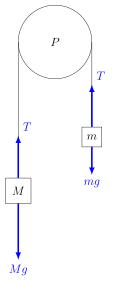
\begin{align*} \text{N2}(\uparrow, m): && T - mg &= ma_1 \\ \text{N2}(\uparrow, M): && T-Mg &= -Ma_1 \\ \Rightarrow && (M-m)g &= a_1(m+M) \\ \Rightarrow && a_1 &= \frac{M-m}{M+m}g \\ && T &= mg + ma_1 \\ &&&= \frac{2mM}{M+m}g \end{align*}
- System II is the same as system I, but with \(m\) replaced with \(2\frac{T}{g} = \frac{4mM}{M+m}\). In particular, this means that: \begin{align*} && a_2 &= \frac{M - \frac{4m_1m_2}{m_1+m_2}}{M + \frac{4m_1m_2}{m_1+m_2}} g \\ &&&= \frac{M-4\mu}{M+4\mu}g \end{align*} If \(m = m_1 + m_2\) then \begin{align*} && a_1 &= a_2 \\ \Leftrightarrow && \frac{M-m_1-m_2}{M+m_1+m_2} &= \frac{M - \frac{4m_1m_2}{m_1+m_2}}{M + \frac{4m_1m_2}{m_1+m_2}} \\ \Leftrightarrow && \frac{M-m_1-m_2}{M+m_1+m_2} &= \frac{M(m_1+m_2) -4m_1m_2}{M(m_1+m_2) + 4m_1m_2} \\ \Leftrightarrow && M^2(m_1+m_2)+4m_1m_2M &- M(m_1+m_2)^2 - 4m_1m_2(m_1+m_2) \\ &&\quad \quad = M^2(m_1+m_2) - 4m_1m_2M &+M(m_1+m_2)^2-4m_1m_2(m_1+m_2) \\ \Leftrightarrow && 8m_1m_2M&= 2M(m_1+m_2)^2 \\ \Leftrightarrow && 0 &= (m_1-m_2)^2 \\ \Leftrightarrow && m_1 &= m_2 \end{align*}