Sequences and series, recurrence and convergence
Method of differences (telescoping)
Show that the sum \(S_N\) of the first \(N\) terms of the series $$\frac{1}{1\cdot2\cdot3}+\frac{3}{\cdot3\cdot4}+\frac{5}{3\cdot4\cdot5}+\cdots +\frac{2n-1}{n(n+1)(n+2)}+\cdots$$ is $${1\over2}\left({3\over2}+{1\over N+1}-{5\over N+2}\right).$$ What is the limit of \(S_N\) as \(N\to\infty\)? The numbers \(a_n\) are such that $$\frac{a_n}{a_{n-1}}=\frac{(n-1)(2n-1)}{(n+2)(2n-3)}.$$ Find an expression for \(a_n/a_1\) and hence, or otherwise, evaluate \(\sum\limits_{n=1}^\infty a_n\) when \(\displaystyle a_1=\frac{2}{9}\;\).
Show SolutionFor each positive integer \(n\), let \begin{align*} a_n&=\frac1{n+1}+\frac1{(n+1)(n+2)}+\frac1{(n+1)(n+2)(n+3)}+\cdots;\\ b_n&=\frac1{n+1}+\frac1{(n+1)^2}+\frac1{(n+1)^3}+\cdots. \end{align*}
- Evaluate \(b_n\).
- Show that \(0
- Deduce that \(a_n=n!{\rm e}-[n!{\rm e}]\) (where \([x]\) is the integer part of \(x\)).
- Hence show that \(\mathrm{e}\) is irrational.
Sum the following infinite series.
- \[ 1 + \frac13 \bigg({\frac12}\bigg)^2 +\frac15\bigg(\frac12\bigg)^4 + \cdots + \frac{1}{2n+1} \bigg(\frac12\bigg)^{2n} + \cdots \] .
- \[ 2 -x -x^3 +2x^4 - \cdots + 2x^{4k} - x^{4k+1} - x^{4k+3} +\cdots \] where \(|x| < 1\).
- \[ \sum _{r=2}^\infty {r\, 2^{r-2} \over 3^{r-1} } \].
- \[ \sum_{r=2}^\infty {2 \over r(r^2-1) } \].
- \begin{align*} && \sum_{i=0}^{\infty} x^{2i+1}&= \frac{x}{1-x^2} \\ \Rightarrow &&&=\frac12 \left ( \frac{1}{1-x} - \frac{1}{1+x} \right) \\ \underbrace{\Rightarrow}_{\int} && \sum_{i=0}^{\infty} \frac{1}{2i+1} x^{2i+2} &= \frac12 \left ( -\ln (1-x) - \ln(1+x) \right) \\ \underbrace{\Rightarrow}_{x = 1/2} && \sum_{i=0}^\infty \frac{1}{2i+1} \left (\frac12 \right)^{2i+2} &= -\frac12 \ln \frac12 - \frac12 \ln \frac32 \\ &&&= -\frac12 \ln \frac34 \\ &&\frac14\sum_{i=0}^\infty \frac{1}{2i+1} \left (\frac12 \right)^{2i}&= \frac12 \ln \frac43 \\ \Rightarrow&& S &= 2 \ln \frac43 \end{align*}
- \begin{align*} \sum_{k=0}^{\infty} \left (2x^{4k} - x^{4k+1} - x^{4k+3} \right) &= \sum_{k=0}^{\infty} \left (2 - x^{1} - x^{3} \right) x^{4k} \\ &= \frac{2-x-x^3}{1-x^4} \\ &= \frac{(1-x)(2+x+x^2)}{(1-x)(1+x+x^2+x^3)} \\ &= \frac{2+x+x^2}{1+x+x^2+x^3} \end{align*}
- \begin{align*} && \frac{1}{(1-x)^2} &= \sum_{r=0}^{\infty} r x^{r-1} \\ \Rightarrow && 9 &= \sum_{r=1}^{\infty} r \left ( \frac23 \right)^{r-1} \\ \Rightarrow && \sum_{r=2}^{\infty} r \left ( \frac{2^{r-2}}{3^{r-1}} \right) &= \frac12 \left ( 9 - 1 \right) \\ &&&= 4 \end{align*}
- \begin{align*} && \frac{2}{r(r^2-1)} &= \frac{1}{r-1} - \frac{2}{r} + \frac{1}{r+1} \\ \Rightarrow && \sum_{r=2}^{\infty} \left ( \frac{1}{r-1} - \frac{2}{r} + \frac{1}{r+1} \right) &= \sum_{r=2}^{\infty} \left ( \frac{1}{r-1} - \frac{1}{r} - \frac{1}{r} + \frac{1}{r+1} \right) \\ &&&= \sum_{r=2}^{\infty} \left ( \frac{1}{r-1} - \frac{1}{r} \right)-\sum_{r=2}^{\infty} \left ( \frac{1}{r} - \frac{1}{r+1} \right) \\ &&&= 1 - \frac12 \\ &&&= \frac12 \end{align*}
For \(x>0\) find \(\int x\ln x\,\mathrm{d}x\). By approximating the area corresponding to \(\int_{0}^{1}x\ln(1/x)\, \d x\) by \(n\) rectangles of equal width and with their top right-hand vertices on the curve \(y=x\ln(1/x)\), show that, as \(n\rightarrow\infty\), \[ \frac{1}{2}\left(1+\frac{1}{n}\right)\ln n-\frac{1}{n^{2}}\left[\ln\left(\frac{n!}{0!}\right)+\ln\left(\frac{n!}{1!}\right)+\ln\left(\frac{n!}{2!}\right)+\cdots+\ln\left(\frac{n!}{(n-1)!}\right)\right]\rightarrow\frac{1}{4}. \] {[}You may assume that \(x\ln x\rightarrow0\) as \(x\rightarrow0\).{]}
Show Solution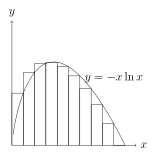
Obtain the sum to infinity of each of the following series.
- \(1{\displaystyle +\frac{2}{2}+\frac{3}{2^{2}}+\frac{4}{2^{3}}+\cdots+\frac{r}{2^{r-1}}+\cdots;}\)
- \(1{\displaystyle +\frac{1}{2}\times\frac{1}{2}+\frac{1}{3}\times\frac{1}{2^{2}}+\cdots+\frac{1}{r}\times\frac{1}{2^{r-1}}+\cdots;}\)
- \({\displaystyle \dfrac{1\times3}{2!}\times\frac{1}{3}+\frac{1\times3\times5}{3!}\frac{1}{3^{2}}+\cdots+\frac{1\times3\times\cdots\times(2k-1)}{k!}\times\frac{1}{3^{k-1}}+\cdots.}\)
- \begin{align*} && \frac1{1-x} &= \sum_{r=0}^{\infty} x^r \\ \underbrace{\Rightarrow}_{\frac{\d}{\d x}} && \frac{1}{(1-x)^2} &= \sum_{r=0}^\infty rx^{r-1} \\ \underbrace{\Rightarrow}_{x = \frac12} && 4 &= \sum_{r=0}^{\infty} \frac{r}{2^{r-1}} \end{align*}
- \begin{align*} && \frac1{1-x} &= \sum_{r=1}^{\infty} x^{r-1} \\ \underbrace{\Rightarrow}_{\int} && -\ln (1-x) &= \sum_{r=1}^{\infty} \frac1{r} x^r \\ \underbrace{\Rightarrow}_{x = \frac12} && \ln 2 &= \sum_{r=1}^{\infty} \frac1{r } \times \frac{1}{ 2^{r}} \\ \Rightarrow && 2 \ln 2 &= \sum_{r=1}^{\infty} \frac1{r } \times \frac{1}{ 2^{r-1}} \\ \end{align*}
- \begin{align*} && (1-x)^{-1/2} &= 1 + \frac{(-\tfrac12)}{1!} (-x) +\frac{(-\tfrac12)(-\tfrac32)}{2!}(-x)^2 + \cdots \\ &&&= \sum_{r=0}^{\infty} \frac{1 \cdot 3 \cdot 5 \cdots \cdot (2r-1)}{2^rr!} x^r \\ \underbrace{\Rightarrow}_{x = \frac23} && \sqrt{3} &= \sum_{r=0}^{\infty} \frac{1 \cdot 3 \cdot 5 \cdots \cdot (2r-1)}{r!} \frac1{3^r} \\ &&&= 1 + \frac{1}{1!} \frac23 + \frac13 \sum_{r=2}^{\infty} \frac{1 \cdot 3 \cdot 5 \cdots \cdot (2r-1)}{r!} \frac1{3^{r-1}} \\ \Rightarrow && 3\sqrt{3}-5 &= \sum_{r=2}^{\infty} \frac{1 \cdot 3 \cdot 5 \cdots \cdot (2r-1)}{r!} \frac1{3^{r-1}} \\ \end{align*}
Show that the sum of the infinite series \[ \log_{2}\mathrm{e}-\log_{4}\mathrm{e}+\log_{16}\mathrm{e}-\ldots+(-1)^{n}\log_{2^{2^{n}}}\mathrm{e}+\ldots \] is \[ \frac{1}{\ln(2\sqrt{2})}. \] {[}\(\log_{a}b=c\) is equivalent to \(a^{c}=b\).{]}
Show SolutionIf \(y=\mathrm{f}(x)\), then the inverse of \(\mathrm{f}\) (when it exists) can be obtained from Lagrange's identity. This identity, which you may use without proof, is \[ \mathrm{f}^{-1}(y)=y+\sum_{n=1}^{\infty}\frac{1}{n!}\frac{\mathrm{d}^{n-1}}{\mathrm{d}y^{n-1}}\left[y-\mathrm{f}\left(y\right)\right]^{n}, \] provided the series converges.
- Verify Lagrange's identity when \(\mathrm{f}(x)=\alpha x\), \((0<\alpha<2)\).
- Show that one root of the equation \[ \tfrac{1}{2}=x-\tfrac{1}{4}x^{3} \] is \[ x=\sum_{n=0}^{\infty}\frac{\left(3n\right)!}{n!\left(2n+1\right)!2^{4n+1}} \]
- Find a solution for \(x\), as a series in \(\lambda,\) of the equation \[ x=\mathrm{e}^{\lambda x}. \]
- If \(f(x) = \alpha x\) then \(f^{-1}(x) = \frac{1}{\alpha}x\). \begin{align*} && \frac{\d^{n-1}}{\d y^{n-1}} [y - \alpha y]^n &= \frac{\d^{n-1}}{\d y^{n-1}} [(1 - \alpha)^n y^n] \\ && &= (1-\alpha)^n n! y \\ \Rightarrow && y + \sum_{n=1}^{\infty} \frac{1}{n!}\frac{\d^{n-1}}{\d y^{n-1}} [y - \alpha y]^n &= y +\sum_{n=1}^{\infty} (1-\alpha)^ny \\ &&&= y + y\l \frac{1}{1-(1-\alpha)}-1 \r \\ &&&= \frac{1}{\alpha}y \end{align*} Where we can sum the geometric progression if \(|1-\alpha| < 1 \Leftrightarrow 0 < \alpha < 2\)
- Suppose that \(f(x) = x-\frac14x^3\). We would like to find \(f^{-1}(\frac12)\). \begin{align*} && \frac{\d^{n-1}}{\d y^{n-1}} [y - (y+\frac14 y^3)]^n &= \frac{\d^{n-1}}{\d y^{n-1}} [\frac1{4^n} y^{3n}] \\ && &= \frac{1}{4^n} \frac{(3n)!}{(2n+1)!} y^{2n+1} \\ \Rightarrow && f^{-1}(\frac12) &= \frac12 + \sum_{n=1}^{\infty} \frac{1}{4^n} \frac{(3n)!}{n!(2n+1)!} \frac{1}{2^{2n+1}} \\ &&&= \frac12 + \sum_{n=1}^{\infty} \frac{(3n)!}{n!(2n+1)!} \frac{1}{2^{4n+1}} \\ \end{align*} Since when \(n = 0\) \(\frac{0!}{0!1!} \frac{1}{2^{0+1}} = \frac12\) we can include the wayward \(\frac12\) in our infinite sum and so we have the required result.
- Consider \(f(x) = x - e^{\lambda x}\) we are interested in \(f^{-1}(0)\). \begin{align*} && \frac{\d^{n-1}}{\d y^{n-1}} [y - (y-e^{\lambda y})]^n &= \frac{\d^{n-1}}{\d y^{n-1}} [e^{n\lambda y}] \\ &&&= n^{n-1} \lambda^{n-1}e^{n \lambda y} \\ \Rightarrow && f^{-1}(0) &= \sum_{n=1}^\infty \frac{1}{n!} n^{n-1} \lambda^{n-1} \end{align*} We don't care about convergence, but it's worth noting this has a radius of convergence of \(\frac{1}{e}\) (ie this series is valid if \(|\lambda| < \frac1e\)).
Prove that \[ \tan^{-1}t=t-\frac{t^{3}}{3}+\frac{t^{5}}{5}-\cdots+\frac{(-1)^{n}t^{2n+1}}{2n+1}+(-1)^{n+1}\int_{0}^{t}\frac{x^{2n+2}}{1+x^{2}}\,\mathrm{d}x. \] Hence show that, if \(0\leqslant t\leqslant1,\) then \[ \frac{t^{2n+3}}{2(2n+3)}\leqslant\left|\tan^{-1}t-\sum_{r=0}^{n}\frac{(-1)^{r}t^{2r+1}}{2r+1}\right|\leqslant\frac{t^{2n+3}}{2n+3}. \] Show that, as \(n\rightarrow\infty,\) \[ 4\sum_{r=0}^{n}\frac{(-1)^{r}}{(2r+1)}\rightarrow\pi, \] but that the error in approximating \(\pi\) by \({\displaystyle 4\sum_{r=0}^{n}\frac{(-1)^{r}}{(2r+1)}}\) is at least \(10^{-2}\) if \(n\) is less than or equal to \(98\).
Show Solution