Sequences and series, recurrence and convergence
Method of differences (telescoping)
- The sequence \(x_n\) for \(n = 0, 1, 2, \ldots\) is defined by \(x_0 = 1\) and by
\[x_{n+1} = \frac{x_n + 2}{x_n + 1}\]
for \(n \geqslant 0\).
- Explain briefly why \(x_n \geqslant 1\) for all \(n\).
- Show that \(x_{n+1}^2 - 2\) and \(x_n^2 - 2\) have opposite sign, and that \[\left|x_{n+1}^2 - 2\right| \leqslant \tfrac{1}{4}\left|x_n^2 - 2\right|\,.\]
- Show that \[2 - 10^{-6} \leqslant x_{10}^2 \leqslant 2\,.\]
- The sequence \(y_n\) for \(n = 0, 1, 2, \ldots\) is defined by \(y_0 = 1\) and by
\[y_{n+1} = \frac{y_n^2 + 2}{2y_n}\]
for \(n \geqslant 0\).
- Show that, for \(n \geqslant 0\), \[y_{n+1} - \sqrt{2} = \frac{(y_n - \sqrt{2})^2}{2y_n}\] and deduce that \(y_n \geqslant 1\) for \(n \geqslant 0\).
- Show that \[y_n - \sqrt{2} \leqslant 2\left(\frac{\sqrt{2}-1}{2}\right)^{2^n}\] for \(n \geqslant 1\).
- Using the fact that \[\sqrt{2} - 1 < \tfrac{1}{2}\,,\] or otherwise, show that \[\sqrt{2} \leqslant y_{10} \leqslant \sqrt{2} + 10^{-600}\,.\]
A sequence \(x_1, x_2, \ldots\) of real numbers is defined by \(x_{n+1} = x_n^2 - 2\) for \(n \geqslant 1\) and \(x_1 = a\).
- Show that if \(a > 2\) then \(x_n \geqslant 2 + 4^{n-1}(a-2)\).
- Show also that \(x_n \to \infty\) as \(n \to \infty\) if and only if \(|a| > 2\).
- When \(a > 2\), a second sequence \(y_1, y_2, \ldots\) is defined by \[ y_n = \frac{Ax_1 x_2 \cdots x_n}{x_{n+1}}, \] where \(A\) is a positive constant and \(n \geqslant 1\). Prove that, for a certain value of \(a\), with \(a > 2\), which you should find in terms of \(A\), \[ y_n = \frac{\sqrt{x_{n+1}^2 - 4}}{x_{n+1}} \] for all \(n \geqslant 1\). Determine whether, for this value of \(a\), the second sequence converges.
- Claim \(x_n \geqslant 2 + 4^{n-1}(a-2)\) Proof: (By induction) Base case: Note that when \(n = 1\), \(x_1 = a = 2 + 1 \cdot(a - 2)\). Inductive step, suppose true for some \(n\), then \begin{align*} && x_{n+1} &= x_n^2 - 2 \\ &&&\geq (2+4^{n-1}(a-2))^2 - 2 \\ &&&= 4 + 4^{2n-2}(a-2)^2 + 4^n(a-2) - 2 \\ &&&= 2 + 4^{n}(a-2) + 4^{2n-2}(a-2)^2 \\ &&&\geq 2 + 4^{n+1-1}(a-2) \end{align*} as required,
- (\(\Leftarrow\)) Suppose \(a > 2\) then \(x_n \geq 2+4^{n-1}(a-2) \to \infty\) as required. Suppose \(a < -2\) then \(x_2 > 4 -2 = 2\) so the sequence starting from \(x_2\) clearly diverges for the same reason. (\(\Rightarrow\)) suppose \(|x_n| \leq 2\) then \(x_{n+1} = x_n^2 - 2 \leq 2\) so the sequence is bounded and cannot tend to \(\infty\).
- Suppose \(y_n = \frac{Ax_1x_2 \cdots x_n}{x_{n+1}}\) and notice that \(x_{n+1}^2 - 4 = (x_n^2 -2)^2 - 4 = x_n^4 - 4x_n^2 = x_n^2(x_n^2-4)\). In particular, \(\frac{\sqrt{x_{n+1}^2-4}}{x_{n+1}} = \frac{x_n\sqrt{x_n^2-4}}{x_{n+1}} = \frac{x_n x_{n-1} \cdots x_1 \sqrt{x_1^2-4}}{x_{n+1}}\) Therefore if \(A = \sqrt{a^2-4}\) \(y_{n+1} = \frac{\sqrt{x_{n+1}^2-4}}{x_{n+1}}\). Notice that \begin{align*} && y_n &= \frac{\sqrt{x_{n+1}^2-4}}{x_{n+1}} \\ &&&= \sqrt{1 - \frac{4}{x_{n+1}^2}} \to 1 \end{align*}
- Prove that, for any positive integers \(n\) and \(r\), \[ \frac{1}{^{n+r}\C_{r+1}} =\frac{r+1}{r} \left(\frac{1}{^{n+r-1}\C_{r}}-\frac{1}{^{n+r}\C_{r}}\right). \] Hence determine \[ \sum_{n=1}^{\infty}{\frac{1}{^{n+r}\C_{r+1}}} \,, \] and deduce that \ \(\displaystyle \sum_{n=2}^\infty \frac 1 {^{n+2}\C_3} = \frac12\,\).
- Show that, for \(n \ge 3\,\), \[ \frac{3!}{n^3} < \frac{1}{^{n+1}\C_{3}} \ \ \ \ \ \text{and} \ \ \ \ \ \frac{20}{^{n+1}\C_3} - \frac{1}{^{n+2}\C_{5}} < \frac{5!}{n^3} \,. \] By summing these inequalities for \(n \ge 3\,\), show that \[ \frac{115}{96} < \sum_{n=1}^{\infty}{\frac{1}{n^3}} < \frac{116}{96} \, . \]
Prove that, for any numbers \(a_1, a_2, \ldots\,,\) and \(b_1, b_2, \ldots\,,\) and for \(n\ge1\), \[ \sum_{m=1}^n a_m(b_{m+1} -b_m) = a_{n+1}b_{n+1} -a_1b_1 -\sum_{m=1}^n b_{m+1}(a_{m+1} -a_m) \,. \]
- By setting \(b_m = \sin mx\), show that \[ \sum_{m=1}^n \cos (m+\tfrac12)x = \tfrac12 \big(\sin (n+1)x - \sin x \big) \cosec \tfrac12 x \,. \] Note: $\sin A - \sin B = \displaystyle 2 \cos \big( \tfrac{{\displaystyle A+B\vphantom{_1}}} {\displaystyle 2\vphantom{^1}} \big)\, \sin\big( \tfrac{{\displaystyle A-B\vphantom{_1}}}{\displaystyle 2\vphantom{^1}} \big)\, $.
- Show that \[ \sum_{m=1}^n m\sin mx = \big (p \sin(n+1)x +q \sin nx\big) \cosec^2 \tfrac12 x \,, \] where \(p\) and \(q\) are to be determined in terms of \(n\). Note: \(2\sin A \sin B = \cos (A-B) - \cos (A+B)\,\); Note: \(2\cos A \sin B = \sin (A+B) - \sin (A-B)\,\).
- Let \(b_m = \sin m x \), \(a_m = \cosec \frac{x}{2}\), so \begin{align*} && \sum_{m=1}^n \cosec \frac{x}{2} \left (\sin (m+1)x - \sin mx \right) &= \sum_{m=1}^n \cosec \frac{x}{2} 2 \cos \left ( \frac{2m+1}{2}x \right) \sin \left ( \frac{(m+1)-m}{2}x \right) \\ &&&=2 \sum_{m=1}^n\cos \left ( (m + \tfrac12)x \right)\\ \\ \Rightarrow && \sum_{m=1}^n\cos \left ( (m + \tfrac12)x \right) &= \tfrac12 \cosec \tfrac{x}{2}\left ( \sin(n+1)x - \sin x \right) \end{align*}
- \(\,\) \begin{align*} && b_{m+1}-b_m &= \sin m x \sin \tfrac12 x \\ &&&= \frac12 \left ( \cos (m-\tfrac12)x - \cos (m+\tfrac12)x \right)\\ \Rightarrow && b_m &= -\tfrac12 \cos (m - \tfrac12)x\\ && a_m &= m \\ \Rightarrow && \sum_{m=1}^n m \sin m x \sin \tfrac12 x &= (n+1) b_{n+1} - 1 \cdot b_1 - \sum_{m=1}^n b_{m+1} \cdot 1 \\ &&&= -(n+1) \tfrac12\cos(n+1-\tfrac12)x+\tfrac12\cos(\tfrac12x) + \tfrac12\sum_{m=1}^n \cos(m+\tfrac12)x \\ &&&= -(n+1) \tfrac12\cos(n+1-\tfrac12)x+\tfrac12\cos(\tfrac12x) + \tfrac14 \cosec \tfrac{x}{2}\left ( \sin(n+1)x - \sin x \right) \\ &&&= -(n+1) \tfrac12\cos(n+1-\tfrac12)x+ \tfrac14 \cosec \tfrac{x}{2}\sin(n+1)x \\ &&&= \tfrac12\cosec\tfrac{x}2 \left (\tfrac12 \sin (n+1)x-(n+1)\cos(n+\tfrac12)x\sin\tfrac12x \right) \\ &&&= \tfrac12\cosec\tfrac{x}2 \left (\tfrac12 \sin (n+1)x-(n+1)\tfrac12 \left ( \sin (n+1)x - \sin nx \right) \right) \\ &&&= \tfrac14 \cosec \tfrac{x}{2} \left ( -n \sin (n+1)x +(n+1) \sin n x \right) \end{align*} Therefore \(p = -\frac{n}4, q = \frac{n+1}{4}\)
Evaluate the integral \[ \hphantom{ \ \ \ \ \ \ \ \ \ (m> \tfrac12)\,.} \int_{m-\frac12} ^\infty \frac 1{x^2}\, \d x { \ \ \ \ \ \ \ \ \ (m > \tfrac12)\,.} \] Show by means of a sketch that \[ \sum_{r=m}^n \frac 1 {r^2} \approx \int_{m-\frac12}^{n+\frac12} \frac1 {x^2} \, \d x \,, \tag{\(*\)} \] where \(m\) and \(n\) are positive integers with \(m < n\).
- You are given that the infinite series \(\displaystyle \sum_{r=1}^\infty \frac 1 {r^2}\) converges to a value denoted by \(E\). Use \((*)\) to obtain the following approximations for \(E\): \[ E\approx 2\,; \ \ \ \ E\approx \frac53\,; \ \ \ \ E\approx \frac{33}{20} \,.\]
- Show that, when \(r\) is large, the error in approximating \(\dfrac 1{r^2}\) by \(\displaystyle \int_{r-\frac12}^{r+\frac12} \frac 1 {x^2} \, \d x\) is approximately \(\dfrac 1{4r^4}\,\). Given that \(E \approx 1.645\), show that \(\displaystyle \sum_{r=1}^\infty \frac1{r^4} \approx 1.08\, \).

- \(\,\) \begin{align*} E &\approx \int_{1-\frac12}^\infty \frac1{x^2} \d x = \frac{1}{1-\frac12} = 2 \\ E &\approx 1 + \int_{2-\frac12}^\infty \frac1{x^2} \d x= 1 + \frac{1}{2 - \frac12} = \frac53 \\ E &\approx 1 +\frac14 + \int_{3-\frac12}^\infty \frac1{x^2} \d x= \frac54 + \frac{1}{3-\frac12} \\ &= \frac54+\frac{2}{5} = \frac{33}{20} \end{align*}
- The error is \begin{align*} && \epsilon &= \int_{r-\frac12}^{r+\frac12} \frac 1 {x^2} \, \d x - \frac1{r^2} \\ &&&= \frac{1}{r-\frac12} - \frac{1}{r + \frac12} - \frac1{r^2} \\ &&&= \frac{1}{r^2 - \frac14} - \frac1{r^2} \\ &&&= \frac{\frac14}{r^2(r^2-\frac14)} \\ &&&\approx \frac{1}{4r^4} \end{align*} Therefore \begin{align*} && \sum_{n=1}^\infty \frac1{r^4} &\approx 4 \left ( 1 +\frac14 + \int_{3-\frac12}^\infty \frac1{x^2} \d x-\sum_{r=1}^\infty \frac{1}{r^2} \right) + 1 + \frac{1}{2^4}\\ &&&= 4 \left ( \frac{33}{20}-1.645 \right) + 1 + \frac{1}{2^4} \\ &&&= 4 \left ( 1.65-1.645 \right) + 1 + \frac{1}{2^4} \\ &&&= 1.0825 \approx 1.08 \end{align*}
- By considering \(\displaystyle \frac1{1+ x^r} - \frac1{1+ x^{r +1}}\) for \(\vert x \vert \ne 1\), simplify \[ \sum_{r=1}^N \frac{x^r}{(1+x^r)(1+x^{r+1})} \] Show that, for \(\vert x \vert <1\), \[ \sum_{r=1}^\infty \frac{x^r}{(1+x^r)(1+x^{r+1})} = \frac x {1-x^2} \]
- Deduce that \[ \sum_{r=1}^\infty \textrm{sech}(ry)\textrm{sech}((r + 1)y) = 2\e^{-y} \textrm{cosech}(2 y) \] for \(y > 0\). Hence simplify \[ \sum_{r=-\infty}^\infty \textrm{sech}(ry) \textrm{sech}((r + 1)y) \] for \(y>0\).
- \(\,\) \begin{align*} && \frac{1}{1+x^r} - \frac{1}{1+x^{r+1}} &= \frac{1+x^{r+1}-1-x^r}{(1+x^r)(1+x^{r+1})} \\ &&&= \frac{x^r(x-1)}{(1+x^r)(1+x^{r+1})} \\ \\ && \sum_{r=1}^N \frac{x^r}{(1+x^r)(1+x^{r+1})} &= \sum_{r=1}^N \frac{1}{x-1} \left ( \frac{1}{1+x^r} - \frac{1}{1+x^{r+1}}\right) \\ &&&= \frac{1}{x-1} \Bigg ( \frac{1}{1+x} + \cdots \\ &&& \qquad \qquad \quad - \frac{1}{1+x^2} + \frac{1}{1+x^2} + \cdots \\ &&& \qquad \qquad \quad - \frac{1}{1+x^3} + \frac{1}{1+x^3} + \cdots \\ &&& \qquad \qquad \quad - \cdots \\ &&& \qquad \qquad \quad - \frac{1}{1+x^{N+1}} \Bigg ) \\ &&&= \frac{1}{x-1} \left (\frac{1}{1+x} - \frac{1}{1+x^{N+1}} \right) \\ \\ && \sum_{r=1}^{\infty} \frac{x^r}{(1+x^r)(1+x^{r+1})} &= \lim_{N\to \infty} \frac{1}{x-1} \left (\frac{1}{1+x} - \frac{1}{1+x^{N+1}} \right) \\ &&&= \frac{1}{x-1} \left ( \frac{1}{1+x} - 1\right) \\ &&&= \frac{1}{x-1} \left ( \frac{-x}{1+x} \right) \\ &&&= \frac{x}{1-x^2} \end{align*}
- \(\,\) \begin{align*} && \sum_{r=1}^\infty \textrm{sech}(ry)\textrm{sech}((r + 1)y) &= \sum_{r=1}^\infty \frac{4}{(e^{ry}+e^{-ry})(e^{(r+1)y}+e^{-(r+1)y})} \\ &&&=\sum_{r=1}^\infty \frac{4e^{-(2r+1)y}}{(1+e^{-2ry})(1+e^{-2(r+1)y})} \\ x = e^{-2y}: &&&= \frac{4e^{-y}e^{-2y}}{1-e^{-4y}} \\ &&&= \frac{4e^{-y}e^{-2y}}{e^{-2y}(e^{2y}-e^{-2y})} \\ &&&=2e^{-y}\textrm{cosech}(2y) \end{align*} \begin{align*} && \sum_{r=-\infty}^\infty \textrm{sech}(ry) \textrm{sech}((r + 1)y) &= \sum_{r=1}^\infty \textrm{sech}(ry) \textrm{sech}((r + 1)y) + \sum_{r=-\infty}^0 \textrm{sech}(ry) \textrm{sech}((r + 1)y) \\ &&&= 2e^{-y}\textrm{cosech}(2y) + \sum_{r=0}^\infty \textrm{sech}(-ry) \textrm{sech}(-(r-1)y) \\ &&&= 2e^{-y}\textrm{cosech}(2y) + \sum_{r=0}^\infty \textrm{sech}((r-1)y) \textrm{sech}(ry) \\ &&&= 4e^{-y}\textrm{cosech}(2y) + \textrm{sech}(y) + \textrm{sech}(-y) \\ &&&= 4e^{-y}\textrm{cosech}(2y)+2\textrm{sech}(y) \\ &&&= 4e^{-y} \frac12 \textrm{sech}(y) \textrm{cosech}(y) + 2 \textrm{sech}(y) \\ &&&= 2\textrm{sech}(y) \left ( e^{-y} \textrm{cosech}(y)+1 \right) \\ &&&= 2\textrm{sech}(y) \left ( \frac{2}{e^{2y}-1} + 1 \right) \\ &&&= 2\textrm{sech}(y) \left ( \frac{e^{2y}+1}{e^{2y}-1} \right) \\ &&&= 2 \textrm{cosech}(y) \end{align*}
The numbers \(f(r)\) satisfy \(f(r)>f(r+1)\) for $r=1, 2, \dots\(. Show that, for any non-negative integer \)n$, \[ k^n(k-1) \, f(k^{n+1}) \le \sum_{r=k^n}^{k^{n+1}-1}f(r) \le k^n(k-1)\, f(k^n)\, \] where \(k\) is an integer greater than 1.
- By taking \(f(r) = 1/r\), show that \[ \frac{N+1}2 \le \sum_{r=1}^{2^{N+1}-1} \frac1r \le N+1 \,. \] Deduce that the sum \(\displaystyle \sum_{r=1}^\infty \frac1r\) does not converge.
- By taking \(f(r)= 1/r^3\), show that \[ \sum_{r=1}^\infty \frac1 {r^3} \le 1 \tfrac 13 \,. \]
- Let \(S(n)\) be the set of positive integers less than \(n\) which do not have a \(2\) in their decimal representation and let \(\sigma(n)\) be the sum of the reciprocals of the numbers in \(S(n)\), so for example \(\sigma(5) = 1+\frac13+\frac14\). Show that \(S(1000)\) contains \(9^3-1\) distinct numbers. Show that \(\sigma (n) < 80\) for all \(n\).
- Notice that if \(f(r) = 1/r\) then \(f(r) > f(r+1)\) so we can apply our lemma, ie \begin{align*} &&&2^N(2-1) \frac{1}{2^{N+1}} &\leq & \sum_{r=2^N}^{2^{N+1}-1} \frac1r &\leq&\quad 2^N(2-1) \frac{1}{2^{N}} \\ \Leftrightarrow &&& \frac12 &\leq & \sum_{r=2^N}^{2^{N+1}-1} \frac1r &\leq&\quad 1 \\ \Rightarrow &&& \frac12+\frac12+\cdots+\frac12 &\leq & \underbrace{\sum_{r=2^0}^{2^{0+1}-1} \frac1r+\sum_{r=2^1}^{2^{1+1}-1} \frac1r+\cdots+\sum_{r=2^N}^{2^{N+1}-1} \frac1r}_{N+1 \text{ terms}} &\leq&\quad 1 +1+\cdots+1\\ \Rightarrow &&& \frac{N+1}{2} &\leq & \underbrace{\sum_{r=1}^{2^{N+1}-1} \frac1r}_{N+1 \text{ terms}} &\leq&\quad N+1 \end{align*} Therefore the sum \(\displaystyle \sum_{r=1}^{2^{N+1}-1} \frac1r\) is always greater than \(N+1\) and in particular we can find an upper limit such that it is always bigger than any value, ie it diverges.
- If \(f(r) = 1/r^3\) then we have \begin{align*} && \sum_{r=2^N}^{2^{N+1}-1} \frac1{r^3} &\leq 2^N(2-1) \frac{1}{2^{3N}} \\ &&&= \frac{1}{4^N} \\ \Rightarrow && \sum_{r=2^0}^{2^{0+1}-1} \frac1{r^3} +\sum_{r=2^1}^{2^{1+1}-1} \frac1{r^3} +\sum_{r=2^N}^{2^{N+1}-1} \frac1{r^3} &\leq 1 + \frac14 + \cdots + \frac1{4^N} \\ \Rightarrow && \sum_{r=1}^{\infty} \frac1{r^3} &\leq 1 + \frac14 + \cdots \\ &&&= \frac{1}{1-\frac14} = \frac43 = 1\tfrac13 \end{align*}
- To count the number of numbers less than \(1000\) without a \(2\) in their decimal representation we can count the number of \(3\) digit numbers (where \(0\) is an acceptable leading digit) which don't contain a \(2\) and remove \(0\). There are \(9\) choices for each digit, so \(9^3-1\). Notice this is true for \(10^N\) for any \(N\), ie \(S(10^N) = 9^N-1\). Notice also that we can now write: \begin{align*} && \sum_{r=10^N }^{10^{N+1}-1} \frac{1}{r} \mathbb{1}_{r \in S} & < \frac{1}{10^{N+1}}\#\{\text{number not containing a }2\} \\ &&&= \frac{1}{10^{N+1}}((9^{N+1}-1)-(9^N-1)) \\ &&&= \frac{9^N}{10^N}(9-1) \\ &&&= 8 \cdot \left (\frac9{10} \right)^N \\ \\ \Rightarrow && \sum_{r=1}^{\infty} \frac{1}{r} \mathbb{1}_{r \in S} &< 8\left ( 1 + \frac9{10} + \cdots \right) \\ &&&= 8 \frac{1}{1-\frac{9}{10}} = 80 \end{align*}
In this question, the following theorem may be used. Let \(u_1\), \(u_2\), \(\ldots\) be a sequence of (real) numbers. If the sequence is bounded above (that is, \(u_n\le b\) for all \(n\), where \(b\) is some fixed number) and increasing (that is, \(u_n \ge u_{n-1}\) for all \(n\)), then the sequence tends to a limit (that is, converges). The sequence \(u_1\), \(u_2\), \(\ldots\) is defined by \(u_1=1\) and \[ u_{n+1} = 1+\frac 1{u_n} \ \ \ \ \ \ \ \ \ \ (n\ge1)\,. \tag{\(*\)} \]
- Show that, for \(n\ge3\), \[ u_{n+2}-u_n = \frac{u_{n} - u_{n-2}}{(1+u_n)(1+u_{n-2})} . \]
- Prove, by induction or otherwise, that \(1\le u_n \le 2\) for all \(n\).
- Show that the sequence \(u_1\), \(u_3\), \(u_5\), \(\ldots\) tends to a limit, and that the sequence \(u_2\), \(u_4\), \(u_6\), \(\ldots\) tends to a limit. Find these limits and deduce that the sequence \(u_1\), \(u_2\), \(u_3\), \(\ldots\,\) tends to a limit. Would this conclusion change if the sequence were defined by \((*)\) and \(u_1=3\)?
- \(\,\) \begin{align*} && u_{n+2} - u_n &= 1 + \frac{1}{u_{n+1}} - \left (1 + \frac{1}{u_{n-1}} \right) \\ &&&= \frac{1}{1 + \frac1{u_n}} - \frac{1}{1 + \frac{1}{u_{n-2}}} \\ &&&= \frac{u_n}{u_n+1} - \frac{u_{n-2}}{1+u_{n-2}} \\ &&&= \frac{u_n(1+u_{n-2}) - u_{n-2}(1+u_n)}{(1+u_n)(1+u_{n-2})} \\ &&&= \frac{u_n - u_{n-2}}{(1+u_n)(1+u_{n-2})} \end{align*}
- Claim: \(u_n \in [1,2]\) Proof: (By induction). Note that \(u_1 = 1, u_2 = 2\) so our claim is true for the first few terms. Note that if \(u_n \in [1,2]\), \(\frac{1}{u_n} \in [\tfrac12, 1]\) and \(1+\frac{1}{u_{n}} \in [\tfrac32,2] \subset [1,2]\). Therefore \(u_{n+1} \in [1,2]\). Therefore since \(u_1 \in [1,2]\) and \(u_n \in [1,2] \Rightarrow u_{n+1} \in [1,2]\) \(u_n \in [1,2]\) for all \(n \ge 1\)
- First notice that \(u_3 = \frac32 > u_1\) and therefore by the recursion we found in the first part, \(u_{2n+1}-u_{2n-1} > 0\) so \(u_{2k+1}\) is increasing and bounded, and so by our theorem converges to a limit. Suppose this limit is \(L\), then we must have \(L = 1 + \frac1{L} \Rightarrow L^2 - L - 1 = 0 \Rightarrow L = \frac{1+\sqrt5}{2}\) since it must be in \([1,2]\). Similarly, not that \(u_4 = \frac{5}{3} < u_2\) and so \(u_{2k+2} - u_{2k} < 0\) and \(-u_{2k}\) is increasing and bounded above. Therefore it tends to a limit (and so does \(u_{2k}\)). By the same reasoning as before, it's the same limit, \(\frac{1+\sqrt5}{2}\) and therefore the sequence converges. If \(u_1 = 3, u_2 = \frac43 \in [1,2]\) so we have our sequence being bounded and all the same logic will follow through.
A sequence of numbers \(t_0\), \(t_1\), \(t_2\), \(\ldots\,\) satisfies \[ \ \ \ \ \ \ \ \ \ \ \ \ \ \ \ \ \ \ \ \ \ \ \ \ t_{n+2} = p t_{n+1}+qt_{n} \ \ \ \ \ \ \ \ \ \ (n\ge0), \] where \(p\) and \(q\) are real. Throughout this question, \(x\), \(y\) and \(z\) are non-zero real numbers.
- Show that, if \(t_n=x\) for all values of \(n\), then \(p+q=1\) and \(x\) can be any (non-zero) real number.
- Show that, if \(t_{2n} = x\) and \(t_{2n+1}=y\) for all values of \(n\), then \(q\pm p=1\). Deduce that either \(x=y\) or \(x=-y\), unless \(p\) and \(q\) take certain values that you should identify.
- Show that, if \(t_{3n} = x\), \(t_{3n+1}=y\) and \(t_{3n+2}=z\) for all values of \(n\), then \[ p^3+q^3 +3pq-1=0\,. \] Deduce that either \(p+q=1\) or \((p-q)^2 +(p+1)^2+(q+1)^2=0\). Hence show that either \(x=y=z\) or \(x+y+z=0\).
- Suppose \(t_n = x\) for all \(n\), then we must have \begin{align*} && x &= p x + q x \\ \Leftrightarrow && 1 &= p+q \end{align*} and this clearly works for any value of \(x\).
- Suppose \(t_{2n} = x, t_{2n+1} = y\) for all \(n\), then \begin{align*} && x &= py + q x \\ && y &= px + q y \\ \Rightarrow && 0 &= py + (q-1) x \\ && 0 &= px + (q-1) y \\ \Rightarrow && p &= (q-1) \frac{x}{y} = (q-1) \frac{y}{x} \\ \Rightarrow && \frac{y}{x} = \pm 1 & \text{ or } q = 1, p = 0 \\ \Rightarrow && y = \pm x & \text{ or } (p,q) = (0,1) \\ \end{align*}
- Suppose \(t_{3n} = x\), \(t_{3n+1}=y\) and \(t_{3n+2}=z\) , so \begin{align*} && x &= pz + qy \\ && y & = px + qz \\ && z &= py + qx \\ \\ && z &= p(px+qz) + q(pz + qy) \\ &&&= p^2x + 2pqz + q^2 y \\ &&&= p^2(pz+qy) + 2pqz + q^2(px+qz) \\ &&&= p^3 z + p^2qy + 2pqz + q^2p x + q^3 z \\ &&&= (p^3+q^3+2pq)z + pq(py+qx) \\ &&&= (p^3 + q^3 + 2pq)z + pq z \\ &&&= (p^3 + q^3 + 3pq)z \\ \Rightarrow && 0 &= p^3 + q^3 + 3pq- 1 \\ &&&= (p+q-1)(p^2+q^2+1+p+q-pq) \\ &&&= \tfrac12(p+q-1)((p-q)^2+(p+1)^2+(q+1)^2) \end{align*} Therefore \(p+q = 1\) or \((p-q)^2+(p+1)^2+(q+1)^2 = 0 \Rightarrow p = q = -1\). If \(p+q = 1\), then \(z = py + (1-p)x\) and \(x = p(py+(1-p)x) + (1-p)y \Rightarrow (1-p+p^2)x = (1-p+p^2)y \Rightarrow x = y \Rightarrow x= y = z\). If \(p = q = -1\) then adding all the equations we get \(x + y + z = -2(x+y+z) \Rightarrow x + y + z = 0\)
The positive numbers \(\alpha\), \(\beta\) and \(q\) satisfy \(\beta-\alpha >q\). Show that \[ \frac{\alpha^2+\beta^2 -q^2}{\alpha\beta}-2> 0\,. \] The sequence \(u_0\), \(u_1\), \(\ldots\) is defined by \(u_0=\alpha\), \(u_1=\beta\) and \[ \ \ \ \ \ \ \ \ \ \ \ \ \ \ \ u_{n+1} = \frac {u_{n}^2 -q^2}{u_{n-1}} \ \ \ \ \ \ \ \ \ \ \ (n\ge1), \] where \(\alpha\), \(\beta\) and \(q\) are given positive numbers (and \(\alpha\) and \(\beta\) are such that no term in the sequence is zero). Prove that \(u_n(u_n+u_{n+2}) = u_{n+1}(u_{n-1}+u_{n+1})\,\). Prove also that \[ u_{n+1} -pu_n + u_{n-1}=0 \] for some number \(p\) which you should express in terms of \(\alpha\), \(\beta\) and \(q\). Hence, or otherwise, show that if \(\beta> \alpha+q\), the sequence is strictly increasing (that is, \(u_{n+1}-u_n > 0\) for all \(n\)). Comment on the case \(\beta =\alpha +q\).
Show SolutionIn this question, \(\vert x \vert <1\) and you may ignore issues of convergence.
- Simplify \[ (1-x)(1+x)(1+x^2)(1+x^4) \cdots (1+x^{2^n})\,, \] where \(n\) is a positive integer, and deduce that \[ \frac1{1-x} = (1+x)(1+x^2)(1+x^4) \cdots (1+x^{2^n}) + \frac {x^{2^{n+1}}}{1-x}\,. \] Deduce further that \[ \ln(1-x) = - \sum_{r=0}^\infty \ln \left (1+ x ^{2^r}\right) \,, \] and hence that \[ \frac1 {1-x} = \frac 1 {1+x} + \frac {2x}{1+x^2} + \frac {4x^3}{1+x^4} +\cdots\,. \]
- Show that \[ \frac{1+2x}{1+x+x^2} = \frac{1-2x}{1-x+x^2} + \frac{2x-4x^3}{1-x^2+x^4} + \frac {4x^3-8x^7}{1-x^4+x^8} + \cdots\,. \]
- \begin{align*} (1-x)&(1+x)(1+x^2)(1+x^4) \cdots (1+x^{2^n}) \\ &= (1-x^2)(1+x^2)(1+x^4) \cdots (1+x^{2^n}) \\ &= (1-x^4)(1+x^4) \cdots (1+x^{2^n}) \\ &= 1-x^{2^{n+1}} \\ \end{align*} Therefore, \begin{align*} && \frac{1}{1-x} - \frac{x^{2^{n+1}}}{1-x} &= (1+x)(1+x^2)\cdots(1+x^{2^n}) \\ \Rightarrow && \frac{1}{1-x} &=(1+x)(1+x^2)\cdots(1+x^{2^n})+ \frac{x^{2^{n+1}}}{1-x} \\ \Rightarrow && -\ln (1-x) &= \sum_{r=0}^{\infty} \ln (1+x^{2^r}) \\ \Rightarrow && \ln(1-x) &= - \sum_{r=0}^{\infty} \ln (1+x^{2^r}) \\ \underbrace{\Rightarrow}_{\frac{\d}{\d x}} && \frac{1}{1-x} &= \sum_{r=0}^{\infty} \frac{2^r x^{2^r-1}}{1+x^{2^r}} \\ &&&= \frac{1}{1+x} + \frac{2x}{1+x^2} + \frac{4x^3}{1+x^4} + \cdots \end{align*}
- Consider \begin{align*}(1+x+x^2)&(1-x+x^2)(1-x^2+x^4)\cdots(1-x^{2^n}+x^{2^{n+1}}) \\ &= (1+x^2 + x^4)(1-x^2+x^4) \cdots (1-x^{2^n}+x^{2^{n+1}}) \\ &= (1-x^{2^{n+1}}+x^{2^{n+2}}) \\ \end{align*} Therefore, \begin{align*} && \frac{1}{1+x+x^2} &= (1-x+x^2)(1-x^2+x^4)\cdots(1-x^{2^n}+x^{2^{n+1}}) + \frac{x^{2^{n+1}}}{1+x+x^2} -\frac{x^{2^{n+2}}}{1+x+x^2} \\ \Rightarrow && -\ln(1+x+x^2) &= \sum_{r=0}^\infty \ln (1 - x^{2^r}+x^{2^{r+1}}) \\ \underbrace{\Rightarrow}_{\frac{\d}{\d x}} && -\frac{1+2x}{1+x+x^2} &= \sum_{r=0}^{\infty} \frac{ -2^r x^{2^r-1}+2^{r+1}x^{2^{r+1}-1}}{1 - x^{2^r}+x^{2^{r+1}}} \\ &&&= \frac{-1+2x}{1-x+x^2}+\frac{-2x+4x^3}{1-x^2+x^4} + \frac{-4x^3+8x^7}{1-x^4+x^8} + \cdots \end{align*} Which is the desired result when we multiply both sides by \(-1\)
The sequence \(F_0\), \(F_1\), \(F_2\), \(\ldots\,\) is defined by \(F_0=0\), \(F_1=1\) and, for \(n\ge0\), \[ F_{n+2} = F_{n+1} + F_n \,. \]
- Show that \(F_0F_3-F_1F_2 = F_2F_5- F_3F_4\,\).
- Find the values of \(F_nF_{n+3} - F_{n+1}F_{n+2}\) in the two cases that arise.
- Prove that, for \(r=1\), \(2\), \(3\), \(\ldots\,\), \[ \arctan \left( \frac 1{F_{2r}}\right) =\arctan \left( \frac 1{F_{2r+1}}\right)+ \arctan \left( \frac 1{F_{2r+2}}\right) \] and hence evaluate the following sum (which you may assume converges): \[ \sum_{r=1}^\infty \arctan \left( \frac 1{F_{2r+1}}\right) \,. \]
Given that \(y = \cos(m \arcsin x)\), for \(\vert x \vert <1\), prove that \[ (1-x^2) \frac {\d^2 y}{\d x^2} -x \frac {\d y}{\d x} +m^2y=0\,. \] Obtain a similar equation relating \(\dfrac{\d^3y}{\d x^3}\,\), \(\dfrac{\d^2y}{\d x^2}\, \) and \(\, \dfrac{\d y}{\d x}\,\), and a similar equation relating \(\dfrac{\d^4y}{\d x^4}\,\), \(\dfrac{\d^3y}{\d x^3}\,\) and \(\,\dfrac{\d^2 y}{\d x^2}\,\). Conjecture and prove a relation between \(\dfrac{\d^{n+2}y}{\d x^{n+2}}\,\), \(\dfrac{\d^{n+1}y}{\d x^{n+1}}\;\) and \(\;\dfrac{\d^n y}{\d x^n}\,\). Obtain the first three non-zero terms of the Maclaurin series for \(y\). Show that, if \(m\) is an even integer, \(\cos m\theta\) may be written as a polynomial in \(\sin\theta\) beginning \[ 1 - \frac{m^2\sin^2\theta}{2!}+ \frac{m^2(m^2-2^2)\sin^4\theta}{4!} -\cdots \,. \, \tag{\(\vert\theta\vert < \tfrac12 \pi\)} \] State the degree of the polynomial.
Show SolutionLet \(S_k(n) \equiv \sum\limits_{r=0}^n r^k\,\), where \(k\) is a positive integer, so that \[ S_1(n) \equiv \tfrac12 n(n+1) \text{ and } S_2(n) \equiv \tfrac16 n(n+1)(2n+1)\,. \]
- By considering \(\sum\limits_{r=0}^n \left[ (r+1)^k-r^k\right]\, \), show that \[ kS_{k-1}(n)=(n+1)^k -(n+1) - \binom{k}{2} S_{k-2}(n) - \binom {k}{3} S_{k-3}(n) - \cdots - \binom{k}{k-1} S_{1}(n) \;. \tag{\(*\)} \] Obtain simplified expressions for \(S_3(n)\) and \(S_4(n)\).
- Explain, using \((*)\), why \(S_k(n)\) is a polynomial of degree \(k+1\) in \(n\). Show that in this polynomial the constant term is zero and the sum of the coefficients is 1.
- \begin{align*} &&(n+1)^k &= \sum_{r=0}^n \left [ (r+1)^k - r^k \right] \\ &&&= \sum_{r=0}^n \left [ \left ( \binom{k}{0}r^k+\binom{k}1r^{k-1} + \binom{k}{2}r^{k-2} + \cdots + \binom{k}{k} 1 \right) - r^k\right] \\ &&&= \sum_{r=0}^n \left ( \binom{k}1r^{k-1} + \binom{k}{2}r^{k-2} + \cdots + \binom{k}{k} 1 \right) \\ &&&=k \sum_{r=0}^n r^{k-1} + \binom{k}{2}\sum_{r=0}^nr^{k-2} + \cdots + \binom{k}{k} \sum_{r=0}^n 1 \\ &&&= kS_{k-1}(n) + \binom{k}2 S_{k-2}(n) + \cdots +\binom{k}{k-1}S_1(n) + (n+1) \\ \Rightarrow && k S_{k-1}(n) &= (n+1)^k -(n+1) -\binom{k}2 S_{k-2}(n) - \cdots -\binom{k}{k-1}S_1(n) \\ && 4S_3(n) &= (n+1)^4-(n+1) - \binom{4}{2} \frac{n(n+1)(2n+1)}{6} - \binom{4}{3} \frac{n(n+1)}{2} \\ &&&= (n+1) \left ( (n+1)^3-1 - n(2n+1)-2n \right) \\ &&&= (n+1) \left ( n^3+3n^2+3n+1-1 - 2n^2-3n \right) \\ &&&= (n+1) \left ( n^3+n^2 \right) \\ &&&= n^2(n+1)^2 \\ \Rightarrow && S_3(n) &= \frac{n^2(n+1)^2}{4} \\ \\ &&5S_4(n) &=(n+1)^5-(n+1) - \binom{5}{2} \frac{n^2(n+1)^2}4 - \binom{5}{3} \frac{n(n+1)(2n+1)}{6} - \binom{5}{4} \frac{n(n+1)}{2} \\ &&&= (n+1) \left ((n+1)^4 - 1-\frac{5n^2(n+1)}{2} - \frac{5n(2n+1)}{3} -\frac{5n}{2}\right)\\ &&&= \frac{n+1}{6} \left (6(n+1)^4-6-15n^2(n+1)-10n(2n+1)-15n \right) \\ &&&= \frac{n+1}{6} \left (6n^4+24n^3+36n^2+24n+6 -6-15n^3-15n^2-20n^2-10n-15n\right) \\ &&&= \frac{n+1}{6} \left (6n^4+9n^3+n^2-n\right) \\ &&&= \frac{(n+1)n(2n+1)(3n^2+3n-1)}{6} \\ \Rightarrow && S_4(n) &= \frac{(n+1)n(2n+1)(3n^2+3n-1)}{30} \end{align*}
- Proceeding by induction, since \(S_k(n)\) is a polynomial of degree \(k+1\) for small \(k\), we can see that \[ (k+1)S_k(n) = \underbrace{(n+1)^{k+1}}_{\text{poly deg }=k+1} - \underbrace{(n+1)}_{\text{poly deg}=1} - \underbrace{\binom{k+1}{2}S_{k-1}(n)}_{\text{poly deg}=k} - \underbrace{\cdots}_{\text{polys deg}< k} - \underbrace{\binom{k+1}{k} S_1(n)}_{\text{poly deg}=1}\] therefore \(S_k(n)\) is a polynomial of degree \(k+1\) (in fact with leading coefficient \(\frac{1}{k+1}\). Since \(S_k(0) = \sum_{r=0}^{0} r^k = 0\) there is no constant term, and since \(S_k(1) = \sum_{r=0}^1 r^k = 1\) the sum of the coefficients is \(1\)
The sequence of real numbers \(u_1\), \(u_2\), \(u_3\), \(\ldots\) is defined by \begin{equation*} u_1=2 \,, \qquad\text{and} \qquad u_{n+1} = k - \frac{36}{u_n} \quad \text{for } n\ge1, \tag{\(*\)} \end{equation*} where \(k\) is a constant.
- Determine the values of \(k\) for which the sequence \((*)\) is: (a) constant; (b) periodic with period 2; (c) periodic with period 4.
- In the case \(k=37\), show that \(u_n\ge 2\) for all \(n\). Given that in this case the sequence \((*)\) converges to a limit \(\ell\), find the value of \(\ell\).
The sequence \(u_n\) (\(n= 1, 2, \ldots\)) satisfies the recurrence relation \[ u_{n+2}= \frac{u_{n+1}}{u_n}(ku_n-u_{n+1}) \] where \(k\) is a constant. If \(u_1=a\) and \(u_2=b\,\), where \(a\) and \(b\) are non-zero and \(b \ne ka\,\), prove by induction that \[ u_{2n}=\Big(\frac b a \Big) u_{2n-1} \] \[ u_{2n+1}= c u_{2n} \] for \(n \ge 1\), where \(c\) is a constant to be found in terms of \(k\), \(a\) and \(b\). Hence express \(u_{2n}\) and \(u_{2n-1}\) in terms of \(a\), \(b\), \(c\) and \(n\). Find conditions on \(a\), \(b\) and \(k\) in the three cases:
- the sequence \(u_n\) is geometric;
- \(u_n\) has period 2;
- the sequence \(u_n\) has period 4.
A sequence \(t_0\), \(t_1\), \(t_2\), \(...\) is said to be strictly increasing if \(t_{n+1} > t_n\) for all \(n\ge{0}\,\).
- The terms of the sequence \(x_0\,\), \(x_1\,\), \(x_2\,\), \(\ldots\) satisfy $$ \ds x_{n+1}=\frac{x_n^2 +6}{5} $$ for \(n\ge{0}\,\). Prove that if \(x_0 > 3\) then the sequence is strictly increasing.
- The terms of the sequence \(y_0\,\), \(y_1\,\), \(y_2\,\), \(\ldots\) satisfy $$ \ds y_{n+1}= 5-\frac 6 {y_n} $$ for \(n\ge{0}\,\). Prove that if \(2 < y_0 < 3\) then the sequence is strictly increasing but that \(y_n<3\) for all \(n\,\).
- Suppose \(x_n> 3\) then \begin{align*} && x_{n+1} &= \frac{x_n^2+9-3}{5} \\ &&& \geq \frac{2\sqrt{x_n^2 \cdot 9} - 3}{5} \\ &&&= \frac{6x_n -3}{5} = x_n + \frac{x_n-3}{5} \\ &&&> x_n > 3 \end{align*} Therefore if \(x_i > 3 \Rightarrow x_{i+1} > x_i\) and \(x_{i+1} > 3\) so by induction \(x_n\) strictly increasing for all \(n\).
- Suppose \(2 < y_n < 3\) then \begin{align*} && y_{n+1} &= 5 - \frac6{y_n} \\ &&&< 5 - \frac63 = 3 \\ \\ && y_{n+1} &= 5 - \frac4{y_n} - \frac{2}{y_n} \\ \\ &&&= y_n + 5 - \frac{2}{y_n} - \left ( y_n + \frac4{y_n} \right) \\ &&&\geq y_n + 5 - \frac{2}{y_n} - 2\sqrt{y_n \frac{4}{y_n}} \\ &&&= y_n + 1 - \frac{2}{y_n} \\ &&&> y_n \end{align*} Therefore if \(y_n \in (2,3)\) we have \(y_{n+1} \in ( y_n, 3)\) and so \(y_n\) is strictly increasing and bounded.
Given that \(\f''(x) > 0\) when \(a \le x \le b\,\), explain with the aid of a sketch why \[ (b-a) \, \f \Big( {a+b \over 2} \Big) < \int^b_a \f(x) \, \mathrm{d}x < (b-a) \, \displaystyle \frac{\f(a) + \f(b)}{2} \;. \] By choosing suitable \(a\), \(b\) and \(\f(x)\,\), show that \[ {4 \over (2n-1)^2} < {1 \over n-1} - {1 \over n} < {1 \over 2} \l {1 \over n^2} + {1 \over (n-1)^2}\r \,, \] where \(n\) is an integer greater than 1. Deduce that \[ 4 \l {1 \over 3^2} +{1 \over 5^2} + {1 \over 7^2} + \cdots \r < 1 < {1 \over 2} + \left( {1 \over 2^2} +{1 \over 3^2} + {1 \over 4^2} + \cdots \right)\,. \] Show that \[ {1 \over 2} \l {1 \over 3^2} + {1 \over 4^2} + {1 \over 5^2} + \frac 1 {6^2} + \cdots \r < {1 \over 3^2} +{1 \over 5^2} + {1 \over 7^2} + \cdots \] and hence show that \[ {3 \over 2} \displaystyle < \sum_{n=1}^\infty {1 \over n^2} <{7 \over 4}\;. \]
Given a sequence \(w_0\), \(w_1\), \(w_2\), \(\ldots\,\), the sequence \(F_1\), \(F_2\), \(\ldots\) is defined by $$F_n = w_n^2 + w_{n-1}^2 - 4w_nw_{n-1} \,.$$ Show that $\; F_{n}-F_{n-1} = \l w_n-w_{n-2} \r \l w_n+w_{n-2}-4w_{n-1} \r \; \( for \)n \ge 2\,$.
- The sequence \(u_0\), \(u_1\), \(u_2\), \(\ldots\) has \(u_0 = 1\), and \(u_1 = 2\) and satisfies \[ u_n = 4u_{n-1} -u_{n-2} \quad (n \ge 2)\;. \] Prove that \ $ u_n^2 + u_{n-1}^2 = 4u_nu_{n-1}-3 \; $ for \(n \ge 1\,\).
- A sequence \(v_0\), \(v_1\), \(v_2\), \(\ldots\,\) has \(v_0=1\) and satisfies \begin{equation*} v_n^2 + v_{n-1}^2 = 4v_nv_{n-1}-3 \quad (n \ge 1). \tag{\(\ast\)} \end{equation*} \makebox[7mm]{(a) \hfill}Find \(v_1\) and prove that, for each \(n\ge2\,\), either \(v_n= 4v_{n-1} -v_{n-2}\) or \(v_n=v_{n-2}\,\). \makebox[7mm]{(b) \hfill}Show that the sequence, with period 2, defined by \begin{equation*} v_n = \begin{cases} 1 & \mbox{for \(n\) even} \\ 2 & \mbox{for \(n\) odd} \end{cases} \end{equation*} \makebox[7mm]{\hfill}satisfies \((\ast)\). \makebox[7mm]{(c) \hfill}Find a sequence \(v_n\) with period 4 which has \(v_0=1\,\), and satisfies~\((\ast)\).
Show that, if \(n>0\,\), then $$ \int_{e^{1/n}}^\infty\,{{\ln x} \over {x^{n+1}}}\,\d x = {2 \over {n^2\e}}\;. $$ You may assume that \(\ds \frac{\ln x} x \to 0\;\) as \(x\to\infty\,\). Explain why, if \(1 < a < b\,\), then $$ \int_b^\infty\,{{\ln x} \over {x^{n+1}}}\,\d x < \int_a^\infty\,{{\ln x} \over {x^{n+1}}}\,\d x\;. $$ Deduce that $$ \sum_{n=1}^{N}{1 \over n^2} < {\e \over 2}\int_{\e^{1/N}}^{\infty} \left({1-x^{-N}} \over {x^2-x}\right) \ln x\,\d x\;, $$ where \(N\,\) is any integer greater than \(1\).
Show that \[ 2\sin \frac12 \theta \, \cos r\theta = \sin\big(r+\frac12\big)\theta - \sin\big(r-\frac12\big)\theta \;. \] Hence, or otherwise, find all solutions of the equation \[ \cos a\theta + \cos (a + 1) \theta + \dots + \cos(b-2)\theta+\cos (b - 1 ) \theta = 0 \;, \] where \(a\) and \(b\) are positive integers with \(a < b-1\,\).
Show SolutionGiven that $$\e = 1 + {1 \over 1 !} + {1 \over 2 !} + {1 \over 3 !} + \cdots + {1 \over r !} + \cdots \; ,$$ use the binomial theorem to show that $$ {\left( 1 + {1 \over n} \right)}^{\!n} < \e $$ for any positive integer \(n\). The product \({\rm P }( n )\) is defined, for any positive integer \(n\), by $$ {\rm P} ( n ) = {3 \over 2} \cdot {5 \over 4} \cdot {9 \over 8} \cdot \ldots \cdot {2^n + 1 \over 2^n} . $$ Use the arithmetic-geometric mean inequality, $$ {a_1 + a_2 + \cdots + a_n \over n} \ge \ {\left( a_1 \cdot a_2 \cdot \ldots \cdot a_n \right)}^{1 \over n}\,, $$ to show that \({\rm P }( n ) < \e\) for all \(n\) . Explain briefly why \({\rm P} ( n )\) tends to a limit as \(n\to\infty\). Show that this limit, \(L\), satisfies \(2 < L\le\e\).
- Let \(\f(x)=(1+x^2)\e^x\). Show that \(\f'(x)\ge 0\) and sketch the graph of \(\f(x)\). Hence, or otherwise, show that the equation \[ (1+x^2)\e^x = k, \] where \(k\) is a constant, has exactly one real root if \(k>0\) and no real roots if \(k\le 0\).
- Determine the number of real roots of the equation $$ (\e^x-1) - k \tan^{-1} x=0 $$ in the cases (a) \(0< k\le 2/\pi\) and (b) \(2/\pi < k < 1\).
- \(\,\) \begin{align*}
&& f(x) &= (1+x^2)e^x \\
&& f'(x) &= 2xe^x + (1+x^2)e^x \\
&&&= (1+x)^2e^x \geq 0
\end{align*}
As \(x \to -\infty\), \(f(x) \to 0\) and as \(x \to \infty\), \(f(x) \to +\infty\) and since \(f\) is strictly increasing we have exactly one solution to \(f(x) = k\) on \((0,\infty)\). Since \(f(x) > 0\) there are no solutions if \(k \leq 0\).
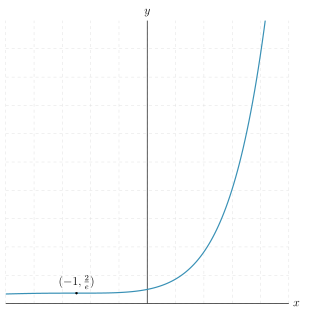
- Considering the function \(g(x) = (e^x-1)-k\tan^{-1} x \) then \(g'(x) = e^x - \frac{k}{1+x^2}\) therefore \(g'(x)\) has exactly one turning point when \(k > 0\) and \(0\) otherwise at the root of \(f(x) = k\) Notice also that \(g(0) = 0\) so we already have one solution, and \(g'(0) = 1 - k > 0\). Notice from our sketch that if \(0 < k < 1\) the root for \(f(x) = k\) has \(x \leq 0\), so our turning point is to the left of the origin and we are interested in the behaviour of \(g(x)\) as \(x \to -\infty\). (ie do we cross the axis again). \(\lim_{x \to -\infty} \left [ e^x - 1 - k \tan^{-1} x \right] = 0 - 1 +k \frac{\pi}{2} = k \frac{\pi}{2} - 1\). if this is positive, ie if \(k > \frac{2}{\pi}\) there are two solutions, otherwise there is only one real root.
Justify, by means of a sketch, the formula $$ \lim_{n\rightarrow\infty}\left\{{1\over n}\sum_{m=1}^n \f(1+m/n)\right\} = \int_1^2 \f(x)\,\d x \,. $$ Show that $$ \lim_{n\rightarrow\infty}\left\{{1\over n+1} + {1\over n+2} + \cdots + {1\over n+n}\right\} = \ln 2 \,. $$ Evaluate $$ \lim_{n\rightarrow\infty}\left\{{n\over n^2+1} + {n\over n^2+4} + \cdots + {n\over n^2+n^2}\right\}\,. $$
Show Solution
The sequence \(u_0\), \(u_1\), \(u_2\), ... is defined by $$ u_0=1,\hspace{0.2in} u_1=1, \quad u_{n+1}=u_n+u_{n-1} \hspace{0.2in}{\rm for}\hspace{0.1in}n \ge 1\,. $$ Prove that $$ u^2_{n+2} + u^2_{n-1} = 2( u^2_{n+1} + u^2_n ) \,. $$ Using induction, or otherwise, prove the following result: \[ u_{2n} = u^2_n + u^2_{n-1} \quad \mbox{ and }\quad u_{2n+1} = u^2_{n+1} - u^2_{n-1} \] for any positive integer \(n\).
Show Solution