Second order differential equations
The differential equation \[\frac{d^2x}{dt^2} = 2x\frac{dx}{dt}\] describes the motion of a particle with position \(x(t)\) at time \(t\). At \(t = 0\), \(x = a\), where \(a > 0\).
- Solve the differential equation in the case where \(\frac{dx}{dt} = a^2\) when \(t = 0\). What happens to the particle as \(t\) increases from 0?
- Solve the differential equation in the case where \(\frac{dx}{dt} = a^2 + p\) when \(t = 0\), where \(p > 0\). What happens to the particle as \(t\) increases from 0?
- Solve the differential equation in the case where \(\frac{dx}{dt} = a^2 - q^2\) when \(t = 0\), where \(q > 0\). What happens to the particle as \(t\) increases from 0? Give conditions on \(a\) and \(q\) for the different cases which arise.
- When \(t = 0, \frac{\d x}{\d t} = a^2\) so \(C = 0\), therefore \(\frac{\d x}{\d t} = x^2 \Rightarrow t = -x^{-1} + k\) and so \(k = a^{-1}\) and \(x = \frac{a}{1-at}\). As \(t\) increases from \(0\) the particle heads to infinity at an increasing rate, `reaching' infinity around \(t=\frac{1}{a}\)
- When \(t = 0, \frac{\d x}{\d t} = a^2 + p\) so \(C = p\). Therefore \(\frac{\d x}{\d t} = x^2 + p \Rightarrow t = \frac{1}{\sqrt{p}} \tan^{-1} \left ( \frac{x}{\sqrt{p}} \right) + c\). When \(c = - \frac{1}{\sqrt{p}} \tan^{-1} \left ( \frac{a}{\sqrt{p}} \right)\), so \begin{align*} && t &= \frac{1}{\sqrt{p}} \tan^{-1} \left ( \frac{x}{\sqrt{p}} \right) - \frac{1}{\sqrt{p}} \tan^{-1} \left ( \frac{a}{\sqrt{p}} \right) \\ &&&= \frac{1}{\sqrt{p}} \tan^{-1} \left ( \frac{\sqrt{p}(x-a)}{\sqrt{p}-ax} \right) \\ \Rightarrow && \frac{\sqrt{p}(x-a)}{\sqrt{p}-ax} &= \tan (\sqrt{p} t) \\ \Leftrightarrow && \sqrt{p}(x-a) &= \tan (\sqrt{p} t)(\sqrt{p}-ax) \\ \Leftrightarrow && x(\sqrt{p}+a\tan (\sqrt{p} t)) &= \sqrt{p} (\tan(\sqrt{p}t) + a) \\ \Leftrightarrow && x &= \frac{\sqrt{p} (\tan(\sqrt{p}t) + a)}{\sqrt{p}+a\tan (\sqrt{p} t)} \end{align*} The particle heads to \(\frac{\sqrt{p}}{a}\).
- When \(t = 0, \frac{\d x}{\d t} = a^2-q^2\) so \(C = -q^2\). Therefore \begin{align*} && \frac{\d x}{\d t} &= x^2 -q^2 \\ \Rightarrow && \int \d t &= \int \frac{1}{(x-q)(x+q)} \d x \\ &&&= \frac{1}{2q} \int \left ( \frac{1}{x-q}- \frac{1}{x+q} \right )\d x \\ &&&= \frac{1}{2q} \left ( \ln (x-q) - \ln(x+q) \right) \\ &&&= \frac{1}{2q} \ln \left ( \frac{x-q}{x+q} \right)\\ \Rightarrow && \frac{x-q}{x+q} &= Ae^{2qt} \\ \underbrace{\Rightarrow}_{t= 0} && A &= \frac{a-q}{a+q} \\ \Rightarrow && x-q &= \frac{a-q}{a+q}e^{2qt}(x+q) \\ \Leftrightarrow && x\left (1-\frac{a-q}{a+q}e^{2qt} \right) &= q\left (1 + \frac{a-q}{a+q}e^{2qt} \right) \\ \Leftrightarrow && x &= q \frac{1 + \frac{a-q}{a+q}e^{2qt}}{1-\frac{a-q}{a+q}e^{2qt}} \end{align*}
If \[y = \begin{cases} \mathrm{k}_1(x) & x \leqslant b \\ \mathrm{k}_2(x) & x \geqslant b \end{cases}\] with \(\mathrm{k}_1(b) = \mathrm{k}_2(b)\), then \(y\) is said to be \emph{continuously differentiable} at \(x = b\) if \(\mathrm{k}_1'(b) = \mathrm{k}_2'(b)\).
- Let \(\mathrm{f}(x) = x\mathrm{e}^{-x}\). Verify that, for all real \(x\), \(y = \mathrm{f}(x)\) is a solution to the differential equation \[\frac{\mathrm{d}^2 y}{\mathrm{d}x^2} + 2\frac{\mathrm{d}y}{\mathrm{d}x} + y = 0\] and that \(y = 0\) and \(\dfrac{\mathrm{d}y}{\mathrm{d}x} = 1\) when \(x = 0\). Show that \(\mathrm{f}'(x) \geqslant 0\) for \(x \leqslant 1\).
- You are given the differential equation \[\frac{\mathrm{d}^2 y}{\mathrm{d}x^2} + 2\left|\frac{\mathrm{d}y}{\mathrm{d}x}\right| + y = 0\] where \(y = 0\) and \(\dfrac{\mathrm{d}y}{\mathrm{d}x} = 1\) when \(x = 0\). Let \[y = \begin{cases} \mathrm{g}_1(x) & x \leqslant 1 \\ \mathrm{g}_2(x) & x \geqslant 1 \end{cases}\] be a solution of the differential equation which is continuously differentiable at \(x = 1\). Write down an expression for \(\mathrm{g}_1(x)\) and find an expression for \(\mathrm{g}_2(x)\).
- State the geometrical relationship between the curves \(y = \mathrm{g}_1(x)\) and \(y = \mathrm{g}_2(x)\).
- Prove that if \(y = \mathrm{k}(x)\) is a solution of the differential equation \[\frac{\mathrm{d}^2 y}{\mathrm{d}x^2} + p\frac{\mathrm{d}y}{\mathrm{d}x} + qy = 0\] in the interval \(r \leqslant x \leqslant s\), where \(p\) and \(q\) are constants, then, in a suitable interval which you should state, \(y = \mathrm{k}(c - x)\) satisfies the differential equation \[\frac{\mathrm{d}^2 y}{\mathrm{d}x^2} - p\frac{\mathrm{d}y}{\mathrm{d}x} + qy = 0\,.\]
- You are given the differential equation
\[\frac{\mathrm{d}^2 y}{\mathrm{d}x^2} + 2\left|\frac{\mathrm{d}y}{\mathrm{d}x}\right| + 2y = 0\]
where \(y = 0\) and \(\dfrac{\mathrm{d}y}{\mathrm{d}x} = 1\) when \(x = 0\).
Let \(\mathrm{h}(x) = \mathrm{e}^{-x}\sin x\). Show that \(\mathrm{h}'\!\left(\frac{1}{4}\pi\right) = 0\).
It is given that \(y = \mathrm{h}(x)\) satisfies the differential equation in the interval \(-\frac{3}{4}\pi \leqslant x \leqslant \frac{1}{4}\pi\) and that \(\mathrm{h}'(x) \geqslant 0\) in this interval.
In a solution to the differential equation which is continuously differentiable at \((n + \frac{1}{4})\pi\) for all \(n \in \mathbb{Z}\), find \(y\) in terms of \(x\) in the intervals
- \(\frac{1}{4}\pi \leqslant x \leqslant \frac{5}{4}\pi\),
- \(\frac{5}{4}\pi \leqslant x \leqslant \frac{9}{4}\pi\).
- Given that the variables \(x\), \(y\) and \(u\) are connected by the differential equations \[ \frac{\mathrm{d}u}{\mathrm{d}x} + \mathrm{f}(x)u = \mathrm{h}(x) \quad \text{and} \quad \frac{\mathrm{d}y}{\mathrm{d}x} + \mathrm{g}(x)y = u, \] show that \[ \frac{\mathrm{d}^2 y}{\mathrm{d}x^2} + (\mathrm{g}(x) + \mathrm{f}(x))\frac{\mathrm{d}y}{\mathrm{d}x} + (\mathrm{g}'(x) + \mathrm{f}(x)\mathrm{g}(x))y = \mathrm{h}(x). \tag{1} \]
- Given that the differential equation \[ \frac{\mathrm{d}^2 y}{\mathrm{d}x^2} + \left(1 + \frac{4}{x}\right)\frac{\mathrm{d}y}{\mathrm{d}x} + \left(\frac{2}{x} + \frac{2}{x^2}\right)y = 4x + 12 \tag{2} \] can be written in the same form as (1), find a first order differential equation which is satisfied by \(\mathrm{g}(x)\). If \(\mathrm{g}(x) = kx^n\), find a possible value of \(n\) and the corresponding value of \(k\). Hence find a solution of (2) with \(y = 5\) and \(\dfrac{\mathrm{d}y}{\mathrm{d}x} = -3\) at \(x = 1\).
The coordinates of a particle at time \(t\) are \(x\) and \(y\). For \(t \geq 0\), they satisfy the pair of coupled differential equations \[ \begin{cases} \dot{x} &= -x -ky \\ \dot{y} &= x - y \end{cases}\] where \(k\) is a constant. When \(t = 0\), \(x = 1\) and \(y = 0\).
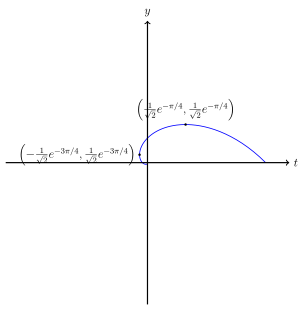
- Let \(k = 1\). Find \(x\) and \(y\) in terms of \(t\) and sketch \(y\) as a function of \(t\). Sketch the path of the particle in the \(x\)-\(y\) plane, giving the coordinates of the point at which \(y\) is greatest and the coordinates of the point at which \(x\) is least.
- Instead, let \(k = 0\). Find \(x\) and \(y\) in terms of \(t\) and sketch the path of the particle in the \(x\)-\(y\) plane.
- Let \(k = 1\), then
\begin{align*}
\dot{x} &= - x - y \\
\dot{y} &= x - y \\
\dot{x}-\dot{y} &= -2x \\
\ddot{x} &= -\dot{x}-\dot{y} \\
&= -\dot{x} - (\dot{x}+2x) \\
&= -2\dot{x}- 2x \\
\dot{x}+\dot{y} &= -2y \\
\ddot{y} &= \dot{x}-\dot{y} \\
&= -2y-2\dot{y}
\end{align*}
So we have an auxiliary equation for \(x\) and \(y\) which is \(\lambda^2 + 2 \lambda+2 = 0 \Rightarrow \lambda = -1 \pm i\).
Therefore \(x = Ae^{-t} \cos t + B e^{-t} \sin t, y = Ce^{-t}\cos t + De^{-t} \sin t\). We also must have that, \(A = 1, C = 0\), so \(x = e^{-t} \cos t + Be^{-t} \sin t\) and \(y = De^{-t} \sin x\).
\begin{align*}
\dot{y} &= -De^{-t} \sin t +De^{-t} \cos t \\
&= e^{-t} \cos x + Be^{-t} \sin t- De^{-t} \sin t \\
\end{align*}
therefore \(B = 0, D = 1\) and \(x = e^{-t} \cos t, y = e^{-t} \sin t\)
\begin{align*} y &= e^{-t} \sin t \\ \dot{y} &= -e^{-t} \sin t + e^{-t} \cos t \\ \dot{x} &= e^{-t} \cos t -e^{-t} \sin t \end{align*}

- \begin{align*}
\dot{x} = -x \\
\dot{y} = x-y
\end{align*}
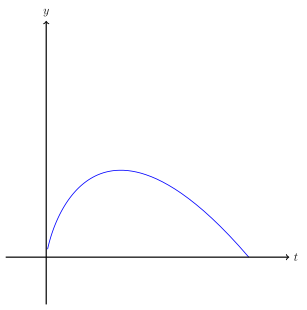
So \(x = e^{-t}\). \(\dot{y} + y = e^{-t}\) so \(y = (t+B)e^{-t}\) and so \(y =te^{-t}\).
Show that the second-order differential equation \[ x^2y''+(1-2p) x\, y' + (p^2-q^2) \, y= \f(x) \,, \] where \(p\) and \(q\) are constants, can be written in the form \[ x^a \big(x^b (x^cy)'\big)' = \f(x) \,, \tag{\(*\)} \] where \(a\), \(b\) and \(c\) are constants.
- Use \((*)\) to derive the general solution of the equation \[ x^{2}y''+(1-2p)xy'+(p^2-q^{2})y=0 \] in the different cases that arise according to the values of \(p\) and \(q\).
- Use \((*)\) to derive the general solution of the equation \[ x^{2}y''+(1-2p)xy'+p^2y=x^{n} \] in the different cases that arise according to the values of \(p\) and \(n\).
Two particles \(X\) and \(Y\), of equal mass \(m\), lie on a smooth horizontal table and are connected by a light elastic spring of natural length \(a\) and modulus of elasticity \(\lambda\). Two more springs, identical to the first, connect \(X\) to a point \(P\) on the table and \(Y\) to a point \(Q\) on the table. The distance between \(P\) and \(Q\) is \(3a\). Initially, the particles are held so that \(XP=a\), \(YQ= \frac12 a\,\), and \(PXYQ\) is a straight line. The particles are then released. At time \(t\), the particle \(X\) is a distance \(a+x\) from \(P\) and the particle \(Y\) is a distance \(a+y\) from \(Q\). Show that \[ m \frac{\.d ^2 x}{\.d t^2} = -\frac\lambda a (2x+y) \] and find a similar expression involving \(\dfrac{\.d^2 y}{\.d t^2}\). Deduce that \[ x-y = A\cos \omega t +B \sin\omega t \] where \(A\) and \(B\) are constants to be determined and \(ma\omega^2=\lambda\). Find a similar expression for \(x+y\). Show that \(Y\) will never return to its initial position.
- Let \(y(x)\) be a solution of the differential equation \( \dfrac {\d^2 y}{\d x^2}+y^3=0\) with \(y = 1\) and \(\dfrac{\d y}{\d x} =0\) at \(x=0\), and let \[ {\rm E} (x)= \left ( \frac {\d y}{\d x}\right)^{\!\!2} + \tfrac 12 y^4\,. \] Show by differentiation that \({\rm E}\) is constant and deduce that \( \vert y(x) \vert \le 1\) for all \(x\).
- Let \(v(x)\) be a solution of the differential equation \( \dfrac{\d^2 v}{\d x^2} + x \dfrac {\d v}{\d x} +\sinh v =0\) with \(v = \ln 3\) and \(\dfrac{\d v}{\d x} =0\) at \(x=0\), and let \[ {\rm E} (x)= \left ( \frac {\d v}{\d x}\right)^{\!\!2} + 2 \cosh v\,. \] Show that \(\dfrac{\d{\rm E}}{\d x}\le 0\) for \(x\ge0\) and deduce that \(\cosh v(x) \le \frac53\) for \(x\ge0\).
- Let \(w(x)\) be a solution of the differential equation \[ \frac{\d^2 w}{\d x^2} + (5\cosh x - 4 \sinh x -3) \frac{\d w}{\d x} + (w\cosh w + 2 \sinh w) =0 \] with \(\dfrac{\d w }{\d x}=\dfrac 1 { \sqrt 2 }\) and \(w=0\) at \(x=0\). Show that \(\cosh w(x) \le \frac54\) for \(x\ge0\).
- \(\,\) \begin{align*} && E(x) &= \left ( \frac{\d y}{\d x} \right)^2 + \frac12 y^4 \\ \Rightarrow && E'(x) &= 2 \frac{\d y}{\d x} \frac{\d^2 y}{\d x^2} + 2y^3 \frac{\d y}{\d x} \\ &&&= 2\frac{\d y}{\d x} \left ( \frac{\d^2 y}{\d x^2} + y^3 \right) \\ &&&= 0 \end{align*} Therefore \(E\) is constant. \(E(0) = \frac12\) and \begin{align*} &&\frac12 &= \left ( \frac{\d y}{\d x} \right)^2 + \frac12 y^4 \\ &&&\geq \frac12 y^4 \\ \Rightarrow && |y| &\leq 1 \end{align*}
- \(\,\) \begin{align*} && E(x) &= \left ( \frac{\d v}{\d x} \right)^2 + 2 \cosh v \\ \Rightarrow && E'(x) &= 2 \frac{\d v}{\d x}\frac{\d^2 v}{\d^2 x} + 2 \sinh v \frac{\d v}{\d x} \\ &&&= 2 \frac{\d v}{\d x} \left ( \frac{\d^2 v}{\d^2 x} + \sinh v\right) \\ &&&= 2 \frac{\d v}{\d x} \left ( -x \frac{\d v}{\d x}\right) \\ &&&= -2x \left ( \frac{\d v}{\d x} \right)^2 \leq 0 \tag{\(x \geq 0\)} \\ \\ && E(0) &= 0^2 + 2 \cosh \ln 3 \\ &&&= 3 + \frac13 = \frac{10}{3} \\ \Rightarrow && \frac{10}{3} &\geq E(x) \\ &&&= \left ( \frac{\d v}{\d x} \right)^2 + 2 \cosh v \\ &&&\geq 2 \cosh v \\ \Rightarrow && \cosh v &\leq \frac53 \end{align*}
- \(\,\) \begin{align*} && E(x) &= \left ( \frac{\d w}{\d x} \right)^2 + 2(w \sinh w + \cosh w) \\ && E'(x) &= 2 \frac{\d w}{\d x}\frac{\d^2 w}{\d^2 x} + 2(w \cosh w + 2 \sinh w) \frac{\d w}{\d x} \\ &&&= 2 \frac{\d w}{\d x} \left ( \frac{\d^2 w}{\d^2 x}+(w \cosh w + 2 \sinh w)\right) \\ &&&= -2 \left ( \frac{\d w}{\d x} \right)^2 \left (\underbrace{5\cosh x - 4 \sinh x -3}_{\geq0} \right) \\ &&&\leq 0 \\ && E(0) &= \frac12 + 2 = \frac52 \\ \Rightarrow && \frac52 &\geq E(x) \\ &&&=\underbrace{ \left ( \frac{\d w}{\d x} \right)^2}_{\geq0} + 2(\underbrace{w \sinh w}_{\geq 0} + \cosh w) \\ &&&\geq2\cosh w \\ \Rightarrow && \cosh w &\leq \frac54 \end{align*}
A sphere of radius \(R\) and uniform density \(\rho_{\text{s}}\) is floating in a large tank of liquid of uniform density \(\rho\). Given that the centre of the sphere is a distance \(x\) above the level of the liquid, where \(x < R\), show that the volume of liquid displaced is \[ \frac \pi 3 (2R^3-3R^2x +x^3)\,. \] The sphere is acted upon by two forces only: its weight and an upward force equal in magnitude to the weight of the liquid it has displaced. Show that \[ 4 R^3\rho_{\text{s}} (g+\ddot x) = (2R^3 -3R^2x +x^3)\rho g\,. \] Given that the sphere is in equilibrium when \(x=\frac12 R\), find \(\rho_{\text{s}}\) in terms of \(\rho\). Find, in terms of \(R\) and \(g\), the period of small oscillations about this equilibrium position.
Given that \(\displaystyle z = y^n \left( \frac{\d y}{\d x}\right)^{\!2}\), show that \[ \frac{\d z}{\d x} = y^{n-1} \frac{\d y}{\d x} \left( n \left(\frac{\d y}{\d x}\right)^{\!2} + 2y \frac{\d^2y}{\d x^2}\right) . \]
- Use the above result to show that the solution to the equation \[ \left(\frac{\d y}{\d x}\right)^{\!2} + 2y \frac{\d^2y}{\d x^2} = \sqrt y \ \ \ \ \ \ \ \ \ \ (y>0) \] that satisfies \(y=1\) and \(\dfrac{\d y}{\d x}=0\) when \(x=0\) is \(y= \big ( \frac38 x^2+1\big)^{\frac23}\).
- Find the solution to the equation \[ \left(\frac{\d y}{\d x}\right)^{\!2} -y \frac{\d^2y}{\d x^2} + y^2=0 \] that satisfies \(y=1\) and \(\dfrac{\d y}{\d x}=0\) when \(x=0\).
- Let \(z = y (y')^2\), then \begin{align*} && \frac{\d z}{\d x} &= y' \sqrt{y} \\ &&&= \sqrt{z} \\ \Rightarrow && \int z^{-1/2} \d z &= x+C \\ \Rightarrow && 2\sqrt{z} &= x + C \\ x = 0, z=0: && C &= 0 \\ \Rightarrow && y(y')^2 &= \frac14 x^2 \\ \Rightarrow &&\sqrt{y} \frac{\d y}{\d x} &= \frac{1}{2}x\\ \Rightarrow && \int \sqrt{y} \d y &= \int \frac{1}{2}x\d x \\ \Rightarrow && \frac23y^{3/2} &=\frac14x^2 + K \\ x = 0, y = 1: && K &= \frac23 \\ \Rightarrow && y &= \left (\frac38 x^2 + 1 \right)^{2/3} \end{align*}
- Let \(z = y^{-2} (y')^2\) \begin{align*} && \frac{\d z}{\d x} &= y^{-3} \frac{\d y}{\d x} \left (-2 \left( \frac{\d y}{\d x}\right) + 2y \frac{\d^2 y}{\d x^2} \right) \\ &&&= y^{-3} \frac{\d y}{\d x} 2y^2 \\ &&&= 2y^{-1}(y') = 2 \sqrt{z} \\ \Rightarrow && 2\sqrt{z} &= 2x + C \\ x = 0, z = 0: && C&= 0 \\ \Rightarrow && z &= x^2 \\ \Rightarrow && \frac{\d y}{\d x} &= xy \\ \Rightarrow && \ln |y| &= \frac12 x^2 + K \\ x =0 , y =1; && K &= 0 \\ \Rightarrow && y &= e^{\frac12 x^2} \end{align*}
A pain-killing drug is injected into the bloodstream. It then diffuses into the brain, where it is absorbed. The quantities at time \(t\) of the drug in the blood and the brain respectively are \(y(t)\) and \(z(t)\). These satisfy \[ \dot y = - 2(y-z)\,, \ \ \ \ \ \ \ \dot z = - \dot y -3z\, , \] where the dot denotes differentiation with respect to \(t\). Obtain a second order differential equation for \(y\) and hence derive the solution \[ y= A\e^{-t} + B\e ^{-6t}\,, \ \ \ \ \ \ \ z= \tfrac12 A \e^{-t} - 2 B \e^{-6t}\,, \] where \(A\) and \(B\) are arbitrary constants. \begin{questionparts} \item Obtain the solution that satisfies \(z(0)=0\) and \(y(0)= 5\). The quantity of the drug in the brain for this solution is denoted by \(z_1(t)\). \item Obtain the solution that satisfies $ z(0)=z(1)= c$, where \(c\) is a given constant. %\[ %C=2(1-\e^{-1})^{-1} - 2(1-\e^{-6})^{-1}\,. %\] The quantity of the drug in the brain for this solution is denoted by \(z_2(t)\). \item Show that for \(0\le t \le 1\), \[ z_2(t) = \sum _{n=-\infty}^{0} z_1(t-n)\,, \] provided \(c\) takes a particular value that you should find. \end {questionparts}
- Find the general solution of the differential equation \[ \frac{\d u}{\d x} - \left(\frac { x +2}{x+1}\right)u =0\,. \]
- Show that substituting\(y=z\e^{-x}\) (where \(z\) is a function of \(x\)) into the second order differential equation \[ (x+1) \frac{\d ^2 y}{\d x^2} + x \frac{\d y}{\d x} -y = 0 \tag{\(*\)} \] leads to a first order differential equation for \(\dfrac{\d z}{\d x}\,\). Find \(z\) and hence show that the general solution of \((*)\) is \[ y= Ax + B\e^{-x}\,, \] where \(A\) and \(B\) are arbitrary constants.
- Find the general solution of the differential equation \[ (x+1) \frac{\d ^2 y}{\d x^2} + x \frac{\d y}{\d x} -y = (x+1)^2 . \]
- \begin{align*} && 0 &= \frac{\d u}{\d x} - \left ( \frac{x+2}{x+1} \right)u \\ \Rightarrow && \int \frac1u \d u &= \int 1 + \frac1{x+1} \d x \\ \Rightarrow && \ln |u| &= x + \ln |x+1| + C \\ \Rightarrow && u &= A(x+1)e^x \end{align*}
- If \(y = ze^{-x}\), \(y' = (z'-z)e^{-x}\), \(y'' = (z''-2z'+z)e^{-x}\) \begin{align*} && 0 &= (x+1) \frac{\d ^2 y}{\d x^2} + x \frac{\d y}{\d x} -y \\ y = ze^{-x}: && 0 &= (x+1) \left ( \frac{\d^2 z}{\d x^2} - 2\frac{\d z}{\d x} +z\right)e^{-x} +x \left ( \frac{\d z}{\d x} -z\right)e^{-x} - ze^{-x} \\ &&&= (x+1) \frac{\d^2 z}{\d x^2} -(x+2)\frac{\d z}{\d x} \\ \Rightarrow && \frac{\d}{\d x} \left ( \frac{\d z}{\d x}\right) &= \left ( \frac{x+2}{x+1}\right) \frac{\d z}{\d x} \end{align*} Therefore \(\frac{\d z}{\d x} = A(x+1)e^x \) and so \begin{align*} z &= A \int (x+1)e^{x} \d x \\ &= A \left ( \left [ (x+1)e^x\right] - \int e^x \d x \right) \\ &= A(x+1)e^x - Ae^x + B \\ y &= Ax + Be^{-x} \end{align*}
- We have found the complementary solution. To find a particular integral consider \(y = ax^2 + bx + c\), then \(y' = 2ax+b, y'' = 2a\) and we have \begin{align*} && x^2+2x+1 &= 2a(x+1) + x(2ax+b) - (ax^2+bx+c) \\ \Rightarrow && x^2+2x+1 &= ax^2+ 2ax + 2a-c \\ \Rightarrow && a = 1, &c=1 \end{align*} so the general solution should be \[ y = Ax + Be^{-x} + x^2+1 \]
Show that, if \(y=\e^x\), then \[ (x-1) \frac{\d^2 y}{\d x^2} -x \frac{\d y}{\d x} +y=0\,. \tag{\(*\)} \] In order to find other solutions of this differential equation, now let \(y=u\e^x\), where \(u\) is a function of \(x\). By substituting this into \((*)\), show that \[ (x-1) \frac{\d^2 u}{\d x^2} + (x-2) \frac{\d u}{\d x} =0\,. \tag{\(**\)} \] By setting \( \dfrac {\d u}{\d x}= v\) in \((**)\) and solving the resulting first order differential equation for \(v\), find \(u\) in terms of \(x\). Hence show that \(y=Ax + B\e^x\) satisfies \((*)\), where \(A\) and \(B\) are any constants.
Show SolutionA small bead \(B\), of mass \(m\), slides without friction on a fixed horizontal ring of radius \(a\). The centre of the ring is at \(O\). The bead is attached by a light elastic string to a fixed point \(P\) in the plane of the ring such that \(OP = b\), where \(b > a\). The natural length of the elastic string is \(c\), where \(c < b - a\), and its modulus of elasticity is \(\lambda\). Show that the equation of motion of the bead is \[ ma\ddot \phi = -\lambda\left( \frac{a\sin\phi}{c\sin\theta}-1\right)\sin(\theta+\phi) \,, \] where \(\theta=\angle BPO\) and \(\phi=\angle BOP\). Given that \(\theta\) and \(\phi\) are small, show that $a(\theta+\phi)\approx b\theta$. Hence find the period of small oscillations about the equilibrium position \(\theta=\phi =0\).
- Let \(\displaystyle y= \sum_{n=0}^\infty a_n x^n\,\), where the coefficients \(a_n\) are independent of \(x\) and are such that this series and all others in this question converge. Show that \[ \displaystyle y'= \sum_{n=1}^\infty na_n x^{n-1}\,, \] and write down a similar expression for \(y''\). Write out explicitly each of the three series as far as the term containing \(a_3\).
- It is given that \(y\) satisfies the differential equation \[ xy''-y'+4x^3y =0\,. \] By substituting the series of part (i) into the differential equation and comparing coefficients, show that \(a_1=0\). Show that, for \(n\ge4\), \[ a_n =- \frac{4}{n(n-2)}\, a_{n-4}\,, \] and that, if \(a_0=1\) and \(a_2=0\), then \( y=\cos (x^2)\,\). Find the corresponding result when \(a_0=0\) and \(a_2=1\).
- Let \(\displaystyle y= \sum_{n=0}^\infty a_n x^n\,\) then \begin{align*} y' &= \frac{\d}{\d x} \l \sum_{n=0}^\infty a_n x^n \r \\ &= \sum_{n=0}^\infty \frac{\d}{\d x} \l a_n x^n \r \\ &= \sum_{n=0}^\infty n a_n x^{n-1} \\ &= \sum_{n=1}^\infty n a_n x^{n-1} \\ \\ y'' &= \frac{\d}{\d x} \l\sum_{n=1}^\infty n a_n x^{n-1} \r \\ &= \sum_{n=1}^\infty \frac{\d}{\d x} \l n a_n x^{n-1} \r \\ &= \sum_{n=1}^\infty n(n-1) a_n x^{n-2} \\ &= \sum_{n=2}^\infty n(n-1) a_n x^{n-2} \\ \\ y &= a_0 + a_1 x+ a_2x^2 + a_3x^3 + \cdots \\ y'&= a_1 + 2a_2x+3a_3x^2 + \cdots \\ y'' &= 2a_2 + 6a_3x + \cdots \end{align*}
- \begin{align*} && 0 &= xy''-y'+4x^3y \\ &&&= x\sum_{n=2}^\infty n(n-1) a_n x^{n-2} - \sum_{n=1}^\infty n a_n x^{n-1} + 4x^3 \sum_{n=0}^\infty a_n x^n \\ &&&= \sum_{n=2}^\infty n(n-1) a_n x^{n-1} - \sum_{n=1}^\infty n a_n x^{n-1} + \sum_{n=0}^\infty 4a_n x^{n+3} \\ &&&= \sum_{n=2}^\infty n(n-1) a_n x^{n-1} - \sum_{n=1}^\infty n a_n x^{n-1} + \sum_{n=4}^\infty 4a_{n-4} x^{n-1} \\ &&&= \sum_{n=4}^{\infty} \l n(n-1) a_n- n a_n +4a_{n-4} \r x^{n-1} + 2a_2x + 6a_3x^2-a_1-2a_2x-3a_3x^2 \\ &&&= \sum_{n=4}^{\infty} \l n(n-2) a_n +4a_{n-4} \r x^{n-1}+ 3a_3x^2-a_1 \\ \end{align*} Therefore since all coefficients are \(0\), \(a_1 = 0\), \(a_3 = 0\) and \(\displaystyle a_n = -\frac{4}{n(n-2)}a_{n-4}\). If \(a_0 = 1, a_2 = 0\), and since \(a_1 = 0, a_3 = 0\) the only values which will take non-zero value are \(a_{4k}\). We can compute these values as: \(a_{4k} = -\frac{4}{(4k)(4k-2)} a_{4k-4} = \frac{1}{2k(2k-1)}a_{4k-r}\) so \(a_{4k} = \frac{(-1)^k}{(2k)!}\), which are precisely the coefficients in the expansion \(\cos x^2\). If \(a_0 = 0, a_2 = 1\) then since \(a_1 = 0, a_3 = 0\) the only values which take non-zero values are \(a_{4k+2}\) we can compute these values as: \(a_{4k+2} = -\frac{4}{(4k+2)(4k)}a_{4k-2} = -\frac{1}{(2k+1)2k}a_{4k-2}\) so we can see that \(a_{4k+2}= \frac{(-1)^k}{(2k+1)!}\) precisely the coefficients of \(\sin x^2\)
- The functions \(\f_n(x)\) are defined for \(n=0\), \(1\), \(2\), \(\ldots\)\, , by \[ \f_0(x) = \frac 1 {1+x^2}\, \qquad \text{and}\qquad \f_{n+1}(x) =\frac{\d \f_n(x)}{\d x}\,. \] Prove, for \(n\ge1\), that \[ (1+x^2)\f_{n+1}(x) + 2(n+1)x\f_n(x) + n(n+1)\f_{n-1}(x)=0\,. \]
- The functions \(\P_n(x)\) are defined for \(n=0\), \(1\), \(2\), \(\ldots\)\, , by \[ \P_n(x) = (1+x^2)^{n+1}\f_n(x)\,. \] Find expressions for \(\P_0(x)\), \(\P_1(x)\) and \(\P_2(x)\). Prove, for \(n\ge0\), that \[ \P_{n+1}(x) -(1+x^2)\frac {\d \P_n(x)}{\d x}+ 2(n+1)x \P_n(x)=0\,, \] and that \(\P_n(x)\) is a polynomial of degree \(n\).
A light spring is fixed at its lower end and its axis is vertical. When a certain particle \(P\) rests on the top of the spring, the compression is \(d\). When, instead, \(P\) is dropped onto the top of the spring from a height \(h\) above it, the compression at time \(t\) after \(P\) hits the top of the spring is \(x\). Obtain a second-order differential equation relating \(x\) and \(t\) for \(0\le t \le T\), where \(T\) is the time at which \(P\) first loses contact with the spring. Find the solution of this equation in the form \[ x= A + B\cos (\omega t) + C\sin(\omega t)\,, \] where the constants \(A\), \(B\), \(C\) and \(\omega\) are to be given in terms of \(d\), \(g\) and \(h\) as appropriate. Show that \[ T = \sqrt{d/g\;} \left (2 \pi - 2 \arctan \sqrt{2h/d\;}\;\right)\,. \]
In this question, \(p\) denotes \(\dfrac{\d y}{\d x}\,\).
- Given that \[ y=p^2 +2 xp\,, \] show by differentiating with respect to \(x\) that \[ \frac{\d x}{\d p} = -2 - \frac {2x} p . \] Hence show that \(x = -\frac23p +Ap^{-2}\,,\) where \(A\) is an arbitrary constant. Find \(y\) in terms of \(x\) if \(p=-3\) when \(x=2\).
- Given instead that \[ y=2xp +p \ln p\,,\] and that \(p=1\) when \(x=-\frac14\), show that \(x=-\frac12 \ln p - \frac14\,\) and find \(y\) in terms of \(x\).
- Find functions \({\rm a}(x)\) and \({\rm b}(x)\) such that \(u=x\) and \(u=\e^{-x}\) both satisfy the equation $$\dfrac{\d^2u}{\d x^2} +{\rm a}(x) \dfrac{\d u}{\d x} + {\rm b} (x)u=0\,.$$ For these functions \({\rm a}(x)\) and \({\rm b}(x)\), write down the general solution of the equation. Show that the substitution \(y= \dfrac 1 {3u} \dfrac {\d u}{\d x}\) transforms the equation \[ \frac{\d y}{\d x} +3y^2 + \frac {x} {1+x} y = \frac 1 {3(1+x)} \tag{\(*\)} \] into \[ \frac{\d^2 u}{\d x^2} +\frac x{1+x} \frac{\d u}{\d x} - \frac 1 {1+x} u=0 \] and hence show that the solution of equation (\(*\)) that satisfies \(y=0\) at \(x=0\) is given by \(y = \dfrac{1-\e^{-x}}{3(x+\e^{-x})}\).
- Find the solution of the equation $$ \frac{\d y}{\d x} +y^2 + \frac x {1-x} y = \frac 1 {1-x} $$ that satisfies \(y=2\) at \(x=0\).
Given that \(y=x\) and \(y=1-x^2\) satisfy the differential equation $$ \frac{\d^2 {y}}{\d x^2} + \p(x) \frac{\d {y}}{\d x} + \q(x) {y}=0\;, \tag{*} $$ show that \(\p(x)= -2x(1+x^2)^{-1}\) and \(\q(x) = 2(1+x^2)^{-1}\). Show also that \(ax+b(1-x^2)\) satisfies the differential equation for any constants \(a\) and \(b\). Given instead that \(y=\cos^2(\frac{1}{2}x^2)\) and \(y=\sin^2(\frac{1}{2}x^2)\) satisfy the equation \((*)\), find \(\p(x)\) and \(\q(x)\).
Show SolutionShow that \(\sin(k\sin^{-1} x)\), where \(k\) is a constant, satisfies the differential equation $$(1-x^{2})\frac {\d^2 y}{\d x^2} -x\frac{\d y}{\d x} +k^{2}y=0. \tag{*}$$ In the particular case when \(k=3\), find the solution of equation \((*)\) of the form \[ y=Ax^{3}+Bx^{2}+Cx+D, \] that satisfies \(y=0\) and \(\displaystyle \frac{\d y}{\d x}=3\) at \(x=0\). Use this result to express \(\sin 3\theta\) in terms of powers of \(\sin\theta\).
Show SolutionThe function \(y(x)\) is defined for \(x\ge0\) and satisfies the conditions \[ y=0 \mbox{ \ \ and \ \ } \frac{\d y}{\d x}=1 \mbox{ \ \ at \(x=0\)}. \] When \(x\) is in the range \(2(n-1)\pi< x <2n\pi\), where \(n\) is a positive integer, \(y(t)\) satisfies the differential equation $$ {\d^2y \over \d x^2} + n^2 y=0. $$ Both \(y\) and \(\displaystyle \frac{\d y}{\d x} \) are continuous at \(x=2n\pi\) for \(n=0,\; 1,\;2,\; \ldots\;\).
- Find \(y(x)\) for \(0\le x \le 2\pi\).
- Show that \(y(x) = \frac12 \sin 2x \) for \(2\pi\le x\le 4\pi\), and find \(y(x)\) for all \(x\ge0\).
- Show that $$ \int_0^\infty y^2 \,\d x = \pi \sum_{n=1}^\infty {1\over n^2} \,. $$
Suppose that \(y_n\) satisfies the equations \[(1-x^2)\frac{{\rm d}^2y_n}{{\rm d}x^2}-x\frac{{\rm d}y_n}{{\rm d}x}+n^2y_n=0,\] \[y_n(1)=1,\quad y_n(x)=(-1)^ny_n(-x).\] If \(x=\cos\theta\), show that \[\frac{{\rm d}^2y_n}{{\rm d}\theta^2}+n^2y_n=0,\] and hence obtain \(y_n\) as a function of \(\theta\). Deduce that for \(|x|\leqslant1\) \[y_0=1,\quad y_1=x,\] \[y_{n+1}-2xy_n+y_{n-1}=0.\]
Suppose that \[{\rm f}''(x)+{\rm f}(-x)=x+3\cos 2x\] and \({\rm f}(0)=1\), \({\rm f}'(0)=-1\). If \({\rm g}(x)={\rm f}(x)+{\rm f}(-x)\), find \({\rm g}(0)\) and show that \({\rm g}'(0)=0\). Show that \[{\rm g}''(x)+{\rm g}(x)=6\cos 2x,\] and hence find \({\rm g}(x)\). Similarly, if \({\rm h}(x)={\rm f}(x)-{\rm f}(-x)\), find \({\rm h}(x)\) and show that \[{\rm f}(x)=2\cos x -\cos2x-x.\]
Show SolutionFind functions \(\mathrm{f,g}\) and \(\mathrm{h}\) such that \[ \frac{\mathrm{d}^{2}y}{\mathrm{d}x^{2}}+\mathrm{f}(x)\frac{\mathrm{d}y}{\mathrm{d}x}+\mathrm{g}(x)y=\mathrm{h}(x)\tag{\ensuremath{*}} \] is satisfied by all three of the solutions \(y=x,y=1\) and \(y=x^{-1}\) for \(0 < x < 1.\) If \(\mathrm{f,g}\) and \(\mathrm{h}\) are the functions you have found in the first paragraph, what condition must the real numbers \(a,b\) and \(c\) satisfy in order that \[ y=ax+b+\frac{c}{x} \] should be a solution of \((*)\)?
What is the general solution of the differential equation \[ \frac{\mathrm{d}^{2}x}{\mathrm{d}t^{2}}+2k\frac{\mathrm{d}x}{\mathrm{d}t}+x=0 \] for each of the cases: (i) \(k>1;\) (ii) \(k=1\); (iii) \(0 < x < 1\)? In case (iii) the equation represents damped simple harmonic motion with damping factor \(k\). Let \(x(0)=0\) and let \(x_{1},x_{2},\ldots,x_{n},\ldots\) be the sequence of successive maxima and minima, so that if \(x_{n}\) is a maximum then \(x_{n+1}\) is the next minimum. Show that \(\left|x_{n+1}/x_{n}\right|\) takes a value \(\alpha\) which is independent of \(n\), and that \[ k^{2}=\frac{(\ln\alpha)^{2}}{\pi^{2}+(\ln\alpha)^{2}}. \]
Show Solution