First order differential equations (integrating factor)
- Use the substitution \(v= \sqrt y\) to solve the differential equation \[ \frac{\d y}{\d t} = \alpha y^{\frac12} - \beta y \ \ \ \ \ \ \ \ \ \ (y\ge0, \ \ t\ge0) \,, \] where \(\alpha\) and \(\beta\) are positive constants. Find the non-constant solution \(y_1(x)\) that satisfies \(y_1(0)=0\,\).
- Solve the differential equation \[ \frac{\d y}{\d t} = \alpha y^{\frac23} - \beta y \ \ \ \ \ \ \ \ \ \ (y\ge0, \ \ t\ge0) \,, \] where \(\alpha\) and \(\beta\) are positive constants. Find the non-constant solution \(y_2(x)\) that satisfies \(y_2(0)=0\,\).
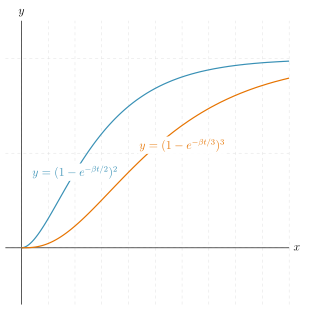
- In the case \(\alpha=\beta\), sketch \(y_1(x)\) and \(y_2(x)\) on the same axes, indicating clearly which is \(y_1(x)\) and which is \(y_2(x)\). You should explain how you determined the positions of the curves relative to each other.
- Suppose \(v = \sqrt{y} \Rightarrow v^2 = y \Rightarrow 2v v' = y'\) so \begin{align*} && 2vv' &= \alpha v-\beta v^2 \\ \Rightarrow && 2v' &= \alpha - \beta v \\ \Rightarrow && v' + \frac{\beta}{2} v &= \frac{\alpha}{2} \\ \Rightarrow && \frac{\d}{\d t} \left (e^{\beta t/2} v \right) &= \frac{\alpha}{2} e^{\beta t/2} \\ \Rightarrow && e^{\beta t/2} v &=C+ \frac{\alpha}{\beta}e^{\beta t /2} \\ \Rightarrow && v &= Ce^{-\beta t/2} + \frac{\alpha}{\beta} \\ \Rightarrow && \sqrt{y} &= Ce^{-\beta t/2} + \frac{\alpha}{\beta} \\ y(0) = 0: && 0 &= C+\frac{\alpha}{\beta} \\ \Rightarrow && \sqrt{y} &= \frac{\alpha}{\beta} \left (1-e^{-\beta t/2} \right) \\ \Rightarrow && y &= \frac{ \alpha^2}{\beta^2} \left (1-e^{-\beta t/2} \right)^2 \end{align*}
- Try \(v = y^{1/3} \Rightarrow v^3 = y \Rightarrow 3v^2 v' = y'\) so \begin{align*} && y' &= \alpha v^2 - \beta y \\ \Rightarrow && 3v^2v' &= \alpha v^2 - \beta v^3 \\ \Rightarrow && v' +\frac{\beta}{3} v &= \frac{\alpha}{3} \\ \Rightarrow && (v e^{\beta t/3})' &= \frac{\alpha}{3}e^{\beta t/3} \\ \Rightarrow && v &= Ce^{-\beta t/3} + \frac{\alpha}{\beta} \\ v(0) = 0: && v &= \frac{\alpha}{\beta} \left (1 - e^{-\beta t/3} \right) \\ \Rightarrow && y &= \frac{\alpha^3}{\beta^3} \left (1 - e^{-\beta t/3} \right) ^3 \end{align*}
- \(y_1 = (1-e^{-\beta t/2})^2, y_2 = (1-e^{-\beta t/3})^3\)
By considering the differential equation, notice that \(0 < y_i < 1\) so \(y^{1/2} > y^{2/3}\) and therefore \(y_1' > y_2'\) and so \(y_1\) increases faster.
A uniform elastic string lies on a smooth horizontal table. One end of the string is attached to a fixed peg, and the other end is pulled at constant speed \(u\). At time \(t=0\), the string is taut and its length is \(a\). Obtain an expression for the speed, at time \(t\), of the point on the string which is a distance \(x\) from the peg at time \(t\). An ant walks along the string starting at \(t=0\) at the peg. The ant walks at constant speed \(v\) along the string (so that its speed relative to the peg is the sum of \(v\) and the speed of the point on the string beneath the ant). At time \(t\), the ant is a distance \(x\) from the peg. Write down a first order differential equation for \(x\), and verify that \[ \frac{\d }{\d t} \left( \frac x {a+ut}\right) = \frac v {a+ut} \,. \] Show that the time \(T\) taken for the ant to reach the end of the string is given by \[uT = a(\e^k-1)\,,\] where \(k=u/v\). On reaching the end of the string, the ant turns round and walks back to the peg. Find in terms of \(T\) and \(k\) the time taken for the journey back.
Show SolutionGiven that \(y=xu\), where \(u\) is a function of \(x\), write down an expression for \(\dfrac {\d y}{\d x}\).
- Use the substitution \(y=xu\) to solve \[ \frac {\d y}{\d x} = \frac {2y+x}{y-2x} \] given that the solution curve passes through the point \((1,1)\). Give your answer in the form of a quadratic in \(x\) and \(y\).
- Using the substitutions \(x=X+a\) and \(y=Y+b\) for appropriate values of \(a\) and \(b\), or otherwise, solve \[ \frac {\d y}{\d x} = \frac {x-2y-4} {2x+y-3}\,, \] given that the solution curve passes through the point \((1,1)\).
- Show that substituting \(y=xv\), where \(v\) is a function of \(x\), in the differential equation \[ xy \frac{\d y}{\d x} +y^2- 2x^2 =0 \quad (x\ne0) \] leads to the differential equation \[ xv\frac{\d v}{\d x} +2v^2 -2=0\,. \] Hence show that the general solution can be written in the form \[ x^2(y^2 -x^2) = C \,,\] where \(C\) is a constant.
- Find the general solution of the differential equation \[ y \frac{\d y}{\d x} +6x +5y=0\, \quad (x\ne0). \]
- \(\,\) \begin{align*} && y &= xv \\ && y' &= v + xv' \\ \Rightarrow && 0 &= x^2 v \left ( v + x\frac{\d v}{\d x} \right) +(x^2v^2) - 2x^2 \\ &&&= 2x^2v^2 + x^3 v \frac{\d v}{\d x} - 2x^2 \\ \Rightarrow && 0 &= xv \frac{\d v}{\d x} + 2v^2-2 \\ \\ \Rightarrow && \frac{v}{1-v^2} \frac{\d v}{\d x} &= \frac{2}{x} \\ \Rightarrow && \int \frac{v}{1-v^2} \d v &=2 \ln |x| \\ \Rightarrow && -\frac12\ln |1-v^2| &= 2\ln |x| + C \\ \Rightarrow && 4\ln |x| + \ln |1-v^2| &= K \\ \Rightarrow && x^4(1-v^2) &= K \\ \Rightarrow && x^2(x^2-y^2) &= K \end{align*}
- \(\,\) \begin{align*} && 0 &= xv \left (v +x \frac{\d v}{\d x} \right) + 6x + 5xv \\ &&&= x^2 v \frac{\d v}{\d x} +xv^2 + 6x+5xv \\ \Rightarrow && 0 &= xv\frac{\d v}{\d x} +v^2 +5v+6 \\ \Rightarrow && -\int \frac{1}{x} \d x &=\int \frac{v}{v^2+5v+6} \d v \\ \Rightarrow && -\ln |x| &= \int \frac{v}{(v+2)(v+3)} \d v \\ &&&= \int \left (\frac{3}{v+3} - \frac{2}{v+2} \right) \d v \\ \Rightarrow && -\ln |x| &= 3\ln |v+3| - 2 \ln |v+2| + C\\ \Rightarrow && -\ln |x| &= \ln \frac{|v+3|^3}{|v+2|^2} + C \\ \Rightarrow && \frac{1}{|x|}|v+2|^2 &= A|v+3|^3 \\ \Rightarrow && \frac{1}{|x|}|\frac{y}{x} + 2|^2&= A|\frac{y}{x} + 3|^3 \\ \Rightarrow && \frac{1}{|x|^3} |y +2x|^2 &= \frac{A}{|x|^3}|y + 3x|^3 \\ \Rightarrow && (y+2x)^2 &= A|y+3x|^3 \end{align*}
Show that if \[ {\mathrm{d}y \over \mathrm{d} x}=\f(x)y + {\g(x) \over y} \] then the substitution \(u = y^2\) gives a linear differential equation for \(u(x)\,\). Hence or otherwise solve the differential equation \[ {\mathrm{d}y \over \mathrm{d} x}={y \over x} - {1 \over y}\;. \] Determine the solution curves of this equation which pass through \((1 \,, 1)\,\), \((2\, , 2)\) and \((4 \, , 4)\) and sketch graphs of all three curves on the same axes.
Show Solution
- Show that the gradient at a point \(\l x\,, \, y \r\) on the curve \[ \l y + 2x \r^3 \l y - 4x \r = c\;, \] where \(c\) is a constant, is given by \[ \frac{\d y}{\d x} = \frac{16 x -y}{2y-5x} \;. \]
- By considering the derivative with respect to \(x\) of \(\l y + ax \r^n \l y + bx \r\,\), or otherwise, find the general solution of the differential equation \[ \frac{\mathrm{d}y}{ \mathrm{d}x} = \frac{10x - 4y}{ 3x - y}\;. \]
- \begin{align*} && c &= \left (y+2x \right)^3\left (y-4x \right) \\ \Rightarrow && 0 &= 3\left (y+2x \right)^2\left (y-4x \right)\left ( \frac{\d y}{\d x} + 2 \right) + \left (y+2x \right)^3 \left ( \frac{\d y}{\d x} - 4 \right) \\ \Rightarrow && 0 &= 3(y-4x)\left ( \frac{\d y}{\d x} + 2 \right) + \left (y+2x \right) \left ( \frac{\d y}{\d x} - 4 \right) \\ \Rightarrow &&&= \frac{\d y}{\d x} \left (3(y-4x) + (y+2x) \right) + 6(y-4x)-4(y+2x) \\ &&&= \frac{\d y}{\d x} \left ( 4y-10x\right) + 2y-32x \\ \Rightarrow && \frac{\d y}{\d x} &= \frac{16x-y}{2y-5x} \end{align*}
- \begin{align*} && c &= \left ( y + ax \right)^n \left ( y + bx \right) \\ \Rightarrow && 0 &= n\left ( y + ax \right)^{n-1} \left ( y + bx \right)\left ( \frac{\d y}{ \d x}+a \right) + \left ( y + ax \right)^{n} \left ( \frac{\d y}{ \d x}+b \right) \\ \Rightarrow && 0 &= n \left ( y + bx \right)\left ( \frac{\d y}{ \d x}+a \right) + \left ( y + ax \right) \left ( \frac{\d y}{ \d x}+b \right) \\ &&&= \frac{\d y}{\d x} \left ( (n+1)y + (nb+a)x \right) + an(y+bx) + by+bax \\ &&&= \frac{\d y}{\d x} \left ( (n+1)y + (nb+a)x \right) + (an+b)y+ab(n+1)x \\ \Rightarrow && \frac{\d y}{\d x} &= -\frac{(an+b)y+ab(n+1)x}{(n+1)y+(nb+a)x} \end{align*} We must have \(ab = 10, a+b = -7\) so say \(a=-5,b=-2,n=2\) and we have \((y-5x)^2(y-2) = c\) is our general solution to the differential equation
- Let \(y\) be the solution of the differential equation \[ \frac{\d y}{\d x} + 4x\e^{-x^2} {(y+3)}^{\frac12} = 0 \qquad (x \ge 0), \] that satisfies the condition \(y=6\) when \(x=0\). Find \(y\) in terms of \(x\) and show that \(y\to1\) as \(x \to \infty\).
- Let \(y\) be any solution of the differential equation \[ \frac{\d y}{\d x} -x\e^{6 x^2} (y+3)^{1-k} = 0 \qquad (x \ge 0). \] %that satisfies the condition \(y=6\) %when \(x=0\). Find a value of \(k\) such that, as \(x \to \infty\), \(\e^{-3x^2}y\) tends to a finite non-zero limit, which you should determine.
If there are \(x\) micrograms of bacteria in a nutrient medium, the population of bacteria will grow at the rate \((2K-x)x\) micrograms per hour. Show that, if \(x=K\) when \(t=0\), the population at time \(t\) is given by \[ x(t)=K+K\frac{1-\mathrm{e}^{-2Kt}}{1+\mathrm{e}^{-2Kt}}. \] Sketch, for \(t\geqslant0\), the graph of \(x\) against \(t\). What happens to \(x(t)\) as \(t\rightarrow\infty\)? Now suppose that the situation is as described in the first paragraph, except that we remove the bacteria from the nutrient medium at a rate \(L\) micrograms per hour where \(K^{2}>L\). We set \(\alpha=\sqrt{K^{2}-L}.\) Write down the new differential equation for \(x\). By considering a new variable \(y=x-K+\alpha,\) or otherwise, show that, if \(x(0)=K\) then \(x(t)\rightarrow K+\alpha\) as \(t\rightarrow\infty\).
Show Solution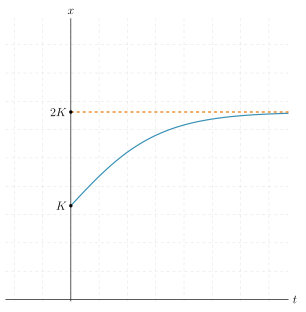
Let \(y,u,v,P\) and \(Q\) all be functions of \(x\). Show that the substitution \(y=uv\) in the differential equation \[ \frac{\mathrm{d}y}{\mathrm{d}x}+Py=Q \] leads to an equation for \(\dfrac{\mathrm{d}v}{\mathrm{d}x}\) in terms of \(x,Q\) and \(u\), provided that \(u\) satisfies a suitable first order differential equation. Hence or otherwise solve \[ \frac{\mathrm{d}y}{\mathrm{d}x}-\frac{2y}{x+1}=\left(x+1\right)^{\frac{5}{2}}, \] given that \(y(1)=0\). For what set of values of \(x\) is the solution valid?
Show SolutionLet \(P,Q\) and \(R\) be functions of \(x\). Prove that, for any function \(y\) of \(x\), the function \[ Py''+Qy'+Ry \] can be written in the form \(\dfrac{\mathrm{d}}{\mathrm{d}x}(py'+qy),\) where \(p\) and \(q\) are functions of \(x\), if and only if \(P''-Q'+R=0.\) Solve the differential equation \[ (x-x^{4})y''+(1-7x^{3})y'-9x^{2}y=(x^{3}+3x^2)\mathrm{e}^{x}, \] given that when \(x=2,y=2\mathrm{e}^{2}\) and \(y'=0.\)
Show SolutionThe matrix \(\mathbf{F}\) is defined by \[ \mathbf{F}=\mathbf{I}+\sum_{n=1}^{\infty}\frac{1}{n!}t^{n}\mathbf{A}^{n}, \] where $\mathbf{A}=\begin{pmatrix}-3 & -1\\ 8 & 3 \end{pmatrix} \( and \) t \( is a variable scalar. Evaluate \)\mathbf{A}^{2}$, and show that \[ \mathbf{F}=\mathbf{I}\cosh t+\mathbf{A}\sinh t. \] Show also that \(\mathbf{F}^{-1}=\mathbf{I}\cosh t-\mathbf{A}\sinh t\), and that \(\dfrac{\mathrm{d}\mathbf{F}}{\mathrm{d}t}=\mathbf{FA}\). The vector $\mathbf{r}=\begin{pmatrix}x(t)\\ y(t) \end{pmatrix}$ satisfies the differential equation \[ \frac{\mathrm{d}\mathbf{r}}{\mathrm{d}t}+\mathbf{A}\mathbf{r}=\mathbf{0}, \] with \(x=\alpha\) and \(y=\beta\) at \(t=0.\) Solve this equation by means of a suitable matrix integrating factor, and hence show that \begin{alignat*}{1} x(t) & =\alpha\cosh t+(3\alpha+\beta)\sinh t\\ y(t) & =\beta\cosh t-(8\alpha+3\beta)\sinh t. \end{alignat*}
Show SolutionBy substituting \(y(x)=xv(x)\) in the differential equation \[ x^{3}\frac{\mathrm{d}v}{\mathrm{d}x}+x^{2}v=\frac{1+x^{2}v^{2}}{\left(1+x^{2}\right)v}, \] or otherwise, find the solution \(v(x)\) that satisfies \(v=1\) when \(x=1\). What value does this solution approach when \(x\) becomes large?
Show Solution