Work, energy and Power 2
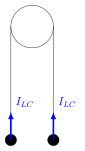
A lift of mass \(M\) and its counterweight of mass \(M\) are connected by a light inextensible cable which passes over a light frictionless pulley. The lift is constrained to move vertically between smooth guides. The distance between the floor and the ceiling of the lift is \(h\). Initially, the lift is at rest, and the distance between the top of the lift and the pulley is greater than \(h\). A small tile of mass \(m\) becomes detached from the ceiling of the lift. Show that the time taken for it to fall to the floor is \[ t=\sqrt{\frac{\left(2M-m\right)h}{Mg}}. \] The collision between the tile and the lift floor is perfectly inelastic. Show that the lift is reduced to rest by the collision, and that the loss of energy of the system is \(mgh\). Note: the question on the STEP database is \[ t=\sqrt{\frac{2\left(M-m\right)h}{Mg}}. \]
Show Solution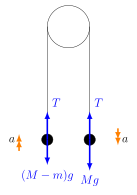
A piece of circus apparatus consists of a rigid uniform plank of mass 1000\(\,\)kg, suspended in a horizontal position by two equal light vertical ropes attached to the ends. The ropes each have natural length 10\(\,\)m and modulus of elasticity 490\(\,\)000 N. Initially the plank is hanging in equilibrium. Nellie, an elephant of mass 4000\(\,\)kg, lands in the middle of the plank while travelling vertically downwards at speed 5\(\,\)ms\(^{-1}.\) While carrying Nellie, the plank comes instantaneously to rest at a negligible height above the floor, and at this instant Nellie steps nimbly and gently off the plank onto the floor. Assuming that the plank remains horizontal, and the rope remain vertical, throughout the motion, find to three significant figures its initial height above the floor. During the motion after Nellie alights, do the ropes ever become slack? {[}Take \(g\) to be \(9.8\mbox{\,\ ms}^{-1}.\){]}
Show SolutionA rubber band band of length \(2\pi\) and modulus of elasticity \(\lambda\) encircles a smooth cylinder of unit radius, whose axis is horizontal. A particle of mass \(m\) is attached to the lowest point of the band, and hangs in equilibrium at a distance \(x\) below the axis of the cylinder. Obtain an expression in terms of \(x\) for the stretched length of the band in equilibrium. What is the value of \(\lambda\) if \(x=2\)?
Show Solution