Moments
Simple static contexts
Two particles, of masses \(m_1\) and \(m_2\) where \(m_1 > m_2\), are attached to the ends of a light, inextensible string. A particle of mass \(M\) is fixed to a point \(P\) on the string. The string passes over two small, smooth pulleys at \(Q\) and \(R\), where \(QR\) is horizontal, so that the particle of mass \(m_1\) hangs vertically below \(Q\) and the particle of mass \(m_2\) hangs vertically below~\(R\). The particle of mass \(M\) hangs between the two pulleys with the section of the string \(PQ\) making an acute angle of \(\theta_1\) with the upward vertical and the section of the string \(PR\) making an acute angle of \(\theta_2\) with the upward vertical. \(S\) is the point on \(QR\) vertically above~\(P\). The system is in equilibrium.
- Using a triangle of forces, or otherwise, show that:
- \(\sqrt{m_1^2 - m_2^2} < M < m_1 + m_2\)\,;
- \(S\) divides \(QR\) in the ratio \(r : 1\), where \[ r = \frac{M^2 - m_1^2 + m_2^2}{M^2 - m_2^2 + m_1^2}. \]
- You are now given that \(M^2 = m_1^2 + m_2^2\). Show that \(\theta_1 + \theta_2 = 90^\circ\) and determine the ratio of \(QR\) to \(SP\) in terms of the masses only.
A small light ring is attached to the end \(A\) of a uniform rod \(AB\) of weight \(W\) and length \(2a\). The ring can slide on a rough horizontal rail. One end of a light inextensible string of length \(2a\) is attached to the rod at \(B\) and the other end is attached to a point \(C\) on the rail so that the rod makes an angle of \(\theta\) with the rail, where \(0 < \theta < 90^{\circ}\). The rod hangs in the same vertical plane as the rail. A force of \(kW\) acts vertically downwards on the rod at \(B\) and the rod is in equilibrium.
- You are given that the string will break if the tension \(T\) is greater than \(W\). Show that (assuming that the ring does not slip) the string will break if $$2k + 1 > 4 \sin \theta.$$
- Show that (assuming that the string does not break) the ring will slip if $$2k + 1 > (2k + 3)\mu \tan \theta,$$ where \(\mu\) is the coefficient of friction between the rail and the ring.
- You are now given that \(\mu \tan \theta < 1\). Show that, when \(k\) is increased gradually from zero, the ring will slip before the string breaks if $$\mu < \frac{2 \cos \theta}{1 + 2 \sin \theta}.$$

- \(\,\) \begin{align*} \overset{\curvearrowright}{A}:&& W \cos \theta \cdot a + kW \cos \theta \cdot 2a - T \cos \theta \sin \theta \cdot 2a - T \sin \theta \cos \theta \cdot 2a &= 0 \\ && (2k+1) \cos \theta W &= T \cos \theta \cdot 4 \sin \theta \\ \Rightarrow && T &= \frac{2k+1}{4 \sin \theta} W \\ \Rightarrow && \text{breaks if }\quad \quad 2k+1 &> 4 \sin \theta \end{align*}
- \(\,\) \begin{align*} \text{N2}(\uparrow): && R - W - kW - T \sin \theta &= 0 \\ \Rightarrow && R &= (k+1)W - T \sin \theta \\ &&&= (k+1)W - \frac{2k+1}{4} W \\ &&&= \frac{2k+3}{4}W \\ \text{N2}(\leftarrow): && F_A - T \cos \theta &= 0 \\ \Rightarrow && F_A &= \frac{2k+1}{4 }\cot \theta \\ \Rightarrow && \text{slips if }\quad \quad\quad \quad\quad \quad F_A &> \mu R \\ \Rightarrow && \text{slips if }\quad \quad \frac{2k+1}{4 }\cot \theta &> \mu \frac{2k+3}{4}W \\ \Rightarrow && 2k+1 &> (2k+3) \mu \tan \theta \end{align*}
- The condition for breaking is \(k > 2\sin \theta -\frac12\). The condition for slipping is equivalent to: \begin{align*} && 2k+1 &> (2k+3) \mu \tan \theta \\ \Leftrightarrow && 2k(1- \mu \tan \theta) &> 3 \mu \tan \theta-1 \\ \Leftrightarrow && k &> \frac{3 \mu \tan \theta-1}{2(1- \mu \tan \theta)} \end{align*} Therefore we will slip first if: \begin{align*} && \frac{3 \mu \tan \theta-1}{2(1- \mu \tan \theta)} &< 2 \sin \theta - \frac12 \\ \Leftrightarrow && 3 \mu \tan \theta-1 &< 4 \sin \theta (1- \mu \tan \theta) - (1- \mu \tan \theta) \\ &&&=4 \sin \theta - 1 + \mu \tan \theta (1-4 \sin \theta) \\ \Leftrightarrow && 3 \mu \tan \theta &< 4 \sin \theta + \mu \tan \theta (1- 4 \sin \theta) \\ \Leftrightarrow && \mu \tan \theta(3-1+4\sin \theta) &< 4 \sin \theta \\ \Leftrightarrow && \mu &< \frac{2 \cos \theta}{1+2 \sin \theta} \end{align*}
Two identical rough cylinders of radius \(r\) and weight \(W\) rest, not touching each other but a negligible distance apart, on a horizontal floor. A thin flat rough plank of width \(2a\), where \(a < r\), and weight \(kW\) rests symmetrically and horizontally on the cylinders, with its length parallel to the axes of the cylinders and its faces horizontal. A vertical cross-section is shown in the diagram below.
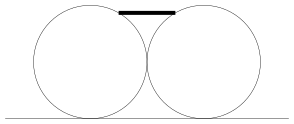
- Let \(F\) be the frictional force between one cylinder and the floor, and let \(R\) be the normal reaction between the plank and one cylinder. Show that \[ R\sin\theta = F(1+\cos\theta)\,, \] where \(\theta\) is the acute angle between the plank and the tangent to the cylinder at the point of contact. Deduce that \(2\sin\theta \le 1+\cos\theta\,\).
- Show that \[ N= \left( 1+\frac2 k\right)\left(\frac{1+\cos\theta}{\sin\theta} \right) F \,, \] where \(N\) is the normal reaction between the floor and one cylinder. Write down the condition that the cylinder does not slip on the floor and show that it is satisfied with no extra restrictions on \(\theta\).
- Show that \(\sin\theta\le\frac45\,\) and hence that \(r\le5a\,\).
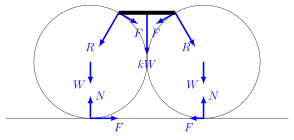
- \(\,\) \begin{align*} \text{N2}(\rightarrow, \text{ one cylinder}): && F\cos \theta + F - R \sin \theta &= 0 \\ \Rightarrow && F(1+\cos \theta) &= R \sin \theta \\ && F \leq \tfrac12 R \\ \Rightarrow && R \sin \theta &\leq \frac12 R(1+\cos \theta) \\ \Rightarrow && 2 \sin \theta &\leq 1 + \cos \theta \end{align*}
- \(\,\) \begin{align*} \text{N2}(\uparrow, \text{system}): && 2N-(k+2)W &= 0 \\ \Rightarrow && W &= \left ( \frac{2}{k+2} \right)N \\ \text{N2}(\uparrow, \text{one cylinder}): && N - W - R\cos \theta -F\sin \theta &= 0 \\ \Rightarrow && N - \left ( \frac{2}{k+2} \right)N - F \left ( \frac{1+\cos \theta}{\sin \theta} \right) \cos \theta - F \sin \theta &= 0 \\ \Rightarrow && \left ( \frac{k}{k+2} \right)N &= \left ( \frac{\cos \theta + \cos^2 \theta + \sin^2 \theta}{\sin \theta} \right) F\\ \Rightarrow && N &= \left ( 1 + \frac2{k} \right) \left ( \frac{\cos \theta + 1}{\sin \theta} \right) F \end{align*} The cylinder does not slip if \(F \leq \tfrac12 N\), ie \begin{align*} && N &\leq \left ( 1 + \frac2{k} \right) \left ( \frac{\cos \theta + 1}{\sin \theta} \right) \frac12 N \\ \Rightarrow && 2\sin \theta &\leq \left ( 1 + \frac2{k} \right) \left ( \cos \theta + 1 \right) \end{align*} but since \(2 \sin \theta \leq (1 + \cos \theta)\) and \((1+\frac2k) > 1\) this inequality is obviously satisfied.
- We can notice that \(2\sin \theta = 1 + \cos \theta\) is satisfied by a \(3-4-5\) triangle, where \(\sin \theta = 4/5, \cos \theta = 3/5\) and hence if \(\sin \theta \leq \frac45\) the condition must hold.
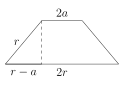
So \(\sin \theta = \frac{r-a}{r} \leq \frac45 \Rightarrow 5r-5a \leq 4r \Rightarrow r \leq 5a\)
Two long circular cylinders of equal radius lie in equilibrium on an inclined plane, in \mbox{contact} with one another and with their axes horizontal. The weights of the upper and lower \mbox{cylinders} are \(W_1\) and \(W_2\), respectively, where \(W_1>W_2\)\,. The coefficients of friction \mbox{between} the \mbox{inclined} plane and the upper and lower cylinders are \(\mu_1\) and \(\mu_2\), respectively, and the \mbox{coefficient} of friction \mbox{between} the two cylinders is \(\mu\). The angle of inclination of the plane is~\(\alpha\) (which is positive).
- Let \(F\) be the magnitude of the frictional force between the two cylinders, and let \(F_1\) and \(F_2\) be the magnitudes of the frictional forces between the upper cylinder and the plane, and the lower cylinder and the plane, respectively. Show that \(F=F_1=F_2\,\).
- Show that \[ \mu \ge \dfrac{W_1+W_2}{W_1-W_2} \,,\] and that \[ \tan\alpha \le \frac{ 2 \mu_1 W_1}{(1+\mu_1)(W_1+ W_2)}\,. \]
The diagram shows three identical discs in equilibrium in a vertical plane. Two discs rest, not in contact with each other, on a horizontal surface and the third disc rests on the other two. The angle at the upper vertex of the triangle joining the centres of the discs is \(2\theta\).
- Show that the normal reaction between the horizontal surface and a disc in contact with the surface is \(\frac32 W\,\).
- Find the normal reaction between two discs in contact and show that the magnitude of the frictional force between two discs in contact is \(\dfrac{W\sin\theta}{2(1+\cos\theta)}\,\).
- Show that if \(\mu <2- \surd3\,\) there is no value of \(\theta\) for which equilibrium is possible.
A thin non-uniform bar \(AB\) of length \(7d\) has centre of mass at a point \(G\), where \(AG=3d\). A light inextensible string has one end attached to \(A\) and the other end attached to \(B\). The string is hung over a smooth peg \(P\) and the bar hangs freely in equilibrium with \(B\) lower than~\(A\). Show that \[ 3\sin\alpha = 4\sin\beta\,, \] where \(\alpha\) and \(\beta\) are the angles \(PAB\) and \(PBA\), respectively. Given that \(\cos\beta=\frac45\) and that \(\alpha\) is acute, find in terms of \(d\) the length of the string and show that the angle of inclination of the bar to the horizontal is \(\arctan \frac17\,\).
A uniform rod \(AB\) of length \(4L \) and weight \(W\) is inclined at an angle \(\theta\) to the horizontal. Its lower end \(A\) rests on a fixed support and the rod is held in equilibrium by a string attached to the rod at a point \(C\) which is \(3L \) from \(A\). The reaction of the support on the rod acts in a direction \(\alpha\) to \(AC\) and the string is inclined at an angle \(\beta\) to \(CA\). Show that \[ \cot\alpha = 3\tan \theta + 2 \cot \beta\,. \] Given that \(\theta =30^\circ\) and \(\beta = 45^\circ\), show that \(\alpha= 15^\circ\).
A painter of weight \(kW\) uses a ladder to reach the guttering on the outside wall of a house. The wall is vertical and the ground is horizontal. The ladder is modelled as a uniform rod of weight \(W\) and length \(6a\). The ladder is not long enough, so the painter stands the ladder on a uniform table. The table has weight \(2W\) and a square top of side \(\frac12 a\) with a leg of length \(a\) at each corner. The foot of the ladder is at the centre of the table top and the ladder is inclined at an angle \(\arctan 2\) to the horizontal. The edge of the table nearest the wall is parallel to the wall. The coefficient of friction between the foot of the ladder and the table top is \(\frac12\). The contact between the ladder and the wall is sufficiently smooth for the effects of friction to be ignored.
- Show that, if the legs of the table are fixed to the ground, the ladder does not slip on the table however high the painter stands on the ladder.
- It is given that \(k=9\) and that the coefficient of friction between each table leg and the ground is \(\frac13\). If the legs of the table are not fixed to the ground, so that the table can tilt or slip, determine which occurs first when the painter slowly climbs the ladder.
\(AB\) is a uniform rod of weight \(W\,\). The point \(C\) on \(AB\) is such that \(AC>CB\,\). The rod is in contact with a rough horizontal floor at \(A\,\) and with a cylinder at \(C\,\). The cylinder is fixed to the floor with its axis horizontal. The rod makes an angle \({\alpha}\) with the horizontal and lies in a vertical plane perpendicular to the axis of the cylinder. The coefficient of friction between the rod and the floor is \(\tan \lambda_1\) and the coefficient of friction between the rod and the cylinder is \(\tan \lambda_2\,\). Show that if friction is limiting both at \(A\) and at \(C\), and \({\alpha} \ne {\lambda}_2 - {\lambda}_1\,\), then the frictional force acting on the rod at \(A\) has magnitude $$ \frac{ W\sin {\lambda}_1 \, \sin({\alpha}-{\lambda}_2)} {\sin ({\alpha}+{\lambda}_1-{\lambda}_2)} \;.$$ %and that %$$ %p=\frac{\cos{\alpha} \, \sin({\alpha}+{\lambda}_1-{\lambda}_2)} %{2\cos{\lambda}_1 \, \sin {\lambda}_2}\;. %$$
\(\,\) \vspace*{-0.5in}
- If the normal reactions on the lower and higher wheels of the lorry are equal, show that the sum of the frictional forces between the wheels and the ground is zero.
- If \(P\) is such that the lorry does not tip over (but the normal reactions on the lower and higher wheels of the lorry need not be equal), show that \[ W\tan(\alpha - \beta) \le P \le W\tan(\alpha+\beta)\;, \] where \(\tan\beta = d/h\,\).
A rigid straight beam \(AB\) has length \(l\) and weight \(W\). Its weight per unit length at a distance \(x\) from \(B\) is \(\alpha Wl^{-1} (x/l)^{\alpha-1}\,\), where \(\alpha\) is a positive constant. Show that the centre of mass of the beam is at a distance \(\alpha l/(\alpha+1)\) from \(B\). The beam is placed with the end \(A\) on a rough horizontal floor and the end \(B\) resting against a rough vertical wall. The beam is in a vertical plane at right angles to the plane of the wall and makes an angle of \(\theta\) with the floor. The coefficient of friction between the floor and the beam is \(\mu\) and the coefficient of friction between the wall and the beam is also \(\mu\,\). Show that, if the equilibrium is limiting at both \(A\) and \(B\), then \[ \tan\theta = \frac{1-\alpha \mu^2}{(1+\alpha)\mu}\;. \] Given that \(\alpha =3/2\,\) and given also that the beam slides for any \(\theta<\pi/4\,\) find the greatest possible value of \(\mu\,\).
Two identical uniform cylinders, each of mass \(m,\) lie in contact with one another on a horizontal plane and a third identical cylinder rests symmetrically on them in such a way that the axes of the three cylinders are parallel. Assuming that all the surfaces in contact are equally rough, show that the minimum possible coefficient of friction is \(2-\sqrt{3}.\)
Show Solution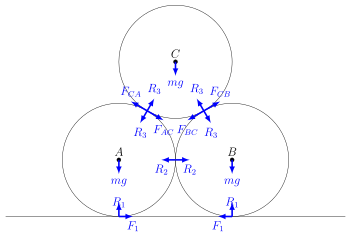
\noindent
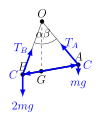
A light rod of length \(2a\) is hung from a point \(O\) by two light inextensible strings \(OA\) and \(OB\) each of length \(b\) and each fixed at \(O\). A particle of mass \(m\) is attached to the end \(A\) and a particle of mass \(2m\) is attached to the end \(B.\) Show that, in equilibrium, the angle \(\theta\) that the rod makes the horizontal satisfies the equation \[ \tan\theta=\frac{a}{3\sqrt{b^{2}-a^{2}}}. \] Express the tension in the string \(AO\) in terms of \(m,g,a\) and \(b\).
Show Solution