Vectors
Vectors in two dimensions (addition, scalar multiplication, equation of a line), scalar product
Let \(ABCD\) be a parallelogram. By using vectors, or otherwise, prove that:
- \(AB^{2}+BC^{2}+CD^{2}+DA^{2}=AC^{2}+BD^{2}\);
- \(|AC^{2}-BD^{2}|\) is 4 times the area of the rectangle whose sides are any side of the parallelogram and the projection of an adjacent side on that side.
- \begin{align*} AC^2 + BD^2 &= (\mathbf{x}+\mathbf{y})\cdot (\mathbf{x}+\mathbf{y}) + (\mathbf{y}-\mathbf{x})\cdot(\mathbf{y}-\mathbf{x}) \\ &= 2\mathbf{x}\cdot\mathbf{x} + 2\mathbf{y}\cdot\mathbf{y} \\ &= AB^2 + CD^2 +AD^2 + BC^2 \end{align*}
- \begin{align*} AC^2 -BD^2 &= (\mathbf{x}+\mathbf{y})\cdot (\mathbf{x}+\mathbf{y}) - (\mathbf{y}-\mathbf{x})\cdot(\mathbf{y}-\mathbf{x}) \\ &= 4 \mathbf{x}\cdot \mathbf{y} \end{align*} \(\mathbf{x}\cdot\mathbf{y} = |\mathbf{x}||\mathbf{y}|\cos \theta\) which is exactly the lenth of one side mutliplied by the length of the projection to that same side.
The distinct points \(O\,(0,0,0),\) \(A\,(a^{3},a^{2},a),\) \(B\,(b^{3},b^{2},b)\) and \(C\,(c^{3},c^{2},c)\) lie in 3-dimensional space.
- Prove that the lines \(OA\) and \(BC\) do not intersect.
- Given that \(a\) and \(b\) can vary with \(ab=1,\) show that \(\angle AOB\) can take any value in the interval \(0<\angle AOB<\frac{1}{2}\pi\), but no others.
- The line \(OA\) is \(\lambda \begin{pmatrix} a^3 \\ a^2 \\ a \end{pmatrix}\). The line \(BC\) is \(\begin{pmatrix} b^3 \\ b^2 \\ b \end{pmatrix} + \mu \begin{pmatrix} c^3-b^3 \\ c^2-b^2 \\ c-b \end{pmatrix}\). If these lies are concurrent then there would be \(\mu\) and \(\lambda\) such that they are equal, and in particular, \begin{align*} && \frac{b^2 + \mu(c^2-b^2)}{b + \mu (c-b)} &= \frac{b^3 + \mu(c^3-b^3)}{b^2 + \mu (c^2-b^2)} \\ \Leftrightarrow && (b^2 + \mu(c^2-b^2))^2 &= (b+\mu(c-b))(b^3+\mu(c^3-b^3)) \\ && b^4 +2\mu b^2 (c^2-b^2) + \mu^2 (c^2-b^2) &= b^4 + \mu(c-b)b^3 + \mu b(c^3-b^3) + \mu^2 (c-b)(c^3-b^3) \\ \Leftrightarrow && 2\mu b^2 (c+b) + \mu^2(c-b)(c+b)^2 &= \mu (b^3 + b(c^2+bc+b^2)) + \mu^2 (c^3-b^3) \\ && \mu = 0 & \Rightarrow a = b \\ \Leftrightarrow && b^2c - bc^2 &= \mu (c^3-b^3-(c-b)(c+b)^2) \\ \Leftrightarrow && bc(b-c) &= \mu (c-b)(c^2+bc+b^2-c^2-2bc-b^2) \\ \Leftrightarrow && bc &= \mu (bc) \\ \Leftrightarrow && \mu &= 1 \\ && \mu = -1 & \Rightarrow a = c \end{align*} Therefore there are no solutions.
- \begin{align*} \cos \angle AOB &= \frac{ab+a^2b^2+a^3b^3}{\sqrt{a^2+a^4+a^6}\sqrt{b^2+b^4+b^6}} \\ &= \frac{3}{\sqrt{1 + a^2 + a^4} \sqrt{1 + b^2 + b^4}} \\ &> 0 \end{align*} Therefore the angle satisfies \(\angle AOB < \tfrac12 \pi\). We cannot achieve \(0\), since that would require \(a = b = 1\), therefore it falls in the range \(0 < \angle AOB < \tfrac12 \pi\)
In the triangle \(OAB,\) \(\overrightarrow{OA}=\mathbf{a},\) \(\overrightarrow{OB}=\mathbf{b}\) and \(OA=OB=1\). Points \(C\) and \(D\) trisect \(AB\) (i.e. \(AC=CD=DB=\frac{1}{3}AB\)). \(X\) and \(Y\) lie on the line-segments \(OA\) and \(OB\) respectively, in such a way that \(CY\) and \(DX\) are perpendicular, and \(OX+OY=1\). Denoting \(OX\) by \(x\), obtain a condition relating \(x\) and \(\mathbf{a\cdot b}\), and prove that \[ \frac{8}{17}\leqslant\mathbf{a\cdot b}\leqslant1. \] If the angle \(AOB\) is as large as possible, determine the distance \(OE,\) where \(E\) is the point of intersection of \(CY\) and \(DX\).
Show Solution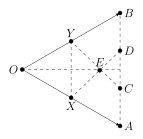
\(ABCD\) is a skew (non-planar) quadrilateral, and its pairs of opposite sides are equal, i.e. \(AB=CD\) and \(BC=AD\). Prove that the line joining the midpoints of the diagonals \(AC\) and \(BD\) is perpendicular to each diagonal.
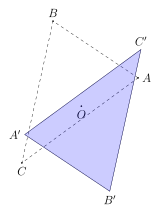
Show Solution\(ABC\) is a triangle whose vertices have position vectors \(\mathbf{a,b,c}\)brespectively, relative to an origin in the plane \(ABC\). Show that an arbitrary point \(P\) on the segment \(AB\) has position vector \[ \rho\mathbf{a}+\sigma\mathbf{b}, \] where \(\rho\geqslant0\), \(\sigma\geqslant0\) and \(\rho+\sigma=1\). Give a similar expression for an arbitrary point on the segment \(PC\), and deduce that any point inside \(ABC\) has position vector \[ \lambda\mathbf{a}+\mu\mathbf{b}+\nu\mathbf{c}, \] where \(\lambda\geqslant0\), \(\mu\geqslant0\), \(\nu\geqslant0\) and \(\lambda+\mu+\nu=1\). Sketch the region of the plane in which the point \(\lambda\mathbf{a}+\mu\mathbf{b}+\nu\mathbf{c}\) lies in each of the following cases:
- \(\lambda+\mu+\nu=-1\), \(\lambda\leqslant0\), \(\mu\leqslant0\), \(\nu\leqslant0\);
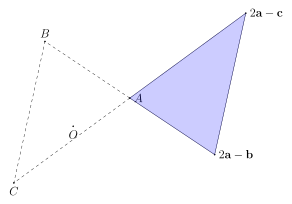
- \(\lambda+\mu+\nu=1\), \(\mu\leqslant0\), \(\nu\leqslant0\).

- This is equivalent to the area inside the triangle where every point (\(\mathbf{a}, \mathbf{b}, \mathbf{c}\)) has been send to it's negative (\(-\mathbf{a}, -\mathbf{b}, -\mathbf{c}\)),
ie
- Writing points as:
\begin{align*}
\lambda\mathbf{a}+\mu\mathbf{b}+\nu\mathbf{c} &= (1-\mu - \nu)\mathbf{a}+\mu\mathbf{b}+\nu\mathbf{c} \\
&= \mathbf{a} + (-\mu)(\mathbf{a}-\mathbf{b}) + (-\nu)(\mathbf{a} - \mathbf{c}) \\
&= \mathbf{a} + (-\mu)(\mathbf{a}-\mathbf{b}) + (-\nu)(\mathbf{a} - \mathbf{c}) + (1+\mu+\nu)\mathbf{0}\\
\end{align*}
So this is a translation of \(\mathbf{a}\) of the triangle with vertices at \(\mathbf{0}, \mathbf{a-b}, \mathbf{a-c}\), or a triangle with vertices \(\mathbf{a}, 2\mathbf{a-b}, 2\mathbf{a-c}\).
Let \(\mathbf{r}\) be the position vector of a point in three-dimensional space. Describe fully the locus of the point whose position vector is \(\mathbf{r}\) in each of the following four cases:
- \(\left(\mathbf{a-b}\right) \cdot \mathbf{r}=\frac{1}{2}(\left|\mathbf{a}\right|^{2}-\left|\mathbf{b}\right|^{2});\)
- \(\left(\mathbf{a-r}\right)\cdot\left(\mathbf{b-r}\right)=0;\)
- \(\left|\mathbf{r-a}\right|^{2}=\frac{1}{2}\left|\mathbf{a-b}\right|^{2};\)
- \(\left|\mathbf{r-b}\right|^{2}=\frac{1}{2}\left|\mathbf{a-b}\right|^{2}.\)
- \(\mathbf{n} \cdot \mathbf{r} = 0\) is the equation of a plane with normal \(\mathbf{n}\). \(\mathbf{n} \cdot (\mathbf{r}-\mathbf{a}) = 0\) is the equation of a plane through \(\mathbf{a}\) with normal \(\mathbf{n}\). Our expression is: \begin{align*} && \left(\mathbf{a-b}\right) \cdot \mathbf{r}&=\frac{1}{2}(\left|\mathbf{a}\right|^{2}-\left|\mathbf{b}\right|^{2}) \\ &&&=\frac{1}{2}(\mathbf{a}-\mathbf{b})\cdot(\mathbf{a}+\mathbf{b}) \\ \Leftrightarrow && \left(\mathbf{a-b}\right) \cdot \left ( \mathbf{r} - \frac12 (\mathbf{a}+\mathbf{b}) \right) &= 0 \end{align*} So this is a plane through \(\frac12 (\mathbf{a}+\mathbf{b})\) perpendicular to \(\mathbf{a}-\mathbf{b}\). ie the plane halfway between \(\mathbf{a}\) and \(\mathbf{b}\) perpendicular to the line between them.
- \begin{align*} && 0 &= \left(\mathbf{a-r}\right)\cdot\left(\mathbf{b-r}\right) \\ &&&= \mathbf{a} \cdot \mathbf{b} - \mathbf{r} \cdot (\mathbf{a}+\mathbf{b}) + \mathbf{r}\cdot\mathbf{r} \\ &&&= \left ( \mathbf{r}- \frac12(\mathbf{a}+\mathbf{b}) \right) \cdot \left ( \mathbf{r}- \frac12(\mathbf{a}+\mathbf{b}) \right) - \frac14 \left (\mathbf{a}\cdot\mathbf{a}+2\mathbf{a}\cdot\mathbf{b} + \mathbf{b}\cdot\mathbf{b} \right) +\mathbf{a}\cdot\mathbf{b} \\ &&&= \left | \mathbf{r} - \frac12 \left (\mathbf{a}+\mathbf{b} \right) \right|^2 - \left |\frac12 \left ( \mathbf{a} - \mathbf{b}\right) \right|^2 \end{align*} Therefore this is a sphere, centre \(\frac12 \left (\mathbf{a}+\mathbf{b} \right)\) radius \(\left |\frac12 \left ( \mathbf{a} - \mathbf{b}\right) \right|\)
- This is a sphere centre \(\mathbf{a}\) radius \(\frac1{\sqrt{2}} \left|\mathbf{a-b}\right|\)
- This is a sphere centre \(\mathbf{b}\) radius \(\frac1{\sqrt{2}} \left|\mathbf{a-b}\right|\)