Problems

Filters
Clear Filters

1 problem found

1988 Paper 2 Q14
D: 1600.0 B: 1488.9

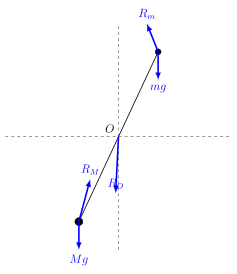
Two particles of mass \(M\) and \(m\) \((M>m)\) are attached to the ends of a light rod of length \(2l.\) The rod is fixed at its midpoint to a point \(O\) on a horizontal axle so that the rod can swing freely about \(O\) in a vertical plane normal to the axle. The axle rotates about a vertical axis through \(O\) at a constant angular speed \(\omega\) such that the rod makes a constant angle \(\alpha\) \((0<\alpha<\frac{1}{2}\pi)\) with the vertical. Show that \[ \omega^{2}=\left(\frac{M-m}{M+m}\right)\frac{g}{l\cos\alpha}. \] Show also that the force of reaction of the rod on the axle is inclined at an angle \[ \tan^{-1}\left[\left(\frac{M-m}{M+m}\right)^{2}\tan\alpha\right] \] with the downward vertical.


Solution:
TikZ diagram
The accelerations of \(M\) and \(m\) are \(l \sin \alpha \omega^2\) and \(-l \sin \alpha \omega^2\) so the forces \(R_M\) and \(R_m\) are \(M\binom{l \sin \alpha \omega^2}{g}, \,m \binom{-l \sin \alpha \omega^2}{g}\). Since the axle is rotating freely, the moment about \(O\) for the rod must be \(O\). The moment for \(M\) will be \(M\binom{l \sin \alpha\omega^2}{g} \cdot \binom{-l\cos \alpha}{l \sin \alpha} = lM\sin\alpha (g - l \cos \alpha\omega^2)\). The moment for \(m\) will be \(m \binom{-l \sin \alpha\omega^2}{g} \cdot \binom{-l\cos \alpha\omega^2}{l \sin \alpha} = lm \sin \alpha(g+l \cos \alpha\omega^2)\) Therefore \begin{align*} && lM\sin\alpha (g - l \cos \alpha\omega^2) &= lm \sin \alpha(g+l \cos \alpha\omega^2) \\ && M(g - l \cos \alpha \omega^2) &= m(g + l \cos \alpha \omega^2 ) \\ \Rightarrow && g(M-m) &= l \cos \alpha (M+m) \omega^2 \\ \Rightarrow && \omega^2 &= \left (\frac{M-m}{M+m} \right) \frac{g}{l \cos \alpha} \end{align*} as required. The total force on the rod is \(\mathbf{0}\) so the reaction force must be \(M\binom{l \sin \alpha \omega^2}{g}+ \,m \binom{-l \sin \alpha \omega^2}{g} = \binom{l \sin \alpha \omega^2 (M-m)}{(M+m)g}\) Therefore the angle this makes with downward vertical is: \begin{align*} \theta &= \tan^{-1} \left ( \frac{l \sin \alpha \omega^2 (M-m)}{(M+m)g} \right) \\ &= \tan^{-1} \left ( \frac{l \sin \alpha (M-m)}{(M+m)g} \omega^2\right) \\ &= \tan^{-1} \left ( \frac{l \sin \alpha (M-m)}{(M+m)g} \left (\frac{M-m}{M+m} \right) \frac{g}{l \cos \alpha}\right) \\ &= \tan^{-1}\left[\left(\frac{M-m}{M+m}\right)^{2}\tan\alpha\right] \end{align*} as required.