Problems
Filters
9 problems found
2022 Paper 2 Q9
A rectangular prism is fixed on a horizontal surface. A vertical wall, parallel to a vertical face of the prism, stands at a distance \(d\) from it. A light plank, making an acute angle \(\theta\) with the horizontal, rests on an upper edge of the prism and is in contact with the wall below the level of that edge of the prism and above the level of the horizontal plane. You may assume that the plank is long enough and the prism high enough to make this possible. The contact between the plank and the prism is smooth, and the coefficient of friction at the contact between the plank and the wall is \(\mu\). When a heavy point mass is fixed to the plank at a distance \(x\), along the plank, from its point of contact with the wall, the system is in equilibrium.
- Show that, if \(x = d\sec^3\theta\), then there is no frictional force acting between the plank and the wall.
- Show that, if \(x > d\sec^3\theta\), it is necessary that \[\mu \geqslant \frac{x - d\sec^3\theta}{x\tan\theta}\] and give the corresponding inequality if \(x < d\sec^3\theta\).
- Show that \[\frac{x}{d} \geqslant \frac{\sec^3\theta}{1 + \mu\tan\theta}\,.\] Show also that, if \(\mu < \cot\theta\), then \[\frac{x}{d} \leqslant \frac{\sec^3\theta}{1 - \mu\tan\theta}\,.\]
- Show that if \(x\) is such that the point mass is fixed to the plank somewhere between the edge of the prism and the wall, then \(\tan\theta < \mu\).
2022 Paper 3 Q10
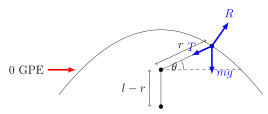
Two light elastic springs each have natural length \(a\). One end of each spring is attached to a particle \(P\) of weight \(W\). The other ends of the springs are attached to the end-points, \(B\) and \(C\), of a fixed horizontal bar \(BC\) of length \(2a\). The moduli of elasticity of the springs \(PB\) and \(PC\) are \(s_1 W\) and \(s_2 W\) respectively; these values are such that the particle \(P\) hangs in equilibrium with angle \(BPC\) equal to \(90^\circ\).
- Let angle \(PBC = \theta\). Show that \(s_1 = \dfrac{\sin\theta}{2\cos\theta - 1}\) and find \(s_2\) in terms of \(\theta\).
- Take the zero level of gravitational potential energy to be the horizontal bar \(BC\) and let the total potential energy of the system be \(-paW\). Show that \(p\) satisfies \[ \frac{1}{2}\sqrt{2} \geqslant p > \frac{1}{4}(1+\sqrt{3}) \] and hence that \(p = 0.7\), correct to one significant figure.
2021 Paper 2 Q9
Two particles, of masses \(m_1\) and \(m_2\) where \(m_1 > m_2\), are attached to the ends of a light, inextensible string. A particle of mass \(M\) is fixed to a point \(P\) on the string. The string passes over two small, smooth pulleys at \(Q\) and \(R\), where \(QR\) is horizontal, so that the particle of mass \(m_1\) hangs vertically below \(Q\) and the particle of mass \(m_2\) hangs vertically below~\(R\). The particle of mass \(M\) hangs between the two pulleys with the section of the string \(PQ\) making an acute angle of \(\theta_1\) with the upward vertical and the section of the string \(PR\) making an acute angle of \(\theta_2\) with the upward vertical. \(S\) is the point on \(QR\) vertically above~\(P\). The system is in equilibrium.
- Using a triangle of forces, or otherwise, show that:
- \(\sqrt{m_1^2 - m_2^2} < M < m_1 + m_2\)\,;
- \(S\) divides \(QR\) in the ratio \(r : 1\), where \[ r = \frac{M^2 - m_1^2 + m_2^2}{M^2 - m_2^2 + m_1^2}. \]
- You are now given that \(M^2 = m_1^2 + m_2^2\). Show that \(\theta_1 + \theta_2 = 90^\circ\) and determine the ratio of \(QR\) to \(SP\) in terms of the masses only.
2011 Paper 2 Q11
Three non-collinear points \(A\), \(B\) and \(C\) lie in a horizontal ceiling. A particle \(P\) of weight \(W\) is suspended from this ceiling by means of three light inextensible strings \(AP\), \(BP\) and \(CP\), as shown in the diagram. The point \(O\) lies vertically above \(P\) in the ceiling.
- Show that the unit vector in the direction \(PB\) can be written in the form \[ -\frac13\, {\bf i} - \frac{\sqrt2\,}3\, {\bf j} + \frac{\sqrt2\, }{\sqrt3 \,} \,{\bf k} \,,\] where \(\bf i\,\), \(\, \bf j\) and \(\bf k\) are the usual mutually perpendicular unit vectors with \(\bf j\) parallel to \(OA\) and \(\bf k\) vertically upwards.
- Find expressions in vector form for the forces acting on \(P\).
- Show that \(U=\sqrt6 V\) and find \(T\), \(U\) and \(V\) in terms of \(W\).
1998 Paper 2 Q9
A light smoothly jointed planar framework in the form of a regular hexagon \(ABCDEF\) is suspended smoothly from \(A\) and a weight 1kg is suspended from \(C\). The framework is kept rigid by three light rods \(BD\), \(BE\) and \(BF\). What is the direction and magnitude of the supporting force which must be exerted on the framework at \(A\)? Indicate on a labelled diagram which rods are in thrust (compression) and which are in tension. Find the magnitude of the force in \(BE\).
1997 Paper 3 Q9
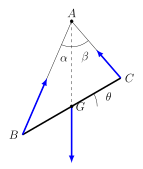
A uniform rigid rod \(BC\) is suspended from a fixed point \(A\) by light stretched springs \(AB,AC\). The springs are of different natural lengths but the ratio of tension to extension is the same constant \(\kappa\) for each. The rod is not hanging vertically. Show that the ratio of the lengths of the stretched springs is equal to the ratio of the natural lengths of the unstretched springs.
Solution:
1991 Paper 1 Q10
\(\ \)\vspace{-1cm} \noindent
1990 Paper 2 Q13
A thin non-uniform rod \(PQ\) of length \(2a\) has its centre of gravity a distance \(a+d\) from \(P\). It hangs (not vertically) in equilibrium suspended from a small smooth peg \(O\) by means of a light inextensible string of length \(2b\) which passes over the peg and is attached at its ends to \(P\) and \(Q\). Express \(OP\) and \(OQ\) in terms of \(a,b\) and \(d\). By considering the angle \(POQ\), or otherwise, show that \(d < a^{2}/b\).
Solution:

1987 Paper 2 Q12
A long, inextensible string passes through a small fixed ring. One end of the string is attached to a particle of mass \(m,\) which hangs freely. The other end is attached to a bead also of mass \(m\) which is threaded on a smooth rigid wire fixed in the same vertical plane as the ring. The curve of the wire is such that the system can be in static equilibrium for all positions of the bead. The shortest distance between the wire and the ring is \(d(>0).\) Using plane polar coordinates centred on the ring, find the equation of the curve. The bead is set in motion. Assuming that the string remains taut, show that the speed of the bead when it is a distance \(r\) from the ring is \[ \left(\frac{r}{2r-d}\right)^{\frac{1}{2}}v, \] where \(v\) is the speed of the bead when \(r=d.\)
Solution: