Problems
Filters
4 problems found
1999 Paper 1 Q11
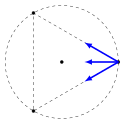
The force of attraction between two stars of masses \(m_{1}\) and \(m_{2}\) a distance \(r\) apart is \(\gamma m_{1}m_{2}/r^{2}\). The Starmakers of Kryton place three stars of equal mass \(m\) at the corners of an equilateral triangle of side \(a\). Show that it is possible for each star to revolve round the centre of mass of the system with angular velocity \((3\gamma m/a^{3})^{1/2}\). Find a corresponding result if the Starmakers place a fourth star, of mass \(\lambda m\), at the centre of mass of the system.
Solution: The net force on the planets will always be towards the centre of mass (by symmetry or similar arguments). Therefore it suffices to check whether we can find a speed where the planets follow uniform circular motion, ie \(F = mr \omega^2\). (But clearly this is possible, we just need to find the speed)

1999 Paper 3 Q9
The gravitational force between two point particles of masses \(m\) and \(m'\) is mutually attractive and has magnitude $$ {G m m' \over r^2}\,, $$ where \(G\) is a constant and \(r\) is the distance between them. A particle of unit mass lies on the axis of a thin uniform circular ring of radius \(r\) and mass \(m\), at a distance \(x\) from its centre. Explain why the net force on the particle is directed towards the centre of the ring and show that its magnitude is $$ {G m x \over (x^2 + r^2)^{3/2}} \,. $$ The particle now lies inside a thin hollow spherical shell of uniform density, mass \(M\) and radius \(a\), at a distance \(b\) from its centre. Show that the particle experiences no gravitational force due to the shell. %Explain without calculation the effect on this result if %the shell has finite thickness \(x\).
1993 Paper 2 Q13
The force \(F\) of repulsion between two particles with positive charges \(Q\) and \(Q'\) is given by \(F=kQQ'/r^{2},\) where \(k\) is a positive constant and \(r\) is the distance between the particles. Two small beads \(P_{1}\) and \(P_{2}\) are fixed to a straight horizontal smooth wire, a distance \(d\) apart. A third bead \(P_{3}\) of mass \(m\) is free to move along the wire between \(P_{1}\) and \(P_{3}.\) The beads carry positive electrical charges \(Q_{1},Q_{2}\) and \(Q_{3}.\) If \(P_{3}\) is in equilibrium at a distance \(a\) from \(P_{1},\) show that \[ a=\frac{d\sqrt{Q_{1}}}{\sqrt{Q_{1}}+\sqrt{Q_{2}}}. \] Suppose that \(P_{3}\) is displaced slightly from its equilibrium position and released from rest. Show that it performs approximate simple harmonic motion with period \[ \frac{\pi d}{(\sqrt{Q_{1}}+\sqrt{Q_{2}})^{2}}\sqrt{\frac{2md\sqrt{Q_{1}Q_{2}}}{kQ_{3}}.} \] {[}You may use the fact that \(\dfrac{1}{(a+y)^{2}}\approx\dfrac{1}{a^{2}}-\dfrac{2y}{a^{3}}\) for small \(y.\){]}
1992 Paper 1 Q13
A comet, which may be regarded as a particle of mass \(m\), moving in the sun's gravitational field, at a distance \(x\) from the sun, experiences a force \(Gm/x^{2}\) (where \(G\) is a constant) directly towards the sun. Show that if, at some time, \(x=h\) and the comet is travelling directly away from the sun with speed \(V\), then \(x\) cannot become arbitrarily large unless \(V^{2}\geqslant2G/h\). A comet is initially motionless at a great distance from the sun. If, at some later time, it is at a distance \(h\) from the sun, how long after that will it take to fall into the sun?
Solution: Consider \(E = \frac12 m \dot{x}^2 - \frac{Gm}{x}\), notice that \begin{align*} && \dot{E} &= m \dot{x} \ddot{x} + \frac{Gm}{x^2} \dot{x} \\ &&&= \dot{x} \underbrace{\left (m\ddot{x} + \frac{Gm}{x^2} \right)}_{=0 \text{ by N2}} \end{align*} Therefore \(E\) is conserved. Therefore if \(x \to \infty\) \(\frac12 m V^2 - \frac{Gm}{h} = \frac12 m u^2 - 0 \geq 0\) so \(V^2 \geqslant 2G/h\) Since \(E \approx 0\) we want to solve \begin{align*} && \dot{x} &= -\sqrt{\frac{2G}{x}} \\ \Rightarrow && -\int_h^0 \sqrt{x} \d x &= \int_0^T \sqrt{2G} \d t \\ \Rightarrow && \frac{2h^{3/2}}{3} &= \sqrt{2G}T \\ \Rightarrow && T &= \frac{\sqrt{2}h^{3/2}}{3\sqrt{G}} = \frac13 \sqrt{\frac{2h^3}{G}} \end{align*}