Problems
Filters
1 problem found
2018 Paper 2 Q9
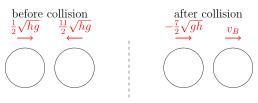
Two small beads, \(A\) and \(B\), of the same mass, are threaded onto a vertical wire on which they slide without friction, and which is fixed to the ground at \(P\). They are released simultaneously from rest, \(A\) from a height of \(8h\) above \(P\) and \(B\) from a height of \(17h\) above \(P\). When \(A\) reaches the ground for the first time, it is moving with speed \( V\). It then rebounds with coefficient of restitution \(\frac{1}{2}\) and subsequently collides with \(B\) at height \(H\) above \(P\). Show that \(H= \frac{15}8h\) and find, in terms of \(g\) and \(h\), the speeds \(u_A\) and \(u_B\) of the two beads just before the collision. When \(A\) reaches the ground for the second time, it is again moving with speed \( V\). Determine the coefficient of restitution between the two beads.
Solution: \begin{align*} && v^2 &= u^2 +2as \\ \Rightarrow && V^2 &= 2 g \cdot (8h)\\ \Rightarrow && V &=4\sqrt{hg}\\ \end{align*} When the first particle collides with the ground, the second particle is at \(9h\) traveling with speed \(V\), the first particle is at \(0\) traveling (upwards) with speed \(\tfrac12 V\). For a collision we need: \begin{align*} && \underbrace{\frac12 V t- \frac12 g t^2}_{\text{position of A}} &= \underbrace{9h - Vt - \frac12 gt^2}_{\text{position of B}} \\ \Rightarrow && \frac32Vt &= 9h \\ \Rightarrow && t &= \frac{6h}{V} \\ \\ && \underbrace{\frac12 V t- \frac12 g t^2}_{\text{position of A}} &= \frac12 V \frac{6h}{V} - \frac12 g t^2 \\ &&&= 3h - \frac12 g\frac{36h^2}{16hg} \\ &&&= 3h - \frac{9}{8}h \\ &&&= \frac{15}{8}h \end{align*} Just before the collision, \(A\) will be moving with velocity (taking upwards as positive) \begin{align*} && u_A &= \frac12 V-gt \\ &&&= 2\sqrt{hg}-g \frac{6h}{V} \\ &&&= 2\sqrt{hg} - g \frac{6h}{4\sqrt{hg}} \\ &&&= 2\sqrt{hg}-\frac32\sqrt{hg} \\ &&&= \frac12 \sqrt{hg} \end{align*} Similarly, for \(B\). \begin{align*} && u_B &= -V -gt \\ &&&= -4\sqrt{hg} - \frac32\sqrt{hg} \\ &&&= -\frac{11}{2}\sqrt{hg} \end{align*} Considering \(A\), to figure out \(v_A\). \begin{align*} && v^2 &= u^2 + 2as \\ && V^2 &= v_A^2 + 2g\frac{15}{8}h \\ && 16hg &= v_A^2 + \frac{15}{4}gh \\ \Rightarrow && v_A^2 &= \frac{49}{4}gh \\ \Rightarrow && v_A &= -\frac{7}{2}\sqrt{gh} \end{align*}