Problems
Filters
1 problem found
2012 Paper 1 Q11
D: 1516.0
B: 1500.0
pulley systems
inclined plane
friction
equilibrium
Newton's second law
constraint equations
arctan angles
connected particles
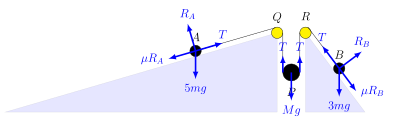
The diagram shows two particles, \(A\) of mass \(5m\) and \(B\) of mass \(3m\), connected by a light inextensible string which passes over two smooth, light, fixed pulleys, \(Q\) and \(R\), and under a smooth pulley \(P\) which has mass \(M\) and is free to move vertically. Particles \(A\) and \(B\) lie on fixed rough planes inclined to the horizontal at angles of \(\arctan \frac 7{24}\) and \(\arctan\frac43\) respectively. The segments \(AQ\) and \(RB\) of the string are parallel to their respective planes, and segments \(QP\) and \(PR\) are vertical. The coefficient of friction between each particle and its plane is \(\mu\).

- Given that the system is in equilibrium, with both \(A\) and \(B\) on the point of moving up their planes, determine the value of \(\mu\) and show that \(M = 6m\).
- In the case when \(M = 9m\), determine the initial accelerations of \(A\), \(B\) and \(P\) in terms of \(g\).
Solution: