Problems
Filters
2 problems found
1997 Paper 2 Q13
A needle of length two cm is dropped at random onto a large piece of paper ruled with parallel lines two cm apart.
- By considering the angle which the needle makes with the lines, find the probability that the needle crosses the nearest line given that its centre is \(x\) cm from it, where \(0 < x < 1\).
- Given that the centre of the needle is \(x\) cm from the nearest line and that the needle crosses that line, find the cumulative distribution function for the length of the shorter segment of the needle cut off by the line.
- Find the probability that the needle misses all the lines.
Solution:
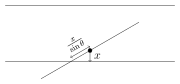
- Suppose the needle's center is \(x\) cm from the nearest line and makes an angle of \(\theta\). Then if \(\sin \theta > x\) it will cross the line, otherwise it will not. Given that \(\theta \sim U(0, \frac{\pi}{2})\), we can see that \begin{align*} && \mathbb{P}(\text{needle crosses}) &= \mathbb{P}(\sin \theta > x) \\ &&&= \mathbb{P}(\theta > \sin^{-1} x) \\ &&&= 1-\frac{2\sin^{-1} x}{\pi} \end{align*}
- The length of the short segment is \(L = 1 - \frac{x}{\sin \theta}\) and \(\theta \sim U(\sin^{-1} x, \frac{\pi}{2})\). So \begin{align*} && F_L(l) &= \mathbb{P}(L < l) \\ &&&= \mathbb{P}\left (1 - \frac{x} {\sin \theta} < l\right) \\ &&&= \mathbb{P}\left ( \sin \theta < \frac{x}{1-l}\right) \\ &&&= \mathbb{P}\left (\theta < \sin^{-1} \frac{x}{1-l}\right) \\ &&&= \frac{ \sin^{-1} \frac{x}{1-l} - \sin^{-1} x }{\frac{\pi}{2} - \sin^{-1}x} \end{align*}
- The needle (with probability \(1\)) cannot hit \(2\) lines, so let's only consider the line it's nearest too. The distance to this line is uniform on \([0,1]\), and the so we want to calculate. \begin{align*} && \mathbb{P}(\text{needle crosses}) &= \int_0^1 \left (1 - \frac{2\sin^{-1}x}{\pi} \right) \d x \\ &&&= 1 - \frac{2}{\pi} \int_0^1 \sin^{-1} x \d x\\ &&&= 1 - \frac{2}{\pi} \left ( \frac{\pi}{2} - 1 \right) \\ &&&= \frac{2}{\pi} \end{align*} Therefore the probability it misses is \(1 - \frac{\pi}{2}\)
1993 Paper 1 Q16
By making the substitution \(y=\cos^{-1}t,\) or otherwise, show that \[ \int_{0}^{1}\cos^{-1}t\,\mathrm{d}t=1. \] A pin of length \(2a\) is thrown onto a floor ruled with parallel lines equally spaced at a distance \(2b\) apart. The distance \(X\) of its centre from the nearest line is a uniformly distributed random variable taking values between \(0\) and \(b\) and the acute angle \(Y\) the pin makes with a direction perpendicular to the line is a uniformly distributed random variable taking values between \(0\) and \(\pi/2\). \(X\) and \(Y\) are independent. If \(X=x\) what is the probability that the pin crosses the line? If \(a < b\) show that the probability that the pin crosses a line for a general throw is \(\dfrac{2a}{\pi b}.\)
Solution: \begin{align*} && I &= \int_0^1 \cos^{-1} t \d t \\ \cos y = t: -\sin y \d y = \d t: &&&= \int_{\frac{\pi}{2}}^0 -y \sin y \d y \\ &&&= \int_0^{\pi/2} y \sin y \d y \\ &&&= \left [-y \cos y \right]_0^{\pi/2} + \int_0^{\pi/2} \cos y \d y \\ &&&= \left [ \sin y \right]_0^{\pi/2} = 1 \end{align*}