Problems
Filters
14 problems found
2002 Paper 3 Q1
Find the area of the region between the curve \(\displaystyle y = {\ln x \over x}\,\) and the \(x\)-axis, for \(1 \le x \le a\). What happens to this area as \(a\) tends to infinity? Find the volume of the solid obtained when the region between the curve \(\displaystyle y = {\ln x \over x}\,\) and the \(x\)-axis, for \(1 \le x\le a\), is rotated through \(2 \pi\) radians about the \(x\)-axis. What happens to this volume as \(a\) tends to infinity?
Solution: \begin{align*} && \int_1^a \frac{\ln x}{x} \d x &= \left [ \ln x \cdot \ln x\right ]_1^a - \int_1^a \frac{\ln x}{x} \d x \\ \Rightarrow && \int_1^a \frac{\ln x}{x} \d x &= \frac12 \left ( \ln a \right) ^2 \\ && \int_1^\infty \frac{\ln x}{x} \d x &= \lim_{a \to \infty} \frac12 (\ln a)^2 \\ &&&= \infty \end{align*} \begin{align*} && \pi \int_1^a \left ( \frac{\ln x}{x} \right)^2 \d x &= \pi \int_{u=0}^{u=\ln a} \left ( \frac{u}{e^u} \right)^2 e^u \d u \\ &&&= \pi \int_0^{\ln a} u^2 e^{-u} \d u \\ &&&= \pi \left [-u^2e^{-u} \right]_0^{\ln a} +\pi \int_0^{\ln a} 2u e^{-u} \d u \\ &&&= -\frac{\pi}{a} (\ln a)^2 + \pi \left [-2u e^{-u} \right]_0^{\ln a} + \pi \int_0^{\ln a} e^{-u} \d u \\ &&&= -\frac{\pi}{a} (\ln a)^2- \frac{2 \pi}{a}\ln a+\pi \left (1 - \frac{1}{a} \right) \\ \\ && \pi \int_1^{\infty} \left ( \frac{\ln x}{x} \right)^2 \d x &= \lim_{a \to \infty} \left ( -\frac{\pi}{a} (\ln a)^2- \frac{2 \pi}{a}\ln a+\pi \left (1 - \frac{1}{a} \right) \right) \\ &&&= \pi \end{align*}
2002 Paper 3 Q2
Prove that \(\displaystyle \arctan a + \arctan b = \arctan \l {a + b \over 1-ab} \r\,\) when \(0 < a < 1\) and \(0 < b < 1\,\). Prove by induction that, for \(n \ge 1\,\), \[ \sum_{r = 1}^n \arctan \l {1 \over r^2 + r + 1} \r = \arctan \l {n \over n+2} \r \] and hence find \[ \sum_{r = 1}^\infty \arctan \l {1 \over r^2 + r + 1} \r\,. \] Hence prove that \[ \sum_{r = 1}^\infty \arctan \l {1 \over r^2 - r + 1} \r = {\pi \over 2}\,. \]
Solution: \begin{align*} && \arctan a &\in (0, \tfrac{\pi}{4}) \\ && \arctan b &\in (0, \tfrac{\pi}{4}) \\ \Rightarrow && \arctan a+\arctan b &\in (0, \tfrac{\pi}{2}) \\ && \tan \left ( \arctan a+\arctan b \right) &= \frac{\tan \arctan a + \tan \arctan b}{1 - \tan \arctan a \tan \arctan b} \\ &&&= \frac{a+b}{1-ab} \in (0, \infty) \\ \Rightarrow && \arctan \left ( \frac{a+b}{1-ab} \right) &\in (0, \tfrac{\pi}{2}) \\ \Rightarrow && \arctan a + \arctan b &= \arctan \left ( \frac{a+b}{1-ab} \right) \end{align*} Claim: \(\displaystyle \sum_{r = 1}^n \arctan \l {1 \over r^2 + r + 1} \r = \arctan \l {n \over n+2} \r\) Proof: (By Induction): Base case (\(n=1\)): \begin{align*} && LHS &= \sum_{r=1}^1 \arctan \left ( \frac{1}{r^2+r+1} \right) \\ &&&= \arctan \left ( \frac{1}{3} \right) \\ && RHS &= \arctan \left ( \frac{1}{1+2} \right)\\ &&&= \arctan \left ( \frac{1}{3} \right) = LHS \end{align*} Inductive step, suppose true for \(n = k\), ie \begin{align*} && \sum_{r = 1}^k \arctan \l {1 \over r^2 + r + 1} \r &= \arctan \l {k \over k+2} \r \\ \Rightarrow && \sum_{r = 1}^{k+1} \arctan \l {1 \over r^2 + r + 1} \r &= \sum_{r = 1}^k \arctan \l {1 \over r^2 + r + 1} \r+ \arctan \left ( \frac{1}{(k+1)^2+(k+1)+1} \right) \\ &&&= \arctan \l {k \over k+2} \r+\arctan \left ( \frac{1}{(k+1)^2+(k+1)+1} \right) \\ &&&= \arctan \left ( \frac{{k \over k+2}+\frac{1}{(k+1)^2+(k+1)+1} }{1-\frac{k}{k+2}\frac{1}{(k+1)^2+(k+1)+1} } \right) \\ &&&= \arctan \left ( \frac{k((k+1)^2+k+1+k)+(k+2) }{(k+2)((k+1)^2+(k+1)+1)-k} \right) \\ &&&= \arctan \left ( \frac{k^3+3k^2+4k+2 }{k^3+5k^2+8k+6} \right) \\ &&&= \arctan \left ( \frac{(k+1)(k^2+2k+2) }{(k+3)(k^2+2k+2)} \right) \\ &&&= \arctan \left ( \frac{k+1 }{(k+1)+2} \right) \\ \end{align*} Therefore it is true for \(n = k+1\), therefore it is true for all \(n \geq 1\) by the principle of mathematical induction. \begin{align*} && S &= \lim_{n \to \infty} \sum_{r = 1}^n \arctan \l {1 \over r^2 + r + 1} \r \\ &&&= \lim_{n \to \infty} \arctan \l \frac{n}{n+2} \r \\ &&&= \lim_{n \to \infty} \arctan \l \frac{1}{1+2/n} \r \\ &&&=\arctan\l \lim_{n \to \infty} \frac{1}{1+2/n} \r \\ &&&= \frac{\pi}{4} \end{align*} \begin{align*} && \sum_{r = 1}^\infty \arctan \l {1 \over r^2 - r + 1} \r &= \sum_{r = 0}^\infty \arctan \left( \frac{1}{ (r+1)^2 - (r+1) + 1} \right) \\ &&&= \sum_{r = 0}^\infty \arctan \left( \frac{1}{ r^2+r+1} \right) \\ &&&= \arctan \l \frac{1}{0^2+0+1} \r + \frac{\pi}{4} \\ &&&= \frac{\pi}{2} \end{align*}
2002 Paper 3 Q3
Let \[\f(x) = a \sqrt{x} - \sqrt{x - b}\;, \] where \(x\ge b >0\) and \(a>1\,\). Sketch the graph of \(\f(x)\,\). Hence show that the equation \(\f(x) = c\), where \(c>0\), has no solution when \(c^2 < b \l a^2 - 1 \r\,\). Find conditions on \(c^2\) in terms of \(a\) and \(b\) for the equation to have exactly one or exactly two solutions. Solve the equations
- \(3 \sqrt{x} - \sqrt{x - 2} = 4\, ,\)
- \(3 \sqrt{x} - \sqrt{x - 3} = 5\;\).
Solution: \begin{align*} && f'(x) &= \frac12 ax^{-1/2}-\frac12(x-b)^{-1/2} \\ \Rightarrow f'(x) = 0: && 0 &= \frac{a\sqrt{x-b}-\sqrt{x}}{\sqrt{x(x-b)}} \\ \Rightarrow && x &= a^2(x-b)\\ \Rightarrow && x &= \frac{a^2b}{a^2-1} \\ && f(x) &= a^2 \sqrt{\frac{b}{a^2-1}} - \sqrt{\frac{a^2b}{a^2-1}-b} \\ &&&= a^2 \sqrt{\frac{b}{a^2-1}} - \sqrt{\frac{b}{a^2-1}} \\ &&&= \sqrt{b(a^2-1)} \end{align*}

- \(c^2 = 16\), \(2 \cdot (3^2-1) = 16\), so we should have exactly one solution at \(x = \frac{3^2 \cdot 2}{3^2 -1 } = \frac{9}{4}\)
- \(c^2 = 25\) and \(3 \cdot (3^2 - 1) = 24, 3 \cdot (3^2) = 27\), so we look for two solutions. \begin{align*} && 5 & = 3 \sqrt{x} - \sqrt{x-3} \\ \Rightarrow && 25 &= 9x+x-3-6\sqrt{x(x-3)} \\ \Rightarrow && 3\sqrt{x(x-3)} &= 5x-14 \\ \Rightarrow && 9x(x-3) &= 25x^2-140x+196 \\ \Rightarrow && 0 &= 16x^2-113x+196 \\ &&&= (x-4)(16x-49) \\ \Rightarrow && x &= 4, \frac{49}{16} \end{align*}
2002 Paper 3 Q4
Show that if \(x\) and \(y\) are positive and \(x^3 + x^2 = y^3 - y^2\) then \(x < y\,\). Show further that if \(0 < x \le y - 1\), then \(x^3 + x^2 < y^3 - y^2\). Prove that there does not exist a pair of {\sl positive} integers such that the difference of their cubes is equal to the sum of their squares. Find all the pairs of integers such that the difference of their cubes is equal to the sum of their squares.
2002 Paper 3 Q5
Give a condition that must be satisfied by \(p\), \(q\) and \(r\) for it to be possible to write the quadratic polynomial \(px^2 + qx + r\) in the form \(p \l x + h \r^2\), for some \(h\). Obtain an equation, which you need not simplify, that must be satisfied by \(t\) if it is possible to write \[ \l x^2 + \textstyle{{1 \over 2}} bx + t \r^2 - \l x^4 + bx^3 + cx^2 +dx +e \r \] in the form \(k \l x + h \r^2\), for some \(k\) and \(h\). Hence, or otherwise, write \(x^4 + 6x^3 + 9x^2 -2x -7\) as a product of two quadratic factors.
2002 Paper 3 Q6
Find all the solution curves of the differential equation \[ y^4 \l {\mathrm{d}y \over \mathrm{d}x }\r^{\! \! 4} = \l y^2 - 1 \r^2 \] that pass through either of the points
- \(\l 0, \, \frac{1}{2}\sqrt3 \r\),
- \(\l 0, \, \frac{1}{2}\sqrt5 \r\).
Solution: \begin{align*} && y^4 \left (\frac{\d y}{\d x} \right)^4 &= (y^2 - 1)^2 \\ \Rightarrow && y^2 \left (\frac{\d y}{\d x} \right)^2 &= |y^2 - 1| \\ && y \left (\frac{\d y}{\d x} \right) &= \pm \sqrt{|y^2-1|} \\ \Rightarrow &&\int \frac{y}{\sqrt{|y^2-1|}} \d y &= \int \pm 1 \d x \\ \Rightarrow && \pm \sqrt{|y^2-1|} &= \pm x + C \\ \end{align*}
- Since \(y^2 < 1\), our solution curve should be of the from \(-\sqrt{1-y^2} = \pm x + C\) Plugging in \((0, \tfrac12 \sqrt{3})\), we obtain \(-\tfrac12 = C\), therefore our solution curves are \(\pm x = \frac12 - \sqrt{1-y^2}\)
- Since \(y^2 > 1\), our solution curve should be of the from \(\sqrt{y^2-1} = \pm x + C\) Plugging in \((0, \tfrac12 \sqrt{5})\), we obtain \(\tfrac12 = C\), therefore our solution curves are \(\pm x = \sqrt{y^2-1}-\frac12\)

2002 Paper 3 Q7
Given that \(\alpha\) and \(\beta\) are acute angles, show that \(\alpha + \beta = \tfrac{1}{2}\pi\) if and only if \(\cos^2 \alpha + \cos^2 \beta = 1\). In the \(x\)--\(y\) plane, the point \(A\) has coordinates \((0,s)\) and the point \(C\) has coordinates \((s,0)\), where \(s>0\). The point \(B\) lies in the first quadrant (\(x>0\), \(y>0\)). The lengths of \(AB\), \(OB\) and \(CB\) are respectively \(a\), \(b\) and \(c\). Show that \[ (s^2 +b^2 - a^2)^2 + (s^2 +b^2 -c^2)^2 = 4s^2b^2 \] and hence that \[ (2s^2 -a^2-c^2)^2 + (2b^2 -a^2-c^2)^2 =4a^2c^2\;. \] Deduce that $$ \l a - c \r^2 \le 2b^2 \le \l a + c \r^2\;. $$ %Show, %by considering the case \(a=1+\surd2\,\), \(b=c=1\,\), % that the condition \(\l \ast \r\,\) %is not sufficient to ensure that \(B\) lies in the first quadrant.
2002 Paper 3 Q8
Four complex numbers \(u_1\), \(u_2\), \(u_3\) and \(u_4\) have unit modulus, and arguments \(\theta_1\), \(\theta_2\), \(\theta_3\) and \(\theta_4\), respectively, with \(-\pi < \theta_1 < \theta_2 < \theta_3 < \theta_4 < \pi\). Show that \[ \arg \l u_1 - u_2 \r = \tfrac{1}{2} \l \theta_1 + \theta_2 -\pi \r + 2n\pi \] where \(n = 0 \hspace{4 pt} \mbox{or} \hspace{4 pt} 1\,\). Deduce that \[ \arg \l \l u_1 - u_2 \r \l u_4 - u_3 \r \r = \arg \l \l u_1 - u_4 \r \l u_3 - u_2 \r \r + 2n\pi \] for some integer \(n\). Prove that \[ | \l u_1 - u_2 \r \l u_4 - u_3 \r | + | \l u_1 - u_4 \r \l u_3 - u_2 \r | = | \l u_1 - u_3 \r \l u_4 - u_2 \r |\;. \]
2002 Paper 3 Q9
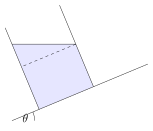
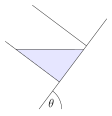
A tall container made of light material of negligible thickness has the form of a prism, with a square base of area \(a^2\). It contains a volume \(ka^3\) of fluid of uniform density. The container is held so that it stands on a rough plane, which is inclined at angle \(\theta\) to the horizontal, with two of the edges of the base of the container horizontal. In the case \(k > \frac12 \tan\theta\), show that the centre of mass of the fluid is at a distance \(x\) from the lower side of the container and at a distance \(y\) from the base of the container, where \[ \frac x a = \frac12 - \frac {\tan\theta}{12k}\;, \ \ \ \ \ \ \frac y a = \frac k 2 + \frac{\tan^2\theta}{24k}\;. \] Determine the corresponding coordinates in the case \(k < \frac12 \tan\theta\). The container is now released. Given that \(k < \frac12\), show that the container will topple if \(\theta >45^\circ\).
Solution:
2002 Paper 3 Q10
A light hollow cylinder of radius \(a\) can rotate freely about its axis of symmetry, which is fixed and horizontal. A particle of mass \(m\) is fixed to the cylinder, and a second particle, also of mass \(m\), moves on the rough inside surface of the cylinder. Initially, the cylinder is at rest, with the fixed particle on the same horizontal level as its axis and the second particle at rest vertically below this axis. The system is then released. Show that, if \(\theta\) is the angle through which the cylinder has rotated, then \[ \ddot{\theta} = {g \over 2a} \l \cos \theta - \sin \theta \r \,, \] provided that the second particle does not slip. Given that the coefficient of friction is \( (3 + \sqrt{3})/6\), show that the second particle starts to slip when the cylinder has rotated through \(60^\circ\).
2002 Paper 3 Q11
A particle moves on a smooth triangular horizontal surface \(AOB\) with angle \(AOB = 30^\circ\). The surface is bounded by two vertical walls \(OA\) and \(OB\) and the coefficient of restitution between the particle and the walls is \(e\), where \(e < 1\). The particle, which is initially at point \(P\) on the surface and moving with velocity \(u_1\), strikes the wall \(OA\) at \(M_1\), with angle \(PM_1A = \theta\), and rebounds, with velocity \(v_1\), to strike the wall \(OB\) at \(N_1\), with angle \(M_1N_1B = \theta\). Find \(e\) and \(\displaystyle {v_1 \over u_1}\) in terms of \(\theta\). The motion continues, with the particle striking side \(OA\) at \(M_2\), \(M_3\), \( \ldots \) and striking side \(OB\) at \(N_2\), \(N_3\), \(\ldots \). Show that, if \(\theta < 60^\circ\,\), the particle reaches \(O\) in a finite time.
2002 Paper 3 Q12
In a game, a player tosses a biased coin repeatedly until two successive tails occur, when the game terminates. For each head which occurs the player wins \(\pounds 1\). If \(E\) is the expected number of tosses of the coin in the course of a game, and \(p\) is the probability of a head, explain why \[ E = p \l 1 + E \r + \l 1 - p \r p \l 2 + E \r + 2 \l 1 - p \r ^2\,, \] and hence determine \(E\) in terms of \(p\). Find also, in terms of \(p\), the expected winnings in the course of a game. A second game is played, with the same rules, except that the player continues to toss the coin until \(r\) successive tails occur. Show that the expected number of tosses in the course of a game is given by the expression \(\displaystyle {1 - q^r \over p q^r}\,\), where \(q = 1 - p\).
2002 Paper 3 Q13
A continuous random variable is said to have an exponential distribution with parameter \(\lambda\) if its density function is \(\f(t) = \lambda \e ^{- \lambda t} \; \l 0 \le t < \infty \r\,\). If \(X_1\) and \(X_2\), which are independent random variables, have exponential distributions with parameters \(\lambda_1\) and \(\lambda_2\) respectively, find an expression for the probability that either \(X_1\) or \(X_2\) (or both) is less than \(x\). Prove that if \(X\) is the random variable whose value is the lesser of the values of \(X_1\) and \(X_2\), then \(X\) also has an exponential distribution. Route A and Route B buses run from my house to my college. The time between buses on each route has an exponential distribution and the mean time between buses is 15 minutes for Route A and 30 minutes for Route B. The timings of the buses on the two routes are independent. If I emerge from my house one day to see a Route A bus and a Route B bus just leaving the stop, show that the median wait for the next bus to my college will be approximately 7 minutes.
2002 Paper 3 Q14
Prove that, for any two discrete random variables \(X\) and \(Y\), \[ \mathrm{Var} \left(X + Y \right) = \mathrm{Var}(X) + \mathrm{Var}(Y) + 2 \, \mathrm{Cov}(X,Y), \] where \(\mathrm{Var}(X)\) is the variance of \(X\) and \(\mathrm{Cov}(X,Y)\) is the covariance of \(X\) and \(Y\). When a Grandmaster plays a sequence of \(m\) games of chess, she is, independently, equally likely to win, lose or draw each game. If the values of the random variables \(W\), \(L\) and \(D\) are the numbers of her wins, losses and draws respectively, justify briefly the following claims:
- \(W + L + D\) has variance \(0\,\);
- \(W + L\) has a binomial distribution.
Solution: \begin{align*} && \var[X+Y] &= \E\left [(X+Y-\E[X+Y])^2 \right] \\ &&&= \E \left [ (X - \E[X] + Y - \E[Y])^2 \right] \\ &&&= \E \left [(X - \E[X])^2 + (Y-\E[Y])^2 + 2(X-\E[X])(Y-\E[Y]) \right] \\ &&&= \E \left [(X - \E[X])^2 \right]+\E \left [(Y-\E[Y])^2 \right]+\E \left [2(X-\E[X])(Y-\E[Y]) \right] \\ &&&= \var[X] + \var[Y] + 2 \mathrm{Cov}(X,Y) \end{align*}
- \(W+L+D = m\) where \(m\) is the number of games, which has variance \(0\). Therefore \(W+L+D\) has variance \(0\).
- The probability of a decisive game is \(\frac23\) and \(W+L\) is the number of decisive games. Each game is independent so this meets the criteria for a binomial distribution.