Problems
Filters
16 problems found
1987 Paper 3 Q1
Find the set of positive integers \(n\) for which \(n\) does not divide \((n-1)!.\) Justify your answer. [Note that small values of \(n\) may require special consideration.]
Solution: Claim: \(n \not \mid (n-1)!\) if and only if \(n\) is prime or \(4\) Proof: \((\Leftarrow)\)
- \(4 \not \mid 3! = 6\).
- If \(p\) is prime, then \(p \not \mid k\) for \(k < n\), therefore \(p \not \mid (n-1)!\)
1987 Paper 3 Q2
Let \({\displaystyle I_{m,n}=\int\cos^{m}x\sin nx\,\mathrm{d}x,}\) where \(m\) and \(n\) are non-negative integers. Prove that for \(m,n\geqslant1,\) \[ (m+n)I_{m,n}=-\cos^{m}x\cos nx+mI_{m-1,n-1}. \]
- Show that \({\displaystyle \int_{0}^{\pi}\cos^{m}x\sin nx\,\mathrm{d}x=0}\) whenever \(m,n\) are both even or both odd.
- Evaluate \({\displaystyle \int_{0}^{\frac{\pi}{2}}\sin^{2}x\sin3x\,\mathrm{d}x.}\)
Solution: Let \({\displaystyle I_{m,n}=\int\cos^{m}x\sin nx\,\mathrm{d}x,}\) Then \begin{align*} && I_{m,n} &= \int\cos^{m}x\sin nx\,\mathrm{d}x \\ &&&= \left [ -\frac1n \cos^m x \cos n x \right] - \frac{m}{n} \int \sin^{m-1} x \cos x \cos n x \d x \\ &&&= \left [ -\frac1n \cos^m x \cos n x \right] + \frac{m}{n} \int \sin^{m-1} x (\cos (n-1)x -\sin x \sin nx) \d x\\ &&&= \left [ -\frac1n \cos^m x \cos n x \right] + \frac{m}{n} \int \sin^{m-1} x \cos (n-1)x \d x-\frac{m}{n} I_{m,n} \\ &&&= \left [ -\frac1n \cos^m x \cos n x \right] + \frac{m}{n} I_{m-1,n-1} -\frac{m}{n} I_{m,n} \\ \Rightarrow && nI_{m,n} &= -\cos^m x \cos n x + mI_{m-1,n-1} -mI_{m,n}\\ \Rightarrow && (m+n)I_{m,n} &= -\cos^m x \cos n x + mI_{m-1,n-1} \end{align*}
- Note that \(I_{2m,0} = 0\) (the integrand is 0) and \(I_{0, 2m} = 0\) (symmetry for our limits). \(\displaystyle \left [-\cos^m x \cos n x \right]_0^\pi = \l - (-1)^m (-1)^n \r - \l -1 \r = 1 - (-1)^{m+n} = 0\) since \(m+n\) is even. Therefore all reductions are \(I_{m,n} = \frac{I_{m-1,n-1}}{m+n}\) terminating at \(0\), so all values are zero
- \begin{align*} \int_{0}^{\frac{\pi}{2}}\sin^{2}x\sin3x\,\mathrm{d}x &= \int_{0}^{\frac{\pi}{2}}(1-\cos^2x)\sin3x\,\mathrm{d}x \\ &= I_{0,3} - I_{2,3} \\ &= \frac13 - \frac15 \l \left [-\cos^2 x \cos 3 x \right]_0^{\pi/2} + 2 \cdot I_{1,2} \r \\ &= \frac13 - \frac15 \l 1 + \frac23 \l \left [-\cos x \cos 2 x \right]_0^{\pi/2} + 1\cdot I_{0,1} \r \r \\ &= \frac13 - \frac15 -\frac2{15} - \frac2{15} \\ &= \frac{5}{15} - \frac{3}{15} - \frac{4}{15} \\ &= -\frac2{15} \end{align*}
1987 Paper 3 Q3
- If \(z=x+\mathrm{i}y,\) with \(x,y\) real, show that \[ \left|x\right|\cos\alpha+\left|y\right|\sin\alpha\leqslant\left|z\right|\leqslant\left|x\right|+\left|y\right| \] for all real \(\alpha.\)
- By considering \((5-\mathrm{i})^{4}(1+\mathrm{i}),\) show that \[ \frac{\pi}{4}=4\tan^{-1}\left(\frac{1}{5}\right)-\tan^{-1}\left(\frac{1}{239}\right). \] Prove similarly that \[ \frac{\pi}{4}=3\tan^{-1}\left(\frac{1}{4}\right)+\tan^{-1}\left(\frac{1}{20}\right)+\tan^{-1}\left(\frac{1}{1985}\right). \]
Solution:
- If \(z=x+iy\) then \(|z|^2 = x^2 + y^2 \leq x^2 + y^2 + 2|x||y| \leq (|x|+|y|)^2\). The LHS is Cauchy-Schwarz with the vectors \(\begin{pmatrix} |x| \\ |y| \end{pmatrix}\) and \(\begin{pmatrix} \cos \alpha \\ \sin \alpha \end{pmatrix}\), although that's not in the spirit of the question. Consider \(e^{i \alpha}z = (\cos \alpha x - \sin \alpha y) + i(\sin \alpha x + \cos \alpha y)\) then \(\left | \textrm{Re}(e^{i \alpha} z) \right | \leq |z|\) for all values of \(\alpha\) and in particular we can choose \(\alpha\) to match the signs of the \(x\) and \(y\) to prove the result in question.
- Consider \((5-\mathrm{i})^{4}(1+\mathrm{i})\), then \begin{align*} \arg \l (5-\mathrm{i})^{4}(1+\mathrm{i}) \r &= \arg (5-i)^4 + \arg (1+i) \\ &= 4 \arg (5-i) + \arg (1+i) \\ &= -4 \tan^{-1} \frac{1}{5} + \tan^{-1} 1 \\ \\ &= \arg ( (24 - 10i)^2 (1+i)) \\ &= \arg (4 (12 - 5i)^2(1+i)) \\ &= \arg ((119 - 120i)(1+i)) \\ &= \arg (239 - i) \\ &= -\tan^{-1} \frac{1}{239} \end{align*} Therefore \(\displaystyle \frac{\pi}{4} =4 \tan^{-1} \frac{1}{5}- \tan^{-1} \frac{1}{239}\) Consider \((4-i)^3(1+i)(20-i)\) then \begin{align*} \arg \l(4-i)^3(1+i)(20-i) \r &= -3 \tan^{-1} \frac14 + \tan^{-1} 1 -\tan^{-1} \frac1{20} \\ \\ &= \arg \l(15-8i)(4-i)(1+i)(20-i) \r \\ &= \arg \l (52 - 47i)(1+i)(20-i) \r \\ &= \arg \l (99 + 5i)(20-i) \r \\ &= \arg (1985+i) \\ &= \tan^{-1} \frac1{1985} \end{align*} Therefore \(\displaystyle \frac{\pi}{4}=3\tan^{-1}\frac{1}{4}+\tan^{-1}\frac{1}{20}+\tan^{-1}\frac{1}{1985}\)
1987 Paper 3 Q4

Solution: The initial volume of water in \(A\) is: \begin{align*} \pi \int_0^4 x^2 \, \d y &= \pi \int_0^4 y \d y \\ &= \pi [ \frac{y^2}{2}]_0^4 \\ &= 8\pi \end{align*} We assume that no water is in the tube as it is `thin'. Therefore we must have: \begin{align*} && 8\pi &= \pi \int_0^{h-1} x^2 \d y +\pi \int_0^{h} x^2 \d y \\ &&&= \pi \int_0^{h-1} y \d y +\pi \int_0^{h} \l \sinh \frac{x}{2}\r^2 \d y \\ &&&= \pi \left [\frac{y^2}{2} \right]_0^{h-1} + \pi \int_0^h \frac{-1+\cosh y}{2}\d y \\ &&&= \pi \frac{(h-1)^2}{2} + \pi \left [ -\frac{y}{2} +\frac{\sinh y}{2}\right]_0^h \\ &&&= \pi \frac{(h-1)^2}{2} -\pi \frac{h}{2} + \pi \frac{\sinh h}{2} \\ \Rightarrow && 0 &= h^2-2h+1-h+\sinh h -16 \\ &&&= h^2 -3h+\sinh h - 15 \\ \Rightarrow && 15 &= h^2 -3h+\sinh h \end{align*}
1987 Paper 3 Q5
A secret message consists of the numbers \(1,3,7,23,24,37,39,43,43,43,45,47\) arranged in some order as \(a_{1},a_{2},\ldots,a_{12}.\) The message is encoded as \(b_{1},b_{2},\ldots,b_{12}\) with \(0\leqslant b_{j}\leqslant49\) and \begin{alignat*}{1} b_{2j} & \equiv a_{2j}+n_{0}+j\pmod{50},\\ b_{2j+1} & \equiv a_{2j+1}+n_{1}+j\pmod{50}, \end{alignat*} for some integers \(n_{0}\) and \(n_{1}.\) If the coded message is \(35,27,2,36,15,35,8,40,40,37,24,48,\) find the original message, explaining your method carefully.
Solution: Considering the odd numbers, we have \begin{array}{l|rrrrrr} b_{2j+1} & 35 & 2 & 15 & 8 & 40 & 24 \\ a_{2j+1}+n_1 & 35 & 1 & 13 & 5 & 36 & 19 \end{array} Considering the even numbers, we have \begin{array}{l|rrrrrr} b_{2j} & 27& 36 & 35 & 40 & 37 & 48 \\ a_{2j}+n_0 & 27 & 35 & 33 & 37 & 33 & 43 \end{array} There are three numbers in the original sequence which are repeated (\(43\)). By the pigeonhole principle, one of the odds or evens must have at least two of them. We can see that the even numbers have some number repeated twice (\(33\)). Therefore these must be the \(43\)s. Therefore \(n_0 = -10\) \begin{array}{l|rrrrrr} b_{2j} & 27& 36 & 35 & 40 & 37 & 48 \\ a_{2j}+n_0 & 27 & 35 & 33 & 37 & 33 & 43 \\ a_{2j} & 37 & 45 & 43 & 47 & 43 & 3 \end{array} This leaves the remaining numbers to be decoded from the original sequence as \(1,7,23,24,39,43\). Two of these numbers are consecutive (\(23\) and \(24\)), and two numbers in our sequence are \(35\) and \(36\). Therefore \(n_1\) must be \(12\). \begin{array}{l|rrrrrr} b_{2j+1} & 35 & 2 & 15 & 8 & 40 & 24 \\ a_{2j+1}+n_1 & 35 & 1 & 13 & 5 & 36 & 19 \\ a_{2j+1} & 23 & 39 & 1 &43 & 24& 7 \end{array} Therefore the original sequence was: \(23, 37, 39, 45, 1, 43, 43, 47, 24, 43, 7, 3\)
1987 Paper 3 Q6
The functions \(x(t)\) and \(y(t)\) satisfy the simultaneous differential equations \begin{alignat*}{1} \dfrac{\mathrm{d}x}{\mathrm{d}t}+2x-5y & =0\\ \frac{\mathrm{d}y}{\mathrm{d}t}+ax-2y & =2\cos t, \end{alignat*} subject to \(x=0,\) \(\dfrac{\mathrm{d}y}{\mathrm{d}t}=0\) at \(t=0.\) Solve these equations for \(x\) and \(y\) in the case when \(a=1\). Without solving the equations explicitly, state briefly how the form of the solutions for \(x\) and \(y\) if \(a>1\) would differ from the form when \(a=1.\)
Solution: Letting \(\mathbf{x} =\begin{pmatrix} x(t) \\ y(t) \end{pmatrix}\) and \(\mathbf{A} = \begin{pmatrix} -2 & 5 \\ -a & 2 \end{pmatrix}\) then our differential equation is \(\mathbf{x}' = \mathbf{Ax} + \begin{pmatrix} 0 \\2 \cos t \end{pmatrix}\). Looking at the eigenvalues of \(\mathbf{A}\), we find: \begin{align*} && \det \begin{pmatrix} -2-\lambda & 5 \\ -a & 2 -\lambda \end{pmatrix} &= (\lambda^2-4)+5a\\ &&&= \lambda^2 +5a-4 \end{align*} Therefore if \(a = 1\), \(\lambda = \pm i\). In which case we should expect the complementary solutions to be of the form \(\mathbf{x} = \begin{pmatrix} A \sin t + B \cos t \\ C \sin t + D \cos t \end{pmatrix}\). The first equation tells us that \((A-5D+B)\cos t + (-B+5C)\sin t=0\) so the complementary solution is:\(\mathbf{x} = \begin{pmatrix} 5(D-C) \sin t + 5C \cos t \\ C \sin t + D \cos t \end{pmatrix}\). Looking for a particular integral, we should expect to try something like \(\mathbf{x} = \begin{pmatrix} Et\cos t+Ft\sin t\\ Gt\cos t+Ht \sin t\end{pmatrix}\) and we find
1987 Paper 3 Q7
Prove that \[ \tan^{-1}t=t-\frac{t^{3}}{3}+\frac{t^{5}}{5}-\cdots+\frac{(-1)^{n}t^{2n+1}}{2n+1}+(-1)^{n+1}\int_{0}^{t}\frac{x^{2n+2}}{1+x^{2}}\,\mathrm{d}x. \] Hence show that, if \(0\leqslant t\leqslant1,\) then \[ \frac{t^{2n+3}}{2(2n+3)}\leqslant\left|\tan^{-1}t-\sum_{r=0}^{n}\frac{(-1)^{r}t^{2r+1}}{2r+1}\right|\leqslant\frac{t^{2n+3}}{2n+3}. \] Show that, as \(n\rightarrow\infty,\) \[ 4\sum_{r=0}^{n}\frac{(-1)^{r}}{(2r+1)}\rightarrow\pi, \] but that the error in approximating \(\pi\) by \({\displaystyle 4\sum_{r=0}^{n}\frac{(-1)^{r}}{(2r+1)}}\) is at least \(10^{-2}\) if \(n\) is less than or equal to \(98\).
Solution: We start by noticing that \(\displaystyle \tan^{-1} t = \int_0^t \frac{1}{1+x^2} \d x\). Consider the geometric series \(1-x^2+(-x^2)^2+ \cdots + (-x^2)^n = \frac{1-(-x^2)^{n+1}}{1+x^2}\). Therefore, \((1+x^2)(1-x^2+(-x^2)^2+ \cdots + (-x^2)^n) = 1-(-x^2)^{n+1}\) or \(1 = (1+x^2)(1-x^2+x^4-\cdots+(-1)^nx^{2n}) +(-1)^{n+1}x^{2n+2}\) \begin{align*} \tan^{-1} t &= \int_0^t \frac{1}{1+x^2} \d x \\ &= \int_0^t \frac{(1+x^2)(1-x^2+x^4-\cdots+(-1)^nx^{2n}) +(-1)^{n+1}x^{2n+2}}{x^2+1} \d x \\ &= \int_0^t (1-x^2+x^4-\cdots+(-1)^nx^{2n})\d x + \int_0^t \frac{(-1)^{n+1}x^{2n+2}}{x^2+1} \d x \\ &= t - \frac{t^3}{3}+\frac{t^5}{5}-\cdots + (-1)^n \frac{t^{2n+1}}{2n+1}+\int_0^t \frac{(-1)^{n+1}x^{2n+2}}{x^2+1} \d x \\ &= \sum_{r=0}^n \frac{(-1)^r t^{2r+1}}{2r+1} + \int_0^t \frac{(-1)^{n+1}x^{2n+2}}{x^2+1} \d x \\ \end{align*} Therefore we can say (for \(0 \leq t \leq 1\)) \begin{align*} \left | \tan^{-1} t - \sum_{r=0}^n \frac{(-1)^r t^{2r+1}}{2r+1} \right | &= \left | \int_0^t \frac{(-1)^{n+1}x^{2n+2}}{x^2+1} \d x \right | \\ &\leq \left | \int_0^t x^{2n+2} \d x \right | \\ &= \frac{t^{2n+3}}{2n+3} \\ \\ \left | \tan^{-1} t - \sum_{r=0}^n \frac{(-1)^r t^{2r+1}}{2r+1} \right | &= \left | \int_0^t \frac{(-1)^{n+1}x^{2n+2}}{x^2+1} \d x \right | \\ &\geq \left | \int_0^t \frac{(-1)^{n+1}x^{2n+2}}{1+1} \d x \right | \\ &= \frac{t^{2n+3}}{2(2n+3)} \\ \end{align*} Since \(\tan^{-1} 1 = \frac{\pi}{4}\) we must have that: \begin{align*} \lim_{n \to \infty} \left | \frac{\pi}{4} - \sum_{r=0}^{n}\frac{(-1)^{r}}{(2r+1)} \right | \to 0 \Rightarrow \lim_{n \to \infty} 4\sum_{r=0}^{n}\frac{(-1)^{r}}{(2r+1)} \to \pi \end{align*} However, \begin{align*} && \left | 4\sum_{r=0}^{n}\frac{(-1)^{r}}{(2r+1)} - \pi \right | &\geq 4 \frac{1}{2(2n+3)} \\ && &= \frac{2}{2n+3} \\ \\ && \frac{2}{2n+3} \geq 10^{-2} \\ \Leftrightarrow && 200 \geq 2n+3 \\ \Leftrightarrow && 197 \geq 2n \\ \Leftrightarrow && 98.5 \geq n \\ \end{align*} Therefore we need more than \(98\) terms to get two decimal places of accuracy. Not great!
1987 Paper 3 Q8
Show that, if the lengths of the diagonals of a parallelogram are specified, then the parallogram has maximum area when the diagonals are perpendicular. Show also that the area of a parallelogram is less than or equal to half the square of the length of its longer diagonal. The set \(A\) of points \((x,y)\) is given by \begin{alignat*}{1} \left|a_{1}x+b_{1}y-c_{1}\right| & \leqslant\delta,\\ \left|a_{2}x+b_{2}y-c_{2}\right| & \leqslant\delta, \end{alignat*} with \(a_{1}b_{2}\neq a_{2}b_{1}.\) Sketch this set and show that it is possible to find \((x_{1},y_{1}),(x_{2},y_{2})\in A\) with \[ (x_{1}-x_{2})^{2}+(y_{1}-y_{2})^{2}\geqslant\frac{8\delta^{2}}{\left|a_{1}b_{2}-a_{2}b_{1}\right|}. \]
Solution: In a parallelogram the diagonals meet at their mid points. Fixing one diagonal, we can look at the two triangles formed by the other diagonal. Suppose the angle between them is \(\theta\). Then the area of the triangles will be \(\frac12 \frac{l_1}{2} \frac{l_2}2 \sin \theta+\frac12 \frac{l_1}{2} \frac{l_2}2 \sin (\pi -\theta) = \frac{l_1l_2}{4} \sin \theta\). This will be true on both sides. Therefore we can maximise this area by setting \(\theta = \frac{\pi}{2}\).

1987 Paper 3 Q9
Let \((G,*)\) and \((H,\circ)\) be two groups and \(G\times H\) be the set of ordered pairs \((g,h)\) with \(g\in G\) and \(h\in H.\) A multiplication on \(G\times H\) is defined by \[ (g_{1},h_{1})(g_{2},h_{2})=(g_{1}*g_{2},h_{1}\circ h_{2}) \] for all \(g_{1},g_{2}\in G\) and \(h_{1},h_{2}\in H\). Show that, with this multiplication, \(G\times H\) is a group. State whether the following are true or false and prove your answers.
- \(G\times H\) is abelian if and only if both \(G\) and \(H\) are abelian.
- \(G\times H\) contains a subgroup isomorphic to \(G\).
- \(\mathbb{Z}_{2}\times\mathbb{Z}_{2}\) is isomorphic to \(\mathbb{Z}_{4}.\)
- \(S_{2}\times S_{3}\) is isomorphic to \(S_{6}.\)
Solution: Claim: \(G \times H\) is a group. (Called the product group). Proof: Checking the group axioms:
- (Closure) is inherited from \(G\) and \(H\), since \(g_1 * g_2 \in G\) and \(h_1 \circ h_2 \in H\)
- (Associativity) \begin{align*} (g_1, h_1)\l (g_2, h_2)(g_3,h_3)\r &= (g_1, h_1)(g_2 *g_3, h_2 \circ h_3) \\ &= (g_1*(g_2 *g_3), h_1 \circ (h_2 \circ h_3)) \\ &= ((g_1*g_2) *g_3), (h_1 \circ h_2) \circ h_3) \\ &= (g_1*g_2, h_1 \circ h_2)(g_3, h_3) \\ &= \l(g_1, h_1)(g_2, h_2) \r(g_3,h_3) \end{align*}
- (Identity) Consider \((e_G, e_H)\), then \((e_G, e_H)(g,h) = (g,h) = (g,h)(e_G, e_H)\)
- (Inverses) If \((g,h) \in G \times H\) then consider \((g^{-1}, h^{-1})\) and we have \((g^{-1}, h^{-1})(g,h) = (e_G,e_H) = (g,h)(g^{-1}, h^{-1})\)
- Claim: \(G \times H\) is abelian iff \(G\) and \(H\) are. Proof: \(\Rightarrow\) Suppose \(g_1, g_2 \in G\) and \(h_1, h_2 \in H\) then \((g_1, g_2)(h_1,h_2) = (g_1 * g_2, h_1 \circ h_2) = (h_1,h_2)(g_1, g_2) = (g_2 * g_1, h_2 \circ h_1)\) so \(g_1*g_2 = g_2*g_1\) and \(h_1 \circ h_2 = h_2 \circ h_1\), therefore \(G\) and \(H\) are commutative. \(\Leftarrow\) If \(H\) and \(G\) are commutative then: \((g_1, g_2)(h_1,h_2) = (g_1 * g_2, h_1 \circ h_2) = (g_2 * g_1, h_2 \circ h_1) = (h_1,h_2)(g_1, g_2)\) so \(G \times H\) is commutative.
- Claim: \(G\times H\) contains a subgroup isomorphic to \(G\). Consider the subset \(S = \{(g,e_H) : g \in G \}\). Then this is a subgroup isomorphic to \(G\) with isomorphism given by \(\phi : S \to G\) by \(\phi((g,e_H)) = g\)
- If \(x \in \mathbb{Z}_2 \times \mathbb{Z}_2\) then \(x^2 = e\), but \(1\) does not have order 2 in \(\mathbb{Z}_4\)
- \(S_2 \times S_3\) has order \(2 \times 6 = 12\). \(S_6\) has order \(6! \neq 12\)
1987 Paper 3 Q10
The Bernoulli polynomials \(P_{n}(x)\), where \(n\) is a non-negative integer, are defined by \(P_{0}(x)=1\) and, for \(n\geqslant1\), \[ \frac{\mathrm{d}P_{n}}{\mathrm{d}x}=nP_{n-1}(x),\qquad\int_{0}^{1}P_{n}(x)\,\mathrm{d}x=0 \] Show by induction or otherwise, that \[ P_{n}(x+1)-P_{n}(x)=nx^{n-1},\quad\mbox{ for }n\geqslant1. \] Deduce that \[ n\sum_{m=0}^{k}m^{n-1}=P_{n}(k+1)-P_{n}(0) \] Hence show that \({\displaystyle \sum_{m=0}^{1000}m^{3}=(500500)^{2}}\)
Solution: \(\displaystyle \int_x^{x+1} nP_{n-1}(x) \, dx = P_n(x+1) - P_n(x)\) Claim: \(P_{n}(x+1)-P_{n}(x)=nx^{n-1},\) for \(n \geq 1\) Proof: (By induction). (Base case, \(n=1\)). \(P_1(x) = x - \frac12\), \(P_1(x+1) - P_1(x) = 1 x^{0}\) as required. Assume the equation is true for \(n = k\). So \(P_k(x+1) - P_k(x) = kx^{k-1}\) now consider \begin{align*} P_{k+1}(x+1) - P_{k+1}(x) &= \int_0^{x+1} (k+1) P_k(t) \d t + P_{k+1}(0)- \int_0^{x} (k+1) P_k(t) \d t - P_{k+1}(0) \\ &= \int_0^x (k+1)(P_k(t+1)-P_k(t)) \d t + \int_0^1 (k+1)P_k(t) \d t \\ &= (k+1)x^{k} + 0 \end{align*} So by induction we are done. \begin{align*} n\sum_{m=0}^{k}m^{n-1} &= \sum_{m=0}^{k}n \cdot m^{n-1} \\ &= \sum_{m=0}^{k}\l P_n(m+1)-P_n(m) \r \\ &= P_n(k+1) - P_n(0) \end{align*} We need to find \(P_4\) \begin{align*} P_0(x) &= 1 \\ P_1(x) &= x - \frac12 \\ P_2(x) &= x^2 -x - \int_0^1 \l x^2 - x \r \d x \\ &= x^2 - x + \frac16 \\ P_3(x) &= x^3 -\frac{3}{2}x^2 + \frac12x - \int_0^1 \l x^3 -\frac{3}{2}x^2 + \frac12x \r \d x \\ &= x^3 -\frac{3}{2}x^2 + \frac12x \\ P_4(x) &= x^4 - 2x^3 + x^2 + c \end{align*} Therefore the sum we are interested in is \(\frac14 \l P_4(1001) - P_4(0) \r = \frac14 (1001)^2 (1001-1)^2 = (1001 \cdot 500)^2 = (500500)^2\)
1987 Paper 3 Q11
A woman stands in a field at a distance of \(a\,\mathrm{m}\) from the straight bank of a river which flows with negligible speed. She sees her frightened child clinging to a tree stump standing in the river \(b\,\mathrm{m}\) downstream from where she stands and \(c\,\mathrm{m}\) from the bank. She runs at a speed of \(u\,\mathrm{ms}^{-1}\) and swims at \(v\,\mathrm{ms}^{-1}\) in straight lines. Find an equation to be satisfied by \(x,\) where \(x\,\mathrm{m}\) is the distance upstream from the stump at which she should enter the river if she is to reach the child in the shortest possible time. Suppose now that the river flows with speed \(v\) ms\(^{-1}\) and the stump remains fixed. Show that, in this case, \(x\) must satisfy the equation \[ 2vx^{2}(b-x)=u(x^{2}-c^{2})[a^{2}+(b-x)^{2}]^{\frac{1}{2}}. \] For this second case, draw sketches of the woman's path for the three possibilities \(b>c,\) \(b=c\) and \(b< c\).
Solution:


1987 Paper 3 Q12
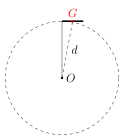
A firework consists of a uniform rod of mass \(M\) and length \(2a\), pivoted smoothly at one end so that it can rotate in a fixed horizontal plane, and a rocket attached to the other end. The rocket is a uniform rod of mass \(m(t)\) and length \(2l(t)\), with \(m(t)=2\alpha l(t)\) and \(\alpha\) constant. It is attached to the rod by its front end and it lies at right angles to the rod in the rod's plane of rotation. The rocket burns fuel in such a way that \(\mathrm{d}m/\mathrm{d}t=-\alpha\beta,\) with \(\beta\) constant. The burnt fuel is ejected from the back of the rocket, with speed \(u\) and directly backwards relative to the rocket. Show that, until the fuel is exhausted, the firework's angular velocity \(\omega\) at time \(t\) satisfies \[ \frac{\mathrm{d}\omega}{\mathrm{d}t}=\frac{3\alpha\beta au}{2[Ma^{2}+2\alpha l(3a^{2}+l^{2})]}. \]
Solution:
1987 Paper 3 Q13
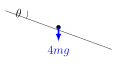
A uniform rod, of mass \(3m\) and length \(2a,\) is freely hinged at one end and held by the other end in a horizontal position. A rough particle, of mass \(m\), is placed on the rod at its mid-point. If the free end is then released, prove that, until the particle begins to slide on the rod, the inclination \(\theta\) of the rod to the horizontal satisfies the equation \[ 5a\dot{\theta}^{2}=8g\sin\theta. \] The coefficient of friction between the particle and the rod is \(\frac{1}{2}.\) Show that, when the particle begins to slide, \(\tan\theta=\frac{1}{26}.\)
Solution:

1987 Paper 3 Q14
It is given that the gravitational force between a disc, of radius \(a,\) thickness \(\delta x\) and uniform density \(\rho,\) and a particle of mass \(m\) at a distance \(b(\geqslant0)\) from the disc on its axis is \[ 2\pi mk\rho\delta x\left(1-\frac{b}{(a^{2}+b^{2})^{\frac{1}{2}}}\right), \] where \(k\) is a constant. Show that the gravitational force on a particle of mass \(m\) at the surface of a uniform sphere of mass \(M\) and radius \(r\) is \(kmM/r^{2}.\) Deduce that in a spherical cloud of particles of uniform density, which all attract one another gravitationally, the radius \(r\) and inward velocity \(v=-\dfrac{\d r}{\d t}\) of a particle at the surface satisfy the equation \[ v\frac{\mathrm{d}v}{\mathrm{d}r}=-\frac{kM}{r^{2}}, \] where \(M\) is the mass of the cloud. At time \(t=0\), the cloud is instantaneously at rest and has radius \(R\). Show that \(r=R\cos^{2}\alpha\) after a time \[ \left(\frac{R^{3}}{2kM}\right)^{\frac{1}{2}}(\alpha+\tfrac{1}{2}\sin2\alpha). \]
Solution: Suppose we divide a sphere of radius \(r\) up into slices of thickness \(\delta x\). Then the force acting on \(P\) will be: \begin{align*} F &= \sum_{\text{slices}} 2\pi mk\rho\delta x\left(1-\frac{b}{(a^{2}+b^{2})^{\frac{1}{2}}}\right) \\ &= \sum_{i=-r/\delta x}^{r/\delta x} 2\pi mk\frac{M}{\frac43 \pi r^3}\delta x\left(1-\frac{i \delta x}{((1-(i\delta x)^2)+(i \delta x)^{2})^{\frac{1}{2}}}\right) \\ &\to \int_{-r}^r \frac{1}{2} \frac{mkM}{r^3}(1-t) \d t \\ &=\frac{mkM}{r^2} \end{align*} We can see that the particle will have a force attracting it towards the centre, with magnitude \(\frac{kmM}{r^2}\), therefore and since \(\frac{\d v}{\d t} = \frac{\d v}{\d r} \frac{\d r}{\d t}\) we must have: \(v \frac{\d v}{\d r}m = - \frac{kmM}{r^2}\) and dividing by \(m\) we get exactly the result we seek. \begin{align*} && v \frac{\d v}{\d r} &= \frac{-kM}{r^2} \\ \Rightarrow && \frac{v^2}{2}+C &= \frac{kM}{r} \\ r = R, v =0: && C &= \frac{kM}{R} \\ \Rightarrow && v^2&= 2kM\left ( \frac1r - \frac1R\right ) \\ \Rightarrow && \frac{\d r}{\d t} &= -\sqrt{2kM\left ( \frac1r - \frac1R\right )} \\ \Rightarrow && -\sqrt{2kM}T &= \int_{r=R}^{r=R\cos^2 \alpha} \frac{1}{\sqrt{\frac1r-\frac1R}} \d r \\ r = R\cos^2 \theta: && -\sqrt{2kM}T &= \int_{\theta = 0}^{\theta = \alpha} \frac{\sqrt{R}}{\sqrt{\sec^2 \theta - 1}} \cdot R \cdot 2 \cdot (-\cos \theta) \cdot \sin \theta \d \theta \\ \Rightarrow && T &= \sqrt{\frac{R^3}{2kM}} \int_0^\alpha \frac{2 \cos \theta \sin \theta}{\sqrt{\sec^2 \theta - 1}} \d \theta \\ &&&= \sqrt{\frac{R^3}{2kM}} \int_0^\alpha \frac{2 \cos \theta \sin \theta}{\tan \theta} \d \theta \\ &&&= \sqrt{\frac{R^3}{2kM}} \int_0^\alpha 2\cos^2 \theta \d \theta \\ &&&= \sqrt{\frac{R^3}{2kM}} \int_0^\alpha 1 + \cos 2 \theta\d \theta \\ &&&= \sqrt{\frac{R^3}{2kM}} \left [1 + \frac12 \sin 2 \theta \right]_0^\alpha \\ &&&= \sqrt{\frac{R^3}{2kM}} \left (\alpha + \frac12 \sin 2 \alpha \right) \\ \end{align*}
1987 Paper 3 Q15
A patient arrives with blue thumbs at the doctor's surgery. With probability \(p\) the patient is suffering from Fenland fever and requires treatment costing \(\pounds 100.\) With probability \(1-p\) he is suffering from Steppe syndrome and will get better anyway. A test exists which infallibly gives positive results if the patient is suffering from Fenland fever but also has probability \(q\) of giving positive results if the patient is not. The test cost \(\pounds 10.\) The doctor decides to proceed as follows. She will give the test repeatedly until either the last test is negative, in which case she dismisses the patient with kind words, or she has given the test \(n\) times with positive results each time, in which case she gives the treatment. In the case \(n=0,\) she treats the patient at once. She wishes to minimise the expected cost \(\pounds E_{n}\) to the National Health Service.
- Show that \[ E_{n+1}-E_{n}=10p-10(1-p)q^{n}(9-10q), \] and deduce that if \(p=10^{-4},q=10^{-2},\) she should choose \(n=3.\)
- Show that if \(q\) is larger than some fixed value \(q_{0},\) to be determined explicitly, then whatever the value of \(p,\) she should choose \(n=0.\)
Solution:
- \(E_{n+1} - E_n\) is the additional cost of the extra test \(10p+10(1-p)q^n\) from people who have yet to fail a test plus the reduce cost of people who will fail the final test, \(-100(1-p)q^n(1-q)\) \begin{align*} E_{n+1}-E_{n} &= 10p+10(1-p)q^n-100(1-p)q^n(1-q) \\ &=10p +10(1-p)q^n(1-10(1-q)) \\ &= 10p +10(1-p)q^n(-9+10q) \\ &= 10p - 10(1-p)q^n(9-10q) \end{align*} \begin{align*} && 10p - 10(1-p)q^n(9-10q) &> 0 \\ \Leftrightarrow && \frac{p}{(1-p)(9-10q)} &>q^n \end{align*} If \(p = 10^{-4}, q = 10^{-2}\) we have: \begin{align*} \frac{p}{(1-p)(9-10q)} &= \frac{10^{-4}}{(1-10^{-4})(9-10^{-3})} \\ &\approx 10^{-5} \end{align*} and \(q^2 < 10^{-5} < q^3\) so she should stop after the 3rd test.
- She shouldn't bother testing if \begin{align*} && \frac{p}{(1-p)(9-10q)} &>1 \\ \Leftrightarrow && \frac{p}{1-p} &>9-10q \\ \Leftrightarrow && 10q &>9 \\ \Leftrightarrow && q &> \frac9{10} = q_0 \end{align*}