Problems
Filters
13 problems found
2012 Paper 2 Q1
Write down the general term in the expansion in powers of \(x\) of \((1-x^6)^{-2}\,\).
- Find the coefficient of \(x^{24}\) in the expansion in powers of \(x\) of \[ (1-x^6)^{-2} (1-x^3)^{-1}\,.\] Obtain also, and simplify, formulae for the coefficient of \(x^n\) in the different cases that arise.
- Show that the coefficient of \(x^{24}\) in the expansion in powers of \(x\) of \[ (1-x^6)^{-2} (1-x^3)^{-1} (1-x)^{-1}\,\] is \(55\), and find the coefficients of \(x^{25}\) and \(x^{66}\).
Solution: \(\displaystyle (1-x^6)^{-2} = \sum_{n=0}^{\infty} (n+1)x^{6n}\)
- \(\,\) \begin{align*} && f(x) &= (1-x^6)^{-2}(1-x^3)^{-1} \\ &&&= \left ( \sum_{n=0}^{\infty} (n+1)x^{6n} \right) \left ( \sum_{n=0}^{\infty} x^{3n} \right) \\ [x^{24}]: && c_{24} &= 1 + 2+ 3+4+5 = 15 \end{align*} Clearly \(n\) must be a multiple of \(3\). If \(n = 6k\) then we have \(1 + 2 + \cdots + (k+1) = \frac{(k+1)(k+2)}{2}\) If \(n = 6k+3\) then we have \(1 + 2 + \cdots + (k+1) = \frac{(k+1)(k+2)}{2}\) the same way, we just must always get one extra \(x^3\) term from the second expansion.
- We can obtain \(x^{24}\) from the product of \((1-x^6)^{-2}(1-x^3)^{-1}\) and \((1-x)^{-1}\) in the following ways: \begin{array}{c|c|c} (1-x^6)^{-2}(1-x^3)^{-1} & (1-x)^{-1} & \text{product} \\ \hline 15x^{24} & x^0 & 15x^{24} \\ 10x^{21} & x^3 & 10x^{24} \\ 10x^{18} & x^6 & 10x^{24} \\ 6x^{15} & x^9 & 6x^{24} \\ 6x^{12} & x^{12} & 6x^{24} \\ 3x^{9} & x^{15} & 3x^{24} \\ 3x^{6} & x^{18} & 3x^{24} \\ x^{3} & x^{21} & x^{24} \\ x^{0} & x^{24}& x^{24} \end{array} So the total is \(55\). Similarly for \(25\) we can only obtain this in the same ways but also taking an extra power of \(x\) from the geometric series, ie \(55\) For \(66\) we obtain by similar reasoning that it is: \(\frac{13\cdot12}{2} + 2 \left (1 + 3 + \cdots + \frac{13 \cdot 12}{2} \right) = \frac{13\cdot12}{2} + 2 \binom{14}{3} = \frac{13 \cdot 12}2 ( 1 + \frac{30}{3}) = 11 \cdot 6 \cdot 13 = 858\)
2012 Paper 2 Q2
If \(\p(x)\) and \(\q(x)\) are polynomials of degree \(m\) and \(n\), respectively, what is the degree of \(\p(\q(x))\)?
- The polynomial \(\p(x)\) satisfies \[ \p(\p(\p(x)))- 3 \p(x)= -2x\, \] for all \(x\). Explain carefully why \(\p(x)\) must be of degree 1, and find all polynomials that satisfy this equation.
- Find all polynomials that satisfy \[ 2\p(\p(x)) +3 [\p(x)]^2 -4\p(x) =x^4 \] for all \(x\).
Solution: If \(\p(x)\) and \(\q(x)\) are polynomials of degree \(m\) and \(n\), \(\p(\q(x))\) has degree \(mn\).
- Suppose \(\p(\p(\p(x)))- 3 \p(x)= -2x\), and suppose \(p(x)\) has degree \(n = \geq 2\), then \(\p(\p(\p(x)))\) has degree \(n^3\) and so the left hand side has degree higher than \(1\) and the right hand side is degree \(1\). Therefore \(\p(x)\) is degree \(1\) or \(0\). If \(p(x) = c\) then \(c^3-3c = -2x\) but the LHS doesn't depend on \(x\) which is also a contradiction. Therefore \(\p(x)\) is degree \(1\). Suppose \(\p(x) = ax+b\) then: \begin{align*} && -2x &= \p(\p(\p(x))) - 3\p(x) \\ &&&= \p(\p(ax+b)) - 3(ax+b) \\ &&&= \p(a(ax+b)+b) - 3ax -3b \\ &&&= a(a^2x+ab+b) + b - 3ax - 3b \\ &&&= (a^3-3a)x + b(a^2+a-2) \\ \Rightarrow &&& \begin{cases} a^3-3a&=-2 \\ b(a^2+a-2) &= 0\end{cases} \\ \Rightarrow &&& \begin{cases} a^3-3a+2 = 0 \\ b = 0, a = 1, a = -2\end{cases} \\ \Rightarrow &&& \begin{cases} (a-1)(a^2+a-2) = 0 \\ b = 0, a = 1, a = -2\end{cases} \\ \Rightarrow && (a,b) &= (1, b), (-2,b) \end{align*}
- Suppose \(2\p(\p(x)) +3 [\p(x)]^2 -4\p(x) =x^4\) and let \(\deg \p(x) = n\), then LHS has degree \(\max(n^2,2n,n)\) and the right hand side has degree \(4\). Therefore \(\p(x)\) must have degree \(2\). Let \(\p(x) = ax^2 + bx + c\), then, considering the coefficient of \(x^4\) in \(2\p(\p(x)) + 3[\p(x)]^2 -4\p(x)\) we will have \(2a^3+3a^2=1 \Rightarrow 2a^3+3a^2-1 = (a+1)^2(2a-1) \Rightarrow a = -1, a=\frac12\). Consider the coefficient of \(x^3\) in \(2\p(\p(x)) + 3[\p(x)]^2 -4\p(x)\) we have \(4a^2b+6ab = 0 \Rightarrow 2ab(2a+3) = 0\) Since \(a = -1, \frac12\) this means \(b = 0\). Consider the constant coefficient in \(2\p(\p(x)) + 3[\p(x)]^2 -4\p(x)\) (using \(b = 0\)). \(2ac^2+c+3c^2-4c = 0 \Rightarrow c(2ac+3c-3) = 0\). Therefore \(c = 0\) or \(a = -1, c = 3, a = \frac12, c = \frac34\), so our possible polynomials are: \(\p(x) = -x^2, \frac12x^2, -x^2+3, \frac12x^2+\frac34\)
2012 Paper 2 Q3
Show that, for any function f (for which the integrals exist), \[ \int_0^\infty \f\big(x+\sqrt{1+x^2}\big) \,\d x = \frac12 \int_1^\infty \left(1+\frac 1 {t^2}\right) \f(t)\, \d t \,. \] Hence evaluate \[ \int_0^\infty \frac1 {2x^2 +1 + 2 x\sqrt{x^2+1} \ } \, \, \d x \,, \] and, using the substitution \(x=\tan\theta\), \[ \int_0^{\frac12\pi} \frac{1}{(1+\sin\theta)^3}\,\d \theta \,. \]
Solution: \begin{align*} && t &= x + \sqrt{1+x^2} \\ &&\frac1t &= \frac{1}{x+\sqrt{1+x^2}} \\ &&&= \frac{\sqrt{1+x^2}-x}{1+x^2-1} \\ &&&= \sqrt{1+x^2}-x \\ \Rightarrow && x &=\frac12 \left ( t - \frac1t\right) \\ \Rightarrow && \d x &=\frac12 \left (1 + \frac1{t^2} \right)\d t \\ \\ \Rightarrow && \int_0^\infty \f\big(x+\sqrt{1+x^2}\big) \,\d x &= \int_{t=1}^{t = \infty}f(t) \frac12\left (1 + \frac1{t^2} \right)\d t \\ &&&= \frac12 \int_1^\infty \left (1 + \frac1{t^2} \right)f(t) \d t \end{align*} \begin{align*} && I &= \int_0^\infty \frac1 {2x^2 +1 + 2 x\sqrt{x^2+1} \ } \d x \\ &&&= \int_0^\infty \frac1 {(x+\sqrt{x^2+1})^2} \d x \\ &&&= \frac12 \int_1^\infty \left (1 + \frac1{t^2} \right) \frac{1}{t^2} \d t \\ &&&= \frac12 \left [-\frac1t-\frac13\frac1{t^3} \right]_1^{\infty} \\ &&&= \frac12 \cdot \frac43 = \frac23 \end{align*} \begin{align*} && J &= \int_0^{\frac12 \pi} \frac{1}{(1+\sin \theta)^3} \d \theta \\ &&x &= \tan \theta\\ && \d x &= \sec^2 \theta = (1+x^2) \d \theta\\ && \tan\theta &= \frac{s}{\sqrt{1-s^2}}\\ \Rightarrow && \tan^2 \theta &= \frac{s^2}{1-s^2} \\ \Rightarrow && \sin \theta &= \frac{\tan\theta}{\sqrt{1+\tan^2\theta}} \\ && J &= \int_0^{\frac12 \pi} \frac{1}{(1+\sin \theta)^3} \d \theta \\ &&&= \int_0^{\frac12 \pi} \frac{1}{\left (1+ \frac{\tan\theta}{\sqrt{1+\tan^2\theta}} \right )^3} \d \theta \\ &&&= \int_{x=0}^{x=\infty} \frac{1}{\left(1 + \frac{x}{\sqrt{1+x^2}} \right)^3} \frac{1}{1+x^2} \d x \\ &&&= \int_0^{\infty} \frac{\sqrt{1+x^2}}{(\sqrt{1+x^2}+x)^3} \d x \\ &&J_a &= \int_0^{\infty} \frac{\sqrt{1+x^2}+x}{(\sqrt{1+x^2}+x)^3} \d x \\ &&&= \frac23 \\ &&J_b &= \int_0^{\infty} \frac{\sqrt{1+x^2}-x}{(\sqrt{1+x^2}+x)^3} \d x \\ &&&= \int_0^{\infty} \frac{1}{(\sqrt{1+x^2}+x)^4} \d x\\ &&&= \frac12\int_1^{\infty} \left (1 +\frac1{t^2} \right)\frac{1}{t^4} \d t \\ &&&= \frac12 \left [-\frac13 t^{-3}-\frac15t^{-5} \right]_1^{\infty} \\ &&&= \frac12 \cdot \frac8{15} = \frac4{15} \\ \Rightarrow && J &= \frac12(J_a+J_b) = \frac7{15} \end{align*}
2012 Paper 2 Q4
In this question, you may assume that the infinite series \[ \ln(1+x) = x-\frac{x^2}2 + \frac{x^3}{3} -\frac {x^4}4 +\cdots + (-1)^{n+1} \frac {x^n}{n} + \cdots \] is valid for \(\vert x \vert <1\).
- Let \(n\) be an integer greater than 1. Show that, for any positive integer \(k\), \[ \frac1{(k+1)n^{k+1}} < \frac1{kn^{k}}\,. \] Hence show that \(\displaystyle \ln\! \left(1+\frac1n\right) <\frac1n\,\). Deduce that \[ \left(1+\frac1n\right)^{\!n}<\e\,. \]
- Show, using an expansion in powers of \(\dfrac1y\,\), that $ \displaystyle \ln \! \left(\frac{2y+1}{2y-1}\right) > \frac 1y %= \sum _{r=0}^\infty \frac 1{(2r+1)(2y)^{2r}}\,. \( for \)y>\frac12$. Deduce that, for any positive integer \(n\), \[ \e < \left(1+\frac1n\right)^{\! n+\frac12}\,. \]
- Use parts (i) and (ii) to show that as \(n\to\infty\) \[ \left(1+\frac1n\right)^{\!n} \to \e\,. \]
Solution:
- Since \(k \geq 1\) we have \(n^{k+1} > n^k\) and \((k+1) > k\), therefore \((k+1)n^{k+1} >kn^k \Rightarrow \frac{1}{(k+1)n^{k+1}} < \frac{1}{kn^k}\) \begin{align*} && \ln \left ( 1 + \frac1n \right) &= \frac1n -\frac{1}{2n^2} + \frac{1}{3n^3} - \frac{1}{4n^4} + \cdots \\ &&&= \frac1n - \underbrace{\left (\frac{1}{2n^2}-\frac{1}{3n^3} \right)}_{>0}- \underbrace{\left (\frac{1}{4n^4}-\frac{1}{5n^5} \right)}_{>0} - \cdot \\ &&&< \frac1n \\ \\ \Rightarrow && n \ln \left ( 1 + \frac1n \right) &< 1 \\ \Rightarrow && \ln \left ( \left ( 1 + \frac1n \right)^n \right) &< 1 \\ \Rightarrow && \left ( 1 + \frac1n \right)^n &< e \end{align*}
- \(\,\) \begin{align*} &&\ln \left(\frac{2y+1}{2y-1}\right) &= \ln \left (1 + \frac{1}{2y} \right)-\ln \left (1 - \frac{1}{2y} \right) \\ &&&= \frac{1}{2y} - \frac{1}{2(2y)^2} + \frac{1}{3(2y)^3} - \cdots - \left (-\frac{1}{2y} - \frac{1}{2(2y)^2} - \frac{1}{3(2y)^3} - \cdots \right) \\ &&&= \frac{1}{y} + \frac{2}{3(2y)^3} + \frac{2}{5(2y)^5} \\ &&&= \sum_{r=1}^{\infty} \frac{2}{(2r-1)(2y)^{2r-1}} \\ &&&> \frac1y \\ \\ \Rightarrow && \ln \left (1 + \frac{1}{y-\frac12} \right) &> \frac{1}{y} \\\Rightarrow && \ln \left (1 + \frac{1}{n} \right) &> \frac{1}{n+\frac12} \\ \Rightarrow &&(n+\tfrac12) \ln \left (1 + \frac{1}{n} \right) &> 1\\ \Rightarrow && \ln \left ( \left (1 + \frac{1}{n} \right)^{n+\tfrac12} \right) &> 1\\ \Rightarrow && \left (1 + \frac{1}{n} \right)^{n+\tfrac12} & > e \end{align*}
2012 Paper 2 Q5
- Sketch the curve \(y=\f(x)\), where \[ \f(x) = \frac 1 {(x-a)^2 -1} \hspace{2cm}(x\ne a\pm1), \] and \(a\) is a constant.
- The function \(\g(x)\) is defined by \[ \g(x) = \frac 1 {\big( (x-a)^2-1 \big) \big( (x-b)^2 -1\big)} \hspace{1cm}(x\ne a\pm1, \ x\ne b\pm1), \] where \(a\) and \(b\) are constants, and \(b>a\). Sketch the curves \(y=\g(x)\) in the two cases \(b>a+2\) and \(b=a+2\), finding the values of \(x\) at the stationary points.
Solution:
- \(\,\)

- \(\,\) \begin{align*}
&& \frac{\d}{\d x} \left ( \frac{1}{g(x)} \right) &= \frac{\d }{\d x} \left ( \big( (x-a)^2-1 \big) \big( (x-b)^2 -1\big)\right) \\
&&&= ((x-a)^2-1)(2(x-b))+((x-b)^2-1)(2(x-a)) \\
&&&= 2(2x-a-b)(x^2-(a+b)x+ab-1) \\
\Rightarrow && x &= \frac{a+b}{2}, \frac{a+b \pm \sqrt{(a+b)^2-4ab+4}}{2} \\
&&&= \frac{a+b}{2}, \frac{a+b \pm \sqrt{(a-b)^2+4}}{2}
\end{align*}
If \(b > a+2\):
If \(b = a+2\):


2012 Paper 2 Q6
A cyclic quadrilateral \(ABCD\) has sides \(AB\), \(BC\), \(CD\) and \(DA\) of lengths \(a\), \(b\), \(c\) and \(d\), respectively. The area of the quadrilateral is \(Q\), and angle \(DAB\) is \(\theta\). Find an expression for \(\cos\theta\) in terms of \(a\), \(b\), \(c\) and \(d\), and an expression for \(\sin\theta\) in terms of \(a\), \(b\), \(c\), \(d\) and \(Q\). Hence show that \[ 16Q^2 = 4(ad+bc)^2 - (a^2+d^2-b^2-c^2)^2 \,, \] and deduce that \[ Q^2 = (s-a)(s-b)(s-c)(s-d)\,, \] where \(s= \frac12(a+b+c+d)\). Deduce a formula for the area of a triangle with sides of length \(a\), \(b\) and \(c\).
Solution:

2012 Paper 2 Q7
Three distinct points, \(X_1\), \(X_2\) and \(X_3\), with position vectors \({\bf x}_1\), \({\bf x}_2\) and \({\bf x}_3\) respectively, lie on a circle of radius 1 with its centre at the origin \(O\). The point \(G\) has position vector \(\frac13({\bf x}_1+{\bf x}_2+{\bf x}_3)\). The line through \(X_1\) and \(G\) meets the circle again at the point \(Y_1\) and the points \(Y_2\) and \(Y_3\) are defined correspondingly. Given that \(\overrightarrow{GY_1} =-\lambda_1\overrightarrow{GX_1}\), where \(\lambda_1\) is a positive scalar, show that \[ \overrightarrow{OY_1}= \tfrac13 \big( (1-2\lambda_1){\bf x}_1 +(1+\lambda_1)({\bf x}_2+{\bf x}_3)\big) \] and hence that \[ \lambda_1 = \frac {3-\alpha-\beta-\gamma} {3+\alpha -2\beta-2\gamma} \,,\] where \(\alpha = {\bf x}_2 \,.\, {\bf x}_3\), \(\beta = {\bf x}_3\,.\, {\bf x}_1\) and \(\gamma = {\bf x}_1\,.\, {\bf x}_2\). Deduce that $\dfrac {GX_1}{GY_1} + \dfrac {GX_2}{GY_2} + \dfrac {GX_3}{GY_3} =3 \,$.
Solution:

2012 Paper 2 Q8
The positive numbers \(\alpha\), \(\beta\) and \(q\) satisfy \(\beta-\alpha >q\). Show that \[ \frac{\alpha^2+\beta^2 -q^2}{\alpha\beta}-2> 0\,. \] The sequence \(u_0\), \(u_1\), \(\ldots\) is defined by \(u_0=\alpha\), \(u_1=\beta\) and \[ \ \ \ \ \ \ \ \ \ \ \ \ \ \ \ u_{n+1} = \frac {u_{n}^2 -q^2}{u_{n-1}} \ \ \ \ \ \ \ \ \ \ \ (n\ge1), \] where \(\alpha\), \(\beta\) and \(q\) are given positive numbers (and \(\alpha\) and \(\beta\) are such that no term in the sequence is zero). Prove that \(u_n(u_n+u_{n+2}) = u_{n+1}(u_{n-1}+u_{n+1})\,\). Prove also that \[ u_{n+1} -pu_n + u_{n-1}=0 \] for some number \(p\) which you should express in terms of \(\alpha\), \(\beta\) and \(q\). Hence, or otherwise, show that if \(\beta> \alpha+q\), the sequence is strictly increasing (that is, \(u_{n+1}-u_n > 0\) for all \(n\)). Comment on the case \(\beta =\alpha +q\).
Solution: \begin{align*} && \beta - \alpha &> q \\ \Rightarrow &&(\beta - \alpha)^2 &> q^2 \\ \Rightarrow && \beta^2 +\alpha^2 - 2\beta \alpha &> q^2 \\ \Rightarrow && \alpha^2+\beta^2-q^2 -2 \beta \alpha &> 0 \\ \Rightarrow && \frac{\alpha^2+\beta^2-q^2}{\alpha\beta} - 2 &> 0 \end{align*} \begin{align*} && u_n(u_n+u_{n+2}) &= u_n \cdot \left (u_n + \frac {u_{n+1}^2 -q^2}{u_{n}}\right) \\ &&&= u_n^2 + u_{n+1}^2-q^2 \\ &&&= u_n^2 + u_{n+1}^2 - (u_n^2-u_{n-1}u_{n+1}) \\ &&&= u_{n+1}^2 + u_{n+1}u_{n-1} \\ &&&= u_{n+1}(u_{n-1}+u_{n+1}) \\ \\ && u_{n+1}-pu_n+u_{n-1} &= -pu_n+\frac{u_{n}(u_{n-2}+u_n)}{u_{n-1}} \\ &&&= \frac{u_n(u_{n}-pu_{n-1}+u_{n-2})}{u_{n-1}} \end{align*} Therefore if \(u_2 -pu_1 + u_0 = 0\) it is always zero, ie if \begin{align*} && u_2 &= p\beta - \alpha \\ && u_2 &= \frac{\beta^2-q^2}{\alpha} \\ \Rightarrow && \frac{\beta^2-q^2}{\alpha} &= p\beta - \alpha \\ \Rightarrow && p &= \frac{\alpha^2+\beta^2-q^2}{\alpha\beta} \end{align*} If \(\beta > \alpha + q\) we must have that \(p > 2\), and so \(u_{n+1}-u_n = (p-1)u_n - u_{n-1} > u_n-u_{n-1} > 0\), therefore the sequence is strictly increasing. If \(\beta = \alpha + q\) the sequence follows \(u_{n+1} - 2u_n + u_{n-1} =0\) and so \(u_{n+1}-u_n = u_n - u_{n-1}\) for all \(n\) (which is still increasing - it's an arithmetic progression with common difference \(\beta - \alpha\)).
2012 Paper 2 Q9
A tennis ball is projected from a height of \(2h\) above horizontal ground with speed \(u\) and at an angle of \(\alpha\) below the horizontal. It travels in a plane perpendicular to a vertical net of height \(h\) which is a horizontal distance of \(a\) from the point of projection. Given that the ball passes over the net, show that \[ \frac 1{u^2}< \frac {2(h-a\tan\alpha)}{ga^2\sec^2\alpha}\,. \] The ball lands before it has travelled a horizontal distance of \(b\) from the point of projection. Show that \[ \sqrt{u^2\sin^2\alpha +4gh \ } < \frac{bg}{u\cos\alpha} + u \sin\alpha\,. \] Hence show that \[ \tan\alpha < \frac{h(b^2-2a^2)}{ab(b-a)}\,. \]
Solution: \begin{align*} && s &= ut \\ \Rightarrow && a &= u \cos \alpha t\\ \Rightarrow && t &= \frac{a}{u \cos \alpha}\\ && s &= ut+ \frac12at^2 \\ \Rightarrow && -h &< -u\sin \alpha \frac{a}{u \cos \alpha}-\frac12 g \left (\frac{a}{u \cos \alpha} \right)^2 \\ &&&= -a \tan \alpha-\frac12 g a^2 \frac{1}{u^2} \sec^2 \alpha \\ \Rightarrow && \frac12 g a^2 \frac{1}{u^2} \sec^2 \alpha &< h -a\tan \alpha \\ \Rightarrow &&\frac{1}{u^2} &< \frac{2(h-a\tan \alpha)}{ga^2 \sec^2 \alpha} \end{align*} \begin{align*} && s &= ut + \frac12a t^2 \\ \Rightarrow && 2h &= u\sin \alpha t + \frac12 gt^2 \\ \Rightarrow && t &= \frac{-u\sin \alpha \pm \sqrt{u^2 \sin^2 \alpha+4hg}}{g}\\ && t &= \frac{-u\sin \alpha +\sqrt{u^2 \sin^2 \alpha+4hg}}{g}\\ && s &= ut \\ \Rightarrow && b &> u \cos \alpha t \\ \Rightarrow && \frac{b}{u \cos \alpha} &> \frac{-u\sin \alpha +\sqrt{u^2 \sin^2 \alpha+4hg}}{g} \\ \Rightarrow && \sqrt{u^2 \sin^2 \alpha+4hg} &< \frac{bg}{u \cos \alpha} + u \sin \alpha \\ \end{align*} \begin{align*} \Rightarrow && u^2 \sin^2 \alpha+4hg &< \frac{b^2g^2}{u^2 \cos^2 \alpha} +u^2 \sin^2 \alpha + 2bg \tan \alpha \\ \Rightarrow && 4hg - 2bg \tan \alpha &< \frac{b^2g^2}{u^2 \cos^2 \alpha} \\ &&&< \frac{b^2g^2}{\cos^2 \alpha} \frac{2(h-a\tan \alpha)}{ga^2 \sec^2 \alpha} \\ &&&= \frac{2b^2g(h-a\tan \alpha)}{a^2} \\ \Rightarrow && \tan \alpha \left (\frac{2b^2g}{a} - 2bg \right) &< \frac{2b^2gh}{a^2} - 4hg \\ \Leftrightarrow && \tan \alpha \left (\frac{2b^2g- 2abg}{a} \right) &< \frac{2b^2gh- 4hga^2}{a^2} \\ \Leftrightarrow && \tan \alpha \left (\frac{2bg(b- a)}{a} \right) &< \frac{2hg(b^2- 2a^2)}{a^2} \\ \Rightarrow && \tan \alpha &< \frac{h(b^2-2a^2)}{ab(b-a)} \end{align*}
2012 Paper 2 Q10
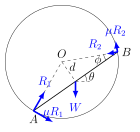
A hollow circular cylinder of internal radius \(r\) is held fixed with its axis horizontal. A uniform rod of length \(2a\) (where \(a < r\)) rests in equilibrium inside the cylinder inclined at an angle of \(\theta\) to the horizontal, where \(\theta\ne0\). The vertical plane containing the rod is perpendicular to the axis of the cylinder. The coefficient of friction between the cylinder and each end of the rod is \(\mu\), where \(\mu > 0\). Show that, if the rod is on the point of slipping, then the normal reactions \(R_1\) and \(R_2\) of the lower and higher ends of the rod, respectively, on the cylinder are related by \[ \mu(R_1+R_2) = (R_1-R_2)\tan\phi \] where \(\phi\) is the angle between the rod and the radius to an end of the rod. Show further that \[ \tan\theta = \frac {\mu r^2}{r^2 -a^2(1+\mu^2)}\,. \] Deduce that \(\lambda <\phi \), where \(\tan\lambda =\mu\).
Solution:
2012 Paper 2 Q11
A small block of mass \(km\) is initially at rest on a smooth horizontal surface. Particles \(P_1\), \(P_2\), \(P_3\), \(\ldots\) are fired, in order, along the surface from a fixed point towards the block. The mass of the \(i\)th particle is \(im\) (\(i = 1, 2, \ldots\))and the speed at which it is fired is \(u/i\,\). Each particle that collides with the block is embedded in it. Show that, if the \(n\)th particle collides with the block, the speed of the block after the collision is \[ \frac{2nu}{2k +n(n+1)}\,. \] In the case \(2k = N(N+1)\), where \(N\) is a positive integer, determine the number of collisions that occur. Show that the total kinetic energy lost in all the collisions is \[ \tfrac12 mu^2\bigg( \sum_{n=2}^{N+1} \frac 1 n \bigg)\,. \]
Solution: \begin{align*} \text{COM}: && \sum_{i=1}^n im \cdot \frac{u}{i} &= \left ( km + \sum_{i=1}^n im \right) v \\ \Rightarrow && nu &= \left ( k + \frac{n(n+1)}{2} \right) v \\ \Rightarrow && v &= \frac{2nu}{2k + n(n+1)} \end{align*} If \(2k = N(N+1)\), there will be no more collisions when \(v_n > \frac{u}{n+1}\), ie \begin{align*} && \frac{u}{n+1} &<\frac{2nu}{2k + n(n+1)} \\ \Leftrightarrow && N(N+1) + n(n+1) &< 2n(n+1) \\ \Leftrightarrow && N(N+1) &< n(n+1) \\ \end{align*} Therefore \(n = N+1\) and there will be \(N+1\) collisions. The loss of kinetic energy is: \begin{align*} && \text{initial k.e.} &= \sum_{k=1}^{N+1} \frac12 im \cdot \frac{u^2}{i^2} \\ &&&= \frac12 m u^2 \left ( \sum_{k=1}^{N+1} \frac{1}{i}\right) \\ && \text{final k.e.} &= \frac12 \left ( k + \frac{(N+1)(N+2)}{2}\right)m \left ( \frac{2(N+1)u}{N(N+1)+(N+1)(N+2)} \right)^2 \\ &&&= \frac12 m u^2 \frac{2(N+1)^2}{(N+1)(2N+2)} \\ &&&= \frac12 mu^2 \\ \Rightarrow && \Delta \text{ k.e.} &= \frac12 m u^2 \left ( \sum_{k=2}^{N+1} \frac{1}{i}\right) \end{align*}
2012 Paper 2 Q12
A modern villa has complicated lighting controls. In order for the light in the swimming pool to be on, a particular switch in the hallway must be on and a particular switch in the kitchen must be on. There are four identical switches in the hallway and four identical switches in the kitchen. Guests cannot tell whether the switches are on or off, or what they control. Each Monday morning a guest arrives, and the switches in the hallway are either all on or all off. The probability that they are all on is \(p\) and the probability that they are all off is \(1-p\). The switches in the kitchen are each on or off, independently, with probability \(\frac12\).
- On the first Monday, a guest presses one switch in the hallway at random and one switch in the kitchen at random. Find the probability that the swimming pool light is on at the end of this process. Show that the probability that the guest has pressed the swimming pool light switch in the hallway, given that the light is on at the end of the process, is \(\displaystyle \frac{1-p}{1+2p}\).
- On each of seven Mondays, guests go through the above process independently of each other, and each time the swimming pool light is found to be on at the end of the process. Given that the most likely number of days on which the swimming pool light switch in the hallway was pressed is 3, show that \(\frac14 < p < \frac{5}{14}\).
Solution:
- \(\,\) \begin{align*} && \mathbb{P}(\text{hall switch on}) &= \underbrace{p \cdot \frac34 }_{\text{already on and not flipped}}+ \underbrace{(1-p) \cdot \frac14}_{\text{not on and flipped}} \\ &&&= \frac14 +\frac12 p\\ && \mathbb{P}(\text{kitchen on}) &= \frac12 \\ \Rightarrow && \mathbb{P}(\text{pool is on}) &= \frac18 + \frac14p \end{align*} \begin{align*} && \mathbb{P}(\text{flipped hall switch} | \text{pool on}) &= \frac{\mathbb{P}(\text{flipped hall and pool on})}{\mathbb{P}(\text{pool on})} \\ &&&= \frac{(1-p)\frac14 \cdot \frac 12}{\frac18 + \frac14 p} \\ &&&= \frac{1-p}{1+2p} \end{align*}
- The number of days the swimming pool light was pressed is \(X = B\left (7, \frac{1-p}{1+2p} \right)\), and we have that \(\mathbb{P}(X = 2) < \mathbb{P}(X = 3) > \mathbb{P}(X=4)\) (since the binomial is unimodal). Let \(q = \frac{1-p}{1+2p} \) \begin{align*} && \mathbb{P}(X = 2) &< \mathbb{P}(X = 3) \\ \Rightarrow && \binom{7}{2} q^2(1-q)^5 &< \binom{7}{3}q^3(1-q)^4 \\ \Rightarrow && 21(1-q) &< 35q \\ \Rightarrow && 21 &< 56q \\ \Rightarrow && \frac{3}{8} &< \frac{1-p}{1+2p} \\ \Rightarrow && 3+6p &< 8-8p \\ \Rightarrow && 14p &< 5\\ \Rightarrow && p &< \frac5{14} \\ \\ && \mathbb{P}(X = 3) &> \mathbb{P}(X = 4) \\ \Rightarrow && \binom{7}{3} q^3(1-q)^4 &> \binom{7}{4}q^4(1-q)^3 \\ \Rightarrow &&(1-q)&> q \\ \Rightarrow && \frac12 &> q \\ \Rightarrow && \frac12 &> \frac{1-p}{1+2p} \\ \Rightarrow && 1+2p &> 2-2p \\ \Rightarrow && 4p &> 1\\ \Rightarrow && p &> \frac1{4} \end{align*} Therefore \(\frac14 < p < \frac{5}{14}\) as required.
2012 Paper 2 Q13
In this question, you may assume that \(\displaystyle \int_0^\infty \!\!\! \e^{-x^2/2} \d x = \sqrt{\tfrac12 \pi}\,\). The number of supermarkets situated in any given region can be modelled by a Poisson random variable, where the mean is \(k\) times the area of the given region. Find the probability that there are no supermarkets within a circle of radius \(y\). The random variable \(Y\) denotes the distance between a randomly chosen point in the region and the nearest supermarket. Write down \(\P(Y < y)\) and hence show that the probability density function of \(Y\) is \(\displaystyle 2\pi y k \e^{-\pi k y^2}\) for \(y\ge0\). Find \(\E(Y)\) and show that \(\var(Y) = \dfrac{4-\pi}{4\pi k}\).
Solution: A circle radius \(y\) has a number of supermarkets \(X\) where \(X \sim Po(k \pi y^2)\). \[ \mathbb{P}(X = 0) = e^{-k\pi y^2} \frac{1}{0!} = e^{-k\pi y^2} \] The probability \(\mathbb{P}(Y < y) = 1-\mathbb{P}(Y \geq y) = 1-e^{-k\pi y^2}\), and in particular \(f_Y(y) = 2k\pi y e^{-k\pi y^2}\) (by differentiating). \begin{align*} && \mathbb{E}(Y) &= \int_0^\infty yf_Y(y) \d y \\ &&&= \int_0^\infty 2\pi y^2 k e^{-\pi k y^2} \d y \\ \sigma^2 = \frac{1}{2k\pi}:&&&= \pi k \sqrt{2 \pi}\sigma \int_{-\infty}^\infty \frac{1}{\sqrt{2 \pi} \sigma }y^2 e^{-\frac12 \cdot 2\pi k y^2} \d y \\ &&&=\pi k \sqrt{2 \pi}\sigma \mathbb{E}\left (N(0, \sigma^2)^2 \right) \\ &&&= \pi k \sqrt{2 \pi}\sigma\sigma^2 \\ &&&= \pi k \sqrt{2 \pi} \frac{1}{(2k\pi)^{3/2}} \\ &&&= \frac{1}{2\sqrt{k}} \end{align*} \begin{align*} && \mathbb{E}(Y^2) &= \int_0^\infty y^2f_Y(y) \d y \\ &&&= \int_0^\infty 2\pi y^3 k e^{-\pi k y^2} \d y \\ &&&= \int_0^{\infty}y^2 2y \pi k e^{-\pi k y^2} \d y \\ \\ &&&= \left [-y^2 e^{-\pi k y^2}\right]_0^{\infty}+\int_0^\infty 2ye^{-\pi k y^2} \d y \\ &&&= \left [-\frac{1}{\pi k}e^{-\pi k y^2} \right]_0^{\infty} \\ &&&= \frac{1}{\pi k} \\ \Rightarrow && \textrm{Var}(Y) &= \mathbb{E}(Y^2) - \left [ \mathbb{E}(Y)\right]^2 \\ &&&= \frac{1}{\pi k} - \frac{1}{4k} \\ &&&= \frac{4 - \pi}{4\pi k} \end{align*}