Problems
Filters
14 problems found
2005 Paper 1 Q1
\(47231\) is a five-digit number whose digits sum to \(4+7+2+3+1 = 17\,\).
- Show that there are \(15\) five-digit numbers whose digits sum to \(43\). You should explain your reasoning clearly.
- How many five-digit numbers are there whose digits sum to \(39\)?
Solution:
- The largest a five-digit number can have for its digit sum is \(45 = 9+9+9+9+9\). To achieve \(43\) we can either have 4 9s and a 7 or 3 9s and 2 8s. The former can be achieved in \(5\) ways and the latter can be achieved in \(\binom{5}{2} = 10\) ways. (2 places to choose to put the 2 8s). In total this is \(15\) ways.
- To achieve \(39\) we can have: \begin{array}{c|l|c} \text{numbers} & \text{logic} & \text{count} \\ \hline 99993 & \binom{5}{1} & 5 \\ 99984 & 5 \cdot 4 & 20 \\ 99974 & 5 \cdot 4 & 20 \\ 99965 & 5 \cdot 4 & 20 \\ 99884 & \binom{5}{2} \binom{3}{2} & 30 \\ 99875 & \binom{5}{2} 3! & 60 \\ 99866 & \binom{5}{2} \binom{3}{2} & 30 \\ 98886 & 5 \cdot 4 & 20 \\ 98877 & \binom{5}{2} \binom{3}{2} & 30 \\ 88887 & \binom{5}{1} & 5 \\ \hline && 240 \end{array}
2005 Paper 1 Q2
The point \(P\) has coordinates \(\l p^2 , 2p \r\) and the point \(Q\) has coordinates \(\l q^2 , 2q \r\), where \(p\) and~\(q\) are non-zero and \(p \neq q\). The curve \(C\) is given by \(y^2 = 4x\,\). The point \(R\) is the intersection of the tangent to \(C\) at \(P\) and the tangent to \(C\) at \(Q\). Show that \(R\) has coordinates \(\l pq , p+q \r\). The point \(S\) is the intersection of the normal to \(C\) at \(P\) and the normal to \(C\) at \(Q\). If \(p\) and \(q\) are such that \(\l 1 , 0 \r\) lies on the line \(PQ\), show that \(S\) has coordinates \(\l p^2 + q^2 + 1 , \, p+q \r\), and that the quadrilateral \(PSQR\) is a rectangle.
2005 Paper 1 Q3
In this question \(a\) and \(b\) are distinct, non-zero real numbers, and \(c\) is a real number.
- Show that, if \(a\) and \(b\) are either both positive or both negative, then the equation \[ \displaystyle \frac {x }{ x-a} + \frac{x }{ x-b} = 1 \] has two distinct real solutions.
- Show that, if \(c\ne1\), the equation \[\displaystyle \frac x { x-a} + \frac{x}{ x-b} = 1 + c\] has exactly one real solution if \(\displaystyle c^2 = - \frac {4ab}{\l a - b \r ^2}\) Show that this condition can be written \(\displaystyle c^2= 1 - \l \frac {a+b}{a-b} \r ^2 \) and deduce that it can only hold if \(0 < c^2 \le 1\,\).
Solution:
- \(\,\) \begin{align*} && 1 &= \frac{x}{x-a} + \frac{x}{x-b} \\ \Leftrightarrow && (x-a)(x-b) &= x(2x-a-b) \\ \Leftrightarrow && 0 &= x^2-ab \end{align*} Therefore if \(a,b\) are both positive or both negative, \(ab > 0\) and there are two distinct solutions \(x = \pm \sqrt{ab}\)
- \(\,\) \begin{align*} && 1+c &= \frac{x}{x-a} + \frac{x}{x-b} \\ \Leftrightarrow && (1+c)(x-a)(x-b) &= x(2x-a-b) \\ \Leftrightarrow && 0 &= (c-1)x^2-c(a+b)x+ab(1+c) \\ \\ && 0 &= \Delta = c^2(a+b)^2 - 4 \cdot(c-1)\cdot ab(1+c) \\ &&&= c^2(a+b)^2-4ab(c^2-1) \\ &&&= c^2 ((a+b)^2-4ab)+4ab \\ &&&= c^2(a-b)^2+4ab \\ \Rightarrow && c^2 &= -\frac{4ab}{(a-b)^2} \\ &&&= -\frac{(a+b)^2-(a-b)^2}{(a-b)^2} \\ &&&= 1 - \left ( \frac{a+b}{a-b} \right)^2 \end{align*} Note that \(c^2 \geq 0\) and \(1-x^2 \leq 1\) so \(0 \leq c^2 \leq 1\). \(c^2 = 0 \Rightarrow ab = 0\), but this is not possible since \(a,b \neq 0\), therefore \(0 < c^2 \leq 1\)
2005 Paper 1 Q4
- Given that \(\displaystyle \cos \theta = \frac35\) and that \(\displaystyle \frac{3\pi }{ 2} \le \theta \le 2\pi\), show that \(\displaystyle \sin 2 \theta = -\frac{24}{25}\), and evaluate \(\cos 3 \theta\).
- Prove the identity \(\displaystyle \tan 3\theta \equiv \frac {3 \tan \theta - \tan^3 \theta}{1 - 3 \tan^2 \theta}\). Hence evaluate \(\tan \theta\), given that \(\displaystyle \tan 3\theta = \frac{11}{ 2}\) and that \(\displaystyle \frac{\pi}{ 4} \le \theta \le \frac{\pi}{2}\).
Solution:
- Since \(\cos^2 \theta + \sin^2 \theta \equiv 1\), \(\sin \theta = \pm \frac45\) and since \(\displaystyle \frac{3\pi }{ 2} \le \theta \le 2\pi\) it must be the case that \(\sin\) is negative, ie \(\sin \theta = -\frac45\). Therefore \(\sin 2 \theta = 2 \sin \theta \cos \theta = 2 \cdot \frac35 \cdot (-\frac45) = -\frac{24}{25}\). \begin{align*} \cos 3 \theta &= \cos 2 \theta \cos \theta - \sin 2\theta \sin \theta \\ &= (\cos^2 \theta - \sin^2 \theta) \cos \theta - \sin 2 \theta \sin \theta \\ &= (\frac{9}{25} - \frac{16}{25}) \frac35 + \frac{24}{25} \cdot (-\frac{4}{5}) \\ &= -\frac{21}{125} - \frac{96}{125} \\ &= -\frac{117}{125} \end{align*}
- \begin{align*} \tan 3 \theta &\equiv \frac{\tan 2 \theta + \tan \theta}{1 - \tan 2 \theta \tan \theta} \\ &\equiv \frac{\frac{2 \tan \theta}{1- \tan^2 \theta} + \tan \theta}{1 - \frac{2 \tan^2 \theta}{1- \tan^2 \theta}} \\ &\equiv \frac{2\tan \theta + \tan \theta -\tan^3 \theta}{1 - \tan^2 \theta - 2 \tan^2 \theta} \\ &\equiv \frac {3 \tan \theta - \tan^3 \theta}{1 - 3 \tan^2 \theta} \end{align*} Let \(t = \tan \theta\), then \begin{align*} && \frac{11}{2} &= \frac{3t - t^3}{1-3t^2} \\ \Leftrightarrow && 11 - 33t^2 &= 6t -2t^3 \\ \Leftrightarrow && 0 &= 2t^3-33t^2-6t+11 \\ \Leftrightarrow && 0 &= (2t-1)(t^2-16t-11) \end{align*} Therefore \(\tan \theta = \frac12, \tan \theta = \frac{16 \pm \sqrt{16^2+4 \cdot 1 \cdot 11}}{2} = \frac{16\pm10\sqrt{3}}{2} = 8 \pm 5 \sqrt{3}\). Since \(\displaystyle \frac{\pi}{ 4} \le \theta \le \frac{\pi}{2}\) we must have that \(\tan\) is both positive and \(\geq 1\), therefore \(\tan \theta = 8 + 5 \sqrt{3}\)
2005 Paper 1 Q5
- Evaluate the integral \[ \int_0^1 \l x + 1 \r ^{k-1} \; \mathrm{d}x \] in the cases \(k\ne0\) and \(k = 0\,\). Deduce that \(\displaystyle \frac{2^k - 1}{k} \approx \ln 2\) when \(k \approx 0\,\).
- Evaluate the integral \[ \int_0^1 x \l x + 1 \r ^m \; \mathrm{d}x \; \] in the different cases that arise according to the value of \(m\).
Solution:
- Case \(k \neq 0\): \begin{align*} && \int_0^1 (x+1)^{k-1} \d x &= \left [\frac{1}{k}(x+1)^k \right]_0^1 \\ &&&= \frac{2^k-1}{k} \\ \end{align*} Case \(k = 0\): \begin{align*} && \int_0^1 (x+1)^{k-1} \d x &= \int_0^1 (x+1)^{-1} \d x \\ &&&= \left [\ln(x+1) \right]_0^1 \\ &&&= \ln 2 \end{align*} Therefore for \(k \approx 0\), we must have both integrals being close to each other, since the function is nice on this interval, ie \(\frac{2^k-1}{k} \approx \ln 2\)
- Case \(m = 0\). \(I = \frac12\) Case \(m \neq 0, -1, -2\) \begin{align*} u = x+1, \d u = \d x && \int_0^1 x(x+1)^m \d x &= \int_{u=1}^{u=2} (u-1)u^m \d u \\ &&&=\left[ \frac{u^{m+2}}{m+2} - \frac{u^{m+1}}{m+1} \right]_1^2 \\ &&&= 2^{m+1}\left ( \frac{2}{m+2} - \frac1{m+1} \right) - \frac{1}{m+2} + \frac{1}{m+1} \\ &&&= 2^{m+1} \frac{m}{(m+1)(m+2)} + \frac{1}{(m+1)(m+2)} \\ &&&= \frac{m2^{m+1}+1}{(m+1)(m+2)} \\ \end{align*} Case \(m = -1\). \begin{align*} && \int_0^1 \frac{x}{x+1} \d x &= \int_0^1 1 - \frac{1}{x+1} \d x \\ &&&= 1 - \ln2 \\ \end{align*} Case \(m = -2\): \begin{align*} && \int_0^1 \frac{x}{(x+1)^2} \d x &= \int_0^1\frac{x+1-1}{(x+1)^2} \d x \\ &&&= \left [ \ln (x+1) +(1+x)^{-1} \right]_0^1 \\ &&&= \ln 2 + \frac12 - 1 \\ &&&= \ln 2 - \frac12 \end{align*}
2005 Paper 1 Q6
- The point \(A\) has coordinates \(\l 5 \, , 16 \r\) and the point \(B\) has coordinates \(\l -4 \, , 4 \r\). The variable point \(P\) has coordinates \(\l x \, , y \r\,\) and moves on a path such that \(AP=2BP\). Show that the Cartesian equation of the path of \(P\) is \[ \displaystyle \l x+7 \r^2 + y^2 =100 \;. \]
- The point \(C\) has coordinates \(\l a \, , 0 \r\) and the point \(D\) has coordinates \(\l b \, , 0 \r\), where \(a\ne b\). The variable point \(Q\) moves on a path such that \[ QC = k \times QD\;, \] where \(k>1\,\). Given that the path of \(Q\) is the same as the path of \(P\), show that \[ \frac{a+7}{b+7}=\frac{a^2+51}{b^2+51}\;. \] Show further that \((a+7)(b+7)=100\,\).
Solution:
- Since \(AP = 2BP\) we also have \(|AP|^2 = 4|BP|^2\) ie \begin{align*} && (x-5)^2 + (y-16)^2 &= 4(x+4)^2 + 4(y-4)^2 \\ \Rightarrow && x^2 - 10x+25 + y^2 -32y + 256 &= 4x^2+32x+64+4y^2-32y+64 \\ \Rightarrow && 281 &= 3x^2+42x+3y^2+128\\ && 281 &= 3(x+7)^2-147+3y^2+128 \\ \Rightarrow && 300 &= 3(x+7)^2 + 3y^2 \\ && 100 &= (x+7)^2 + y^2 \end{align*}
- Since \(|QC|^2 = k^2 |QD|^2\), \begin{align*} && (x-a)^2 + y^2 &= k^2 (x-b)^2 + k^2y^2 \\ \Rightarrow && x^2-2ax+a^2 &= k^2x^2-2k^2bx+k^2b^2 + (k^2-1)y^2 \\ && a^2-k^2b^2 &= (k^2-1)x^2-2(k^2b-a)x + (k^2-1)y^2 \\ && a^2-k^2b^2&= (k^2-1)\left(x-\frac{k^2b-a}{k^2-1}\right)^2-(k^2-1)\left(\frac{k^2b-a}{k^2-1}\right)^2+(k^2-1)y^2 \\ && \frac{a^2-k^2b^2}{k^2-1}+\left(\frac{k^2b-a}{k^2-1}\right)^2&= \left(x-\frac{k^2b-a}{k^2-1}\right)^2+y^2 \\ \Rightarrow && -7 &= \frac{k^2b-a}{k^2-1} \tag{*} \\ && 100 &= \frac{a^2-k^2b^2}{k^2-1}+\left(\frac{k^2b-a}{k^2-1}\right)^2 \\ &&&= \frac{a^2-k^2b^2}{k^2-1}+7^2 \\ \Rightarrow && 51 &= \frac{a^2-k^2b^2}{k^2-1} \tag{**} \\ (*) \Rightarrow && k^2(b+7)&= a+7 \\ (**) \Rightarrow && k^2(51+b^2)&= a^2+51 \\ \Rightarrow && \frac{a^2+51}{b^2+51} &= \frac{a+7}{b+7} \\ \\ \Rightarrow && a^2b+51b+7a^2 &= ab^2+51a+7b^2 \\ && 0 &= ab(b-a)-51(b-a)+7(b-a)(b+a) \\ &&&= (b-a)(ab+7(b+a)-51) \\ &&&= (b-a)((a+7)(b+7)-100) \\ \Rightarrow && 100 &= (a+7)(b+7) \end{align*} Since \(a \neq b\)
2005 Paper 1 Q7
The notation \(\displaystyle \prod^n_{r=1} \f (r)\) denotes the product $\f (1) \times \f (2) \times \f(3) \times \cdots \times \f(n)$. %For example, \(\displaystyle \prod_{r=1}^4 r = 24\). %Simplify \(\displaystyle \prod^n_{r=1} \frac{\g (r) }{ \g (r-1) }\). %You may assume that \(\g (r) \neq 0\) for any integer \(0 \le r \le n \). Simplify the following products as far as possible:
- \(\displaystyle \prod^n_{r=1} \l \frac{r+ 1 }{ r } \r\,\);
- \(\displaystyle \prod^n_{r=2} \l \frac{r^2 -1}{r^2 } \r\,\);
- $\displaystyle \prod^n_{r=1} \l {\cos \frac{2\pi }{ n} + \sin \frac{2\pi}{ n} \cot \frac{\l 2r-1 \r \pi }{ n} }\r\,$, where \(n\) is even.
Solution:
- \(\,\) \begin{align*} \prod^n_{r=1} \left ( \frac{r+ 1 }{ r } \right) &= \frac{2}{1} \cdot \frac{3}{2} \cdot \frac{4}{3} \cdots \frac{n-1}{n-2} \cdot \frac{n}{n-1} \cdot \frac{n+1}{n} \\ &= \frac{n+1}{1} = n+1 \end{align*}
- \(\,\) \begin{align*} \prod^n_{r=2} \left ( \frac{r^2 -1}{r^2 } \right) &= \prod^n_{r=2} \left ( \frac{(r -1)(r+1)}{r^2 } \right) \\ &= \left ( \frac{1}{2} \cdot \frac{3}{2} \right) \cdot \left ( \frac{2}{3} \cdot \frac{4}{3} \right) \cdots \left ( \frac{r-1}{r} \cdot \frac{r+1}{r}\right) \cdots \frac{n-1}{n} \cdot \frac{n+1}{n} \\ &= \frac{1}{n} \cdot \frac{n+1}{2} \\ &= \frac{n+1}{2n} \end{align*}
- When \(n\) is odd, the product is undefined, since we have a \(\cot \pi\) lurking in there. \begin{align*} \prod^n_{r=1} \left ( {\cos \frac{2\pi }{ n} + \sin \frac{2\pi}{ n} \cot \frac{ (2r-1 ) \pi }{ n} } \right) &= \prod^n_{r=1} \left ( {\cos \frac{2\pi }{ n} + \sin \frac{2\pi}{ n} \frac{\cos \frac{ (2r-1 ) \pi }{ n}}{\sin\frac{ (2r-1 ) \pi }{ n}} } \right) \\ &= \prod^n_{r=1} \frac{1}{\sin\frac{ (2r-1 ) \pi }{ n}} \left ( {\cos \frac{2\pi }{ n} \sin\frac{ (2r-1 ) \pi }{ n} + \sin \frac{2\pi}{ n} \cos \frac{ (2r-1 ) \pi }{ n} } \right) \\ &= \prod^n_{r=1} \frac{1}{\sin\frac{ (2r-1 ) \pi }{ n}} \sin \left ( \frac{2\pi}{n} + \frac{(2r-1)\pi}{n} \right) \\ &= \prod^n_{r=1} \frac{1}{\sin\frac{ (2r-1 ) \pi }{ n}} \sin \left ( \frac{(2r+1)\pi}{n} \right) \\ &= \frac{\sin \frac{3\pi}{n}}{\sin \frac{\pi}{n}} \cdot \frac{\sin \frac{5\pi}{n}}{\sin \frac{3\pi}{n}} \cdots \frac{\sin \frac{(2n+1)\pi}{n}}{\sin \frac{(2n-1)\pi}{n}} \\ &= \frac{\sin \frac{(2n+1)\pi}{n}}{\sin \frac{\pi}{n}} \\ &= 1 \end{align*}
2005 Paper 1 Q8
Show that, if \(y^2 = x^k \f(x)\), then $\displaystyle 2xy \frac{\mathrm{d}y }{ \mathrm{d}x} = ky^2 + x^{k+1} \frac{\mathrm{d}\f }{ \mathrm{d}x}$\,.
- By setting \(k=1\) in this result, find the solution of the differential equation \[ \displaystyle 2xy \frac{\mathrm{d}y }{ \mathrm{d}x} = y^2 + x^2 - 1 \] for which \(y=2\) when \(x=1\). Describe geometrically this solution.
- Find the solution of the differential equation \[ 2x^2y\displaystyle \frac{\mathrm{d}y}{\mathrm{d}x} = 2 \ln(x) - xy^2 \] for which \(y=1\) when \(x=1\,\).
2005 Paper 1 Q9
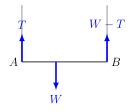
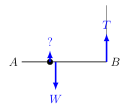
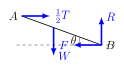
A non-uniform rod \(AB\) has weight \(W\) and length \(3l\). When the rod is suspended horizontally in equilibrium by vertical strings attached to the ends \(A\) and \(B\), the tension in the string attached to \(A\) is \(T\). When instead the rod is held in equilibrium in a horizontal position by means of a smooth pivot at a distance \(l\) from \(A\) and a vertical string attached to \(B\), the tension in the string is \(T\). Show that \(5T = 2W\). When instead the end \(B\) of the rod rests on rough horizontal ground and the rod is held in equilibrium at an angle \(\theta\) to the horizontal by means of a string that is perpendicular to the rod and attached to \(A\), the tension in the string is \(\frac12 T\). Calculate \(\theta\) and find the smallest value of the coefficient of friction between the rod and the ground that will prevent slipping.
Solution:
2005 Paper 1 Q10
Three collinear, non-touching particles \(A\), \(B\) and \(C\) have masses \(a\), \(b\) and \(c\), respectively, and are at rest on a smooth horizontal surface. The particle \(A\) is given an initial velocity \(u\) towards~\(B\). These particles collide, giving \(B\) a velocity \(v\) towards \(C\). These two particles then collide, giving \(C\) a velocity \(w\). The coefficient of restitution is \(e\) in both collisions. Determine an expression for \(v\), and show that \[ \displaystyle w = \frac {abu \l 1+e \r^2}{\l a + b \r \l b+c \r}\;. \] Determine the final velocities of each of the three particles in the cases:
- \(\displaystyle \frac ab = \frac bc = e\,\);
- \(\displaystyle \frac ba = \frac cb = e\,\).
2005 Paper 1 Q11
A particle moves so that \({\bf r}\), its displacement from a fixed origin at time \(t\), is given by \[{\bf r} = \l \sin{2t} \r {\bf i} + \l 2\cos t \r \bf{j}\,,\] where \(0 \le t < 2\pi\).
- Show that the particle passes through the origin exactly twice.
- Determine the times when the velocity of the particle is perpendicular to its displacement.
- Show that, when the particle is not at the origin, its velocity is never parallel to its displacement.
- Determine the maximum distance of the particle from the origin, and sketch the path of the particle.
Solution:
- It is at the origin when both \(\sin 2t\) and \(\cos t = 0\), but this \(\sin 2t = 2 \sin t \cos t\) so this happens precisely when \(\cos t = 0\), ie when \(t = \frac{\pi}{2}, \frac{3\pi}{2}\)
- \(\,\) \begin{align*} && \dot{\mathbf{r}} &= 2 \cos 2t \mathbf{i} - 2 \sin t \mathbf{j} \\ && \mathbf{r} \cdot \dot{\mathbf{r}} &= 2\cos 2t \sin 2t - 2 \sin t 2 \cos t \\ &&&= \sin 2t \left (2\cos 2t - 2 \right) \end{align*} Therefore they are perpendicular when \(\sin 2t = 0 \Rightarrow t = 0, \frac{\pi}{2}, \pi, \frac{3\pi}{2}, 2\pi\) and when \(\cos 2t = 1 \Rightarrow 2t = 0, 2\pi, 4\pi \Rightarrow t = 0, \pi, 2\pi\), therefore all solutions are \( t = 0, \frac{\pi}{2}, \pi, \frac{3\pi}{2}, 2\pi\)
- For \(\mathbf{r}\) and \(\dot{\mathbf{r}}\) to be parallel, we would need \begin{align*} && \frac{2 \cos 2t}{\sin 2t} &= \frac{-2 \sin t}{2 \cos t}\\ && 2 \cos 2t \cos t &= - \sin t \sin 2t \\ && 0 &= 2\cos t (\cos 2t + \sin ^2 t) \\ &&&= 2 \cos t (\cos^2 t) \\ &&&= 2 \cos^3 t \end{align*} Therefore the only time we can be parallel is when \(\cos t = 0\), which is when we are at the origin.
- \(\frac{\d }{\d t} (\mathbf{r} \cdot \mathbf{r}) = 2 \mathbf{r} \cdot \mathbf{\dot{r}}\) so we should check the values when velocity and displacement are perpendicular, ie \( t = 0, \frac{\pi}{2}, \pi, \frac{3\pi}{2}, 2\pi\) which have values \(\mathbf{r} = \binom{0}{2}, \binom{0}{0}, \binom{0}{-2}, \binom{0}{0}, \binom{0}{2}\). Therefore the maximum distance is \(2\).

2005 Paper 1 Q12
- The probability that a hobbit smokes a pipe is 0.7 and the probability that a hobbit wears a hat is 0.4. The probability that a hobbit smokes a pipe but does not wear a hat is \(p\). Determine the range of values of \(p\) consistent with this information.
- The probability that a wizard wears a hat is 0.7; the probability that a wizard wears a cloak is 0.8; and the probability that a wizard wears a ring is 0.4. The probability that a wizard does not wear a hat, does not wear a cloak and does not wear a ring is 0.05. The probability that a wizard wears a hat, a cloak and also a ring is 0.1. Determine the probability that a wizard wears exactly two of a hat, a cloak, and a ring. The probability that a wizard wears a hat but not a ring, given that he wears a cloak, is \(q\). Determine the range of values of \(q\) consistent with this information.
Solution:
- \(\,\)
The overlap can be at most 0.4, which would mean \(p =0.7-0.4 = 0.3\) It must be at least 0.1, which would mean \(p =0.7-0.1 = 0.6\) so \(0.3 \leq p \leq 0.6\)

- Notice that: \begin{align*} && 1 &= 0.05 + 0.7 -(hc+hr+0.1) + \\ &&&\quad\quad 0.8 - (hc+cr + 0.1) + \\ &&&\quad \quad \quad 0.4 - (hr+cr+0.1) +\\ &&&\quad \quad \quad \quad hc+hr+cr+0.1 \\ && &= 0.05 +0.7+0.8+0.4 - (hc+hr+cr)-2\cdot 0.1 \\ \Rightarrow && hc+hr+cr &=0.05 +0.7 + 0.8 + 0.4 - 0.2-1 \\ \Rightarrow && \mathbb{P}(\text{exactly 2}) &= 0.75 \end{align*} Notice \(q = \frac{hc}{0.8}\) Notice that we must have: \(hc, hr cr \geq 0\) as well as \(hc+hr+cr = 0.75\) \begin{align*} && \mathbb{P}(\text{only hat}) &= 0.7 -(hc+hr+0.1) \geq 0 \\ \Rightarrow && hc+hr & \leq 0.6 \\ && \mathbb{P}(\text{only cloak}) &= 0.8 - (hc+cr + 0.1)\geq 0 \\ \Rightarrow &&hc+cr & \leq 0.7 \\ && \mathbb{P}(\text{only ring}) &= 0.4 - (hr+cr+0.1) \geq 0 \\ \Rightarrow && hc+hr & \leq 0.3 \\ \end{align*} To find the minimum for \(hc\) we want to maximise \(hr+cr = 0.3\), so \(hc = 0.75 - 0.3 = 0.45\). To find the maximum for \(hc\) we want to minimise \(hr\) and \(cr\) \(cr \leq 0.7 - hc\) and \(hr \leq 0.6 - hc\) so \(0.75 \leq hc + (0.6 - hc) + (0.7 - hc) = 1.3-hc\) so \(hc \leq 1.3 - 0.75 = 0.55\) Therefore the range for \(q\) is \(\frac{.45}{.8}\) to \(\frac{.55}{.8}\) or \(\frac9{16} \leq q \leq \frac{11}{16}\)

2005 Paper 1 Q13
The random variable \(X\) has mean \(\mu\) and standard deviation \(\sigma\). The distribution of \(X\) is symmetrical about \(\mu\) and satisfies: \[\P \l X \le \mu + \sigma \r = a \mbox{ and } \P \l X \le \mu + \tfrac{1}{ 2}\sigma \r = b\,,\] where \(a\) and \(b\) are fixed numbers. Do not assume that \(X\) is Normally distributed.
- Determine expressions (in terms of \(a\) and \(b\)) for \[ \P \l \mu-\tfrac12 \sigma \le X \le \mu + \sigma \r \mbox{ and } \P \l X \le \mu +\tfrac12 \sigma \; \vert \; X \ge \mu - \tfrac12 \sigma \r.\]
- My local supermarket sells cartons of skimmed milk and cartons of full-fat milk: \(60\%\) of the cartons it sells contain skimmed milk, and the rest contain full-fat milk.
The volume of skimmed milk in a carton is modelled by \(X\) ml, with \(\mu = 500\) and \(\sigma =10\,\). The volume of full-fat milk in a carton is modelled by \(X\) ml, with \(\mu = 495\) and \(\sigma = 10\,\).
- Today, I bought one carton of milk, chosen at random, from this supermarket. When I get home, I find that it contains less than 505 ml. Determine an expression (in terms of \(a\) and \(b\)) for the probability that this carton of milk contains more than 500 ml.
- Over the years, I have bought a very large number of cartons of milk, all chosen at random, from this supermarket. \(70\%\) of the cartons I have bought have contained at most 505 ml of milk. Of all the cartons that have contained at least 495 ml of milk, one third of them have contained full-fat milk. Use this information to estimate the values of \(a\) and \(b\).
Solution:
- \(\,\) \begin{align*} && \mathbb{P}\left (\mu - \tfrac12 \sigma \leq X \right) &= \mathbb{P}\left (X \leq \mu + \tfrac12 \sigma \right) \tag{by symmetry} \\ &&&= b \\ \Rightarrow && \mathbb{P} \left (\mu - \tfrac12 \sigma \leq X \leq \mu + \sigma \right) &= a - (1-b) = a+b - 1\\ \\ && \mathbb{P} \left ( X \le \mu +\tfrac12 \sigma \vert X \ge \mu - \tfrac12 \sigma \right ) &= \frac{ \mathbb{P} \left (\mu - \tfrac12 \sigma \leq X \leq \mu + \tfrac12 \sigma \right)}{\mathbb{P} \left ( X \ge \mu - \tfrac12 \sigma \right )} \\ &&&= \frac{b-(1-b)}{1-(1-b)} \\ &&&= \frac{2b-1}{b} \end{align*}
- Let \(Y\) be the volume of milk in the carton I bring home, we are interested in: \begin{align*} && \mathbb{P}(Y \geq 500 | Y \leq 505) &= \frac{\mathbb{P}(500 \leq Y \leq 505)}{\mathbb{P}(Y \leq 505)} \\ &&&=\frac{\mathbb{P}(500 \leq Y \leq 505|\text{skimmed})\mathbb{P}(\text{skimmed})+\mathbb{P}(500 \leq Y \leq 505|\text{full fat})\mathbb{P}(\text{full fat})}{\mathbb{P}(Y \leq 505|\text{skimmed})\mathbb{P}(\text{skimmed})+\mathbb{P}(Y \leq 505|\text{full fat})\mathbb{P}(\text{full fat})} \\ &&&= \frac{\frac35 \cdot \mathbb{P}(\mu \leq X \leq \mu + \tfrac12 \sigma) + \frac25 \cdot \mathbb{P}(\mu+\tfrac12 \sigma \leq X \leq \mu +\sigma)}{\frac35 \cdot \mathbb{P}(X \leq \mu + \tfrac12 \sigma) + \frac25 \cdot \mathbb{P}(X \leq \mu +\sigma)} \\ &&&= \frac{\frac35 \cdot(b-\tfrac12) + \frac25 \cdot (a-b)}{\frac35 \cdot b + \frac25 \cdot a} \\ &&&= \frac{b+2a-\frac32}{3b+2a} \\ &&&= \frac{4a+2b-3}{4a+6b} \end{align*}
- \(70\%\) of cartons have contained at most 505 ml, so: \begin{align*} && \tfrac7{10} &= \mathbb{P}(Y \leq 505) \\ &&&= \mathbb{P}(Y \leq 505 | \text{ skimmed}) \mathbb{P}(\text{skimmed}) + \mathbb{P}(Y \leq 505 | \text{ full fat}) \mathbb{P}(\text{full fat}) \\ &&&= \mathbb{P}(X \leq \mu + \tfrac12 \sigma) \cdot \tfrac35 + \mathbb{P}(X\leq \mu + \sigma ) \cdot \tfrac25 \\ \Rightarrow && 7 &= 6b+ 4a \end{align*} \(\tfrac13\) of cartons containing 495 ml contained full fat milk: \begin{align*} && \tfrac13 &= \mathbb{P}(\text{full fat} | Y \geq 495) \\ &&&= \frac{\mathbb{P}(\text{full fat and} Y \geq 495) }{\mathbb{P}(Y \geq 495)} \\ &&&= \frac{\mathbb{P}(X \geq \mu)\frac25}{\mathbb{P}(X \geq \mu)\cdot \frac25+\mathbb{P}(X \geq \mu-\tfrac12 \sigma)\cdot \frac35} \\ &&&= \frac{\frac15}{\frac12 \cdot \frac25 + b\frac35}\\ &&&= \frac{1}{1+ 3b }\\ \Rightarrow && 3b+1 &= 3 \\ \Rightarrow && b &= \frac23 \\ && a &= \frac34 \end{align*}
2005 Paper 1 Q14
The random variable \(X\) can take the value \(X=-1\), and also any value in the range \(0\le X <\infty\,\). The distribution of \(X\) is given by \[ \P(X=-1) =m \,, \ \ \ \ \ \ \ \P(0\le X\le x) = k(1-\e^{-x})\,, \] for any non-negative number \(x\), where \(k\) and \(m\) are constants, and \(m <\frac12\,\).
- Find \(k\) in terms of \(m\).
- Show that \(\E(X)= 1-2m\,\).
- Find, in terms of \(m\), \(\var (X)\) and the median value of \(X\).
- Given that \[ \int_0^\infty y^2 \e^{-y^2} \d y = \tfrac14 \sqrt{ \pi}\;,\] find \(\E\big(\vert X \vert^{\frac12}\big)\,\) in terms of \(m\).
Solution:
- We must have the total probability summing to \(1\), therefore \(1 =m + k\) (as \(x \to \infty\)) therefore \(k = 1-m\).
- \(\,\) \begin{align*} && \E[X] &= \mathbb{P}(X=-1) \cdot (-1) + \int_0^{\infty} kx e^{-x} \d x \\ &&&= -m + (1-m) = 1-2m \end{align*}
- \(\,\) \begin{align*} && \var[X] &= \E[X^2]-\E[X]^2 \\ &&&= \mathbb{P}(X=-1)\cdot(-1)^2 + (1-m)\int_0^{\infty} x^2e^{-x} \d x - (1-2m)^2 \\ &&&= m + (1-m)(1+1^2) - (1-2m)^2 \\ &&&= 3-4m - 1+4m -4m^2 \\ &&&= 2(1-m^2) \end{align*} To find the median \(q\), we need \begin{align*} && \frac12 &= \mathbb{P}(X \leq q) \\ &&&= m + (1-m)(1-e^{-q}) \\ \Rightarrow && e^{-q} &= 1-\frac{\frac12-m}{1-m} \\ &&&= \frac{1-m - \frac12+m}{1-m} \\ &&&= \frac{1}{2(1-m)} \\ \Rightarrow && q &= \ln 2(1-m) \end{align*}
- \(\,\) \begin{align*} && \E\left [|X|^{\frac12}\right] &= \mathbb{P}(X=-1) \cdot 1 + \int_0^{\infty} \sqrt{x} (1-m)e^{-x} \d x \\ &&&= m + (1-m)\int_0^\infty \sqrt{x} e^{-x} \d x \\ u^2 = x, \d x = 2u \d u : &&&= m + (1-m) \int_{u=0}^{u=\infty} u e^{-u^2} \cdot 2u \d u \\ &&&= m + 2(1-m) \int_0^{\infty} u^2 e^{-u^2} \d u \\ &&&= m + (1-m)\frac{\sqrt{\pi}}2 \end{align*}