Problems
Filters
124 problems found
1987 Paper 1 Q6
Let \(y=\mathrm{f}(x)\), \((0\leqslant x\leqslant a)\), be a continuous curve lying in the first quadrant and passing through the origin. Suppose that, for each non-negative value of \(y\) with \(0\leqslant y\leqslant\mathrm{f}(a)\), there is exactly one value of \(x\) such that \(\mathrm{f}(x)=y\); thus we may write \(x=\mathrm{g}(y)\), for a suitable function \(\mathrm{g}.\) For \(0\leqslant s\leqslant a,\) \(0\leqslant t\leqslant \mathrm{f}(a)\), define \[ \mathrm{F}(s)=\int_{0}^{s}\mathrm{f}(x)\,\mathrm{d}x,\qquad\mathrm{G}(t)=\int_{0}^{t}\mathrm{g}(y)\,\mathrm{d}y. \] By a geometrical argument, show that \[ \mathrm{F}(s)+\mathrm{G}(t)\geqslant st.\tag{*} \] When does equality occur in \((*)\)? Suppose that \(y=\sin x\) and that the ranges of \(x,y,s,t\) are restricted to \(0\leqslant x\leqslant s\leqslant\frac{1}{2}\pi,\) \(0\leqslant y\leqslant t\leqslant1\). By considering \(s\) such that the equality holds in \((*)\), show that \[ \int_{0}^{t}\sin^{-1}y\,\mathrm{d}y=t\sin^{-1}t-\left(1-\cos(\sin^{-1}t)\right). \] Check this result by differentiating both sides with respect to \(t\).
Solution:

1987 Paper 1 Q9
\(ABC\) is a triangle whose vertices have position vectors \(\mathbf{a,b,c}\)brespectively, relative to an origin in the plane \(ABC\). Show that an arbitrary point \(P\) on the segment \(AB\) has position vector \[ \rho\mathbf{a}+\sigma\mathbf{b}, \] where \(\rho\geqslant0\), \(\sigma\geqslant0\) and \(\rho+\sigma=1\). Give a similar expression for an arbitrary point on the segment \(PC\), and deduce that any point inside \(ABC\) has position vector \[ \lambda\mathbf{a}+\mu\mathbf{b}+\nu\mathbf{c}, \] where \(\lambda\geqslant0\), \(\mu\geqslant0\), \(\nu\geqslant0\) and \(\lambda+\mu+\nu=1\). Sketch the region of the plane in which the point \(\lambda\mathbf{a}+\mu\mathbf{b}+\nu\mathbf{c}\) lies in each of the following cases:
- \(\lambda+\mu+\nu=-1\), \(\lambda\leqslant0\), \(\mu\leqslant0\), \(\nu\leqslant0\);
- \(\lambda+\mu+\nu=1\), \(\mu\leqslant0\), \(\nu\leqslant0\).
Solution:

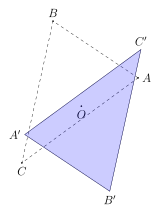
- This is equivalent to the area inside the triangle where every point (\(\mathbf{a}, \mathbf{b}, \mathbf{c}\)) has been send to it's negative (\(-\mathbf{a}, -\mathbf{b}, -\mathbf{c}\)),
ie
- Writing points as:
\begin{align*}
\lambda\mathbf{a}+\mu\mathbf{b}+\nu\mathbf{c} &= (1-\mu - \nu)\mathbf{a}+\mu\mathbf{b}+\nu\mathbf{c} \\
&= \mathbf{a} + (-\mu)(\mathbf{a}-\mathbf{b}) + (-\nu)(\mathbf{a} - \mathbf{c}) \\
&= \mathbf{a} + (-\mu)(\mathbf{a}-\mathbf{b}) + (-\nu)(\mathbf{a} - \mathbf{c}) + (1+\mu+\nu)\mathbf{0}\\
\end{align*}
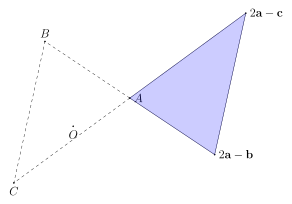
So this is a translation of \(\mathbf{a}\) of the triangle with vertices at \(\mathbf{0}, \mathbf{a-b}, \mathbf{a-c}\), or a triangle with vertices \(\mathbf{a}, 2\mathbf{a-b}, 2\mathbf{a-c}\).
1987 Paper 2 Q4
Explain the geometrical relationship between the points in the Argand diagram represented by the complex numbers \(z\) and \(z\mathrm{e}^{\mathrm{i}\theta}.\) Write down necessary and sufficient conditions that the distinct complex numbers \(\alpha,\beta\) and \(\gamma\) represent the vertices of an equilateral triangle taken in anticlockwise order. Show that \(\alpha,\beta\) and \(\gamma\) represent the vertices of an equilateral triangle (taken in any order) if and only if \[ \alpha^{2}+\beta^{2}+\gamma^{2}-\beta\gamma-\gamma\alpha-\alpha\beta=0. \] Find necessary and sufficient conditions on the complex coefficients \(a,b\) and \(c\) for the roots of the equation \[ z^{3}+az^{2}+bz+c=0 \] to lie at the vertices of an equilateral triangle in the Argand digram.
Solution: The point \(ze^{i\theta}\) is obtained by rotating the point \(z\) about \(0\) by an angle \(\theta\) anticlockwise. The complex numbers \(\alpha, \beta\) and \(\gamma\) will form an equilateral triangle iff the angles between each side are \(\frac{\pi}{3}\), ie \begin{align*} \begin{cases}{\gamma - \beta} &= e^{i \frac{\pi}{3}}({\beta - \alpha}) \\ {\alpha- \gamma} &= e^{i \frac{\pi}{3}}({\gamma- \beta}) \\ {\beta- \alpha} &= e^{i \frac{\pi}{3}}({\alpha- \gamma})\end{cases} \end{align*} We don't need all these equations, since the first two are equivalent to the third. Combining the first two equations, we have \begin{align*} && \frac{\gamma - \beta}{\beta-\alpha} &= \frac{\alpha-\gamma}{\gamma - \beta} \\ \Leftrightarrow && (\gamma - \beta)^2 &= (\alpha-\gamma)(\beta-\alpha) \\ \Leftrightarrow && \gamma^2 +\beta^2 - 2\gamma \beta &= \alpha\beta-\alpha^2-\gamma\beta+\gamma\alpha \\ \Leftrightarrow && \alpha^{2}+\beta^{2}+\gamma^{2}-\beta\gamma-\gamma\alpha-\alpha\beta&=0 \end{align*} as required. If the roots of \(z^{3}+az^{2}+bz+c=0\) are \(\alpha, \beta, \gamma\) then \(\alpha+\beta+\gamma = -a\) and \(\beta\gamma+\gamma\alpha+\alpha\beta = b\). We also have that \(a^2 - 2b = \alpha^2+\beta^2+\gamma^2\). Therefore there roots will lie at the vertices of an equilateral triangle iff \(a^2-3b = 0\)
1987 Paper 2 Q8
Let \(\mathbf{r}\) be the position vector of a point in three-dimensional space. Describe fully the locus of the point whose position vector is \(\mathbf{r}\) in each of the following four cases:
- \(\left(\mathbf{a-b}\right) \cdot \mathbf{r}=\frac{1}{2}(\left|\mathbf{a}\right|^{2}-\left|\mathbf{b}\right|^{2});\)
- \(\left(\mathbf{a-r}\right)\cdot\left(\mathbf{b-r}\right)=0;\)
- \(\left|\mathbf{r-a}\right|^{2}=\frac{1}{2}\left|\mathbf{a-b}\right|^{2};\)
- \(\left|\mathbf{r-b}\right|^{2}=\frac{1}{2}\left|\mathbf{a-b}\right|^{2}.\)
Solution:
- \(\mathbf{n} \cdot \mathbf{r} = 0\) is the equation of a plane with normal \(\mathbf{n}\). \(\mathbf{n} \cdot (\mathbf{r}-\mathbf{a}) = 0\) is the equation of a plane through \(\mathbf{a}\) with normal \(\mathbf{n}\). Our expression is: \begin{align*} && \left(\mathbf{a-b}\right) \cdot \mathbf{r}&=\frac{1}{2}(\left|\mathbf{a}\right|^{2}-\left|\mathbf{b}\right|^{2}) \\ &&&=\frac{1}{2}(\mathbf{a}-\mathbf{b})\cdot(\mathbf{a}+\mathbf{b}) \\ \Leftrightarrow && \left(\mathbf{a-b}\right) \cdot \left ( \mathbf{r} - \frac12 (\mathbf{a}+\mathbf{b}) \right) &= 0 \end{align*} So this is a plane through \(\frac12 (\mathbf{a}+\mathbf{b})\) perpendicular to \(\mathbf{a}-\mathbf{b}\). ie the plane halfway between \(\mathbf{a}\) and \(\mathbf{b}\) perpendicular to the line between them.
- \begin{align*} && 0 &= \left(\mathbf{a-r}\right)\cdot\left(\mathbf{b-r}\right) \\ &&&= \mathbf{a} \cdot \mathbf{b} - \mathbf{r} \cdot (\mathbf{a}+\mathbf{b}) + \mathbf{r}\cdot\mathbf{r} \\ &&&= \left ( \mathbf{r}- \frac12(\mathbf{a}+\mathbf{b}) \right) \cdot \left ( \mathbf{r}- \frac12(\mathbf{a}+\mathbf{b}) \right) - \frac14 \left (\mathbf{a}\cdot\mathbf{a}+2\mathbf{a}\cdot\mathbf{b} + \mathbf{b}\cdot\mathbf{b} \right) +\mathbf{a}\cdot\mathbf{b} \\ &&&= \left | \mathbf{r} - \frac12 \left (\mathbf{a}+\mathbf{b} \right) \right|^2 - \left |\frac12 \left ( \mathbf{a} - \mathbf{b}\right) \right|^2 \end{align*} Therefore this is a sphere, centre \(\frac12 \left (\mathbf{a}+\mathbf{b} \right)\) radius \(\left |\frac12 \left ( \mathbf{a} - \mathbf{b}\right) \right|\)
- This is a sphere centre \(\mathbf{a}\) radius \(\frac1{\sqrt{2}} \left|\mathbf{a-b}\right|\)
- This is a sphere centre \(\mathbf{b}\) radius \(\frac1{\sqrt{2}} \left|\mathbf{a-b}\right|\)