Problems
Filters
1531 problems found
2020 Paper 2 Q1
- Use the substitution \(x = \dfrac{1}{1-u}\), where \(0 < u < 1\), to find in terms of \(x\) the integral \[\int \frac{1}{x^{\frac{3}{2}}(x-1)^{\frac{1}{2}}}\,\mathrm{d}x \quad \text{(where } x > 1\text{).}\]
- Find in terms of \(x\) the integral \[\int \frac{1}{(x-2)^{\frac{3}{2}}(x+1)^{\frac{1}{2}}}\,\mathrm{d}x \quad \text{(where } x > 2\text{).}\]
- Show that \[\int_2^{\infty} \frac{1}{(x-1)(x-2)^{\frac{1}{2}}(3x-2)^{\frac{1}{2}}}\,\mathrm{d}x = \tfrac{1}{3}\pi.\]
Solution:
- \(\,\) \begin{align*} && x &= \frac1{1-u} \\ \Rightarrow && \d x &= \frac{1}{(1-u)^2} \d u \\ && I &= \int \frac{1}{x^{\frac32}(x-1)^{\frac12} } \d x \\ &&&= \int \frac1{(1-u)^{-\frac32}u^{\frac12}(1-u)^{-\frac12}} (1-u)^{-2} \d u \\ &&&= \int u^{-\frac12} \d u \\ &&&= 2\sqrt{u} + C \\ &&&= 2\sqrt{1-\frac{1}{x}} + C \end{align*}
- \(\,\) \begin{align*} && J &= \int \frac{1}{(x-2)^{\frac32}(x+1)^{\frac12}} \d x \\ y = x+1: &&&= \int \frac{1}{(y-3)^{\frac32}y^{\frac12}} \d y \\ y = 9(3-u)^{-1}: &&&= \int \frac1{\left (9(3-u)^{-1}-3 \right)^{\frac32}3(3-u)^{-\frac12}} \frac{9}{(3-u)^2} \d u \\ &&&= \int \frac1{\left (3u(3-u)^{-1} \right)^{\frac32}3(3-u)^{-\frac12}} \frac{9}{(3-u)^2} \d u \\ &&&= \frac{1}{\sqrt3} \int u^{-\frac32} \d u \\ &&&= -\frac2{\sqrt3} u^{-\frac12} + C \\ &&&= -\frac2{\sqrt3} \sqrt{\frac{y}{3(y-3)}} + C \\ &&&= -\frac2{3} \sqrt{\frac{x+1}{x-2}} + C \\ \end{align*}
- \(\,\) \begin{align*} && K &= \int_2^{\infty} \frac{1}{(x-1)(x-2)^{\frac12}(3x-2)^{\frac12}} \d x \\ y = x - 1: &&&=\int_{y=1}^{\infty} \frac{1}{y(y-1)^{\frac12}(3y+1)^{\frac12}} \d y \\ y = (1-u)^{-1}: &&&= \int_{u=0}^{u=1} \frac{1}{(1-u)^{-1}(u(1-u)^{-1})^{\frac12}((4-u)(1-u)^{-1})^{\frac12}} \frac{1}{(1-u)^2} \d u \\ &&&= \int_0^1 \frac{1}{u^{\frac12}(4-u)^{\frac12}} \d u \\ &&&= \int_0^1 \frac{1}{\sqrt{4-(u-2)^2}} \d u \\ &&&= \left [-\sin^{-1} \left ( \frac{2-u}{2} \right) \right]_0^1 \\ &&&= \sin^{-1} 1 - \sin^{-1} \tfrac12 \\ &&&= \frac{\pi}{2} - \frac{\pi}{6} = \frac{\pi}{3} \end{align*}
2020 Paper 2 Q2
The curves \(C_1\) and \(C_2\) both satisfy the differential equation \[\frac{\mathrm{d}y}{\mathrm{d}x} = \frac{kxy - y}{x - kxy},\] where \(k = \ln 2\). All points on \(C_1\) have positive \(x\) and \(y\) co-ordinates and \(C_1\) passes through \((1,\,1)\). All points on \(C_2\) have negative \(x\) and \(y\) co-ordinates and \(C_2\) passes through \((-1,\,-1)\).
- Show that the equation of \(C_1\) can be written as \((x-y)^2 = (x+y)^2 - 2^{x+y}\). Determine a similar result for curve \(C_2\). Hence show that \(y = x\) is a line of symmetry of each curve.
- Sketch on the same axes the curves \(y = x^2\) and \(y = 2^x\), for \(x \geqslant 0\). Hence show that \(C_1\) lies between the lines \(x + y = 2\) and \(x + y = 4\). Sketch curve \(C_1\).
- Sketch curve \(C_2\).
2020 Paper 2 Q3
A sequence \(u_1, u_2, \ldots, u_n\) of positive real numbers is said to be unimodal if there is a value \(k\) such that \[u_1 \leqslant u_2 \leqslant \ldots \leqslant u_k\] and \[u_k \geqslant u_{k+1} \geqslant \ldots \geqslant u_n.\] So the sequences \(1, 2, 3, 2, 1\);\ \(1, 2, 3, 4, 5\);\ \(1, 1, 3, 3, 2\) and \(2, 2, 2, 2, 2\) are all unimodal, but \(1, 2, 1, 3, 1\) is not. A sequence \(u_1, u_2, \ldots, u_n\) of positive real numbers is said to have property \(L\) if \(u_{r-1}u_{r+1} \leqslant u_r^2\) for all \(r\) with \(2 \leqslant r \leqslant n-1\).
- Show that, in any sequence of positive real numbers with property \(L\), \[u_{r-1} \geqslant u_r \implies u_r \geqslant u_{r+1}.\] Prove that any sequence of positive real numbers with property \(L\) is unimodal.
- A sequence \(u_1, u_2, \ldots, u_n\) of real numbers satisfies \(u_r = 2\alpha u_{r-1} - \alpha^2 u_{r-2}\) for \(3 \leqslant r \leqslant n\), where \(\alpha\) is a positive real constant. Prove that, for \(2 \leqslant r \leqslant n\), \[u_r - \alpha u_{r-1} = \alpha^{r-2}(u_2 - \alpha u_1)\] and, for \(2 \leqslant r \leqslant n-1\), \[u_r^2 - u_{r-1}u_{r+1} = (u_r - \alpha u_{r-1})^2.\] Hence show that the sequence consists of positive terms and is unimodal, provided \(u_2 > \alpha u_1 > 0\). In the case \(u_1 = 1\) and \(u_2 = 2\), prove by induction that \(u_r = (2-r)\alpha^{r-1} + 2(r-1)\alpha^{r-2}\). Let \(\alpha = 1 - \dfrac{1}{N}\), where \(N\) is an integer with \(2 \leqslant N \leqslant n\). In the case \(u_1 = 1\) and \(u_2 = 2\), prove that \(u_r\) is largest when \(r = N\).
2020 Paper 2 Q4
- Given that \(a\), \(b\) and \(c\) are the lengths of the sides of a triangle, explain why \(c < a + b\), \(a < b + c\) and \(b < a + c\).
- Use a diagram to show that the converse of the result in part (i) also holds: if \(a\), \(b\) and \(c\) are positive numbers such that \(c < a + b\), \(a < b + c\) and \(b < c + a\) then it is possible to construct a triangle with sides of length \(a\), \(b\) and \(c\).
- When \(a\), \(b\) and \(c\) are the lengths of the sides of a triangle, determine in each case whether the following sets of three lengths can
- always
- sometimes but not always
- never
- Let \(\mathrm{f}\) be a function defined on the positive real numbers and such that, whenever \(x > y > 0\), \[\mathrm{f}(x) > \mathrm{f}(y) > 0 \quad \text{but} \quad \frac{\mathrm{f}(x)}{x} < \frac{\mathrm{f}(y)}{y}.\] Show that, whenever \(a\), \(b\) and \(c\) are the lengths of the sides of a triangle, then \(\mathrm{f}(a)\), \(\mathrm{f}(b)\) and \(\mathrm{f}(c)\) can also be the lengths of the sides of a triangle.
Solution:
- Not that unless a side is the largest side, it is clearly shorter than the sum of the other two sides (since it's greater than or equal to one on its own). Note also that the distance from one vertex to the other (say \(c\)) is shorter than going via the other vertex \(a+b\), therefore \(c < a+b\).
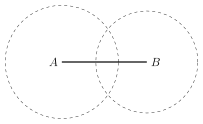
- Draw a line of the length of the largest number, say \(c\), then since \(c < a+b\) we must have circles radius \(a\) and \(b\) at the endpoints cross, and at their intersection we have a vertex of a \(c\)-\(a\)-\(b\) triangle.
- (A) always. Suppose \(c\) is the longest side, then \(c < a+b \Rightarrow c+1 < a + 1 + b+1\) so \((a+1,b+1,c+1)\) are still sides of a triangle. (B) sometimes, but not always. \((1,1,1) \to (1,1,1)\) is still a triangle, but \((10, 10, 1) \to (1, 10, \frac{1}{10})\) is not a triangle since \(10 > 1 + \frac{1}{10}\) (C) never, suppose \(a \leq b \leq c\) then the sides are \(b-a, c-b, c-a\) but \(c-a = (c-b)+(b-a)\) so the triangle inequality cannot be satisfied. (D) always - without loss of generality let \(c\) be the longest side, and since every term is homogeneous degree \(2\) we can divide through by \(c^2\) to see we have the sides \(a^2+b, b^2+a, 1+ab\) and note that \(1 + ab < a+b +ab < a+b+a^2+b^2\), also \(a^2+b < 1 + b < 1 + (a+b)b = 1 + b^2 + ab < (1+ab)+(b^2+a)\).
- Suppose \(f\) is increasing and \(\f(x)/x\) is decreasing, and suppose \(a,b,c\) are side-lengths of a triangle. Wlog \(c\) is the longest side, then note \(f(c) > f(b), f(a)\), so it suffices to prove that \(f(c) < f(a)+f(b)\) \begin{align*} \frac{f(c)}{c} < \frac{f(a)}{a}: && f(a) &> \frac{a}{c} f(c) \\ \frac{f(c)}{c} < \frac{f(b)}{b}: && f(b) &> \frac{b}{c} f(c) \\ \Rightarrow && f(a)+f(b) &> f(c) \underbrace{\left ( \frac{a+b}{c} \right)}_{>1} \\ &&&> f(c) \end{align*} as required
2020 Paper 2 Q5
If \(x\) is a positive integer, the value of the function \(\mathrm{d}(x)\) is the sum of the digits of \(x\) in base 10. For example, \(\mathrm{d}(249) = 2 + 4 + 9 = 15\). An \(n\)-digit positive integer \(x\) is written in the form \(\displaystyle\sum_{r=0}^{n-1} a_r \times 10^r\), where \(0 \leqslant a_r \leqslant 9\) for all \(0 \leqslant r \leqslant n-1\) and \(a_{n-1} > 0\).
- Prove that \(x - \mathrm{d}(x)\) is non-negative and divisible by \(9\).
- Prove that \(x - 44\mathrm{d}(x)\) is a multiple of \(9\) if and only if \(x\) is a multiple of \(9\). Suppose that \(x = 44\mathrm{d}(x)\). Show that if \(x\) has \(n\) digits, then \(x \leqslant 396n\) and \(x \geqslant 10^{n-1}\), and hence that \(n \leqslant 4\). Find a value of \(x\) for which \(x = 44\mathrm{d}(x)\). Show that there are no further values of \(x\) satisfying this equation.
- Find a value of \(x\) for which \(x = 107\mathrm{d}\left(\mathrm{d}(x)\right)\). Show that there are no further values of \(x\) satisfying this equation.
2020 Paper 2 Q6
A \(2 \times 2\) matrix \(\mathbf{M}\) is real if it can be written as \(\mathbf{M} = \begin{pmatrix} a & b \\ c & d \end{pmatrix}\), where \(a\), \(b\), \(c\) and \(d\) are real. In this case, the \emph{trace} of matrix \(\mathbf{M}\) is defined to be \(\mathrm{tr}(\mathbf{M}) = a + d\) and \(\det(\mathbf{M})\) is the determinant of matrix \(\mathbf{M}\). In this question, \(\mathbf{M}\) is a real \(2 \times 2\) matrix.
- Prove that \[\mathrm{tr}(\mathbf{M}^2) = \mathrm{tr}(\mathbf{M})^2 - 2\det(\mathbf{M}).\]
- Prove that \[\mathbf{M}^2 = \mathbf{I} \text{ but } \mathbf{M} \neq \pm\mathbf{I} \iff \mathrm{tr}(\mathbf{M}) = 0 \text{ and } \det(\mathbf{M}) = -1,\] and that \[\mathbf{M}^2 = -\mathbf{I} \iff \mathrm{tr}(\mathbf{M}) = 0 \text{ and } \det(\mathbf{M}) = 1.\]
- Use part (ii) to prove that \[\mathbf{M}^4 = \mathbf{I} \iff \mathbf{M}^2 = \pm\mathbf{I}.\] Find a necessary and sufficient condition on \(\det(\mathbf{M})\) and \(\mathrm{tr}(\mathbf{M})\) so that \(\mathbf{M}^4 = -\mathbf{I}\).
- Give an example of a matrix \(\mathbf{M}\) for which \(\mathbf{M}^8 = \mathbf{I}\), but which does not represent a rotation or reflection. [Note that the matrices \(\pm\mathbf{I}\) are both rotations.]
2020 Paper 2 Q7
In this question, \(w = \dfrac{2}{z-2}\).
- Let \(z\) be the complex number \(3 + t\mathrm{i}\), where \(t \in \mathbb{R}\). Show that \(|w - 1|\) is independent of \(t\). Hence show that, if \(z\) is a complex number on the line \(\operatorname{Re}(z) = 3\) in the Argand diagram, then \(w\) lies on a circle in the Argand diagram with centre \(1\). Let \(V\) be the line \(\operatorname{Re}(z) = p\), where \(p\) is a real constant not equal to \(2\). Show that, if \(z\) lies on \(V\), then \(w\) lies on a circle whose centre and radius you should give in terms of \(p\). For which \(z\) on \(V\) is \(\operatorname{Im}(w) > 0\)?
- Let \(H\) be the line \(\operatorname{Im}(z) = q\), where \(q\) is a non-zero real constant. Show that, if \(z\) lies on \(H\), then \(w\) lies on a circle whose centre and radius you should give in terms of \(q\). For which \(z\) on \(H\) is \(\operatorname{Re}(w) > 0\)?
2020 Paper 2 Q8
In this question, \(\mathrm{f}(x)\) is a quartic polynomial where the coefficient of \(x^4\) is equal to \(1\), and which has four real roots, \(0\), \(a\), \(b\) and \(c\), where \(0 < a < b < c\). \(\mathrm{F}(x)\) is defined by \(\mathrm{F}(x) = \displaystyle\int_0^x \mathrm{f}(t)\,\mathrm{d}t\). The area enclosed by the curve \(y = \mathrm{f}(x)\) and the \(x\)-axis between \(0\) and \(a\) is equal to that between \(b\) and \(c\), and half that between \(a\) and \(b\).
- Sketch the curve \(y = \mathrm{F}(x)\), showing the \(x\) co-ordinates of its turning points. Explain why \(\mathrm{F}(x)\) must have the form \(\mathrm{F}(x) = \frac{1}{5}x^2(x-c)^2(x-h)\), where \(0 < h < c\). Find, in factorised form, an expression for \(\mathrm{F}(x) + \mathrm{F}(c-x)\) in terms of \(c\), \(h\) and \(x\).
- If \(0 \leqslant x \leqslant c\), explain why \(\mathrm{F}(b) + \mathrm{F}(x) \geqslant 0\) and why \(\mathrm{F}(b) + \mathrm{F}(x) > 0\) if \(x \neq a\). Hence show that \(c - b = a\) or \(c > 2h\). By considering also \(\mathrm{F}(a) + \mathrm{F}(x)\), show that \(c = a + b\) and that \(c = 2h\).
- Find an expression for \(\mathrm{f}(x)\) in terms of \(c\) and \(x\) only. Show that the points of inflection on \(y = \mathrm{f}(x)\) lie on the \(x\)-axis.
2020 Paper 2 Q9
Point \(A\) is a distance \(h\) above ground level and point \(N\) is directly below \(A\) at ground level. Point \(B\) is also at ground level, a distance \(d\) horizontally from \(N\). The angle of elevation of \(A\) from \(B\) is \(\beta\). A particle is projected horizontally from \(A\), with initial speed \(V\). A second particle is projected from \(B\) with speed \(U\) at an acute angle \(\theta\) above the horizontal. The horizontal components of the velocities of the two particles are in opposite directions. The two particles are projected simultaneously, in the vertical plane through \(A\), \(N\) and \(B\). Given that the two particles collide, show that \[d\sin\theta - h\cos\theta = \frac{Vh}{U}\] and also that
- \(\theta > \beta\);
- \(U\sin\theta \geqslant \sqrt{\dfrac{gh}{2}}\);
- \(\dfrac{U}{V} > \sin\beta\).
2020 Paper 2 Q10
A particle \(P\) of mass \(m\) moves freely and without friction on a wire circle of radius \(a\), whose axis is horizontal. The highest point of the circle is \(H\), the lowest point of the circle is \(L\) and angle \(PHL = \theta\). A light spring of modulus of elasticity \(\lambda\) is attached to \(P\) and to \(H\). The natural length of the spring is \(l\), which is less than the diameter of the circle.
- Show that, if there is an equilibrium position of the particle at \(\theta = \alpha\), where \(\alpha > 0\), then \(\cos\alpha = \dfrac{\lambda l}{2(a\lambda - mgl)}\). Show also that there will only be such an equilibrium position if \(\lambda > \dfrac{2mgl}{2a - l}\). When the particle is at the lowest point \(L\) of the circular wire, it has speed \(u\).
- Show that, if the particle comes to rest before reaching \(H\), it does so when \(\theta = \beta\), where \(\cos\beta\) satisfies \[(\cos\alpha - \cos\beta)^2 = (1 - \cos\alpha)^2 + \frac{mu^2}{2a\lambda}\cos\alpha,\] where \(\cos\alpha = \dfrac{\lambda l}{2(a\lambda - mgl)}\). Show also that this will only occur if \(u^2 < \dfrac{2a\lambda}{m}(2 - \sec\alpha)\).
2020 Paper 2 Q11
A coin is tossed repeatedly. The probability that a head appears is \(p\) and the probability that a tail appears is \(q = 1 - p\).
- A and B play a game. The game ends if two successive heads appear, in which case A wins, or if two successive tails appear, in which case B wins. Show that the probability that the game never ends is \(0\). Given that the first toss is a head, show that the probability that A wins is \(\dfrac{p}{1 - pq}\). Find and simplify an expression for the probability that A wins.
- A and B play another game. The game ends if three successive heads appear, in which case A wins, or if three successive tails appear, in which case B wins. Show that \[\mathrm{P}(\text{A wins} \mid \text{the first toss is a head}) = p^2 + (q + pq)\,\mathrm{P}(\text{A wins} \mid \text{the first toss is a tail})\] and give a similar result for \(\mathrm{P}(\text{A wins} \mid \text{the first toss is a tail})\). Show that \[\mathrm{P}(\text{A wins}) = \frac{p^2(1-q^3)}{1-(1-p^2)(1-q^2)}.\]
- A and B play a third game. The game ends if \(a\) successive heads appear, in which case A wins, or if \(b\) successive tails appear, in which case B wins, where \(a\) and \(b\) are integers greater than \(1\). Find the probability that A wins this game. Verify that your result agrees with part (i) when \(a = b = 2\).
2020 Paper 2 Q12
The score shown on a biased \(n\)-sided die is represented by the random variable \(X\) which has distribution \(\mathrm{P}(X = i) = \dfrac{1}{n} + \varepsilon_i\) for \(i = 1, 2, \ldots, n\), where not all the \(\varepsilon_i\) are equal to \(0\).
- Find the probability that, when the die is rolled twice, the same score is shown on both rolls. Hence determine whether it is more likely for a fair die or a biased die to show the same score on two successive rolls.
- Use part (i) to prove that, for any set of \(n\) positive numbers \(x_i\) (\(i = 1, 2, \ldots, n\)), \[\sum_{i=2}^{n}\sum_{j=1}^{i-1} x_i x_j \leqslant \frac{n-1}{2n}\left(\sum_{i=1}^{n} x_i\right)^2.\]
- Determine, with justification, whether it is more likely for a fair die or a biased die to show the same score on three successive rolls.
2020 Paper 3 Q1
For non-negative integers \(a\) and \(b\), let \[ \mathrm{I}(a,b) = \int_0^{\frac{\pi}{2}} \cos^a x \cos bx \; \mathrm{d}x. \]
- Show that for positive integers \(a\) and \(b\), \[ \mathrm{I}(a,b) = \frac{a}{a+b} \, \mathrm{I}(a-1, b-1). \]
- Prove by induction on \(n\) that for non-negative integers \(n\) and \(m\), \[ \int_0^{\frac{\pi}{2}} \cos^n x \cos(n+2m+1)x \; \mathrm{d}x = (-1)^m \frac{2^n \, n! \, (2m)! \, (n+m)!}{m! \, (2n+2m+1)!}. \]
2020 Paper 3 Q2
The curve \(C\) has equation \(\sinh x + \sinh y = 2k\), where \(k\) is a positive constant.
- Show that the curve \(C\) has no stationary points and that \(\dfrac{\mathrm{d}^2 y}{\mathrm{d}x^2} = 0\) at the point \((x,y)\) on the curve if and only if \[ 1 + \sinh x \sinh y = 0. \] Find the co-ordinates of the points of inflection on the curve \(C\), leaving your answers in terms of inverse hyperbolic functions.
- Show that if \((x,y)\) lies on the curve \(C\) and on the line \(x + y = a\), then \[ \mathrm{e}^{2x}(1 - \mathrm{e}^{-a}) - 4k\mathrm{e}^x + (\mathrm{e}^a - 1) = 0 \] and deduce that \(1 < \cosh a \leqslant 2k^2 + 1\).
- Sketch the curve \(C\).
2020 Paper 3 Q3
Given distinct points \(A\) and \(B\) in the complex plane, the point \(G_{AB}\) is defined to be the centroid of the triangle \(ABK\), where the point \(K\) is the image of \(B\) under rotation about \(A\) through a clockwise angle of \(\frac{1}{3}\pi\). Note: if the points \(P\), \(Q\) and \(R\) are represented in the complex plane by \(p\), \(q\) and \(r\), the centroid of triangle \(PQR\) is defined to be the point represented by \(\frac{1}{3}(p+q+r)\).
- If \(A\), \(B\) and \(G_{AB}\) are represented in the complex plane by \(a\), \(b\) and \(g_{ab}\), show that \[ g_{ab} = \frac{1}{\sqrt{3}}(\omega a + \omega^* b), \] where \(\omega = \mathrm{e}^{\frac{\mathrm{i}\pi}{6}}\).
- The quadrilateral \(Q_1\) has vertices \(A\), \(B\), \(C\) and \(D\), in that order, and the quadrilateral \(Q_2\) has vertices \(G_{AB}\), \(G_{BC}\), \(G_{CD}\) and \(G_{DA}\), in that order. Using the result in part (i), show that \(Q_1\) is a parallelogram if and only if \(Q_2\) is a parallelogram.
- The triangle \(T_1\) has vertices \(A\), \(B\) and \(C\) and the triangle \(T_2\) has vertices \(G_{AB}\), \(G_{BC}\) and \(G_{CA}\). Using the result in part (i), show that \(T_2\) is always an equilateral triangle.
Solution:
- Note that the vector \(\overrightarrow{AB}\) is \(b-a\), and if we rotate this by \(\frac13\pi\) we get \(e^{-i\pi/3}(b-a)\) after rotating it. Therefore the point \(K\) is represented by \(a + e^{-i\pi/3}(b-a)\) and so \(G_{AB}\) is \begin{align*} && g_{ab} &= \tfrac13(a + b + a + e^{-i\pi/3}(b-a)) \\ &&&= \tfrac13((1+ e^{-i\pi/3})b+(2-e^{-i\pi/3})a)\\ &&&= \tfrac13((1+\tfrac12 - \tfrac{\sqrt3}{2}i)b + ((2-\tfrac12+\tfrac{\sqrt3}{2}i)a) \\ &&&= \tfrac13((\tfrac32 - \tfrac{\sqrt3}{2}i)b + ((\tfrac32+\tfrac{\sqrt3}{2}i)a) \\ &&&= \tfrac1{\sqrt3}((\tfrac{\sqrt3}2 - \tfrac{1}{2}i)b + ((\tfrac{\sqrt3}2+\tfrac{1}{2}i)a) \\ &&&= \frac{1}{\sqrt3}(\omega^* b + \omega a) \end{align*}
- First note that \(Q_1\) is a parallelogram iff \(c - a = (b-a) + (d-a)\) ie \(a + c = b+d\) (indeed this is true for all quadrilaterals), so. \begin{align*} && Q_1 &\text{ is a parallelogram} \\ \Longleftrightarrow && a + b &= c + d \\ \Longleftrightarrow && \frac{1}{\sqrt{3}}(\omega - \omega^*)(a + c) &= \frac{1}{\sqrt{3}}(\omega -\omega^*)(b + d) \\ \Longleftrightarrow && \frac{1}{\sqrt{3}}(\omega a + \omega^*b)+\frac{1}{\sqrt{3}}(\omega c + \omega^*d) &=\frac{1}{\sqrt{3}}(\omega b + \omega^*c)+\frac{1}{\sqrt{3}}(\omega d + \omega^*a) \\ \Longleftrightarrow && g_{ab}+g_{cd} &=g_{bc}+g_{da} \\ \Longleftrightarrow && Q_2 &\text{ is a parallelogram} \\ \end{align*}
- We consider \(\frac{g_{ab}-g_{bc}}{g_{ca}-g_{bc}}\) so \begin{align*} && \frac{g_{ab}-g_{bc}}{g_{ca}-g_{bc}} &= \frac{(\omega a + \omega^*b)-(\omega b + \omega^* c)}{(\omega c + \omega^*a)-(\omega b + \omega^* c)} \\ &&&= \frac{\omega a- \omega^* c -(\omega- \omega^*)b }{\omega^*a-\omega b -(\omega^* -\omega )c} \\ &&&= \frac{\omega^2 a- c -(\omega^2- 1)b }{a-\omega^2 b -(1 -\omega^2 )c} \\ &&&=\omega^2\frac{ a- \omega^4 c -(1- \omega^4)b }{a-\omega^2 b -(1 -\omega^2 )c} \\ &&&=\omega^2\frac{ a- (1-\omega^2) c -\omega^2b }{a-\omega^2 b -(1 -\omega^2 )c} \\ &&&= \omega^2 \end{align*} Therefore the triangle is equilateral.