Problems
Filters
142 problems found
1995 Paper 1 Q2
- Suppose that \[ S=\int\frac{\cos x}{\cos x+\sin x}\,\mathrm{d}x\quad\mbox{ and }\quad T=\int\frac{\sin x}{\cos x+\sin x}\,\mathrm{d}x. \] By considering \(S+T\) and \(S-T\) determine \(S\) and \(T\).
- Evaluate \({\displaystyle \int_{\frac{1}{4}}^{\frac{1}{2}}(1-4x)\sqrt{\frac{1}{x}-1}\,\mathrm{d}x}\) by using the substitution \(x=\sin^{2}t.\)
Solution:
- \begin{align*} && S + T &= \int \frac{\cos x + \sin x }{\cos x + \sin x} \d x \\ &&&= \int \d x \\ &&&= x + C \\ && S - T &= \int \frac{\cos x - \sin x}{\cos x + \sin x} \d x \\ &&&= \ln( \cos x + \sin x) + C \\ \Rightarrow && 2S &= x + \ln(\cos x + \sin x) + C \\ \Rightarrow && S &= \frac12 \left ( x + \ln(\cos x + \sin x) \right) + C \\ \Rightarrow && 2T &= x - \ln(\cos x + \sin x) + C \\ \Rightarrow && T &= \frac12 \left ( x - \ln(\cos x + \sin x) \right) + C \end{align*}
- \begin{align*} && I &= \int_{1/4}^{1/2} (1-4x)\sqrt{\frac1x-1} \d x \\ x = \sin^2 t, \d x = 2 \sin t \cos t \d t: &&&= \int_{\pi/6}^{\pi/4} (1-4\sin^2 t) \sqrt{\frac{1-\sin^2 t}{\sin^2 t}} 2 \sin t \cos t \d t\\ &&&=\int_{\pi/6}^{\pi/4} (1-4\sin^2 t)\frac{\cos t}{\sin t} 2 \sin t \cos t \d t \\ &&&= \int_{\pi/6}^{\pi/4} (1-4\sin^2 t) 2 \cos^2 t \d t \\ &&&= \int_{\pi/6}^{\pi/4} \left ( 2\cos^2t - 8 \sin^2t \cos^2 t \right) \d t \\ &&&= \int_{\pi/6}^{\pi/4} \left ( 1+\cos2t - 2 \sin^2 2t \right) \d t \\ &&&= \int_{\pi/6}^{\pi/4} \left ( 1+\cos2t +(\cos 4t-1)\right) \d t \\ &&&= \left[\frac12 \sin 2t + \frac14 \sin 4t \right]_{\pi/6}^{\pi/4} \\ &&&= \left ( \frac12 \right) - \left (\frac12 \frac{\sqrt{3}}{2} + \frac14 \frac{\sqrt{3}}{2} \right) \\ &&&= \frac{4-3\sqrt{3}}{8} \end{align*}
1995 Paper 2 Q4
Let \[ u_{n}=\int_{0}^{\frac{1}{2}\pi}\sin^{n}t\,\mathrm{d}t \] for each integer \(n\geqslant0\). By integrating \[ \int_{0}^{\frac{1}{2}\pi}\sin t\sin^{n-1}t\,\mathrm{d}t \] by parts, or otherwise, obtain a formula connecting \(u_{n}\) and \(u_{n-2}\) when \(n\geqslant2\) and deduce that \[ nu_{n}u_{n-1}=\left(n-1\right)u_{n-1}u_{n-2} \] for all \(n\geqslant2\). Deduce that \[ nu_{n}u_{n-1}=\tfrac{1}{2}\pi. \] Sketch graphs of \(\sin^{n}t\) and \(\sin^{n-1}t\), for \(0\leqslant t\leqslant\frac{1}{2}\pi,\) on the same diagram and explain why \(0 < u_{n} < u_{n-1}.\) By using the result of the previous paragraph show that \[ nu_{n}^{2} < \tfrac{1}{2}\pi < nu_{n-1}^{2} \] for all \(n\geqslant1\). Hence show that \[ \left(\frac{n}{n+1}\right)\tfrac{1}{2}\pi < nu_{n}^{2} < \tfrac{1}{2}\pi \] and deduce that \(nu_{n}^{2}\rightarrow\tfrac{1}{2}\pi\) as \(n\rightarrow\infty\).
Solution: \begin{align*} && u_n &= \int_0^{\tfrac12 \pi} \sin^{n} t \, \d t \\ && &= \int_0^{\tfrac12 \pi} \sin t \sin^{n-1} t \, \d t \\ && &= \left [ -\cos t \sin^{n-1} t \right]_0^{\tfrac12 \pi} + \int_0^{\tfrac12 \pi} \cos t (n-1) \sin^{n-2} t \cos t \d t \\ && &= 0 + (n-1)\int_0^{\tfrac12 \pi} \cos^2 t \sin^{n-2} t \d t \\ && &= (n-1) \int_0^{\tfrac12 \pi}(1-\sin^2 t) \sin^{n-2} t \d t \\ && &= (n-1)u_{n-2} - (n-1)u_n \\ \Rightarrow && n u_n &= (n-1)u_{n-2} \\ \end{align*} Mutplying both sides by \(u_{n-1}\) we obtain \(nu_{n}u_{n-1}=\left(n-1\right)u_{n-1}u_{n-2}\). Therefore \(nu_nu_{n-1}\) is constant, ie is equal to \(\displaystyle u_1u_0 = \int_0^{\tfrac12 \pi} \sin^{1} t \, \d t \int_0^{\tfrac12 \pi} \sin^{0} t \, \d t = 1 \cdot \frac{\pi}{2} = \frac{\pi}{2}\)

1994 Paper 1 Q8
By means of the change of variable \(\theta=\frac{1}{4}\pi-\phi,\) or otherwise, show that \[ \int_{0}^{\frac{1}{4}\pi}\ln(1+\tan\theta)\,\mathrm{d}\theta=\tfrac{1}{8}\pi\ln2. \] Evaluate \[ {\displaystyle \int_{0}^{1}\frac{\ln(1+x)}{1+x^{2}}\,\mathrm{d}x}\qquad\mbox{ and }\qquad{\displaystyle \int_{0}^{\frac{1}{2}\pi}\ln\left(\frac{1+\sin x}{1+\cos x}\right)\,\mathrm{d}x}. \]
Solution: \begin{align*} && I &= \int_0^{\frac14\pi} \ln (1 + \tan \theta) \d \theta \\ \theta = \tfrac14\pi - \phi, \d \theta = -\d\phi: &&&= \int_0^{\frac14 \pi} \ln ( 1 + \tan (\tfrac14\pi - \phi)) \d \phi \\ &&&= \int_0^{\frac14 \pi} \ln \left ( 1 + \frac{1 - \tan \phi}{1+\tan \phi} \right) \d \phi \\ &&&= \int_0^{\frac14 \pi} \ln \left ( \frac{2}{1+\tan \phi} \right) \d \phi \\ &&&= \tfrac14 \pi \ln 2 - I \\ \Rightarrow && I &= \tfrac18\pi \ln 2 \end{align*} \begin{align*} && J &= \int_0^1 \frac{\ln(1+x)}{1+x^2} \d x \\ x= \tan \theta \d \theta, \d \theta = \frac{\d x}{1+x^2} &&&= \int_0^{\frac14 \pi} \ln(1 + \tan \theta) \d \theta \\ &&&= \tfrac18 \pi \ln 2 \end{align*} \begin{align*} && K &= \int_0^{\frac12 \pi} \ln \left ( \frac{1 + \sin x}{1 + \cos x} \right) \d x \\ y = \tfrac12\pi - x, \d y = -\d x: &&&= \int_0^{\frac12\pi} \ln \left ( \frac{1+\cos y}{1+\sin y}\right) \d y \\ &&&= -K \\ \Rightarrow && K &= 0 \end{align*}
1994 Paper 1 Q9
A cannon-ball is fired from a cannon at an initial speed \(u\). After time \(t\) it has reached height \(h\) and is at a distance \(\sqrt{x^{2}+h^{2}}\) from the cannon. Ignoring air resistance, show that \[ \tfrac{1}{4}g^{2}t^{4}-(u^{2}-gh)t^{2}+h^{2}+x^{2}=0. \] Hence show that if \(u^{2}>2gh\) then the horizontal range for a given height \(h\) and initial speed \(u\) is less than or equal to \[ \frac{u\sqrt{u^{2}-2gh}}{g}. \] Show that there is always an angle of firing for which this value is attained.
Solution: Suppose it is fired with angle to the horizontal \(\alpha\), then \begin{align*} \rightarrow: && x &= u\cos \alpha \cdot t \\ \uparrow: && h &= u \sin \alpha \cdot t - \frac12 g t^2 \\ \Rightarrow && u\cos \alpha &= \frac{x}{t} \\ && u \sin \alpha &= \frac{h + \frac12 gt^2}{t} \\ \Rightarrow && u^2 &= \frac{x^2}{t^2} + \frac{(h + \frac12 gt^2)^2}{t^2} \\ \Rightarrow && 0 &= x^2+h^2-u^2t^2+ght^2+\tfrac14 g^2 t^4 \\ &&&= \tfrac14 g^2 t^4 - (u^2 - gh)t^2 + h^2 + x^2 \end{align*} For a distance \(x\) to be achievable there must be a root to this quadratic in \(t^2\), ie \begin{align*} && 0 &\leq \Delta = (u^2-gh)^2 - 4 \cdot \tfrac14 g^2 (h^2 + x^2) \\ \Rightarrow && x^2 &\leq \frac{(u^2-gh)^2}{g^2} - h^2 \\ &&&= \frac{u^4+g^2h^2 - 2ghu^2-g^2h^2}{g^2} \\ &&&= \frac{u^2(u^2-2gh)}{g^2} \\ \Rightarrow && x &\leq \frac{u\sqrt{u^2-2gh}}{g} \end{align*} This is achieved when \begin{align*} && t^2 &= \frac{u^2-gh}{\tfrac12g^2}\\ &&&= \frac{2(u^2-gh)}{g^2} \\ \Rightarrow && \cos \alpha &= \frac{u\sqrt{u^2-2gh}}{g} \cdot \frac{g}{\sqrt{2(u^2-gh)}} \frac{1}{u} \\ &&&= \frac{1}{\sqrt{2}} \end{align*} ie when \(\alpha = \frac{\pi}{4}\)
1994 Paper 2 Q3
The function \(\mathrm{f}\) satisfies \(\mathrm{f}(0)=1\) and \[ \mathrm{f}(x-y)=\mathrm{f}(x)\mathrm{f}(y)-\mathrm{f}(a-x)\mathrm{f}(a+y) \] for some fixed number \(a\) and all \(x\) and \(y\). Without making any further assumptions about the nature of the function show that \(\mathrm{f}(a)=0\). Show that, for all \(t\),
- \(\mathrm{f}(t)=\mathrm{f}(-t)\),
- \(\mathrm{f}(2a)=-1\),
- \(\mathrm{f}(2a-t)=-\mathrm{f}(t)\),
- \(\mathrm{f}(4a+t)=\mathrm{f}(t)\).
Solution: Let \(P(x,y)\) be the statement that the functional equation holds, then: \begin{align*} P(0,0): && f(0) &= f(0)f(0)-f(a)f(a) \\ \Rightarrow && 1 &= 1 - f(a)^2 \\ \Rightarrow && f(a)^2 &= 0 \\ \Rightarrow && f(a) &= 0 \end{align*}
- \begin{align*} P(0,t): && f(-t) &= f(0)f(t) - f(a)f(a-t) \\ \Rightarrow && f(-t) &= f(t) - 0 \\ \Rightarrow && f(t) &= f(-t) \end{align*}
- \begin{align*} P(a,a): && f(0) &= f(a)f(a)-f(0)f(2a) \\ \Rightarrow && 1 &= 0 - f(2a) \\ \Rightarrow && f(2a) &= -1 \end{align*}
- \begin{align*} P(2a,t): && f(2a-t) &= f(2a)f(t) - f(-a)f(a+t) \\ \Rightarrow && f(2a-t) &= -f(t)-f(a)f(a+t) \\ &&&= -f(t)-0 \\ \Rightarrow && f(2a-t) &= -f(t) \end{align*}
- \begin{align*} && f(4a+t) &= f(2a-(-2a-t)) \\ &&&=-f(2a+t) \\ &&&=-f(2a-(-t)) \\ &&&=f(-t) \\ &&&=f(t) \end{align*}
1993 Paper 1 Q4
By making the change of variable \(t=\pi-x\) in the integral \[ \int_{0}^{\pi}x\mathrm{f}(\sin x)\,\mathrm{d}x, \] or otherwise, show that, for any function \(\mathrm{f},\) \[ \int_{0}^{\pi}x\mathrm{f}(\sin x)\,\mathrm{d}x=\frac{\pi}{2}\int_{0}^{\pi}\mathrm{f}(\sin x)\,\mathrm{d}x\,. \] Evaluate \[ \int_{0}^{\pi}\frac{x\sin x}{1+\cos^{2}x}\,\mathrm{d}x\quad\mbox{ and }\quad\int_{0}^{2\pi}\frac{x\sin x}{1+\cos^{2}x}\,\mathrm{d}x\,. \]
Solution: \begin{align*} && I &= \int_0^{\pi} x f(\sin x) \d x \\ t = \pi - x, \d t = -\d t : &&&= \int_{t = \pi}^{t = 0} (\pi - t) f(\sin (\pi - t)) -\d t \\ &&&= \int_0^{\pi} (\pi - t) f(\sin t) \d t \\ \Rightarrow && 2 I &= \pi \int_0^\pi f(\sin t) \d t \\ \Rightarrow && I &= \frac{\pi}{2} \int_0^{\pi} f(\sin x) \d x \end{align*} \begin{align*} && I &= \int_{0}^{\pi}\frac{x\sin x}{1+\cos^{2}x}\,\mathrm{d}x \\ &&&= \frac{\pi}{2}\int_0^\pi \frac{\sin x}{1 + \cos^2 x} \d x \\ &&&= \frac{\pi}{2}\left [ -\tan^{-1} \cos x\right]_0^{\pi} \\ &&&= \tan 1 - \tan (-1) = \frac{\pi^2}{4} \\ \\ && I &= \int_{0}^{2\pi}\frac{x\sin x}{1+\cos^{2}x}\,\mathrm{d}x \\ &&&= \int_{0}^{\pi}\frac{x\sin x}{1+\cos^{2}x}\,\mathrm{d}x + \int_{\pi}^{2\pi} \frac{x\sin x}{1+\cos^{2}x}\,\mathrm{d}x \\ u = x - \pi, \d u = \d x: &&&= \frac{\pi^2}{4} + \int_{0}^{\pi} \frac{(u+\pi)(-\sin u)}{1 + \cos^2 u}\d u \\ &&&= \frac{\pi^2}{4} -\frac{3\pi}{2} \int_0^{\pi} \frac{\sin u}{1+\cos^2 u} \d u \\ &&&= - \frac{\pi^2}2 \end{align*}
1993 Paper 1 Q6
Let \(N=10^{100}.\) The graph of \[ \mathrm{f}(x)=\frac{x^{N}}{1+x^{N}}+2 \] for \(-3\leqslant x\leqslant3\) is sketched in the following diagram. \noindent
1993 Paper 2 Q2
- Evaluate \[ \int_{0}^{2\pi}\cos(mx)\cos(nx)\,\mathrm{d}x, \] where \(m,n\) are integers, taking into account any special cases that arise.
- Find \({\displaystyle \int\sqrt{1+\frac{1}{x}}\,\mathrm{d}x}.\)
1992 Paper 1 Q3
Evaluate
- \({\displaystyle \int_{-\pi}^{\pi}\left|\sin x\right|\,\mathrm{d}x,}\)
- \({\displaystyle \int_{-\pi}^{\pi}\sin\left|x\right|\,\mathrm{d}x},\)
- \({\displaystyle \int_{-\pi}^{\pi}x\sin x\,\mathrm{d}x},\)
- \({\displaystyle \int_{-\pi}^{\pi}x^{10}\sin x\,\mathrm{d}x.}\)
Solution:
- \begin{align*} \int_{-\pi}^\pi |\sin x | \d x &= \int_{-\pi}^{0} - \sin x \d x + \int_0^\pi \sin x \d x \\ &= \left [\cos x \right]_{-\pi}^{0} +[-\cos x]_0^{\pi} \\ &= 1-(-1)+(1)-(-1) \\ &= 4 \end{align*}
- \begin{align*} \int_{-\pi}^\pi \sin | x | \d x &= \int_{-\pi}^0 - \sin x \d x + \int_0^\pi \sin x \d x \\ &= 4 \end{align*}
- \begin{align*} \int_{-\pi}^\pi x \sin x \d x &= \left [ -x \cos x \right]_{-\pi}^\pi + \int_{-\pi}^{\pi} \cos x \d x \\ &= \pi -(-\pi) + \left [\sin x \right]_{-\pi}^\pi \\ &= 2\pi \end{align*}
- \begin{align*} \int_{-\pi}^{\pi} x^{10} \sin x \d x &\underbrace{=}_{x^{10}\sin x \text{ is odd}} 0 \end{align*}
1992 Paper 2 Q1
Find the limit, as \(n\rightarrow\infty,\) of each of the following. You should explain your reasoning briefly. \begin{alignat*}{4} \mathbf{(i)\ \ } & \dfrac{n}{n+1}, & \qquad & \mathbf{(ii)\ \ } & \dfrac{5n+1}{n^{2}-3n+4}, & \qquad & \mathbf{(iii)\ \ } & \dfrac{\sin n}{n},\\ \\ \mathbf{(iv)\ \ } & \dfrac{\sin(1/n)}{(1/n)}, & & \mathbf{(v)}\ \ & (\arctan n)^{-1}, & & \mathbf{(vi)\ \ } & \dfrac{\sqrt{n+1}-\sqrt{n}}{\sqrt{n+2}-\sqrt{n}}. \end{alignat*}
Solution:
- \begin{align*} \lim_{n \to \infty} \frac{n}{n+1} &= \lim_{n \to \infty} \left (1 - \frac{1}{n+1} \right ) \\ &\underbrace{=}_{\text{sum of limits}} \lim_{n \to \infty} 1 - \lim_{n \to \infty} \frac{1}{n+1}\\ &= 1 \end{align*}
- \begin{align*} \lim_{n \to \infty} \frac{5n+1}{n^2-3n+4} &= \lim_{n \to \infty} \frac{5/n + 1/n^2}{1-3/n+ 4/n^2} \\ &\underbrace{=}_{\text{ratio of limits}} \frac{\displaystyle \lim_{n \to \infty}(5/n + 1/n^2)}{\displaystyle \lim_{n \to \infty}(1-3/n+ 4/n^2)} \\ &= \frac{0}{1} = 0 \end{align*}
- \begin{align*} && \lvert \frac{\sin n}{n} \rvert &\leq \frac{1}{n} \quad \quad (n \geq 1) \\ \Rightarrow && \lim_{n \to \infty} \lvert \frac{\sin n}{n} \rvert &\leq \lim_{n \to \infty}\frac{1}{n} \\ &&&= 0\\ \Rightarrow && \lim_{n \to \infty} \frac{\sin n}{n} &= 0 \end{align*}
- First note that \(\displaystyle \lim_{x \to 0} \frac{\sin x}{x} \to 1\), then \(\frac1n\) is a sequence converging to zero, therefore \(\frac{\sin 1/n}{1/n}\) also must tend to \(1\).
- Note that \(\lim_{x \to \infty} \tan^{-1} x = \frac{\pi}{2}\) and since \(n\) is a sequence tending to infinity we must have \(\lim_{n \to \infty} \tan^{-1} n = \frac{\pi}{2}\)
- \begin{align*} \lim_{n \to \infty} \dfrac{\sqrt{n+1}-\sqrt{n}}{\sqrt{n+2}-\sqrt{n}} &= \lim_{n \to \infty} \dfrac{\frac{1}{\sqrt{n+1}+\sqrt{n}}}{\frac{2}{\sqrt{n+2}+\sqrt{n}}} \\ &= \frac12 \lim_{n \to \infty} \dfrac{\sqrt{n+2}+\sqrt{n}}{\sqrt{n+1}+\sqrt{n}}\\ &= \frac12 \lim_{n \to \infty} \dfrac{\sqrt{1+2/n}+\sqrt{1}}{\sqrt{1+1/n}+\sqrt{1}}\\ &= \frac12 \end{align*}
1992 Paper 2 Q3
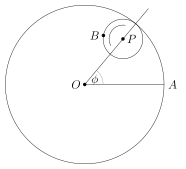
In the figure, the large circle with centre \(O\) has radius \(4\) and the small circle with centre \(P\) has radius \(1\). The small circle rolls around the inside of the larger one. When \(P\) was on the line \(OA\) (before the small circle began to roll), the point \(B\) was in contact with the point \(A\) on the large circle.
1992 Paper 2 Q6
Sketch the graphs of \(y=\sec x\) and \(y=\ln(2\sec x)\) for \(0\leqslant x\leqslant\frac{1}{2}\pi\). Show graphically that the equation \[ kx=\ln(2\sec x) \] has no solution with \(0\leqslant x<\frac{1}{2}\pi\) if \(k\) is a small positive number but two solutions if \(k\) is large. Explain why there is a number \(k_{0}\) such that \[ k_{0}x=\ln(2\sec x) \] has exactly one solution with \(0\leqslant x<\frac{1}{2}\pi\). Let \(x_{0}\) be this solution, so that \(0\leqslant x_{0}<\frac{1}{2}\pi\) and \(k_{0}x_{0}=\ln(2\sec x_0)\). Show that \[ x_{0}=\cot x_{0}\ln(2\sec x_{0}). \] Use any appropriate method to find \(x_{0}\) correct to two decimal places. Hence find an approximate value for \(k_{0}\).
Solution:

1992 Paper 2 Q8
Calculate the following integrals
- \({\displaystyle \int\frac{x}{(x-1)(x^{2}-1)}\,\mathrm{d}x}\);
- \({\displaystyle \int\frac{1}{3\cos x+4\sin x}\,\mathrm{d}x}\);
- \({\displaystyle \int\frac{1}{\sinh x}\,\mathrm{d}x}.\)
Solution:
- \begin{align*} \int\frac{x}{(x-1)(x^{2}-1)}\,\mathrm{d}x &= \int \frac{x}{(x-1)^2 (x+1)} \d x \\ &= \int \frac{1}{2(x-1)^2} + \frac{1}{4(x-1)} - \frac{1}{4(x+1)} \d x \\ &= -\frac12 (x-1)^{-1} + \frac14 \ln(x-1) - \frac14 \ln (x+1) + C \end{align*}
- \begin{align*} \int \frac{1}{3 \cos x + 4 \sin x } \d x &= \int \frac{1}{5 \cos (x - \cos^{-1}(3/5))} \d x \\ &= \frac15 \int \sec (x - \cos^{-1}(3/5)) \d x\\ &= \frac15 \left (\ln | \sec (x - \cos^{-1}(3/5)) + \tan (x - \cos^{-1}(3/5)) | \right) + C \end{align*}
- \begin{align*} \int \frac{1}{\sinh x} \d x &= \int \frac{2}{e^x - e^{-x}} \\ &= \int \frac{2e^x}{e^{2x}-1} \d x \\ &=\int \frac{e^x}{e^x-1} - \frac{e^x}{e^x+1} \d x \\ &= \ln (e^x - 1) + \ln (e^x+1) + C \end{align*}
1992 Paper 3 Q6
Given that \({\displaystyle I_{n}=\int_{0}^{\pi}\frac{x\sin^{2}(nx)}{\sin^{2}x}\,\mathrm{d}x,}\) where \(n\) is a positive integer, show that \(I_{n}-I_{n-1}=J_{n},\) where \[ J_{n}=\int_{0}^{\pi}\frac{x\sin(2n-1)x}{\sin x}\,\mathrm{d}x. \] Obtain also a reduction formula for \(J_{n}.\) The curve \(C\) is given by the cartesian equation \[ y=\dfrac{x\sin^{2}(nx)}{\sin^{2}x}, \] where \(n\) is a positive integer and \(0\leqslant x\leqslant\pi.\) Show that the area under the curve \(C\) is \(\frac{1}{2}n\pi^{2}.\)
Solution: \begin{align*} I_n - I_{n-1} &= \int_0^{\pi} \frac{x \sin^2(nx)}{\sin ^2 x} \d x-\int_0^{\pi} \frac{x \sin^2((n-1)x)}{\sin ^2 x} \d x \\ &= \int_0^{\pi} \frac{x}{\sin^2 x} \left ( \sin^2 (nx) - \sin^2((n-1)x) \right) \d x \\ &= \int_0^{\pi} \frac{x}{\sin^2 x}\frac12 \left ( \cos (2(n-1)x) - \cos(2nx) \right) \d x \\ &= \int_0^{\pi} \frac{x}{\sin^2 x}\frac12 2 \sin ((2n-1)x )\sin x \d x \\ &= \int_0^{\pi} \frac{x\sin ((2n-1)x )}{\sin x}d x \\ &= J_n \\ \\ J_{n+1} - J_{n} &= \int_0^{\pi} \frac{x \left (\sin ((2n+1)x )-\sin ((2n-1)x )\right)}{\sin x} \d x \\ &= \int_0^{\pi} \frac{x \left ( 2 \cos (\frac{4n x}{2}) \sin \frac{2x}{2} \right)}{\sin x} \d x \\ &= \int_0^{\pi}2x \cos (2n x) \d x \\ &= \left [ \frac{x}{2n} \sin (2n x) \right]_0^{\pi} - \int_0^{\pi} \frac{1}{2n} \sin (2n x) \d x \\ &= \left [ \frac{1}{4n^2} \cos (2n x)\right]_0^{\pi} \\ &= 0 \\ \\ J_1 &= \int_0^\pi x \d x \\ &= \frac{\pi^2}{2} \\ \Rightarrow J_n &= \frac{\pi^2}{2} \\ \end{align*} And so \(I_n = I_1 + (n-1) \frac{\pi^2}{2}\) and \(I_1 = \frac{\pi^2}{2}\) so \(I_n = \frac12 n \pi^2\). But \(I_n\) is exactly the area under the curve described.
1992 Paper 3 Q9
The straight line \(OSA,\) where \(O\) is the origin, bisects the angle between the positive \(x\) and \(y\) axes. The ellipse \(E\) has \(S\) as focus. In polar coordinates with \(S\) as pole and \(SA\) as the initial line, \(E\) has equation \(\ell=r(1+e\cos\theta).\) Show that, at the point on \(E\) given by \(\theta=\alpha,\) the gradient of the tangent to the ellipse is given by \[ \frac{\mathrm{d}y}{\mathrm{d}x}=\frac{\sin\alpha-\cos\alpha-e}{\sin\alpha+\cos\alpha+e}. \] The points on \(E\) given by \(\theta=\alpha\) and \(\theta=\beta\) are the ends of a diameter of \(E\). Show that \[ \tan(\alpha/2)\tan(\beta/2)=-\frac{1+e}{1-e}. \] [Hint. A diameter of an ellipse is a chord through its centre.]
Solution:
