Problems
Filters
219 problems found
2002 Paper 3 Q3
Let \[\f(x) = a \sqrt{x} - \sqrt{x - b}\;, \] where \(x\ge b >0\) and \(a>1\,\). Sketch the graph of \(\f(x)\,\). Hence show that the equation \(\f(x) = c\), where \(c>0\), has no solution when \(c^2 < b \l a^2 - 1 \r\,\). Find conditions on \(c^2\) in terms of \(a\) and \(b\) for the equation to have exactly one or exactly two solutions. Solve the equations
- \(3 \sqrt{x} - \sqrt{x - 2} = 4\, ,\)
- \(3 \sqrt{x} - \sqrt{x - 3} = 5\;\).
Solution: \begin{align*} && f'(x) &= \frac12 ax^{-1/2}-\frac12(x-b)^{-1/2} \\ \Rightarrow f'(x) = 0: && 0 &= \frac{a\sqrt{x-b}-\sqrt{x}}{\sqrt{x(x-b)}} \\ \Rightarrow && x &= a^2(x-b)\\ \Rightarrow && x &= \frac{a^2b}{a^2-1} \\ && f(x) &= a^2 \sqrt{\frac{b}{a^2-1}} - \sqrt{\frac{a^2b}{a^2-1}-b} \\ &&&= a^2 \sqrt{\frac{b}{a^2-1}} - \sqrt{\frac{b}{a^2-1}} \\ &&&= \sqrt{b(a^2-1)} \end{align*}

- \(c^2 = 16\), \(2 \cdot (3^2-1) = 16\), so we should have exactly one solution at \(x = \frac{3^2 \cdot 2}{3^2 -1 } = \frac{9}{4}\)
- \(c^2 = 25\) and \(3 \cdot (3^2 - 1) = 24, 3 \cdot (3^2) = 27\), so we look for two solutions. \begin{align*} && 5 & = 3 \sqrt{x} - \sqrt{x-3} \\ \Rightarrow && 25 &= 9x+x-3-6\sqrt{x(x-3)} \\ \Rightarrow && 3\sqrt{x(x-3)} &= 5x-14 \\ \Rightarrow && 9x(x-3) &= 25x^2-140x+196 \\ \Rightarrow && 0 &= 16x^2-113x+196 \\ &&&= (x-4)(16x-49) \\ \Rightarrow && x &= 4, \frac{49}{16} \end{align*}
2002 Paper 3 Q9
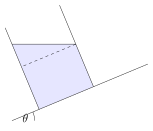
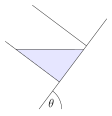
A tall container made of light material of negligible thickness has the form of a prism, with a square base of area \(a^2\). It contains a volume \(ka^3\) of fluid of uniform density. The container is held so that it stands on a rough plane, which is inclined at angle \(\theta\) to the horizontal, with two of the edges of the base of the container horizontal. In the case \(k > \frac12 \tan\theta\), show that the centre of mass of the fluid is at a distance \(x\) from the lower side of the container and at a distance \(y\) from the base of the container, where \[ \frac x a = \frac12 - \frac {\tan\theta}{12k}\;, \ \ \ \ \ \ \frac y a = \frac k 2 + \frac{\tan^2\theta}{24k}\;. \] Determine the corresponding coordinates in the case \(k < \frac12 \tan\theta\). The container is now released. Given that \(k < \frac12\), show that the container will topple if \(\theta >45^\circ\).
Solution:
2001 Paper 1 Q1
The points \(A\), \(B\) and \(C\) lie on the sides of a square of side 1 cm and no two points lie on the same side. Show that the length of at least one side of the triangle \(ABC\) must be less than or equal to \((\sqrt6 -\sqrt2)\) cm.
2001 Paper 1 Q6
A spherical loaf of bread is cut into parallel slices of equal thickness. Show that, after any number of the slices have been eaten, the area of crust remaining is proportional to the number of slices remaining. A European ruling decrees that a parallel-sliced spherical loaf can only be referred to as `crusty' if the ratio of volume \(V\) (in cubic metres) of bread remaining to area \(A\) (in square metres) of crust remaining after any number of slices have been eaten satisfies \(V/A<1\). Show that the radius of a crusty parallel-sliced spherical loaf must be less than \(2\frac23\) metres. [{\sl The area \(A\) and volume \(V\) formed by rotating a curve in the \(x\)--\(y\) plane round the \(x\)-axis from \(x=-a\) to \(x=-a+t\) are given by \[ A= 2\pi\int_{-a}^{-a+t} { y}\left( 1+ \Big(\frac{\d {y}}{\d x}\Big)^2\right)^{\frac12} \d x\;, \ \ \ \ \ \ \ \ \ \ \ V= \pi \int_{-a}^{-a+t} {y}^2 \d x \;. \ \ ] \] }
2001 Paper 1 Q9
A ship sails at \(20\) kilometres/hour in a straight line which is, at its closest, 1 kilometre from a port. A tug-boat with maximum speed 12 kilometres/hour leaves the port and intercepts the ship, leaving the port at the latest possible time for which the interception is still possible. How far does the tug-boat travel?
Solution: The position of the ship is \(\mathbf{s} = \binom{20t}{1}\). Suppose the interception is at \(T\), then the ship leaves at \(T-\frac1{12}\underbrace{\sqrt{400T^2+1}}_{\text{distance to intercept}}\). We wish to maximise this, ie \begin{align*} && \frac{\d}{\d T} \left ( T - \frac1{12}\sqrt{400T^2+1}\right) &= 1 - \frac{1}{12} \cdot \frac12 \cdot 400 \cdot 2T \cdot \left (400T^2+1 \right)^{-1/2} \\ &&&= 1 - \frac{100}3 T(400T^2+1)^{-1/2} \\ \Rightarrow && \frac{T}{\sqrt{400T^2+1}} &= \frac{3}{100} \\ \Rightarrow && \frac{T^2}{400T^2+1} &= \frac{9}{10000} \\ \Rightarrow && 10000T^2 &= 3600T^2+9 \\ \Rightarrow && 6400T^2 &= 9 \\ \Rightarrow && T &= \pm \frac{3}{80} \quad \text{(T > 0)} \end{align*} Therefore the distance is \(\sqrt{400 \frac{9}{6400} + 1} = \sqrt{\frac{9}{16}+1} = \frac{5}{4} = 1.25 \text{ km}\)
2001 Paper 1 Q10
A gun is sited on a horizontal plain and can fire shells in any direction and at any elevation at speed \(v\). The gun is a distance \(d\) from a straight railway line which crosses the plain, where \(v^2>gd\). The gunner aims to hit the line, choosing the direction and elevation so as to maximize the time of flight of the shell. Show that the time of flight, \(T\), of the shell satisfies \[ %\frac{2v}{g} \sin \left( \frac12 \arccos \frac{gd}{v^2}\right)\,. g^2 T^2 = 2 v^2 +2 \left(v^4 -g^2d^2\right)^{\frac12}\,. \] Extension: (Not in original paper) Find the time of flight if the gun is constrained so that the angle of elevation \(\alpha \) is not greater than \( 45^\circ\).
Solution: If we fire the gun at an angle to the track, as long as we can travel a horizontal distance \(\geq d\) we can hit the track. Suppose we am at an elevatation \(\alpha\), then \begin{align*} (\uparrow): && s &= ut + \frac12 at^2 \\ && 0 &= v\sin \alpha T - \frac12 g T^2 \\ \Rightarrow &&T &= \frac{2v\sin \alpha}{g}\\ \\ (\rightarrow): && s &= ut \\ && s &= v \cos \alpha T \\ &&&= v\sqrt{1-\sin^2 \alpha} T \\ &&&= vT\sqrt{1 - \frac{g^2T^2}{4v^2}}\\ &&&= \frac{T}{2}\sqrt{4v^2-g^2T^2}\\ \Rightarrow && d & \leq \frac{T}{2}\sqrt{4v^2-g^2T^2} \\ \Rightarrow && 4g^2d^2&\leq g^2T^2(4v^2-g^2T^2) \\ \Rightarrow && 0 &\leq -(g^2T^2)^2 + 4v^2 (g^2T^2)-4g^2d^2 \\ &&&=4v^4-4g^2d^2 -\left (g^2T^2-2v^2 \right)^2 \\ \Rightarrow && \left (g^2T^2-2v^2 \right)^2 & \leq 4v^4-4g^2d^2 \\ \Rightarrow && g^2T^2 &\leq 2v^2+2\sqrt{v^4-g^2d^2} \end{align*} Therefore the maximum value for \(g^2T^2\) is \(2v^2+2\sqrt{v^4-g^2d^2}\) Notice that we are hitting the track directly at \(d\). This is because to maximise the time of flight (for a fixed speed) we want to maximise the angle of elevation. Therefore we want the highest angle where we still hit the track (which is clearly the shortest distance). If we are constraint to \(\alpha \leq 45^\circ\) we know that \(T\) is maximised when \(\alpha = 45^\circ\) (and we will reach the track since the range \(\frac{v^2 \sin 2 \alpha}{g}\) is increasing). Therefore the maximum time is \(T = \frac{\sqrt{2}v}{g}\)
2001 Paper 1 Q11
A smooth cylinder with circular cross-section of radius \(a\) is held with its axis horizontal. A~light elastic band of unstretched length \(2\pi a\) and modulus of elasticity \(\lambda\) is wrapped round the circumference of the cylinder, so that it forms a circle in a plane perpendicular to the axis of the cylinder. A particle of mass \(m\) is then attached to the rubber band at its lowest point and released from rest.
- Given that the particle falls to a distance \(2a\) below the below the axis of the cylinder, but no further, show that \[ \lambda = \frac{9\pi m g}{(3\sqrt3-\pi)^2} \;. \]
- Given instead that the particle reaches its maximum speed at a distance \(2a\) below the axis of the cylinder, find a similar expression for \(\lambda\)\,.
2001 Paper 2 Q3
The cuboid \(ABCDEFGH\) is such \(AE\), \(BF\), \(CG\), \(DH\) are perpendicular to the opposite faces \(ABCD\) and \(EFGH\), and \(AB =2, BC=1, AE={\lambda}\). Show that if \(\alpha\) is the acute angle between the diagonals \(AG\) and \(BH\) then $$\cos {\alpha} = |\frac {3-{\lambda}^2} {5+{\lambda}^2} |$$ Let \(R\) be the ratio of the volume of the cuboid to its surface area. Show that \(R<\frac{1}{3}\) for all possible values of \(\lambda\). Prove that, if \(R\ge \frac{1}{4}\), then \(\alpha \le \arccos \frac{1}{9}\).
Solution:

2001 Paper 2 Q11
A two-stage missile is projected from a point \(A\) on the ground with horizontal and vertical velocity components \(u\) and \(v\), respectively. When it reaches the highest point of its trajectory an internal explosion causes it to break up into two fragments. Immediately after this explosion one of these fragments, \(P\), begins to move vertically upwards with speed \(v_e\), but retains the previous horizontal velocity. Show that \(P\) will hit the ground at a distance \(R\) from \(A\) given by $$ \frac{gR}u = v+v_e + \sqrt{v_e^2 +v^2}\, . $$ It is required that the range \(R\) should be greater than a certain distance \(D\) (where \(D> 2uv/g\)). Show that this requirement is satisfied if \[ v_e> \frac{gD}{2u}\left( \frac{gD-2uv}{gD-uv}\right). \] \noindent[{\sl The effect of air resistance is to be neglected.}]
2001 Paper 2 Q12
The national lottery of Ruritania is based on the positive integers from \(1\) to \(N\), where \(N\) is very large and fixed. Tickets cost \(\pounds1\) each. For each ticket purchased, the punter (i.e. the purchaser) chooses a number from \(1\) to \(N\). The winning number is chosen at random, and the jackpot is shared equally amongst those punters who chose the winning number. A syndicate decides to buy \(N\) tickets, choosing every number once to be sure of winning a share of the jackpot. The total number of tickets purchased in this draw is \(3.8N\) and the jackpot is \(\pounds W\). Assuming that the non-syndicate punters choose their numbers independently and at random, find the most probable number of winning tickets and show that the expected net loss of the syndicate is approximately \[ N\; - \; %\textstyle{ \frac{5 \big(1- e^{-2.8}\big)}{14} \;W\;. \]
2001 Paper 2 Q14
Two coins \(A\) and \(B\) are tossed together. \(A\) has probability \(p\) of showing a head, and \(B\) has probability \(2p\), independent of \(A\), of showing a head, where \(0 < p < \frac12\). The random variable \(X\) takes the value 1 if \(A\) shows a head and it takes the value \(0\) if \(A\) shows a tail. The random variable \(Y\) takes the value 1 if \(B\) shows a head and it takes the value \(0\) if \(B\) shows a tail. The random variable \(T\) is defined by \[ T= \lambda X + {\textstyle\frac12} (1-\lambda)Y. \] Show that \(\E(T)=p\) and find an expression for \(\var(T)\) in terms of \(p\) and \(\lambda\). Show that as \(\lambda\) varies, the minimum of \(\var(T)\) occurs when \[ \lambda =\frac{1-2p}{3-4p}\;. \] The two coins are tossed \(n\) times, where \(n>30\), and \(\overline{T}\) is the mean value of \(T\). Let \(b\) be a fixed positive number. Show that the maximum value of \(\P\big(\vert \overline{T}-p\vert < b\big)\) as \(\lambda\) varies is approximately \(2\Phi(b/s)-1\), where \(\Phi\) is the cumulative distribution function of a standard normal variate and \[ s^2= \frac{p(1-p)(1-2p)}{(3-4p)n}\;. \]
Solution: \begin{align*} && \E[T] &= \E[\lambda X + \tfrac12(1-\lambda)Y] \\ &&&= \lambda \E[X] + \tfrac12(1-\lambda) \E[Y] \\ &&&= \lambda p + \tfrac12 (1-\lambda) 2p \\ &&&= p \\ \\ && \var[T] &= \var[\lambda X + \tfrac12(1-\lambda)Y] \\ &&&= \lambda^2 \var[X] + \tfrac14(1-\lambda)^2 \var[Y] \\ &&&= \lambda^2 p(1-p) + \tfrac14(1-\lambda)^22p(1-2p) \\ &&&= p(\lambda^2 + \tfrac12(1-\lambda)^2) -p^2(\lambda^2+(1-\lambda)^2)\\ &&&= p(\tfrac32\lambda^2 - \lambda + \tfrac12) -p^2(2\lambda^2 -2\lambda + 2) \end{align*} Differentiating \(\var[T]\) with respect to \(\lambda\), and noting it is a quadratic with positive leading coefficient, we get \begin{align*} && \frac{\d \var[T]}{\d \lambda} &= p(2\lambda -(1-\lambda)) - p^2(2 \lambda -2(1-\lambda)) \\ &&&= p(3\lambda - 1)-p^2(4\lambda - 2) \\ \Rightarrow && \lambda(4p-3) &= 2p-1 \\ \Rightarrow && \lambda &= \frac{1-2p}{3-4p} \end{align*} By the central limit theorem \(\overline{T} \sim N(p, \frac{\sigma^2}{n})\) in particular, \(\mathbb{P}(|\overline{T} - p| < b) = \mathbb{P}(\left \lvert |\frac{\overline{T}-p}{\frac{\sigma}{\sqrt{n}}} \right \lvert < \frac{b}{\frac{\sigma}{\sqrt{n}}}) = \mathbb{P}(|Z| < \frac{b\sqrt{n}}{\sigma}) = 2\Phi(b/s) - 1\) where \(s = \frac{\sigma}{\sqrt{n}}\) so \begin{align*} && s^2 &= \frac1n \sigma^2 \\ &&&= \frac1n \left ( \left (\left ( \frac{1-2p}{3-4p} \right)^2 + \tfrac12 \left (1-\frac{1-2p}{3-4p} \right)^2 \right)p - \left ( \left ( \frac{1-2p}{3-4p} \right)^2 + \left (1-\frac{1-2p}{3-4p} \right)^2\right)p^2 \right) \\ &&&= \frac1n \left ( \left (\left ( \frac{1-2p}{3-4p} \right)^2 + \tfrac12 \left (\frac{2-2p}{3-4p} \right)^2 \right)p - \left ( \left ( \frac{1-2p}{3-4p} \right)^2 + \left (\frac{2-2p}{3-4p} \right)^2\right)p^2 \right) \\ &&&= \frac{p}{n(3-4p)^2} \left ( (1 -4p + 4p^2 + 2-4p+2p^2) - (1-4p+4p^2+4-8p+4p^2)p \right) \\ &&&= \frac{p}{n(3-4p)^2} \left (3-13p+18p^2-8p^3 \right) \\ &&&= \frac{p}{n(3-4p)^2} (3-4p)(1-2p)(1-p) \\ &&&= \frac{p(1-p)(1-2p)}{(3-4p)n} \end{align*}
2001 Paper 3 Q11
A uniform cylinder of radius \(a\) rotates freely about its axis, which is fixed and horizontal. The moment of inertia of the cylinder about its axis is \(I\,\). A light string is wrapped around the cylinder and supports a mass \(m\) which hangs freely. A particle of mass \(M\) is fixed to the surface of the cylinder. The system is held at rest with the particle vertically below the axis of the cylinder, and then released. Find, in terms of \(I\), \(a\), \(M\), \(m\), \(g\) and \(\theta\), the angular velocity of the cylinder when it has rotated through angle \(\theta\,\). Show that the cylinder will rotate without coming to a halt if \(m/M>\sin\alpha\,\), where \(\alpha\) satisifes \(\alpha=\tan \frac12\alpha\) and \(0<\alpha<\pi\,\).
2000 Paper 1 Q4
- Show that, for \(0\le x\le 1\), the largest value of \(\displaystyle \frac{x^6}{(x^2+1)^4}\) is \(\frac1{16}\).
- Find constants \(A\), \(B\), \(C\) and \(D\) such that, for all \(x\), \[ \frac{1}{(x^2+1)^4}= \frac{\d \ }{\d x} \left( \frac{Ax^5+Bx^3+Cx}{(x^2+1)^3}\right) +\frac{Dx^6}{(x^2+1)^4}. \]
- Hence, or otherwise, prove that \[ \frac{11}{24} \le \int_{0}^{1}\frac{1}{(x^{2}+1)^{4}}\, \d x \le \frac{11}{24} + \frac 1{16} \; . \]
Solution:
- \(x^2 + 1 \geq 2x \Rightarrow \frac{1}{x^2+1} \leq \frac1{2x} \Rightarrow \frac{x^6}{(x^2+1)^4}\leq \frac{x^6}{16x^2} = \frac1{16}x^2 \leq \frac1{16}\) with equality when \(x = 1\)
- \(\,\) \begin{align*} && RHS &= \frac{\d \ }{\d x} \left( \frac{Ax^5+Bx^3+Cx}{(x^2+1)^3}\right) +\frac{Dx^6}{(x^2+1)^4} \\ &&&= \frac{(5Ax^4+3Bx^2+C)(x^2+1)^3-6x(x^2+1)^2(Ax^5+Bx^3+Cx)}{(x^2+1)^6}+\frac{Dx^6}{(x^2+1)^4} \\ &&&= \frac{(5Ax^4+3Bx^2+C)(x^2+1)-6x(Ax^5+Bx^3+Cx)+Dx^6}{(x^2+1)^4} \\ &&&= \frac{(D-A) x^6 + (5A-3B) x^4 + (3B-5C)x^2 + C}{(x^2+1)^4} \\ \Rightarrow && C &= 1 \\ && 3B &= 5 \quad\quad\quad\Rightarrow B = \frac53 \\ && 5A &= 3B = 5\Rightarrow A = 1 \\ && D &= A \quad\quad \Rightarrow D = 1 \end{align*}
- So \begin{align*} && I &= \int_{0}^{1}\frac{1}{(x^{2}+1)^{4}}\, \d x \\ &&&= \int_{0}^{1}\frac{\d \ }{\d x} \left( \frac{Ax^5+Bx^3+Cx}{(x^2+1)^3}\right) +\frac{Dx^6}{(x^2+1)^4} \, \d x \\ &&&= \left [ \frac{Ax^5+Bx^3+Cx}{(x^2+1)^3} \right]_0^1 + \int_{0}^{1}\frac{Dx^6}{(x^2+1)^4} \, \d x \\ &&& \leq \frac{A+B+C}{8} + \frac1{16} \\ &&&= \frac{2+\frac53}{8} + \frac1{16} = \frac{11}{24} + \frac{1}{16} \\ && I &\geq \left [ \frac{Ax^5+Bx^3+Cx}{(x^2+1)^3} \right]_0^1 = \frac{11}{24} \end{align*}
2000 Paper 1 Q7
Let \[ {\f}(x)=a x-\frac{x^{3}}{1+x^{2}}, \] where \(a\) is a constant. Show that, if \(a\ge 9/8\), then \(\mathrm{f}' (x) \ge0\) for all \(x\).
Solution: \begin{align*} && f(x) &= a x-\frac{x^{3}}{1+x^{2}} \\ \Rightarrow && f'(x) &= a - \frac{3x^2(1+x^2)-x^3 \cdot 2 x}{(1+x^2)^2} \\ &&&= a - \frac{-x^4+3x^2}{(1+x^2)^2} \\ &&&= a - \frac{-t^2+3t}{(1+t)^2} \\ &&&= \frac{a+2at+at^2-t^2-3t}{(1+t)^2} \\ &&&= \frac{(a-1)t^2+(2a-3)t+a}{(1+t)^2} \\ \\ && 0 \leq \Delta &= (2a-3)^2 - 4 \cdot (a-1) \cdot a \\ &&&= 4a^2-12a+9 - 4a^2+4a \\ &&&= -8a + 9 \\ \Leftrightarrow && a &\geq 9/8 \end{align*} Therefore if \(a \geq 9/8\) the numerator is always non-negative and \(f'(x) \geq 0\)
2000 Paper 1 Q9
A child is playing with a toy cannon on the floor of a long railway carriage. The carriage is moving horizontally in a northerly direction with acceleration \(a\). The child points the cannon southward at an angle \(\theta\) to the horizontal and fires a toy shell which leaves the cannon at speed \(V\). Find, in terms of \(a\) and \(g\), the value of \(\tan 2\theta\) for which the cannon has maximum range (in the carriage). If \(a\) is small compared with \(g\), show that the value of \(\theta\) which gives the maximum range is approximately \[ \frac \pi 4 + \frac a {2g}, \] and show that the maximum range is approximately \(\displaystyle \frac {V^2} g + \frac {V^2a}{g^2}. \)
Solution: \begin{align*} && s_x &= V \cos \theta t + \frac12at^2 \\ && s_y &= V \sin \theta t - \frac12 gt^2 \\ \Rightarrow && T &= \frac{2V \sin \theta}g \\ \Rightarrow && s_{max} &= \frac{2V^2 \sin \theta \cos \theta}{g} + \frac12a \frac{4V^2 \sin^2 \theta}{g^2} \\ &&&= (g \sin 2 \theta+2a\sin^2 \theta)\frac{V^2}{g^2} \\ && \frac{\d s_{max}}{\d \theta} &= (2g \cos 2 \theta +4 a \cos \theta \sin \theta)\frac{V^2}{g^2} \\ &&&= (2g \cos 2\theta + 2a \sin2 \theta) \frac{V^2}{g^2} \\ \Rightarrow && \tan 2\theta &= -\frac{a}{g} \\ \Rightarrow && 2 \theta &\in (\frac{\pi}2, \pi) \\ \Rightarrow && \tan \left (\frac{\pi}{2} - 2 \theta\right) &=-\frac{a}{g} \\ \Rightarrow && \frac{\pi}{2} - 2 \theta&\approx -\frac{a}{g} \\ \Rightarrow && \theta &\approx \frac{\pi}{4} + \frac{a}{2g} \\ \\ && s_{max} & \approx \left (g \sin \left (\frac{\pi}{2} + \frac{a}{g} \right)+2a\sin^2 \left ( \frac{\pi}{4} + \frac{a}{2g}\right)\right)\frac{V^2}{g^2} \\ &&&\approx \left (g \cdot 1+2a\left( \frac{1}{\sqrt{2}}(\frac{a}{2g}+1)\right)^2\right)\frac{V^2}{g^2} \\ &&&\approx \left (g+a\left(1+\frac{a}{g}\right)^2\right)\frac{V^2}{g^2} \\ &&&\approx \left (g+a\right)\frac{V^2}{g^2} \\ &&&= \frac{V^2}{g} + \frac{V^2a}{g} \end{align*}