Problems
Filters
107 problems found
1987 Paper 3 Q12
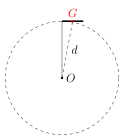
A firework consists of a uniform rod of mass \(M\) and length \(2a\), pivoted smoothly at one end so that it can rotate in a fixed horizontal plane, and a rocket attached to the other end. The rocket is a uniform rod of mass \(m(t)\) and length \(2l(t)\), with \(m(t)=2\alpha l(t)\) and \(\alpha\) constant. It is attached to the rod by its front end and it lies at right angles to the rod in the rod's plane of rotation. The rocket burns fuel in such a way that \(\mathrm{d}m/\mathrm{d}t=-\alpha\beta,\) with \(\beta\) constant. The burnt fuel is ejected from the back of the rocket, with speed \(u\) and directly backwards relative to the rocket. Show that, until the fuel is exhausted, the firework's angular velocity \(\omega\) at time \(t\) satisfies \[ \frac{\mathrm{d}\omega}{\mathrm{d}t}=\frac{3\alpha\beta au}{2[Ma^{2}+2\alpha l(3a^{2}+l^{2})]}. \]
Solution:
1987 Paper 3 Q14
It is given that the gravitational force between a disc, of radius \(a,\) thickness \(\delta x\) and uniform density \(\rho,\) and a particle of mass \(m\) at a distance \(b(\geqslant0)\) from the disc on its axis is \[ 2\pi mk\rho\delta x\left(1-\frac{b}{(a^{2}+b^{2})^{\frac{1}{2}}}\right), \] where \(k\) is a constant. Show that the gravitational force on a particle of mass \(m\) at the surface of a uniform sphere of mass \(M\) and radius \(r\) is \(kmM/r^{2}.\) Deduce that in a spherical cloud of particles of uniform density, which all attract one another gravitationally, the radius \(r\) and inward velocity \(v=-\dfrac{\d r}{\d t}\) of a particle at the surface satisfy the equation \[ v\frac{\mathrm{d}v}{\mathrm{d}r}=-\frac{kM}{r^{2}}, \] where \(M\) is the mass of the cloud. At time \(t=0\), the cloud is instantaneously at rest and has radius \(R\). Show that \(r=R\cos^{2}\alpha\) after a time \[ \left(\frac{R^{3}}{2kM}\right)^{\frac{1}{2}}(\alpha+\tfrac{1}{2}\sin2\alpha). \]
Solution: Suppose we divide a sphere of radius \(r\) up into slices of thickness \(\delta x\). Then the force acting on \(P\) will be: \begin{align*} F &= \sum_{\text{slices}} 2\pi mk\rho\delta x\left(1-\frac{b}{(a^{2}+b^{2})^{\frac{1}{2}}}\right) \\ &= \sum_{i=-r/\delta x}^{r/\delta x} 2\pi mk\frac{M}{\frac43 \pi r^3}\delta x\left(1-\frac{i \delta x}{((1-(i\delta x)^2)+(i \delta x)^{2})^{\frac{1}{2}}}\right) \\ &\to \int_{-r}^r \frac{1}{2} \frac{mkM}{r^3}(1-t) \d t \\ &=\frac{mkM}{r^2} \end{align*} We can see that the particle will have a force attracting it towards the centre, with magnitude \(\frac{kmM}{r^2}\), therefore and since \(\frac{\d v}{\d t} = \frac{\d v}{\d r} \frac{\d r}{\d t}\) we must have: \(v \frac{\d v}{\d r}m = - \frac{kmM}{r^2}\) and dividing by \(m\) we get exactly the result we seek. \begin{align*} && v \frac{\d v}{\d r} &= \frac{-kM}{r^2} \\ \Rightarrow && \frac{v^2}{2}+C &= \frac{kM}{r} \\ r = R, v =0: && C &= \frac{kM}{R} \\ \Rightarrow && v^2&= 2kM\left ( \frac1r - \frac1R\right ) \\ \Rightarrow && \frac{\d r}{\d t} &= -\sqrt{2kM\left ( \frac1r - \frac1R\right )} \\ \Rightarrow && -\sqrt{2kM}T &= \int_{r=R}^{r=R\cos^2 \alpha} \frac{1}{\sqrt{\frac1r-\frac1R}} \d r \\ r = R\cos^2 \theta: && -\sqrt{2kM}T &= \int_{\theta = 0}^{\theta = \alpha} \frac{\sqrt{R}}{\sqrt{\sec^2 \theta - 1}} \cdot R \cdot 2 \cdot (-\cos \theta) \cdot \sin \theta \d \theta \\ \Rightarrow && T &= \sqrt{\frac{R^3}{2kM}} \int_0^\alpha \frac{2 \cos \theta \sin \theta}{\sqrt{\sec^2 \theta - 1}} \d \theta \\ &&&= \sqrt{\frac{R^3}{2kM}} \int_0^\alpha \frac{2 \cos \theta \sin \theta}{\tan \theta} \d \theta \\ &&&= \sqrt{\frac{R^3}{2kM}} \int_0^\alpha 2\cos^2 \theta \d \theta \\ &&&= \sqrt{\frac{R^3}{2kM}} \int_0^\alpha 1 + \cos 2 \theta\d \theta \\ &&&= \sqrt{\frac{R^3}{2kM}} \left [1 + \frac12 \sin 2 \theta \right]_0^\alpha \\ &&&= \sqrt{\frac{R^3}{2kM}} \left (\alpha + \frac12 \sin 2 \alpha \right) \\ \end{align*}