Problems
Filters
107 problems found
1990 Paper 2 Q11
A disc is free to rotate in a horizontal plane about a vertical axis through its centre. The moment of inertia of the disc about this axis is \(mk^{2}.\) Along one diameter is a narrow groove in which a particle of mass \(m\) slides freely. At time \(t=0,\) the disc is rotating with angular speed \(\Omega,\) and the particle is at a distance \(a\) from the axis and is moving towards the axis with speed \(V\), where \(k^{2}V^{2}=\Omega^{2}a^{2}(k^{2}+a^{2}).\) Show that, at a later time \(t,\) while the particle is still moving towards the axis, the angular speed \(\omega\) of the disc and the distance \(r\) of the particle from the axis are related by \[ \omega=\frac{\Omega(k^{2}+a^{2})}{k^{2}+r^{2}}\qquad\mbox{ and }\qquad\frac{\mathrm{d}r}{\mathrm{d}t}=-\frac{\Omega r(k^{2}+a^{2})}{k(k^{2}+r^{2})^{\frac{1}{2}}}. \] Deduce that \[ k\frac{\mathrm{d}r}{\mathrm{d}\theta}=-r(k^{2}+r^{2})^{\frac{1}{2}}, \] where \(\theta\) is the angle through which the disc has turned at time \(t\). By making the substitution \(u=1/r\), or otherwise, show that \(r\sinh(\theta+\alpha)=k,\) where \(\sinh\alpha=k/a.\) Hence, or otherwise, show that the particle never reaches the axis.
1990 Paper 3 Q8
Let \(P,Q\) and \(R\) be functions of \(x\). Prove that, for any function \(y\) of \(x\), the function \[ Py''+Qy'+Ry \] can be written in the form \(\dfrac{\mathrm{d}}{\mathrm{d}x}(py'+qy),\) where \(p\) and \(q\) are functions of \(x\), if and only if \(P''-Q'+R=0.\) Solve the differential equation \[ (x-x^{4})y''+(1-7x^{3})y'-9x^{2}y=(x^{3}+3x^2)\mathrm{e}^{x}, \] given that when \(x=2,y=2\mathrm{e}^{2}\) and \(y'=0.\)
Solution: Suppose \(Py'' + Qy' + Ry = \frac{\d}{\d x}(p y' + qy)\), then \begin{align*} Py'' + Qy' + Ry &= \frac{\d}{\d x}(p y' + qy) \\ &= py'' + p'y' + qy' + q' y \\ &= py'' + (p'+q)y' + q' y \end{align*} Therefore \(P = p, Q = p'+q, R = q'\), Therefore \(q = Q-P'\) and \(R = Q'-P''\) or \(P'' -Q'+R = 0\). \((\Rightarrow)\) Suppose it can be written in that form, then the logic we have applied shows that equation is true. \((\Leftarrow)\) Suppose \(P''-Q'+R = 0\), then letting \(p = P, q = Q-P'\) we find functions of the form which will be expressed correctly. Notice that if \(P = x-x^4, Q = (1-7x^3), R = -9x^2\) then: \begin{align*} P'' - Q' + R &= -12x^2+21x^2-9x^2 \\ &= 0 \end{align*} Therefore we can write our second order ODE as: \begin{align*} && (x^{3}+3x)\mathrm{e}^{x} &= \frac{\d}{\d x} \left ( (x-x^4) y' +(1-7x^3-(1-4x^3))y \right) \\ &&&= \frac{\d}{\d x} \left ( (x-x^4) y' -3x^3y \right) \end{align*} Suppose \(z = (x-x^4)y' - 3x^2y\), then \(z = (2-2^4) \cdot 0 - 3 \cdot 2^2 \cdot 2e^2 = -24e^2\) when \(x = 2\). and we have: \begin{align*} && \frac{\d z}{\d x} &= (x^3+3x^2)e^x \\ \Rightarrow && z &= \int (x^3+3x^2)e^x \d x \\ &&&= x^3 e^x+c \\ \Rightarrow && -48e^2 &= e^2(8) + c \\ \Rightarrow && c &= -56e^2 \\ \Rightarrow && z &= e^x(x^3)-56e^2 \\ \end{align*} So our differential equation is: \begin{align*} && (x-x^4)y'-3x^3 y &= x^3e^x -5 6e^2 \\ \Rightarrow && (1-x^3)y' -3x^2y &= x^2 e^x - \frac{6e^2}{x} \\ \Rightarrow && \frac{\d }{\d x} \left ( (1-x^3)y \right) &= x^2e^x - \frac{56e^2}{x} \\ \Rightarrow && (1-x^3)y &= (x^2-2x+2)e^x - 56e^2 \ln x + k \\ \underbrace{\Rightarrow}_{x=2} && (1-2^3)2e^2 &= (2^2-2\cdot2 + 2)e^2 -56e^2 \ln 2 + k \\ \Rightarrow && k &= -16e^2+56 \ln 2 \cdot e^2 \\ \Rightarrow && y &= \frac{(x^2-2x+2)e^x - 56e^2 \ln x -16e^2+56 \ln 2 \cdot e^2}{(1-x^3)} \end{align*}
1989 Paper 1 Q6
The normal to the curve \(y=\mathrm{f}(x)\) at the point \(P\) with coordinates \((x,\mathrm{f}(x))\) cuts the \(y\)-axis at the point \(Q\). Derive an expression in terms of \(x\), \(\mathrm{f}(x)\) and \(\mathrm{f}'(x)\) for the \(y\)-coordinate of \(Q\). If, for all \(x\), \(PQ=\sqrt{\mathrm{e}^{x^{2}}+x^{2}}\), find a differential equation satisfied by \(\mathrm{f}(x)\). If the curve also has a minimum point \((0,-2)\), find its equation.
Solution: The normal to the curve \(y = f(x)\) has gradient \(-\frac{1}{f'(x)}\) and so has equation: \begin{align*} && \frac{Y - f(x)}{X - x} &= -\frac{1}{f'(x)} \\ \Rightarrow && Y &= -\frac{1}{f'(x)}X + \frac{x}{f'(x)}+f(x) \end{align*} Hence the \(Q\) is \(\displaystyle \left (0, f(x) + \frac{x}{f'(x)} \right)\). \begin{align*} && |PQ|^2 &= x^2 + \frac{x^2}{(f'(x))^2} \\ \Rightarrow && x^2 + e^{x^2} &= x^2 + \frac{x^2}{(f'(x))^2} \\ \Rightarrow && (f'(x))^2 &=x^2 e^{-x^2} \end{align*} Therefore \(f'(x) = \pm x e^{-x^2/2}\). If \(f(x)\) has a minimum at \((0,-2)\) then \(f''(0) > 0\), and \(f''(x) = \pm (e^{-x^2/2} - x^2e^{-x^2/2}) = \pm e^{-x^2/2}(1-x^2)\) so we should take the positive branch of the solution, ie \(f'(x) = xe^{-x^2/2}\). Therefore \(f(x) = - e^{-x^2/2}+C\). Since \(f(0) = -2\) we must have \(-2 = -1 + C\), ie \(C = -1\). Therefore \(f(x) = -1 - e^{-x^2/2}\)
1989 Paper 1 Q10
A spaceship of mass \(M\) is travelling at constant speed \(V\) in a straight line when it enters a force field which applies a resistive force acting directly backwards and of magnitude \(M\omega(v^{2}+V^{2})/v\), where \(v\) is the instantaneous speed of the spaceship, and \(\omega\) is a positive constant. No other forces act on the spaceship. Find the distance travelled from the edge of the force field until the speed is reduced to \(\frac{1}{2}V\). As soon as the spaceship has travelled this distance within the force field, the field is altered to a constant resistive force, acting directly backwards, whose magnitude is within 10% of that of the force acting on the spaceship immediately before the change. If \(z\) is the extra distance travelled by the spaceship before coming instantaneously to rest, determine limits between which \(z\) must lie.
Solution: Using Newton's second law, we have: \begin{align*} && -M\omega(v^2+V^2)/v &= M v \frac{\d v}{\d x} \\ \Rightarrow && \frac{v^2}{v^2+V^2} \frac{\d v}{\d x} &= -\omega \\ \Rightarrow && \omega X &= \int_{V/2}^V \frac{v^2}{v^2+V^2} \d v \\ &&&= \int_{V/2}^V \l 1 - \frac{V^2}{v^2+V^2} \r \d v \\ &&&= \left [v - V\tan^{-1} \frac{v}{V} \right]_{V/2}^V \\ &&&= V \l \frac12 - \tan^{-1} 1 + \tan^{-1} \frac12 \r \\ \Rightarrow X &= \frac{V}{\omega} \l \tan^{-1} \frac12 + \frac12 - \frac{\pi}{4} \r \end{align*}. The resistive force just before the field changes is \(M \omega (\frac{V^2}{4} + V^2)/\frac{V}{2} = \frac52MV\omega\). Therefor the constant resistive force is between \(\frac{11}4MV\omega\) and \(\frac{9}{4}MV \omega\) and acceleration is \(\frac{11}{4}V\omega, \frac{9}{4}V\omega\). Since \(v^2 = u^2 + 2as \Rightarrow s = \frac{v^2-u^2}{2a} = \frac{\frac{V^2}{4}}{2kV\omega} = \frac{V}{8k\omega}\) therefore \(z \in \left [ \frac{V}{22\omega},\frac{V}{18 \omega} \right]\)
1989 Paper 2 Q5
- Show that in polar coordinates, the gradient of any curve at the point
\((r,\theta)\) is
\[
\left.\left(\frac{\mathrm{d}r}{\mathrm{d}\theta}\tan\theta+r\right)\right/\left(\frac{\mathrm{d}r}{\mathrm{d}\theta}-r\tan\theta\right).
\]

- A mirror is designed so that any ray of light which hits one side of the mirror and which is parallel to a certain fixed line \(L\) is reflected through a fixed point \(O\) on \(L\). For any ray hitting the mirror, the normal to the mirror at the point of reflection bisects the angle between the incident ray and the reflected ray, as shown in the figure. Prove that the mirror intersects any plane containing \(L\) in a parabola.
Solution:
- Suppose our curve is \(r(\theta)\), then \(y = r \sin \theta, x = r \cos \theta\) and \begin{align*} && \frac{\d y}{\d \theta} &= \frac{\d r}{\d \theta} \sin \theta + r \cos \theta \\ && \frac{\d x}{\d \theta} &= \frac{\d r}{\d \theta} \cos \theta - r \sin \theta \\ \Rightarrow && \frac{\d y}{\d x} &= \frac{\d y}{\d \theta} \Bigg / \frac{\d x}{\d \theta} \\ &&&= \frac{\frac{\d r}{\d \theta} \sin \theta + r \cos \theta}{\frac{\d r}{\d \theta} \cos \theta - r \sin \theta} \\ &&&= \frac{\frac{\d r}{\d \theta} \tan\theta + r }{\frac{\d r}{\d \theta} - r \tan\theta} \end{align*} as required.
- Set up a system of polar coordinates such that the origin is at \(O\) and all points in the plane containing \(L\) are represented by \((r, \theta)\). The constraint we have is that the angle of the normal, is \(\frac12 \theta\). Let \(\tan \tfrac12 \theta = t\), then \(\tan \theta = \frac{2t}{1-t^2}\) \begin{align*} && \tan \frac12 \theta &= -\frac{\frac{\d r}{\d \theta} - r \tan\theta}{\frac{\d r}{\d \theta} \tan\theta + r } \\ \Rightarrow && t &= -\frac{r'-r\frac{2t}{1-t^2}}{r' \frac{2t}{1-t^2}+r} \\ &&&= \frac{2tr-(1-t^2)r'}{2tr'+(1-t^2)r} \\ \Rightarrow && (2t^2+1-t^2)r' &= (2t-t+t^3)r \\ && (1+t^2)r' &= t(t^2+1) r \\ \Rightarrow && r' &= t r \\ \Rightarrow && \frac{\d r}{\d \theta} &= \tan \tfrac12 \theta r \\ \Rightarrow && \int \frac1r \d r &= \int \tan \frac12 \theta \d \theta \\ && \ln r &= -2\ln \cos \tfrac12 \theta+C \\ \Rightarrow && r\cos^2 \frac12 \theta &= C \\ \Rightarrow && r + r\cos \theta &= D \\ \Rightarrow && r &= D-x \\ \Rightarrow && x^2 + y^2 &= D^2 - 2Dx + x^2 \\ \Rightarrow && y^2 &= D^2-2Dx \end{align*} Therefore it is a parabola
1989 Paper 2 Q7
By means of the substitution \(x^{\alpha},\) where \(\alpha\) is a suitably chosen constant, find the general solution for \(x>0\) of the differential equation \[ x\frac{\mathrm{d}^{2}y}{\mathrm{d}x^{2}}-b\frac{\mathrm{d}y}{\mathrm{d}x}+x^{2b+1}y=0, \] where \(b\) is a constant and \(b>-1\). Show that, if \(b>0\), there exist solutions which satisfy \(y\rightarrow1\) and \(\mathrm{d}y/\mathrm{d}x\rightarrow0\) as \(x\rightarrow0\), but that these conditions do not determine a unique solution. For what values of \(b\) do these conditions determine a unique solution?
Solution: Let \(z = x^\alpha, \frac{\d z}{\d x}=\alpha x^{\alpha-1} \), then \begin{align*} \frac{\d y}{\d x} &= \frac{\d y}{\d z} \frac{\d z}{\d x} \\ &= \alpha x^{\alpha-1}\frac{\d y}{\d z} \\ \\ \frac{\d^2 y}{\d x^2} &= \frac{\d }{\d x} \left ( \alpha x^{\alpha-1}\frac{\d y}{\d z} \right) \\ &= \alpha (\alpha-1)x^{\alpha-2} \frac{\d y}{\d z} + \alpha x^{\alpha-1} \frac{\d ^2 y}{\d z^2} \frac{\d z}{\d x} \\ &= \alpha(\alpha-1)x^{\alpha-2} \frac{\d y}{\d z} + \alpha^2 x^{2\alpha-2} \frac{\d ^2y}{\d z^2} \end{align*} \begin{align*} && 0 &=x\frac{\mathrm{d}^{2}y}{\mathrm{d}x^{2}}-b\frac{\mathrm{d}y}{\mathrm{d}x}+x^{2b+1}y \\ &&&= x \left ( \alpha(\alpha-1)x^{\alpha-2} \frac{\d y}{\d z} + \alpha^2 x^{2\alpha-2} \frac{\d ^2y}{\d z^2}\right) - b \left ( \alpha x^{\alpha-1}\frac{\d y}{\d z} \right) + x^{2b+1}y \\ &&&= \alpha^2 x^{2\alpha-1} \frac{\d^2 y}{\d z^2} +\left (\alpha(\alpha-1)x^{\alpha-1}-b\alpha x^{\alpha-1} \right) \frac{\d y}{\d z} + x^{2b+1} y \\ \end{align*} If we set \(\alpha = b +1\) the middle term disappears, so we get \begin{align*} && 0 &= (b+1)^2 x^{2b+1} \frac{\d^2 y}{\d z^2} + x^{2b+1} y \\ \Rightarrow && 0 &= (b+1)^2 \frac{\d^2 y}{\d z^2} + y \\ \Rightarrow && y &= A \sin \left (\frac{z}{b+1} \right) + B \cos \left (\frac{z}{b+1} \right) \\ &&&= \boxed{A \sin \left (\frac{x^{b+1}}{b+1} \right) + B \cos \left (\frac{x^{b+1}}{b+1} \right)} \\ \\ \lim_{x \to 0}: && y &\to B \\ && \frac{\d y}{\d x} &= A x^b \cos\left (\frac{x^{b+1}}{b+1} \right) - B x^b \sin\left (\frac{x^{b+1}}{b+1} \right) \\ b>0: && \frac{\d y}{\d x} &\to 0 \\ \end{align*} So there are infinitely many different solutions with \(B = 1\) and \(A\) is anything it wants to be. If \(b = 0\) \(y' \to A\) so \(A =0 \) and unique. If \(b < 0\) \(x^b \to \infty\) so we need \(A = 0\), unique. However, we also need \(y' \to 0\), so we need to check \(y' = -x^b \sin \left ( \frac{x^{b+1}}{b+1}\right) \to 0\), \begin{align*} y' &= -x^b \sin \left ( \frac{x^{b+1}}{b+1}\right) \\ &\approx -x^b \left ( \frac{x^{b+1}}{b+1}\right) \\ &= - \frac{x^{2b+1}}{b+1} \end{align*} so we need \(2b+1>0 \Rightarrow b > -\frac12\). Therefore the solution is unique on \((-\frac12,0]\)
1989 Paper 3 Q8
Given that \[ \frac{\mathrm{d}x}{\mathrm{d}t}=4(x-y)\qquad\mbox{ and }\qquad\frac{\mathrm{d}y}{\mathrm{d}t}=x-12(\mathrm{e}^{2t}+\mathrm{e}^{-2t}), \] obtain a differential equation for \(x\) which does not contain \(y\). Hence, or otherwise, find \(x\) and \(y\) in terms of \(t\) given that \(x=y=0\) when \(t=0\).
Solution: \begin{align*} && \frac{\d x}{\d t} &= 4(x-y) \\ && \frac{\d y}{\d t} &= x - 12(e^{2t}+e^{-2t}) \\ \Rightarrow && \frac{\d^2 x}{\d t^2} &= 4 \frac{\d x}{\d t}-4\frac{\d y}{\d t} \\ &&&= 4 \frac{\d x}{\d t}-4 \left ( x - 12(e^{2t}+e^{-2t}) \right) \\ \Rightarrow && \frac{\d^2 x}{\d t^2} - 4 \frac{\d x}{\d t}+4x &= 48 (e^{2t}+e^{-2t}) \end{align*} This differential equation has characteristic polynomial \(\lambda^2 - 4\lambda + 4 = (\lambda-2)^2\). Therefore we should expect a general solution of \((At+B)e^{2t}\). For particular integrals we should try \(ke^{-2t}\) and \(Ct^2 e^{2t}\). For the former, we have: \begin{align*} && 48 &= 4k+8k+k \\ \Rightarrow && k &= \frac{48}{13} \end{align*} For the latter we have: \begin{align*} &&4Ct^2e^{2t} -4C(2te^{2t}+2t^2e^{2t})+2C((1+2t)e^{2t}+2t^2e^{2t}) &= 48e^{2t} \\ \Rightarrow && 2C &= 48 \\ \Rightarrow && C &= 24 \end{align*} Therefore the solution should be: \begin{align*} x = (At+B)e^{2t} + \frac{48}{13}e^{-2t} + 24t^2 e^{2t} \\ x(0) = B + \frac{48}{13} \\ x'(0) = 2B+A-\frac{96}{13} \\ x =\frac{48}{13}((4t-1)e^{2t}+e^{-2t})+24t^2e^{2t} \\ y = x - \frac{1}{4} \frac{\d x}{\d t} \end{align*}
1989 Paper 3 Q12
A smooth horizontal plane rotates with constant angular velocity \(\Omega\) about a fixed vertical axis through a fixed point \(O\) of the plane. The point \(A\) is fixed in the plane and \(OA=a.\) A particle \(P\) lies on the plane and is joined to \(A\) by a light rod of length \(b(>a)\) freely pivoted at \(A\). Initially \(OAP\) is a straight line and \(P\) is moving with speed \((a+2\sqrt{ab})\Omega\) perpendicular to \(OP\) in the same sense as \(\Omega.\) At time \(t,\) \(AP\) makes an angle \(\phi\) with \(OA\) produced. Obtain an expression for the component of the acceleration of \(P\) perpendicular to \(AP\) in terms of \(\dfrac{\mathrm{d}^{2}\phi}{\mathrm{d}t^{2}},\phi,a,b\) and \(\Omega.\) Hence find \(\dfrac{\mathrm{d}\phi}{\mathrm{d}t}\), in terms of \(\phi,a,b\) and \(\Omega,\) and show that \(P\) never crosses \(OA.\)
Solution: Set up coordinate axes so that at time \(t\) \(OA\) is the \(x\)-axis, and all rotations are counter-clockwise. Then if \(OA = \mathbf{a}\), \(AP = \mathbf{x}\) and \(OP = \mathbf{p}\) we have: \begin{align*} \mathbf{a} &= \binom{a}{0} \\ \dot{\mathbf{a}} &= \binom{0}{-a \Omega} \\ \ddot{\mathbf{a}} &= \binom{-a \Omega^2}{0} \\ \\ \mathbf{x} &= \binom{b \cos \phi }{b \sin \phi } \\ \dot{\mathbf{x}} &= b \dot{\phi} \binom{-\sin \phi}{\cos \phi} \\ \ddot{\mathbf{x}} &= \binom{-b \ddot{\phi} \sin \phi-b \dot{\phi}^2 \cos \phi }{b \ddot{\phi} \cos \phi-b \dot{\phi}^2 \sin \phi} \\ \\ \ddot{\mathbf{p}} &= \binom{-a \Omega^2 +-b \ddot{\phi} \sin \phi-b \dot{\phi}^2 \cos \phi }{b \ddot{\phi} \cos \phi-b \dot{\phi}^2 \sin \phi} \end{align*} We can take a dot product with \(\mathbf{n} = \binom{-\sin \phi}{\cos \phi}\) to obtain the component perpendicular to \(AP\), which is: \begin{align*} && \binom{-\sin \phi}{\cos \phi} \cdot \ddot{x} &= a \Omega^2 \sin \phi + b \ddot{\phi} \end{align*} Noticing that this component must be \(0\) (since the only force acting on \(P\) is the rod), this must be equal to zero. \begin{align*} && 0 &= a \Omega^2 \sin \phi + b \ddot{\phi} \\ \Rightarrow && 0 &= a \Omega^2 \dot{\phi} \sin \phi + b\dot{\phi} \ddot{\phi} \\ \Rightarrow && C &= -a \Omega^2 \cos \phi + \tfrac12 b \dot{\phi}^2 \end{align*} Noticing that the initial conditions are \(\phi = 0\) and \(\dot{\phi} = 2\sqrt{\frac{a}{b}} \Omega\), so \begin{align*} && C &= -a \Omega^2+ \tfrac12 b \left ( 2\sqrt{\frac{a}{b}} \Omega \right)^2 \\ &&&= -a \Omega^2 + 2a \Omega^2 \\ &&&= a \Omega^2\\ \Rightarrow && \dot{\phi} &=\sqrt{\frac{2}{b} \left ( a \Omega^2 + a \Omega^2 \cos \phi \right)} \\ &&&= \Omega \sqrt{\frac{2a}{b}} \sqrt{1+ \cos \phi} \\ &&& = \Omega \sqrt{\frac{2a}{b}}\sqrt{2} \cos \tfrac{\phi}{2} \\ \Rightarrow && \int \sec \tfrac{\phi}{2} \d \phi &= 2 \Omega \sqrt{\frac{a}{b}}t \\ \Rightarrow && \tfrac12 \ln | \sec \tfrac{\phi}{2}+\tan \tfrac{\phi}{2} | &= 2 \Omega \sqrt{\frac{a}{b}}t + C \\ t = 0, \phi = 0: && C = 0 \\ \Rightarrow && \sec \tfrac{\phi}{2}+\tan \tfrac{\phi}{2} &= e^{4 \Omega \sqrt{\frac{a}{b}}t} \end{align*} Since when \(t > 0\) this is positive and larger than \(1\) we cannot have \(\phi = 0\) and since it remains below infinite \(\phi\) cannot reach \(\pi\). Therefore it cannot cross \(OA\)
1988 Paper 2 Q12
One end of a thin uniform inextensible, but perfectly flexible, string of length \(l\) and uniform mass per unit length is held at a point on a smooth table a distance \(d(< l)\) away from a small vertical hole in the surface of the table. The string passes through the hole so that a length \(l-d\) of the string hangs vertically. The string is released from rest. Assuming that the height of the table is greater than \(l\), find the time taken for the end of the string to reach the top of the hole.
Solution: Consider some point once the string is moving, there will be \(x\) above the table and \(l - x\) hanging in the air. For the hanging string we must have \((l-x)mg - T = -(l-x)m\ddot{x}\). For the string on the table we must have that \(T = -xm \ddot{x}\). Eliminating T, we have \((l-x)g = -l \ddot{x}\) Solving the differential equation, we must have \(x = A \cosh \sqrt \frac{g}{l}t+B \sinh\sqrt \frac{g}{l}t+l\), Since \(x(0) = d, \dot{x}(0) = 0 \Rightarrow B = 0, A = (-d)\). Therefore \(x = l-(l-d) \cosh \sqrt \frac{g}{l} t \Rightarrow t =\sqrt \frac{l}{g} \cosh^{-1} \l \frac{l-x}{l-d} \r\) and we go over the edge when \(x = 0\), ie \(\sqrt \frac{l}{g} \cosh^{-1} \l \frac{l}{l-d} \r\)
1988 Paper 3 Q10
Four greyhounds \(A,B,C\) and \(D\) are held at positions such that \(ABCD\) is a large square. At a given instant, the dogs are released and \(A\) runs directly towards \(B\) at constant speed \(v\), \(B\) runs directly towards \(C\) at constant speed \(v\), and so on. Show that \(A\)'s path is given in polar coordinates (referred to an origin at the centre of the field and a suitable initial line) by \(r=\lambda\mathrm{e}^{-\theta},\) where \(\lambda\) is a constant. Generalise this result to the case of \(n\) dogs held at the vertices of a regular \(n\)-gon (\(n\geqslant3\)).
Solution:


1988 Paper 3 Q13
A goalkeeper stands on the goal-line and kicks the football directly into the wind, at an angle \(\alpha\) to the horizontal. The ball has mass \(m\) and is kicked with velocity \(\mathbf{v}_{0}.\) The wind blows horizontally with constant velocity \(\mathbf{w}\) and the air resistance on the ball is \(mk\) times its velocity relative to the wind velocity, where \(k\) is a positive constant. Show that the equation of motion of the ball can be written in the form \[ \frac{\mathrm{d}\mathbf{v}}{\mathrm{d}t}+k\mathbf{v}=\mathbf{g}+k\mathbf{w}, \] where \(\mathbf{v}\) is the ball's velocity relative to the ground, and \(\mathbf{g}\) is the acceleration due to gravity. By writing down horizontal and vertical equations of motion for the ball, or otherwise, find its position at time \(t\) after it was kicked. On the assumption that the goalkeeper moves out of the way, show that if \(\tan\alpha=\left|\mathbf{g}\right|/(k\left|\mathbf{w}\right|),\) then the goalkeeper scores an own goal.
Solution: Applying \(\mathbf{F} = m\mathbf{a} = m \frac{\d \mathbf{v}}{dt}\) we have: \begin{align*} && m \frac{\d \mathbf{v}}{d t} &= m\mathbf{g} - mk(\mathbf{v} - \mathbf{w}) \\ \Rightarrow && \frac{\d \mathbf{v}}{d t} +k \mathbf{v} &= \mathbf{g} + k \mathbf{w} \\ \\ \Rightarrow && e^{k t} \l \frac{\d \mathbf{v}}{d t} +k \mathbf{v} \r &= e^{kt} ( \mathbf{g} + k \mathbf{w}) \\ \Rightarrow && \frac{\d}{\d t} \l e^{kt} \mathbf{v} \r &= e^{kt}( \mathbf{g} + k \mathbf{w}) \\ \Rightarrow && e^{kt} \mathbf{v} &= \frac{1}ke^{kt}( \mathbf{g} + k \mathbf{w}) + c \\ \Rightarrow && \mathbf{v}_0 &= \frac{1}{k} ( \mathbf{g} + k \mathbf{w})+c \\ \Rightarrow && \mathbf{v} &= e^{-kt} \l \mathbf{v_0} - \frac{1}{k}\mathbf{g} - \mathbf{w} \r + \frac{1}{k} \mathbf{g} + \mathbf{w} \\ \Rightarrow && \mathbf{x} &= -\frac{1}{k}e^{-kt} \l \mathbf{v_0} - \frac{1}{k}\mathbf{g} - \mathbf{w} \r + \frac{1}{k} \mathbf{g}t + \mathbf{w}t+C \\ \Rightarrow && \mathbf{0} &= -\frac{1}{k} \l \mathbf{v_0} - \frac{1}{k}\mathbf{g} - \mathbf{w} \r + C \\ \Rightarrow && \mathbf{x} &= \frac1{k}\l 1- e^{-kt} \r\l \mathbf{v_0} - \frac{1}{k}\mathbf{g} - \mathbf{w} \r + \frac{1}{k} \mathbf{g}t + \mathbf{w}t \end{align*} Position at time \(t\) is: \begin{align*} && x_x &= \frac1{k} ( 1-e^{-kt})(u_x - w)+wt \\ && x_y &= \frac1{k} ( 1-e^{-kt})(u_x \frac{g}{kw} - \frac{g}{k})+\frac{1}{k}gt \\ &&&= \frac{g}{kw} \left ( ( 1-e^{-kt})(u_x - w)+wt \right) \\ &&&= \frac{g}{kw} x_x \end{align*} Therefore if \(x_x\) is ever \(0\) then \(x_y\) will also be zero. But the ball must eventually hit the ground, and when it does, it will be in the process of scoring an own goal.
1987 Paper 1 Q3
By substituting \(y(x)=xv(x)\) in the differential equation \[ x^{3}\frac{\mathrm{d}v}{\mathrm{d}x}+x^{2}v=\frac{1+x^{2}v^{2}}{\left(1+x^{2}\right)v}, \] or otherwise, find the solution \(v(x)\) that satisfies \(v=1\) when \(x=1\). What value does this solution approach when \(x\) becomes large?
Solution: Let \(y = xv\) then \(y' = v + xv'\) and so \(x^2y' = x^2v + x^3v'\) Our differential equation is now: \begin{align*} && x^2 y' &= \frac{1+y^2}{(1+x^2)\frac{y}{x}} \\ \Rightarrow && xy' &= \frac{(1+y^2)}{(1+x^2)y} \\ \Rightarrow && \frac{y}{1+y^2} \frac{\d y}{\d x} &= \frac{1}{x(1+x^2)} \\ \Rightarrow && \frac{y}{1+y^2} \frac{\d y}{\d x} &= \frac{1}{x} - \frac{x}{1+x^2} \\ \Rightarrow && \frac12 \ln(1+y^2) &= \ln x - \frac12 \ln(1+x^2) + C \\ \Rightarrow && \frac12 \ln (1 + y^2) &= \frac12 \ln \l \frac{x^2}{1+x^2}\r + C \\ \Rightarrow && 1+y^2 &= \frac{Dx^2}{1+x^2} \\ \Rightarrow && D &= 4 \quad \quad: (x = 1, v = 1, y = 1) \\ \Rightarrow && 1 + x^2v^2&= \frac{4x^2}{1+x^2}\\ \Rightarrow && v^2 &= \frac{3x^2-1}{x^2(1+x^2)} \\ \Rightarrow && v &= \sqrt{\frac{3x^2-1}{x^2(1+x^2)}} \\ \end{align*} As \(x \to \infty\), \(v \to 0\)
1987 Paper 1 Q13
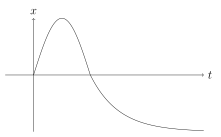
A particle of mass \(m\) moves along the \(x\)-axis. At time \(t=0\) it passes through \(x=0\) with velocity \(v_{0} > 0\). The particle is acted on by a force \(\mathrm{F}(x)\), directed along the \(x\)-axis and measured in the direction of positive \(x\), which is given by \[ \mathrm{F}(x)=\begin{cases} -m\mu^{2}x & \qquad(x\geqslant0),\\ -m\kappa\dfrac{\mathrm{d}x}{\mathrm{d}t} & \qquad(x < 0), \end{cases} \] where \(\mu\) and \(\kappa\) are positive constants. Obtain the particle's subsequent position as a function of time, and give a rough sketch of the \(x\)-\(t\) graph.
Solution: Using Newton's second law in the form, \(\F(x) = m \ddot{x}\). Our two different differential equations can be solved as follows: When \(x \geq 0\) \(-\mu^2x = \ddot{x} \Rightarrow x = A\sin \mu t + B \cos \mu t\) when \(x \geq 0\). And when \(x < 0\) \(-\kappa \dot{x} = \ddot{x} \Rightarrow \dot{x} = Ce^{-\kappa t} \Rightarrow x = De^{-\kappa t} + E\) when \(x < 0\) Following the trajectory of the particle: At \(t = 0, x = 0, \dot{x} = v_0 > 0\), so \(x = \frac{v_0}{\mu} \sin \mu t\) until \(t = \frac{\pi}{\mu}\). When \(t = \frac{\pi}{\mu}\) the particle will head into the negative \(x\)-axis with velocity \(-v_0\). At which point our initial conditions for our differential equations give us that \(De^{-\frac{\pi\kappa}{\mu}} + E = 0, -\kappa De^{-\frac{\pi\kappa}{\mu}} = -v_0 \Rightarrow De^{-\frac{\pi\kappa}{\mu}} = \frac{v_0}{\kappa}, E = -\frac{v_0}{\kappa}\). To summarise: \[ x(t) = \begin{cases} \frac{v_0}{\mu} \sin \mu t & 0 \leq t \leq \frac{\pi}{\mu} \\ -\frac{v_0}{\kappa} \l 1-e^{-\kappa(t-\frac{\pi}{\mu})}\r & t > \frac{\pi}{\mu}\end{cases}\]
1987 Paper 2 Q14
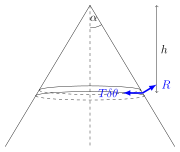
A thin uniform elastic band of mass \(m,\) length \(l\) and modulus of elasticity \(\lambda\) is pushed on to a smooth circular cone of vertex angle \(2\alpha,\) in such a way that all elements of the band are the same distance from the vertex. It is then released from rest. Let \(x(t)\) be the length of the band at time \(t\) after release, and let \(t_{0}\) be the time at which the band becomes slack. Assuming that a small element of the band which subtends an angle \(\delta\theta\) at the axis of the cone experiences a force, due to the tension \(T\) in the band, of magnitude \(T\delta\theta\) directed towards the axis, and ignoring the effects of gravity, show that \[ \frac{\mathrm{d}^{2}x}{\mathrm{d}t^{2}}+\frac{4\pi^{2}\lambda}{ml}(x-l)\sin^{2}\alpha=0,\qquad(0< t< t_{0}). \] Find the value of \(t_{0}.\)
Solution:
1987 Paper 3 Q6
The functions \(x(t)\) and \(y(t)\) satisfy the simultaneous differential equations \begin{alignat*}{1} \dfrac{\mathrm{d}x}{\mathrm{d}t}+2x-5y & =0\\ \frac{\mathrm{d}y}{\mathrm{d}t}+ax-2y & =2\cos t, \end{alignat*} subject to \(x=0,\) \(\dfrac{\mathrm{d}y}{\mathrm{d}t}=0\) at \(t=0.\) Solve these equations for \(x\) and \(y\) in the case when \(a=1\). Without solving the equations explicitly, state briefly how the form of the solutions for \(x\) and \(y\) if \(a>1\) would differ from the form when \(a=1.\)
Solution: Letting \(\mathbf{x} =\begin{pmatrix} x(t) \\ y(t) \end{pmatrix}\) and \(\mathbf{A} = \begin{pmatrix} -2 & 5 \\ -a & 2 \end{pmatrix}\) then our differential equation is \(\mathbf{x}' = \mathbf{Ax} + \begin{pmatrix} 0 \\2 \cos t \end{pmatrix}\). Looking at the eigenvalues of \(\mathbf{A}\), we find: \begin{align*} && \det \begin{pmatrix} -2-\lambda & 5 \\ -a & 2 -\lambda \end{pmatrix} &= (\lambda^2-4)+5a\\ &&&= \lambda^2 +5a-4 \end{align*} Therefore if \(a = 1\), \(\lambda = \pm i\). In which case we should expect the complementary solutions to be of the form \(\mathbf{x} = \begin{pmatrix} A \sin t + B \cos t \\ C \sin t + D \cos t \end{pmatrix}\). The first equation tells us that \((A-5D+B)\cos t + (-B+5C)\sin t=0\) so the complementary solution is:\(\mathbf{x} = \begin{pmatrix} 5(D-C) \sin t + 5C \cos t \\ C \sin t + D \cos t \end{pmatrix}\). Looking for a particular integral, we should expect to try something like \(\mathbf{x} = \begin{pmatrix} Et\cos t+Ft\sin t\\ Gt\cos t+Ht \sin t\end{pmatrix}\) and we find