Problems
Filters
112 problems found
2004 Paper 3 Q1
Show that \[ \int_0^a \frac{\sinh x}{2\cosh^2 x -1} \, \mathrm{d} x = \frac{1}{2 \sqrt{2}} \ln \l \frac{\sqrt{2}\cosh a -1}{\sqrt{2}\cosh a +1}\r + \frac{1}{2 \sqrt{2}} \ln \l \frac{\sqrt{2}+1}{\sqrt{2}-1}\r \] and find \[ \int_0^a \frac{\cosh x}{1+2\sinh^2 x} \, \mathrm{d} x \, . \] Hence show that \[ \int_0^\infty \frac{\cosh x - \sinh x}{1+2\sinh^2 x} \, \mathrm{d} x = \frac{\pi}{2\sqrt{2}} - \frac{1}{2 \sqrt{2}} \ln \l \frac{\sqrt{2}+1}{\sqrt{2}-1}\r \, . \] By substituting \(u = \e^x\) in this result, or otherwise, find \[ \int_1^\infty \frac{1}{1+u^4} \, \mathrm{d} u \, . \]
2004 Paper 3 Q8
Show that if \[ {\mathrm{d}y \over \mathrm{d} x}=\f(x)y + {\g(x) \over y} \] then the substitution \(u = y^2\) gives a linear differential equation for \(u(x)\,\). Hence or otherwise solve the differential equation \[ {\mathrm{d}y \over \mathrm{d} x}={y \over x} - {1 \over y}\;. \] Determine the solution curves of this equation which pass through \((1 \,, 1)\,\), \((2\, , 2)\) and \((4 \, , 4)\) and sketch graphs of all three curves on the same axes.
Solution: \begin{align*} && \frac{\d y}{\d x} &= f(x) y + \frac{g(x)}{y} \\ && y \frac{\d y}{\d x} &= f(x) y^2 + g(x) \\ u = y^2: && \frac12 \frac{\d u}{\d x} &= f(x) u + g(x) \end{align*} Which is a linear differential equation for \(u\). \begin{align*} && \frac12 u' &= \frac1x u -1 \\ \Rightarrow && u' - \frac2xu &= -1 \\ \Rightarrow && \frac{1}{x^2} u' - \frac{2}{x^3} u &= -\frac{1}{x^2} \\ \Rightarrow && (\frac{u}{x^2})' &= - \frac{1}{x^2} \\ \Rightarrow && \frac{u}{x^2} &= \frac1x + C \\ \Rightarrow && u &= Cx^2 + x \\ \Rightarrow && y^2 &= Cx^2 + x \end{align*} If \((1,1)\) is on the curve then \(1 = C + 1 \Rightarrow C = 0 \Rightarrow y^2 = x\). If \((2,2)\) is on the curve then \(4 = 4C + 2 \Rightarrow C = \frac12 \Rightarrow y^2 = x + \frac12 x^2\). If \((3,3)\) is on the curve then \(9 = 9C + 3 \Rightarrow C = \frac23 \Rightarrow y^2 = x + \frac23 x^2\)

2002 Paper 2 Q1
Show that \[ \int_{\frac{1}{6}\pi}^{\frac{1}{4}\pi} \frac 1{1-\cos2\theta} \;\d\theta = \frac{\sqrt3}2 - \frac12\;. \] By using the substitution \(x=\sin2\theta\), or otherwise, show that \[ \int_{\sqrt3/2}^1 \frac 1 {1-\sqrt{1-x^2}} \, \d x = \sqrt 3 -1 -\frac\pi 6 \;. \] Hence evaluate the integral \[ \int_1^{2/\sqrt3} \frac 1{y ( y - \sqrt{y^2-1^2})} \, \d y \;. \]
Solution: \begin{align*} && I &= \int_{\frac{1}{6}\pi}^{\frac{1}{4}\pi} \frac 1{1-\cos2\theta} \;\d\theta \\ &&&= \int_{\frac{1}{6}\pi}^{\frac{1}{4}\pi} \frac 1{2\sin^2 \theta} \;\d\theta \\ &&&= \frac12\int_{\frac{1}{6}\pi}^{\frac{1}{4}\pi} \cosec^2 \theta \;\d\theta \\ &&&= \frac12\left [-\cot \theta \right]_{\frac{1}{6}\pi}^{\frac{1}{4}\pi} \\ &&&= \frac12 \left (\cot \frac{\pi}{6} - \cot \frac{\pi}{4} \right)\\ &&&= \frac{\sqrt{3} - 1}{2} \end{align*} \begin{align*} && J &= \int_{\sqrt3/2}^1 \frac 1 {1-\sqrt{1-x^2}} \, \d x \\ x = \sin 2 \theta, \d x = 2\cos 2\theta \d \theta &&&=\int_{\pi/6}^{\pi/4} \frac{2 \cos 2 \theta }{1-\cos 2 \theta} \d \theta \\ &&&=\int_{\pi/6}^{\pi/4} \frac{2 \cos 2 \theta -2+2}{1-\cos 2 \theta} \d \theta \\ &&&= -2\left (\frac{\pi}{4} - \frac{\pi}6 \right) + 2I \\ &&&= \sqrt{3}-1-\frac{\pi}{6} \end{align*} \begin{align*} && K &= \int_1^{2/\sqrt{3}} \frac{1}{y(y-\sqrt{y^2-1})} \d y \\ y = 1/x, \d x = -1/y^2 \d y &&&= \int_{x=1}^{x=\sqrt{3}/2} \frac{1}{1-\sqrt{1-x^2}} \d x\\ &&&= \sqrt{3}-1 -\frac{\pi}6 \end{align*}
2002 Paper 2 Q2
Show that setting \(z - z^{-1}=w\) in the quartic equation \[ z^4 +5z^3 +4z^2 -5z +1=0 \] results in the quadratic equation \(w^2+5w+6=0\). Hence solve the above quartic equation. Solve similarly the equation \[ 2z^8 -3z^7-12z^6 +12z^5 +22z^4-12z^3 -12 z^2 +3z +2=0 \;. \]
Solution: \begin{align*} && 0 &= z^4 +5z^3 +4z^2 -5z +1 \\ &&0 &= z^2 + z^{-2} + 5(z-z^{-1}) + 4 \\ &&&= (z-z^{-1})^2+2+5(z-z^{-1})+4 \\ &&&= w^2 + 5w + 6 \\ &&&= (w+3)(w+2) \\ \Rightarrow && 0 &= z-z^{-1}+3 \\ \Rightarrow && 0 &= z^2+3z-1 \\ \Rightarrow && z &= \frac{-3 \pm \sqrt{3^2+4}}{2} = \frac{-3 \pm \sqrt{13}}{2} \\ \Rightarrow && 0 &= z-z^{-1}+2 \\ \Rightarrow && 0 &= z^2+2z-1 \\ \Rightarrow && z &= \frac{-2 \pm \sqrt{2^2+4}}{2} = - 1 \pm \sqrt{2} \\ \end{align*} \begin{align*} &&0 &= 2z^8 -3z^7-12z^6 +12z^5 +22z^4-12z^3 -12 z^2 +3z +2 \\ && 0 &= 2(z^4+z^{-4}) - 3(z^3-z^{-3})-12(z^2+z^{-2})+12(z-z^{-1})+22 \\ &&&= 2\left ((z-z^{-1})^4+4(z^2+z^{-2})-6\right)-3 \left ((z-z^{-1})^3+3(z-z^{-1}) \right)-12 \left ((z-z^{-1})^2+2 \right)+12(z-z^{-1})+22 \\ &&&= 2(w^4+4(w^2+2)-6)-3w^3-9w-12w^2-24+12w+22 \\ &&&= 2 w^4-3w^3-4w^2+3w+2 \\ \Rightarrow && 0 &= 2(w^2+w^{-2})-3(w-w^{-1})-4 \\ &&&= 2((w-w^{-1})^2+2)-3(w-w^{-1})-4 \\ &&&= 2x^2-3x \\ &&&= x(2x-3) \\ \Rightarrow && 0 &= w -w^{-1} \\ \Rightarrow && w &= \pm 1 \\ \Rightarrow && \pm 1 &= z-z^{-1} \\ \Rightarrow && 0 &= z^2 \mp z-1 \\ \Rightarrow && z &= \frac{\pm 1 \pm \sqrt{5}}{2} \\ \Rightarrow && \frac32 &= w-w^{-1} \\ \Rightarrow && 0 &= 2w^2-3w -2 \\ &&&= (2w+1)(w-2) \\ \Rightarrow && 2 &= z-z^{-1} \\ \Rightarrow && 0 &= z^2-2z-1 \\ \Rightarrow && z &= 1 \pm \sqrt{2} \\ \Rightarrow && -\frac12 &= z-z^{-1} \\ \Rightarrow && 0 &= 2z^2+z-2 \\ \Rightarrow && z &= \frac{-1 \pm \sqrt{17}}{4} \\ \Rightarrow && z &\in \left \{ \frac{\pm 1 \pm \sqrt{5}}{2}, 1 \pm \sqrt{2}, \frac{-1 \pm \sqrt{17}}{4} \right \} \end{align*}
2002 Paper 2 Q4
Give a sketch to show that, if \(\f(x) > 0\) for \(p < x < q\,\), then \(\displaystyle \int_p^{q} \f(x) \d x > 0\,\).
- By considering \(\f(x) = ax^2-bx+c\,\) show that, if \(a > 0\) and \(b^2 < 4ac\), then \(3b < 2a+6c\,\).
- By considering \(\f(x)= a\sin^2x - b\sin x + c\,\) show that, if \(a > 0\) and \(b^2< 4ac\), then \(4b < (a+2c)\pi\)
- Show that, if \(a > 0\), \(b^2 < 4ac\) and \(q > p > 0\,\), then $$ b\ln(q/p) < a\left(\frac1p -\frac1q\right) +c(q-p)\;. $$
Solution:
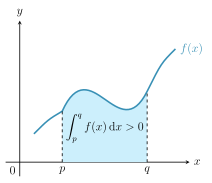
- If \(a > 0\) and \(b^2 < 4ac \Rightarrow \Delta < 0\) then \(f(x) = ax^2-bx+c > 0\) for all \(x\). Therefore \begin{align*} && 0 & < \int_0^1 (ax^2-bx+c) \d x\\ &&&= \frac13 a-\frac12b+c \\ \Rightarrow && 3b &< 2a+6c \end{align*}
- Similar logic tells us this must also be always positive, therefore \begin{align*} && 0 &< \int_0^{\pi} (a \sin^2 x - b \sin x +c ) \d x\\ &&&= \frac{\pi}{2}a - 2b+\pi c \\ \Rightarrow && 4b &< (a+2c)\pi \end{align*}
- Similar logic shows that \(f(x) = \frac{a}{x^2}-\frac{b}{x} +c>0\), therefore \begin{align*} && 0 &< \int_p^q \left (\frac{a}{x^2} - \frac{b}{x} + c\right) \d x \\ &&&=a\left (\frac{1}{p} - \frac{1}{q} \right) - b(\ln q - \ln p)+c(q-p) \\ \Rightarrow && b \ln (q/p) &,< a\left (\frac{1}{p} - \frac{1}{q} \right) +c(q-p) \end{align*}
2001 Paper 2 Q6
Show that \[ \int_0^1 \frac{x^4}{1+x^2} \, \d x = \frac \pi {4} - \frac 23 \;. \] Determine the values of
- \(\displaystyle \int_0^1 x^3 \; \tan ^{-1} \left(\frac {1-x} {1+x} \right) \,\d x \)
- \(\displaystyle \int_0^1 \frac {(1-y)^3} {(1+y)^5} \; {{\tan}^{-1} y}\, \d y\)
Solution: \begin{align*} && \int_0^1 \frac{x^4}{1+x^2} \d x &= \int_0^1 \frac{(x^2-1)(1+x^2)+1}{x^2+1} \d x\\ &&&= \int_0^1 \frac{1}{1+x^2} \d x -\int_0^1 (1-x^2) \d x \\ &&&= \left [\tan^{-1}x \right]_0^1 - \left [x - \tfrac13x^3 \right]_0^1 \\ &&&= \frac{\pi}{4} - \frac23 \end{align*}
- \(\,\) \begin{align*} && I &= \int_0^1 x^3 \; \tan ^{-1} \left(\frac {1-x} {1+x} \right) \,\d x \\ &&&= \left [ \frac{x^4}{4}\tan ^{-1} \left(\frac {1-x} {1+x} \right) \right]_0^1 -\int_0^1 \frac{x^4}{4} \frac{1}{1 +\left(\frac {1-x} {1+x} \right) ^2 } \cdot \frac{-2}{(1+x)^2} \d x \\ &&&= \frac{1}{2} \int_0^1 \frac{x^4}{(1+x)^2+(1-x)^2} \d x \\ &&&= \frac{1}{4} \int_0^1 \frac{x^4}{1+x^2} \d x \\ &&&= \frac{\pi}{16} - \frac{1}{6} \end{align*}
- \(\,\) \begin{align*} && J &= \int_0^1 \frac {(1-y)^3} {(1+y)^5} \; {{\tan}^{-1} y}\, \d y \\ &&&= \left [ \frac {(y(1+y^2)} {(1+y)^4} \tan^{-1}y \right]_0^1 - \int_0^1 \frac {(y(1+y^2)} {(1+y)^4} \frac{1}{1+y^2} \d y \\ &&&= \frac{\pi}{32} - \int_0^1 \frac{y}{(1+y)^4} \d y \\ &&&= \frac{\pi}{32} - \left[ - \frac{3y+1}{6(1+y)^3} \right]_0^1 \\ &&&= \frac{\pi}{32} +\frac{4}{6 \cdot 8} - \frac{1}{6} \\ &&&= \frac{\pi}{32} - \frac{1}{12} \end{align*}
2001 Paper 3 Q4
In this question, the function \(\sin^{-1}\) is defined to have domain \( -1\le x \le 1\) and range \linebreak \( - \frac{1}{2}\pi \le x \le \frac{1}{2}\pi\) and the function \(\tan^{-1}\) is defined to have the real numbers as its domain and range \( - \frac{1}{2}\pi < x < \frac{1}{2}\pi\).
- Let
$$
\g(x) = \displaystyle {2x \over 1 + x^2}\;, \ \ \ \ \ \ \ \ \ \ -\infty
- Let \[ \displaystyle \f \l x \r = \sin^{-1} \l {2x \over 1 + x^2} \r \;,\ \ \ \ \ \ \ \ \ -\infty < x < \infty\;. \] Show that $ \f(x ) = 2 \tan^{-1} x\( for \) -1 \le x \le 1\,\( and \)\f(x) = \pi - 2 \tan^{-1} x \( for \)x\ge1\,$. Sketch the graph of \(\f(x)\).
1999 Paper 2 Q6
Find \(\displaystyle \ \frac{\d y}{\d x} \ \) if $$ y = \frac{ax+b}{cx+d}. \tag{*} $$ By using changes of variable of the form \((*)\), or otherwise, show that \[ \int_0^1 \frac{1}{(x+3)^2} \; \ln \left(\frac{x+1}{x+3}\right)\d x = {\frac16} \ln3 - {\frac14}\ln 2 - \frac 1{12}, \] and evaluate the integrals \[ \int_0^1 \frac{1}{(x+3)^2} \; \ln \left(\frac{x^2+3x+2}{(x+3)^2}\right)\d x \mbox{ and } \int_0^1 \frac{1}{(x+3)^2} \; \ln\left(\frac{x+1}{x+2}\right)\d x . \] [Not on original paper:] By changing to the variable \(y\) defined by $$ y=\frac{2x-3}{x+1},$$ evaluate the integral $$ \int_2^4 \frac{2x-3}{(x+1)^3}\; \ln\!\left(\frac{2x-3}{x+1}\right)\d x.$$ Evaluate the integral $$ \int_9^{25} {\big({2z^{-3/2} -5z^{-2}}\big)}\ln{\big(2-5z^{-1/2}\big)}\; \d z.$$
Solution: \begin{align*} && y &= \frac{ax+b}{cx+d} \\ &&&= \frac{\frac{a}{c}(cx+d) - \frac{da}{c} + b}{cx+d} \\ \Rightarrow && y' &= \left (b - \frac{da}{c} \right)(-1)(cx+d)^{-2} \cdot c \\ &&&= (ad-bc)(cx+d)^{-2} \end{align*} \begin{align*} && y &= \frac{x+1}{x+3} \\ && \frac{\d y}{\d x} &= \frac{2}{(x+3)^2} \\ \Rightarrow && I &= \int_0^1 \frac{1}{(x+3)^2} \; \ln \left(\frac{x+1}{x+3}\right)\d x \\ &&&= \int_{y=1/3}^{y=1/2} \frac12 \ln y \, \d y \\ &&&= \frac12 \left [ y \ln y - y \right]_{1/3}^{1/2} \\ &&&= \frac12 \left ( \frac12\ln \frac12 - \frac12 - \frac13 \ln\frac13 + \frac13 \right) \\ &&&= \frac16 \ln 3 -\frac14 \ln 2 -\frac1{12} \end{align*} \begin{align*} && J &= \int_0^1 \frac1{(x+3)^2} \ln \left ( \frac{x^2+3x+2}{(x+3)^2} \right) \d x \\ &&&= \int_0^1 \frac1{(x+3)^2} \left ( \ln \frac{x+1}{x+3} + \ln \frac{x+2}{x+3} \right) \d x \\ &&&= I + \int_0^1 \frac1{(x+3)^2} \ln \left ( \frac{x+2}{x+3} \right) \d x \\ &&&= I + \int_{y=2/3}^{y=3/4} \ln y\, \d y \\ &&&= I + \left [ y \ln y- y\right]_{2/3}^{3/4} \\ &&&= I + \left ( \frac34 \ln \frac34 - \frac34 - \frac23 \ln \frac23 + \frac23 \right) \\ &&&= I + \left ( \frac34 \ln 3 - \frac32 \ln 2- \frac1{12} - \frac23 \ln 2 + \frac23 \ln 3\right) \\ &&&= I + \left ( \frac{17}{12} \ln 3 - \frac{13}6 \ln 2- \frac1{12} \right) \\ &&&= \frac16 \ln 3 -\frac14 \ln 2 -\frac1{12} + \left ( \frac{17}{12} \ln 3 - \frac{13}6 \ln 2- \frac1{12} \right) \\ &&&= \frac{19}{12} \ln 3 -\frac{29}{12}\ln 2 - \frac16 \end{align*} \begin{align*} && K &= \int_0^1 \frac{1}{(x+3)^2} \; \ln\left(\frac{x+1}{x+2}\right)\d x \\ &&&= \int_0^1 \frac{1}{(x+3)^2} \; \left ( \ln\left(\frac{x+1}{x+3}\right) - \ln \left ( \frac{x+3}{x+2} \right) \right)\d x \\ &&&= \frac16 \ln 3 -\frac14 \ln 2 -\frac1{12} - \left ( \frac{17}{12} \ln 3 - \frac{13}6 \ln 2- \frac1{12} \right) \\ &&&= -\frac54 \ln 3 +\frac{23}{12} \ln 2 \end{align*}
1998 Paper 1 Q2
Show, by means of a suitable change of variable, or otherwise, that \[ \int_{0}^{\infty}\mathrm{f}((x^{2}+1)^{1/2}+x)\,{\mathrm d}x =\frac{1}{2} \int_{1}^{\infty}(1+t^{-2})\mathrm{f}(t)\,{\mathrm d}t. \] Hence, or otherwise, show that \[ \int_{0}^{\infty}((x^{2}+1)^{1/2}+x)^{-3}\,{\mathrm d}x =\frac{3}{8}. \]
Solution: \begin{align*} && t &= (x^2+1)^{1/2}+x \\ && 1&=t^2-2tx \\ && x &= \frac{t^2-1}{2t} = \frac12 \left (t - \frac1t\right) \\ && \frac{\d x}{\d t} &= \frac12 \left ( 1+ \frac{1}{t^2} \right) \\ \Rightarrow && \int_0^{\infty} f((x^2+1)^{1/2}+x) \d x &= \int_{t=1}^{t = \infty}f(t) \frac12(1 + t^{-2}) \d t\\ &&&= \frac12 \int_1^{\infty}(1+t^{-2})f(t) \d t \end{align*} \begin{align*} \int_{0}^{\infty}((x^{2}+1)^{1/2}+x)^{-3}\,{\mathrm d}x &= \frac12 \int_1^{\infty}(1+t^{-2})t^{-3} \d t \\ &= \frac12 \left [\frac{-1}{2}t^{-2}-\frac{1}{4}t^{-4} \right]_{1}^{\infty} \\ &= \frac12 \left ( \frac12 + \frac14\right) = \frac38 \end{align*}
1998 Paper 3 Q2
Let $$ {\rm I}(a,b) = \int_0^1 t^{a}(1-t)^{b} \, \d t \; \qquad (a\ge0,\ b\ge0) .$$
- Show that \({\rm I}(a,b)={\rm I}(b,a)\),
- Show that \({\rm I}(a,b)={\rm I}(a+1,b)+{\rm I}(a,b+1)\).
- Show that \((a+1){\rm I}(a,b)=b{\rm I}(a+1,b-1)\) when \(a\) and \(b\) are positive and hence calculate \({\rm I}(a,b)\) when \(a\) and \(b\) are positive integers.
Solution:
- Let \(u = 1-t, \d u = -\d t\), then: \begin{align*} \mathrm{I}(a,b) &= \int_0^1 t^a(1-t)^b \d t \\ &= \int_{u=1}^{u=0} -(1-u)^a u^b \d u \\ &= \int_0^1(1-u)^a u^b \d u \\ &= \mathrm{I}(b, a) \end{align*}
- \begin{align*} \mathrm{I}(a+1,b)+\mathrm{I}(a,b+1) &= \int_0^1 t^{a+1}(1-t)^b + t^a(1-t)^{b+1} \d t \\ &= \int_0^1 (t+(1-t))t^a(1-t)^b \d t \\ &= \int_0^1 t^a(1-t)^b \d t \\ &= \mathrm{I}(a,b) \end{align*}
- Integrating by parts with \(\frac{du}{dt} = t^a, v = (1-t)^{b}\)\begin{align*} \mathrm{I}(a,b) &= \int_0^1 t^a (1-t)^b \d t \\ &= \left [ \frac{t^{a+1}}{a+1} (1-t)^b \right ]_0^1 + \int_0^1 \frac{t^{a+1}}{a+1} b(1-t)^{b-1} \\ &= \frac{b}{a+1} \int_0^1 t^{a+1}(1-t)^{b-1} \d t \\ &= \frac{b}{a+1} \mathrm{I}(a+1,b-1) \end{align*} Claim: \(\mathrm{I}(a,b) = \frac{a!b!}{(a+b+1)!}\) Proof: Note that \(I(a,0) = \frac{1}{a+1}\) so the formula holds for this case. We will induct on \(b\). The base case is done. Suppose that for \(b = k\) our formula is true, ie: \(\mathrm{I}(a,k) = \frac{a!k!}{(a+k+1)!}\) for all \(a\) (and fixed \(k\)) \begin{align*} \mathrm{I}(a,k+1) &= \frac{k+1}{a+1} \mathrm{I}(a+1,k) \\ &= \frac{k+1}{a+1} \frac{(a+1)!k!}{(a+1+k+1)!} \\ &= \frac{a!(k+1)!}{(a+(k+1)+1)!} \end{align*} So the formula is true for \(b=k+1\). Therefore, since it is true if \(b=0\) and if \(b=k\) is true then \(b=k+1\) is true, it is true for all values of \(b\).
1998 Paper 3 Q7
Sketch the graph of \({\rm f}(s)={ \e}^s(s-3)+3\) for \(0\le s < \infty\). Taking \({\e\approx 2.7}\), find the smallest positive integer, \(m\), such that \({\rm f}(m) > 0\). Now let $$ {\rm b}(x) = {x^3 \over \e^{x/T} -1} \, $$ where \(T\) is a positive constant. Show that \({\rm b}(x)\) has a single turning point in \(0 < x < \infty\). By considering the behaviour for small \(x\) and for large \(x\), sketch \({\rm b}(x)\) for \(0\le x < \infty\). Let $$ \int_0^\infty {\rm b}(x)\,\d x =B, $$ which may be assumed to be finite. Show that \(B = K T^n\) where \(K\) is a constant, and \(n\) is an integer which you should determine. Given that \(\displaystyle{B \approx 2 \int_0^{Tm} {\rm b}(x) {\,\rm d }x}\), use your graph of \({\rm b}(x)\) to find a rough estimate for \(K\).
1997 Paper 3 Q6
Suppose that \(y_n\) satisfies the equations \[(1-x^2)\frac{{\rm d}^2y_n}{{\rm d}x^2}-x\frac{{\rm d}y_n}{{\rm d}x}+n^2y_n=0,\] \[y_n(1)=1,\quad y_n(x)=(-1)^ny_n(-x).\] If \(x=\cos\theta\), show that \[\frac{{\rm d}^2y_n}{{\rm d}\theta^2}+n^2y_n=0,\] and hence obtain \(y_n\) as a function of \(\theta\). Deduce that for \(|x|\leqslant1\) \[y_0=1,\quad y_1=x,\] \[y_{n+1}-2xy_n+y_{n-1}=0.\]
1996 Paper 2 Q2
Consider the system of equations \begin{alignat*}{1} 2yz+zx-5xy & =2\\ yz-zx+2xy & =1\\ yz-2zx+6xy & =3 \end{alignat*} Show that \[xyz=\pm 6\] and find the possible values of \(x\), \(y\) and \(z\).
Solution: Consider the linear \(3\times 3\) system in \(yz, zx, xy\), then \begin{align*} \left(\begin{array}{ccc|c} 2 & 1 & -5 & 2 \\ 1 & -1 & 2 & 1 \\ 1 & -2 & 6 & 3 \\ \end{array}\right) \\ \left(\begin{array}{ccc|c} 1 & -1 & 2 & 1 \\ 1 & -2 & 6 & 3 \\ 2 & 1 & -5 & 2 \\ \end{array}\right) \\ \left(\begin{array}{ccc|c} 1 & -1 & 2 & 1 \\ 0 & -1 & 4 & 2 \\ 0 & 3 & -9 & 0 \\ \end{array}\right) \\ \left(\begin{array}{ccc|c} 1 & -1 & 2 & 1 \\ 0 & -1 & 4 & 2 \\ 0 & 0 & 3 & 6 \\ \end{array}\right) \\ \end{align*} Therefore \(yz = 2, zx = 6, xy = 3 \Rightarrow (xyz)^2 = 36 \Rightarrow xyz = \pm 6\). If \(xyz = 6, x = 3, y = 1, z = 2\), if \(xyz = -6, x = -3, y = -1, z = -2\)
1996 Paper 2 Q4
Show that \(\cos 4u=8\cos^{4}u-8\cos^{2}u+1\). If \[ I=\int_{-1}^{1} \frac{1}{\vphantom{{\big(}^2}\; \surd(1+x)+\surd(1-x)+2\; }\;{\rm d}x ,\] show, by using the change of variable \(x=\cos t\), that \[ I= \int_0^\pi \frac{\sin t}{4\cos^{2}\left(\frac{t}{4}-\frac{\pi}{8}\right)}\,{\rm d}t.\] By using the further change of variable \(u=\frac{t}{4}-\frac{\pi}{8}\), or otherwise, show that \[I=4\surd{2}-\pi-2.\] \noindent[You may assume that \(\tan\frac{\pi}{8}=\surd{2}-1\).]
Solution: \begin{align*} && \cos 4u &= 2\cos^2 2u - 1 \\ &&&= 2 (2\cos^2 u - 1)^2 - 1 \\ &&&= 2(4\cos^4u - 4\cos^2 u + 1) - 1\\ &&&= 8\cos^4u - 8\cos^2 u + 1 \end{align*} \begin{align*} && I &= \int_{-1}^1 \frac{1}{\sqrt{1+x}+\sqrt{1-x}+2} \d x \\ x = \cos t, \d x = - \sin t \d t: &&&= \int_{t = \pi}^{t=0} \frac{1}{\sqrt{1+\cos t} + \sqrt{1-\cos t} + 2} (- \sin t ) \d t \\ &&&= \int_0^\pi \frac{\sin t}{\sqrt{2 \cos^2 \frac{t}{2}}+\sqrt{2 \sin^2 \frac{t}{2}}+2} \d t \\ &&&= \int_0^\pi \frac{\sin t}{\sqrt{2}(\cos \frac{t}{2} + \sin \frac{t}{2}) + 2} \d t \\ &&&= \int_0^\pi \frac{\sin t}{\sqrt{2}(\sqrt{2} \cos (\frac{t}{2}-\frac{\pi}{4})) + 2} \d t \\ &&&= \int_0^\pi \frac{\sin t}{2(1+\cos (\frac{t}{2}-\frac{\pi}{4}))} \d t \\ &&&= \int_0^\pi \frac{\sin t}{4\cos^2(\frac{t}{4}-\frac{\pi}{8})} \d t \\ \\ u = \tfrac{t}{4} -\tfrac{\pi}{8}, \d u = \tfrac14 \d t:&&&=\int_{-\frac{\pi}{8}}^{\frac{\pi}{8}} \frac{\sin (4u+\frac{\pi}{2})}{4 \cos^2 u} 4 \d u \\ &&&= \int_{-\frac{\pi}{8}}^{\frac{\pi}{8}} \frac{\cos4u}{\cos^2 u} \d u \\ &&&= \int_{-\frac{\pi}{8}}^{\frac{\pi}{8}} 4 (2 \cos^2 u-1)-4 + \sec^2 u \d u \\ &&&= \int_{-\frac{\pi}{8}}^{\frac{\pi}{8}} 4 \cos 2u-4 + \sec^2 u \d u \\ &&&= \left [2\sin 2u - 4u + \tan u \right]_{-\pi/8}^{\pi/8} \\ &&&= 4 \sin \frac{\pi}{4} - \pi+ 2\tan \frac{\pi}{8} \\ &&&= \frac{4}{\sqrt{2}} - \pi + 2\sqrt{2}-2 \\ &&&= 4\sqrt{2} - \pi - 2 \end{align*}
1996 Paper 2 Q5
If $$ z^{4}+z^{3}+z^{2}+z+1=0\tag{*} $$ and \(u=z+z^{-1}\), find the possible values of \(u\). Hence find the possible values of \(z\). [Do not try to simplify your answers.] Show that, if \(z\) satisfies \((*)\), then \[z^{5}-1=0.\] Hence write the solutions of \((*)\) in the form \(z=r(\cos\theta+i\sin\theta)\) for suitable real \(r\) and \(\theta\). Deduce that \[\sin\frac{2\pi}{5}=\frac{\surd(10+2\surd 5)}{4} \ \ \hbox{and}\ \ \cos\frac{2\pi}{5}=\frac{-1+\surd 5}{4}.\]
Solution: \begin{align*} && 0 &= z^4+z^3+z^2+z+1 \\ \Rightarrow && 0 &= z^2+z+1+z^{-1}+z^{-2} \tag{\(z \neq 0\)} \\ &&&= \left ( z+z^{-1} \right)^2-2 + z+z^{-1} + 1 \\ &&&= u^2+u-1 \\ \Rightarrow && u &= \frac{-1 \pm \sqrt{5}}{2} \\ \Rightarrow && z+z^{-1} &= \frac{-1 \pm \sqrt{5}}{2} \\ \Rightarrow && 0 &= z^2-\left ( \frac{-1 \pm \sqrt{5}}{2}\right)z+1 \\ \Rightarrow && z &= \frac{\left ( \frac{-1 \pm \sqrt{5}}{2}\right) \pm \sqrt{\left ( \frac{-1 \pm \sqrt{5}}{2}\right)^2-4}}{2} \\ &&&= \frac{\left ( \frac{-1 \pm \sqrt{5}}{2}\right) \pm \sqrt{\frac{1+5\mp2\sqrt{5}-16}{4}}}{2} \\ &&&= \frac{\left ( \frac{-1 \pm \sqrt{5}}{2}\right) \pm \sqrt{\frac{-10\mp2\sqrt{5}-16}{4}}}{2} \\ &&&= \frac{-1\pm\sqrt{5}}{4} \pm i\frac{\sqrt{10\pm 2\sqrt{5}}}{4} \end{align*} Since \(z^4+z^3+z^2+z+1 = 0\) we can multiply both sides by \(z-1\) to obtain \(z^5-1 = 0\). Therefore if \(z = r(\cos \theta + i \sin \theta)\) we see that \(z^5 = 1 \Rightarrow r^5 (\cos 5 \theta + i \sin 5 \theta) = 1 \Rightarrow r = 1, 5 \theta = 2n \pi\) ie \(z = \cos \frac{2n\pi}{5} + i\sin \frac{2n \pi}{5}\). We are looking for a solution in the first quadrant, therefore \(\cos \frac{2\pi}{5} = \frac{-1 + \sqrt{5}}4\) and \(\sin \frac{2\pi}{5} = \frac{\sqrt{10+2\sqrt{5}}}{4}\)