Problems
Filters
87 problems found
2001 Paper 3 Q4
In this question, the function \(\sin^{-1}\) is defined to have domain \( -1\le x \le 1\) and range \linebreak \( - \frac{1}{2}\pi \le x \le \frac{1}{2}\pi\) and the function \(\tan^{-1}\) is defined to have the real numbers as its domain and range \( - \frac{1}{2}\pi < x < \frac{1}{2}\pi\).
- Let
$$
\g(x) = \displaystyle {2x \over 1 + x^2}\;, \ \ \ \ \ \ \ \ \ \ -\infty
- Let \[ \displaystyle \f \l x \r = \sin^{-1} \l {2x \over 1 + x^2} \r \;,\ \ \ \ \ \ \ \ \ -\infty < x < \infty\;. \] Show that $ \f(x ) = 2 \tan^{-1} x\( for \) -1 \le x \le 1\,\( and \)\f(x) = \pi - 2 \tan^{-1} x \( for \)x\ge1\,$. Sketch the graph of \(\f(x)\).
2000 Paper 1 Q5
Arthur and Bertha stand at a point \(O\) on an inclined plane. The steepest line in the plane through \(O\) makes an angle \(\theta\) with the horizontal. Arthur walks uphill at a steady pace in a straight line which makes an angle \(\alpha\) with the steepest line. Bertha walks uphill at the same speed in a straight line which makes an angle \(\beta\) with the steepest line (and is on the same side of the steepest line as Arthur). Show that, when Arthur has walked a distance \(d\), the distance between Arthur and Bertha is \(2d \vert\sin\frac12(\alpha-\beta)\vert\). Show also that, if \(\alpha\ne\beta\), the line joining Arthur and Bertha makes an angle \(\phi\) with the vertical, where \[ \cos\phi = \sin\theta \sin \frac12(\alpha+\beta). \]
1999 Paper 1 Q5
For this question, you may use the following approximations, valid if \(\theta \) is small: \ \(\sin\theta \approx \theta\) and \(\cos\theta \approx 1-\theta^2/2\,\). A satellite \(X\) is directly above the point \(Y\) on the Earth's surface and can just be seen (on the horizon) from another point \(Z\) on the Earth's surface. The radius of the Earth is \(R\) and the height of the satellite above the Earth is \(h\).
- Find the distance \(d\) of \(Z\) from \(Y\) along the Earth's surface.
- If the satellite is in low orbit (so that \(h\) is small compared with \(R\)), show that $$d \approx k(Rh)^{1/2},$$ where \(k\) is to be found.
- If the satellite is very distant from the Earth (so that \(R\) is small compared with \(h\)), show that $$d\approx aR+b(R^2/h),$$ where \(a\) and \(b\) are to be found.
1999 Paper 2 Q5
Show that if \(\alpha\) is a solution of the equation $$ 5{\cos x} + 12{\sin x} = 7, $$ then either $$ {\cos }{\alpha} = \frac{35 -12\sqrt{120}}{169} $$ or \(\cos \alpha\) has one other value which you should find. Prove carefully that if \(\frac{1}{2}\pi< \alpha < \pi\), then \(\alpha < \frac{3}{4}\pi\).
Solution: \begin{align*} && 5 \cos x + 12\sin x &= 7 \\ \Rightarrow && 5 \cos x - 7 &= -12 \sin x \\ \Rightarrow && 25 \cos^2 x - 70\cos x + 49 &= 144 \sin^2 x \\ \Rightarrow && 25 \cos^2 x - 70\cos x + 49 &= 144 (1-\cos^2 x) \\ \Rightarrow && 169 \cos^2 x - 70 \cos x -95 &= 0 \\ \Rightarrow && \cos \alpha &= \frac{70 \pm \sqrt{70^2 - 4 \cdot 169 \cdot (-95)}}{2 \cdot 169} \\ &&&= \frac{35 \pm \sqrt{35^2 + 169 \cdot 95} }{169} \\ &&&= \frac{35 \pm 12\sqrt{120}}{169} \end{align*} If \(\frac12 \pi < \alpha < \pi\) then \(\cos \alpha\) is negative, in particular \(\cos \alpha = \frac{35 -12\sqrt{120}}{169}\). Since \(\cos\) is decreasing over this range, if \(\cos \alpha > \cos \frac34 \pi = -\frac{\sqrt{2}}2\), then we will have shown \(\alpha < \frac34 \pi\) \begin{align*} && \cos \alpha &= \frac{35 - 12 \sqrt{120}}{169} \\ &&&> \frac{35 - 12 \cdot \sqrt{121}}{169} \\ &&&= \frac{35 - 12 \cdot 11}{169} \\ &&&= \frac{35 - 132}{169} \\ &&&= -\frac{97}{169} \\ &&&> -\frac{8}{13} \end{align*} but \(\left ( \frac{8}{13} \right)^2 = \frac{64}{169} < \frac12\), so we are done.
1998 Paper 1 Q6
Let \(a_{1}=\cos x\) with \(0 < x < \pi/2\) and let \(b_{1}=1\). Given that \begin{eqnarray*} a_{n+1}&=&{\textstyle \frac{1}{2}}(a_{n}+b_{n}),\\[2mm] b_{n+1}&=&(a_{n+1}b_{n})^{1/2}, \end{eqnarray*} find \(a_{2}\) and \(b_{2}\) and show that \[a_{3}=\cos\frac{x}{2}\cos^{2}\frac{x}{4} \ \quad\mbox{and}\quad \ b_{3}=\cos\frac{x}{2}\cos\frac{x}{4}.\] Guess general expressions for \(a_{n}\) and \(b_{n}\) (for \(n\ge2\)) as products of cosines and verify that they satisfy the given equations.
Solution: \begin{array}{c|c|c} n & a_n & b_n \\ \hline 1 & \cos x & 1 \\ \hline 2 & \frac12(1 + \cos x) & \sqrt{a_2} \\ &=\frac12(1+2\cos^2 \frac{x}{2}-1)& \sqrt{a_2} \\ &= \cos^2 \frac{x}{2} & \cos \frac{x}{2} \\ \hline 3 & \frac12(\cos^2 \frac{x}{2}+\cos \frac{x}{2}) & \sqrt{a_3\cos \frac{x}{2}} \\ &= \cos \frac{x}{2} \cdot \frac12 (\cos \frac{x}{2}+1) & \sqrt{a_3\cos \frac{x}{2}} \\ &= \cos \frac{x}{2} \cos^2 \frac{x}{4} & \cos \frac{x}{2} \cos \frac{x}{4} \end{array} Claim: \(\displaystyle a_n = \cos \frac{x}{2^{n-1}}\prod_{k=1}^{n-1} \cos \frac{x}{2^k}\), \(\displaystyle b_n = \prod_{k=1}^{n-1} \cos \frac{x}{2^k}\) Claim: \(a_{n+1} = \frac12(a_n + b_n)\) Proof: \begin{align*} && \frac12(a_n + b_n) &= \frac12 \left ( \cos \frac{x}{2^{n-1}}\prod_{k=1}^{n-1} \cos \frac{x}{2^k} + \prod_{k=1}^{n-1} \cos \frac{x}{2^k} \right) \\ &&&= \prod_{k=1}^{n-1} \cos \frac{x}{2^k} \frac12\left (\cos \frac{x}{2^{n-1}} + 1 \right) \\ &&&= \left ( \prod_{k=1}^{n-1} \cos \frac{x}{2^k} \right) \cos^{2} \frac{x}{2^n} \\ &&&= \cos \frac{x}{2^n} \prod_{k=1}^{n} \cos \frac{x}{2^k} \\ &= a_{n+1} \end{align*} Claim: \(b_{n+1} = \sqrt{a_{n+1}b_n}\) Proof: \begin{align*} && \sqrt{a_{n+1}b_n} &= \sqrt{ \cos \frac{x}{2^n} \prod_{k=1}^{n} \cos \frac{x}{2^k} \cdot \prod_{k=1}^{n-1} \cos \frac{x}{2^k} }\\ &&&= \prod_{k=1}^{n-1} \cos \frac{x}{2^k} \sqrt{\cos ^2\frac{x}{2^{n}}} \\ &&&= \prod_{k=1}^{n} \cos \frac{x}{2^k} \\ &&&= b_{n+1} \end{align*}
1998 Paper 2 Q11
A fielder, who is perfectly placed to catch a ball struck by the batsman in a game of cricket, watches the ball in flight. Assuming that the ball is struck at the fielder's eye level and is caught just in front of her eye, show that \(\frac{ {\rm d}}{{\rm d t}} (\tan\theta ) \) is constant, where \(\theta\) is the angle between the horizontal and the fielder's line of sight. In order to catch the next ball, which is also struck towards her but at a different velocity, the fielder runs at constant speed \(v\) towards the batsman. Assuming that the ground is horizontal, show that the fielder should choose \(v\) so that \(\frac{ {\rm d}}{{\rm d t}} (\tan\theta ) \) remains constant.
Solution: Set up a coordinate frame such that the position of the catch is the origin and the time of the catch is \(t = 0\) . We must have then that the trajectory of the ball is \(\mathbf{s} =\mathbf{u} t + \frac12 \mathbf{g} t^2 = \binom{u_x t}{u_y t - \frac12 gt^2}\). We must then have: \begin{align*} && \tan \theta &= \frac{u_y t - \frac12 gt^2}{u_x t} \\ &&&= \frac{u_y}{u_x} - \frac{g}{2u_x} t \\ \Rightarrow && \frac{\d}{\d \theta} \left ( \tan \theta \right) &= 0 - \frac{g}{2 u_x} \end{align*} which is clearly constant. Set coordinates so \(y\)-axis starts from eye-level and \(t = 0\) the first time the ball reaches that level. (Or move the trajectory backwards if that's not the case). Then the ball has trajectory \(\binom{u_xt}{u_yt - \frac12 gt^2}\). The ball reaches eye level a second time when \(t = \frac{2u_y}{g}\), ie at a point \(\frac{2u_xu_y}{g}\). The fielder therefore needs to have position \(f + (u_x-\frac{g}{2u_y}f)t\) at all times. Therefore \begin{align*} && \tan \theta &= \frac{u_y t - \frac12 gt^2}{f + (u_x-\frac{g}{2u_y}f)t - u_x t} \\ &&&= \frac{u_y t - \frac12 gt^2}{f(1-\frac{g}{2u_y}t)} \\ &&&= \frac{u_yt ( 1- \frac{g}{2u_y}t)}{f( 1- \frac{g}{2u_y}t)} \\ &&&= u_y t \\ \Rightarrow && \frac{\d}{\d \theta} \left ( \tan \theta \right) &= u_y \end{align*} Ie \( \frac{\d}{\d \theta} \left ( \tan \theta \right) \) is constant as required.
1997 Paper 2 Q6
Show that, if \(\,\tan^2\phi=2\tan\phi+1\), then \(\tan2\phi=-1\). Find all solutions of the equation $$\tan\theta=2+\tan3\theta$$ which satisfy \(0<\theta< 2\pi\), expressing your answers as rational multiples of \(\pi\). Find all solutions of the equation the equation $$\cot\theta=2+\cot3\theta$$ which satisfy $$-\frac{3\pi}{2}<\theta<\frac{\pi}{2}.$$
1997 Paper 2 Q11
A tennis player serves from height \(H\) above horizontal ground, hitting the ball downwards with speed \(v\) at an angle \(\alpha\) below the horizontal. The ball just clears the net of height \(h\) at horizontal distance \(a\) from the server and hits the ground a further horizontal distance \(b\) beyond the net. Show that $$v^2 = \frac{ g(a+b)^2(1+\tan^2\alpha)}{ 2[H-(a+b)\tan\alpha]}$$ and $$\tan\alpha = \frac{2a+b }{ a(a+b)}H - \frac{a+b }{ ab}h \,.$$ By considering the signs of \(v^2\) and \(\tan\alpha\), find upper and lower bounds on \(H\) for such a serve to be possible.
Solution: We have \begin{align*} \rightarrow: && a &= v\cos \alpha t_{net} \\ \Rightarrow && t_{net} &= \frac{a}{v \cos \alpha} \\ \downarrow: && H-h &= v\sin \alpha t_{net} + \frac12 g t_{net}^2 \\ &&&= a \tan \alpha + \frac12 g \frac{a^2}{v^2} \sec^2 \alpha \\ &&&= a \tan \alpha + \frac{a^2g}{2v^2}(1 + \tan^2 \alpha) \tag{*}\\ \\ \rightarrow: && a+b &= v \cos \alpha t_{ground} \\ && t_{ground} &= \frac{a+b}{v \cos \alpha}\\ \downarrow: && H &= v\sin \alpha t_{ground} + \frac12 g t_{ground}^2 \\ &&&= (a+b)\tan \alpha + \frac{(a+b)^2g}{2v^2}(1+\tan^2\alpha) \tag{**} \\ \\ (**): && v^2 &= \frac{g(a+b)^2(1+\tan^2\alpha)}{2[H-(a+b)\tan \alpha]} \\ (a+b)^2(*) - a^2(**): && (a+b)^2(H-h) -a^2H &= [(a+b)^2a - a^2(a+b)]\tan \alpha \\ \Rightarrow && (2ab+b^2)H - (a+b)^2h &= ab(a+b) \tan \alpha \\ \Rightarrow && \tan \alpha &= \frac{2a+b}{a(a+b)}H - \frac{a+b}{ab} h \end{align*} Noting that \(v^2 \geq 0\) and the numerator is positive, we must have \begin{align*} && H &> (a+b)\tan \alpha \\ &&&= \frac{2a+b}{a}H - \frac{(a+b)^2}{ab} h \\ \Rightarrow && \frac{a+b}{a}H &< \frac{(a+b)^2}{ab} h \\ \Rightarrow && H &< \frac{a+b}{b} h \end{align*} Noting that \(\tan \alpha > 0\) we must have \begin{align*} && \frac{2a+b}{a(a+b)} H & > \frac{a+b}{ab} h \\ \Rightarrow && H &> \frac{(a+b)^2}{b(2a+b)}h \end{align*}
1995 Paper 2 Q5
The famous film star Birkhoff Maclane is sunning herself by the side of her enormous circular swimming pool (with centre \(O\)) at a point \(A\) on its circumference. She wants a drink from a small jug of iced tea placed at the diametrically opposite point \(B\). She has three choices:
- to swim directly to \(B\).
- to choose \(\theta\) with \(0<\theta<\pi,\) to run round the pool to a point \(X\) with \(\angle AOX=\theta\) and then to swim directly from \(X\) to \(B\).
- to run round the pool from \(A\) to \(B\).
1995 Paper 3 Q4
Let \[ \mathrm{C}_{n}(\theta)=\sum_{k=0}^{n}\cos k\theta \] and let \[ \mathrm{S}_{n}(\theta)=\sum_{k=0}^{n}\sin k\theta, \] where \(n\) is a positive integer and \(0<\theta<2\pi.\) Show that \[ \mathrm{C}_{n}(\theta)=\frac{\cos(\tfrac{1}{2}n\theta)\sin\left(\frac{1}{2}(n+1)\theta\right)}{\sin(\frac{1}{2}\theta)}, \] and obtain the corresponding expression for \(\mathrm{S}_{n}(\theta)\). Hence, or otherwise, show that for \(0<\theta<2\pi,\) \[ \left|\mathrm{C}_{n}(\theta)-\frac{1}{2}\right|\leqslant\frac{1}{2\sin(\frac{1}{2}\theta)}. \]
Solution: \begin{align*} && C_n(\theta) &= \sum_{k=0}^n \cos k \theta \\ &&&= \textrm{Re} \left ( \sum_{k=0}^n \exp (ik \theta)\right)\\ &&&= \textrm{Re} \left ( \frac{e^{i(n+1)\theta}-1}{e^{i\theta}-1}\right)\\ &&&= \textrm{Re} \left ( \frac{e^{i(n+1)\theta/2}}{e^{i\theta/2}}\frac{e^{i(n+1)\theta/2}-e^{-i(n+1)\theta/2}}{e^{i\theta/2}-e^{-i\theta/2}}\right)\\ &&&= \textrm{Re} \left ( e^{in\theta/2}\frac{\sin \left ( (n+1)\theta/2 \right)}{\sin \left ( \theta/2 \right)}\right)\\ &&&= \frac{\sin \left ( (n+1)\theta/2 \right)}{\sin \left ( \theta/2 \right)}\textrm{Re} \left ( e^{in\theta/2}\right)\\ &&&= \frac{\sin \left ( (n+1)\theta/2 \right)}{\sin \left ( \theta/2 \right)}\cos \left ( \frac12n\theta\right)\\ \\ && S_n(\theta) &= \sum_{k=0}^n \sin k \theta \\ &&&= \textrm{Im} \left ( \sum_{k=0}^n \exp (ik \theta)\right)\\ &&&= \frac{\sin \left ( (n+1)\theta/2 \right)}{\sin \left ( \theta/2 \right)}\textrm{Im} \left ( e^{in\theta/2}\right)\\ &&&= \frac{\sin \left ( (n+1)\theta/2 \right)}{\sin \left ( \theta/2 \right)}\sin\left ( \frac12n\theta\right)\\ \\ && C_n(\theta) - \frac12 &= \frac{\sin \left ( (n+1)\theta/2 \right)}{\sin \left ( \theta/2 \right)}\cos \left ( \frac12n\theta\right) - \frac12 \\ &&&= \frac{2\sin \left ( (n+1)\theta/2 \right)\cos\left ( n\theta/2 \right)-\sin (\theta/2)}{2 \sin (\theta/2)} \\ &&&= \frac{\sin\left ( (n+1)\theta/2+n\theta/2\right)+\sin\left ( (n+1)\theta/2-n\theta/2\right)-\sin (\theta/2)}{2 \sin (\theta/2)} \\ &&&= \frac{\sin\left ( (n+1)\theta/2+n\theta/2\right)+\sin\left ( \theta/2\right)-\sin (\theta/2)}{2 \sin (\theta/2)} \\ &&&= \frac{\sin\left ( (2n+1)\theta/2\right)}{2 \sin (\theta/2)} \leqslant\frac{1}{2 \sin (\theta/2)} \\ \end{align*}
1995 Paper 3 Q11
A ship is sailing due west at \(V\) knots while a plane, with an airspeed of \(kV\) knots, where \(k>\sqrt{2},\) patrols so that it is always to the north west of the ship. If the wind in the area is blowing from north to south at \(V\) knots and the pilot is instructed to return to the ship every thirty minutes, how long will her outward flight last? Assume that the maximum distance of the plane from the ship during the above patrol was \(d_{w}\) miles. If the air now becomes dead calm, and the pilot's orders are maintained, show that the ratio \(d_{w}/d_{c}\) of \(d_{w}\) to the new maximum distance, \(d_{c}\) miles, of the plane from the ship is \[ \frac{k^{2}-2}{2k(k^{2}-1)}\sqrt{4k^{2}-2}. \]
1994 Paper 1 Q1
My house has an attic consisting of a horizontal rectangular base of length \(2q\) and breadth \(2p\) (where \(p < q\)) and four plane roof sections each at angle \(\theta\) to the horizontal. Show that the length of the roof ridge is independent of \(\theta\) and find the volume of the attic and the surface area of the roof.
Solution:

1994 Paper 2 Q6
Prove by induction, or otherwise, that, if \(0<\theta<\pi\), \[ \frac{1}{2}\tan\frac{\theta}{2}+\frac{1}{2^{2}}\tan\frac{\theta}{2^{2}}+\cdots+\frac{1}{2^{n}}\tan\frac{\theta}{2^{n}}=\frac{1}{2^{n}}\cot\frac{\theta}{2^{n}}-\cot\theta. \] Deduce that \[ \sum_{r=1}^{\infty}\frac{1}{2^{r}}\tan\frac{\theta}{2^{r}}=\frac{1}{\theta}-\cot\theta. \]
Solution: Claim: \(\displaystyle \sum_{r=1}^n \frac1{2^r} \tan \tfrac{\theta}{2^r} = \frac1{2^n}\cot \tfrac{\theta}{2^n} - \cot \theta\) Proof: (By Induction) Base case: \(n = 1\) \begin{align*} && LHS &= \sum_{r=1}^1 \frac1{2^r} \tan \frac{\theta}{2^r} \\ &&&= \frac1{2} \tan \frac{\theta}{2}\\ \\ && RHS &= \frac12 \cot \frac{\theta}{2} - \cot \theta \\ &&&= \frac12 \frac{1}{\tan \frac{\theta}{2}} - \frac{1-\tan^2 \frac{\theta}{2}}{2 \tan \frac{\theta}{2}} \\ &&&= \frac{1}{2} \tan \frac{\theta}{2} = LHS \end{align*} Therefore our base case is true. Assume our statement is true for some \(n=k\), then consider \(n = k+1\), ie \begin{align*} \sum_{r=1}^{k+1} \frac1{2^r} \tan \tfrac{\theta}{2^r} &= \sum_{r=1}^{k} \frac1{2^r} \tan \tfrac{\theta}{2^r} + \frac1{2^{k+1}} \tan \frac{\theta}{2^{k+1}} \\ &= \frac{1}{2^k} \cot \frac{\theta}{2^k} - \cot \theta + \frac{1}{2^{k+1}}\tan \frac{\theta}{2^{k+1}} \\ &= \frac{1}{2^{k+1}} \left (2 \cot \frac{\theta}{2^k} +\tan \frac{\theta}{2^{k+1}} \right) - \cot \theta \\ &= \frac{1}{2^{k+1}} \left (2\frac{1-\tan^2 \frac{\theta}{2^{k+1}}}{2 \tan \frac{\theta}{2^{k+1}}} + \tan \frac{\theta}{2^{k+1}} \right) - \cot \theta \\ &= \frac{1}{2^{k+1}} \cot \frac{\theta}{2^{k+1}} - \cot \theta \\ \end{align*} Therefore, since as \(x \to 0, x\cot x \to 1\) or \(x \cot \theta x \to \frac{1}{\theta}\) \begin{align*} \sum_{r=1}^{\infty}\frac{1}{2^{r}}\tan\frac{\theta}{2^{r}} &= \lim_{k\to \infty} \sum_{r=1}^{k}\frac{1}{2^{r}}\tan\frac{\theta}{2^{r}} \\ &= \lim_{k\to \infty} \left ( \frac{1}{2^{k+1}} \cot \frac{\theta}{2^{k+1}} - \cot \theta \right) \\ &= \lim_{k\to \infty}\frac{1}{2^{k+1}} \cot \frac{\theta}{2^{k+1}} - \cot \theta \\ &= \lim_{k\to \infty}\frac{1}{2^{k+1}} \cot \frac{\theta}{2^{k+1}} - \cot \theta \\ &= \lim_{k\to \infty}\frac{1}{2^{k+1}} \cot \frac{\theta}{2^{k+1}} - \cot \theta \\ &= \frac{1}{\theta} - \cot \theta \end{align*}
1994 Paper 2 Q9
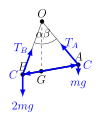
A light rod of length \(2a\) is hung from a point \(O\) by two light inextensible strings \(OA\) and \(OB\) each of length \(b\) and each fixed at \(O\). A particle of mass \(m\) is attached to the end \(A\) and a particle of mass \(2m\) is attached to the end \(B.\) Show that, in equilibrium, the angle \(\theta\) that the rod makes the horizontal satisfies the equation \[ \tan\theta=\frac{a}{3\sqrt{b^{2}-a^{2}}}. \] Express the tension in the string \(AO\) in terms of \(m,g,a\) and \(b\).
Solution:

1994 Paper 3 Q10
The island of Gammaland is totally flat and subject to a constant wind of \(w\) kh\(^{-1},\) blowing from the West. Its southernmost shore stretches almost indefinitely, due east and west, from the coastal city of Alphabet. A novice pilot is making her first solo flight from Alphaport to the town of Betaville which lies north-east of Alphaport. Her instructor has given her the correct heading to reach Betaville, flying at the plane's recommended airspeed of \(v\) kh\(^{-1},\) where \(v>w.\) On reaching Betaport the pilot returns with the opposite heading to that of the outward flight and, so featureless is Gammaland, that she only realises her error as she crosses the coast with Alphaport nowhere in sight. Assuming that she then turns West along the coast, and that her outward flight took \(t\) hours, show that her return flight takes \[ \left(\frac{v+w}{v-w}\right)t\ \text{hours.} \] If Betaville is \(d\) kilometres from Alphaport, show that, with the correct heading, the return flight should have taken \[ t+\frac{\sqrt{2}wd}{v^{2}-w^{2}}\ \text{hours.} \]