Problems
Filters
298 problems found
2017 Paper 2 Q9
Two identical rough cylinders of radius \(r\) and weight \(W\) rest, not touching each other but a negligible distance apart, on a horizontal floor. A thin flat rough plank of width \(2a\), where \(a < r\), and weight \(kW\) rests symmetrically and horizontally on the cylinders, with its length parallel to the axes of the cylinders and its faces horizontal. A vertical cross-section is shown in the diagram below.
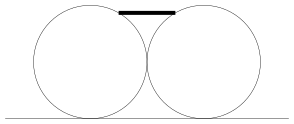
- Let \(F\) be the frictional force between one cylinder and the floor, and let \(R\) be the normal reaction between the plank and one cylinder. Show that \[ R\sin\theta = F(1+\cos\theta)\,, \] where \(\theta\) is the acute angle between the plank and the tangent to the cylinder at the point of contact. Deduce that \(2\sin\theta \le 1+\cos\theta\,\).
- Show that \[ N= \left( 1+\frac2 k\right)\left(\frac{1+\cos\theta}{\sin\theta} \right) F \,, \] where \(N\) is the normal reaction between the floor and one cylinder. Write down the condition that the cylinder does not slip on the floor and show that it is satisfied with no extra restrictions on \(\theta\).
- Show that \(\sin\theta\le\frac45\,\) and hence that \(r\le5a\,\).
Solution:
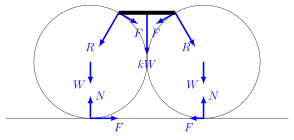
- \(\,\) \begin{align*} \text{N2}(\rightarrow, \text{ one cylinder}): && F\cos \theta + F - R \sin \theta &= 0 \\ \Rightarrow && F(1+\cos \theta) &= R \sin \theta \\ && F \leq \tfrac12 R \\ \Rightarrow && R \sin \theta &\leq \frac12 R(1+\cos \theta) \\ \Rightarrow && 2 \sin \theta &\leq 1 + \cos \theta \end{align*}
- \(\,\) \begin{align*} \text{N2}(\uparrow, \text{system}): && 2N-(k+2)W &= 0 \\ \Rightarrow && W &= \left ( \frac{2}{k+2} \right)N \\ \text{N2}(\uparrow, \text{one cylinder}): && N - W - R\cos \theta -F\sin \theta &= 0 \\ \Rightarrow && N - \left ( \frac{2}{k+2} \right)N - F \left ( \frac{1+\cos \theta}{\sin \theta} \right) \cos \theta - F \sin \theta &= 0 \\ \Rightarrow && \left ( \frac{k}{k+2} \right)N &= \left ( \frac{\cos \theta + \cos^2 \theta + \sin^2 \theta}{\sin \theta} \right) F\\ \Rightarrow && N &= \left ( 1 + \frac2{k} \right) \left ( \frac{\cos \theta + 1}{\sin \theta} \right) F \end{align*} The cylinder does not slip if \(F \leq \tfrac12 N\), ie \begin{align*} && N &\leq \left ( 1 + \frac2{k} \right) \left ( \frac{\cos \theta + 1}{\sin \theta} \right) \frac12 N \\ \Rightarrow && 2\sin \theta &\leq \left ( 1 + \frac2{k} \right) \left ( \cos \theta + 1 \right) \end{align*} but since \(2 \sin \theta \leq (1 + \cos \theta)\) and \((1+\frac2k) > 1\) this inequality is obviously satisfied.
- We can notice that \(2\sin \theta = 1 + \cos \theta\) is satisfied by a \(3-4-5\) triangle, where \(\sin \theta = 4/5, \cos \theta = 3/5\) and hence if \(\sin \theta \leq \frac45\) the condition must hold.
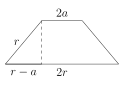
So \(\sin \theta = \frac{r-a}{r} \leq \frac45 \Rightarrow 5r-5a \leq 4r \Rightarrow r \leq 5a\)
2017 Paper 2 Q11
Two thin vertical parallel walls, each of height \(2a\), stand a distance \(a\) apart on horizontal ground. The projectiles in this question move in a plane perpendicular to the walls.
- A particle is projected with speed \(\sqrt{5ag}\) towards the two walls from a point \( A\) at ground level. It just clears the first wall. By considering the energy of the particle, find its speed when it passes over the first wall. Given that it just clears the second wall, show that the angle its trajectory makes with the horizontal when it passes over the first wall is \(45^\circ\,\). Find the distance of \(A\) from the foot of the first wall.
- A second particle is projected with speed \(\sqrt{5ag}\) from a point \(B\) at ground level towards the two walls. It passes a distance \(h\) above the first wall, where \(h>0\). Show that it does not clear the second wall.
Solution:
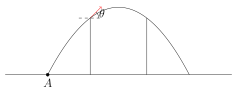
- \(\,\) \begin{align*} \bf{COE}: && \frac12 m \cdot 5ag &= mg\cdot 2a + \frac12 m v^2 \\ \Rightarrow && v^2 &= ag \\ && v &= \sqrt{ag} \end{align*} If it just clears the second wall, we must have: \begin{align*} && 0 &= \sqrt{ag} \sin \theta t - \frac12 gt^2 \\ \Rightarrow && t &= \frac{2\sqrt{ag}\sin \theta}{g} \\ && a &= \sqrt{ag} \cos \theta t \\ &&&=\sqrt{ag} \cos \theta \frac{2\sqrt{ag}\sin \theta}{g} \\ &&&= a \sin 2 \theta \\ \Rightarrow && \theta &= 45^{\circ} \end{align*} Imagine firing the particle backwards from the top of the wall at \(45^\circ\) then \begin{align*} && -2a &= \sqrt{ag}\cdot \left ( -\frac1{\sqrt{2}} \right) t - \frac12 g t^2 \\ \Rightarrow && 0 &= gt^2+\sqrt{2ag} t -4a \\ &&&= (\sqrt{g}t -\sqrt{2} \sqrt{a})(\sqrt{g}t +2\sqrt{2} \sqrt{a}) \\ \Rightarrow && t &= \sqrt{\frac{2a}{g}} \\ \Rightarrow && s &= \left ( -\frac1{\sqrt{2}} \right) \sqrt{ag} \sqrt{\frac{2a}{g}} \\ &&&= -a \end{align*} Therefore the \(A\) is \(a\) from the wall.
- When it passes over the first wall, \begin{align*} \bf{COE}: && \frac52amg &= (2a+h)mg + \frac12 m v^2 \\ \Rightarrow && v^2 &= (a-2h)g \end{align*} Now imagine firing a particle with this speed in any direction. The question is asking whether we can ever travel \(2a\) without descending more than \(h\). \begin{align*} && a &= \sqrt{(a-2h)g} \cos \beta t \\ \Rightarrow && t &= \frac{a}{\sqrt{(a-2h)g} \cos \beta}\\ && -h &= \sqrt{(a-2h)g} \sin \beta t - \frac12 g t^2 \\ &&&= a \tan \beta - \frac12 \frac{a^2}{(a-2h)} \sec^2 \beta \\ &&&= a \tan \beta - \frac{a^2}{2(a-2h)}(1+ \tan^2 \beta )\\ \Rightarrow && 0 &= \frac{a^2}{2(a-2h)} \tan^2 \beta-a \tan \beta + \frac{a^2-2ah+4h^2}{2(a-2h)} \\ && \Delta &= a^2 - \frac{a^2}{a-2h} \frac{a^2-2ah+4h^2}{a-2h} \\ &&&= \frac{a^2}{(a-2h)^2}\left ( a^2-4ah+4h^2-a^2+2ah-4h^2\right) \\ &&&= \frac{a^2}{(a-2h)^2}\left ( -2ah\right) < 0 \\ \end{align*} So there are no solutions if \(h > 0\)
2017 Paper 3 Q1
- Prove that, for any positive integers \(n\) and \(r\), \[ \frac{1}{^{n+r}\C_{r+1}} =\frac{r+1}{r} \left(\frac{1}{^{n+r-1}\C_{r}}-\frac{1}{^{n+r}\C_{r}}\right). \] Hence determine \[ \sum_{n=1}^{\infty}{\frac{1}{^{n+r}\C_{r+1}}} \,, \] and deduce that \ \(\displaystyle \sum_{n=2}^\infty \frac 1 {^{n+2}\C_3} = \frac12\,\).
- Show that, for \(n \ge 3\,\), \[ \frac{3!}{n^3} < \frac{1}{^{n+1}\C_{3}} \ \ \ \ \ \text{and} \ \ \ \ \ \frac{20}{^{n+1}\C_3} - \frac{1}{^{n+2}\C_{5}} < \frac{5!}{n^3} \,. \] By summing these inequalities for \(n \ge 3\,\), show that \[ \frac{115}{96} < \sum_{n=1}^{\infty}{\frac{1}{n^3}} < \frac{116}{96} \, . \]
Solution: \begin{align*} \frac{r+1}{r} \left(\frac{1}{^{n+r-1}\C_{r}}-\frac{1}{^{n+r}\C_{r}}\right) &= \frac{r+1}{r} \l \frac{r!(n-1)!}{(n+r-1)!} - \frac{r!n!}{(n+r)!} \r \\ &= \frac{(r+1)!(n-1)!}{r(n+r-1)!} \l 1 - \frac{n}{n+r} \r \\ &= \frac{(r+1)!(n-1)!}{r(n+r-1)!} \frac{r}{n+r} \\ &= \frac{(r+1)!n!}{(n+r)!} \\ &= \frac{1}{^{n+r}\C_{r+1}} \end{align*} \begin{align*} \sum_{n=1}^{\infty}{\frac{1}{^{n+r}\C_{r+1}}} &= \sum_{n=1}^{\infty} \l \frac{r+1}{r} \left(\frac{1}{^{n+r-1}\C_{r}}-\frac{1}{^{n+r}\C_{r}}\right) \r \\ &= \frac{r+1}{r} \sum_{n=1}^{\infty} \l \frac{1}{^{n+r-1}\C_{r}}-\frac{1}{^{n+r}\C_{r}} \r \\ &= \frac{r+1}{r} \lim_{N \to \infty} \sum_{n=1}^{N} \l \frac{1}{^{n+r-1}\C_{r}}-\frac{1}{^{n+r}\C_{r}} \r \\ &= \frac{r+1}{r} \lim_{N \to \infty} \l \frac{1}{^{1+r-1}\C_{r}} - \frac{1}{^{N+r}\C_{r}}\r \\ &= \frac{r+1}{r} \frac{1}{^{1+r-1}\C_{r}} \tag{since \(\frac{1}{^{N+r}\C_{r}} \to 0\)} \\ &= \frac{r+1}{r} \end{align*} When \(r = 2\), we have: \begin{align*} && \frac{3}{2} &= \sum_{n=1}^{\infty}{\frac{1}{^{n+2}\C_{3}}} \\ && &=\frac{1}{^{1+2}\C_{3}} + \sum_{n=2}^{\infty}{\frac{1}{^{n+2}\C_{3}}} \\ && &= 1 + \sum_{n=2}^{\infty}{\frac{1}{^{n+2}\C_{3}}} \\ \Rightarrow && \sum_{n=2}^{\infty}{\frac{1}{^{n+2}\C_{3}}} &= \frac12 \end{align*} \begin{align*} \frac{1}{^{n+1}\C_{3}} &= \frac{3!}{(n+1)n(n-1)} \\ &= \frac{3!}{n^3-n} \\ &> \frac{3!}{n^3} \end{align*} \begin{align*} \frac{20}{^{n+1}\C_3} - \frac{1}{^{n+2}\C_{5}} &= \frac{5!}{(n+1)n(n-1)} - \frac{5!}{(n+2)(n+1)n(n-1)(n-2)} \\ &= \frac{5!}{n^3} \frac{n^2}{n^2-1}\l 1- \frac{1}{n^2-4} \r \\ &= \frac{5!}{n^3} \frac{n^2}{n^2-1}\l \frac{n^2-5}{n^2-4} \r \\ &= \frac{5!}{n^3} \frac{n^2(n^2-5)}{(n^2-1)(n^2-4)} \\ &< \frac{5!}{n^3} \end{align*} Since \(k(k-5) < (k-1)(k-4) \Leftrightarrow 0 < 4\), this only makes sense if \(n \geq 3\) \begin{align*} &&\frac{3!}{n^3} &< \frac{1}{^{n+1}\C_{3}} \tag{if \(n \geq 3\)} \\ \Rightarrow &&\sum_{n=3}^\infty \frac{3!}{n^3} &< \sum_{n=3}^\infty \frac{1}{^{n+1}\C_{3}} \\ \Rightarrow && \frac{6}{1^3} + \frac{6}{2^3} + \sum_{n=3}^\infty \frac{3!}{n^3} &< \frac{6}{1^3} + \frac{6}{2^3} + \sum_{n=3}^\infty \frac{1}{^{n+1}\C_{3}} \\ \Rightarrow && \sum_{n=1}^\infty \frac{3!}{n^3} &< 6 + \frac{3}{4} + \sum_{n=2}^\infty \frac{1}{^{n+2}\C_{2+1}} \\ \Rightarrow && \sum_{n=1}^\infty \frac{3!}{n^3} &< 6 + \frac{3}{4} + \frac{1}{2} = \frac{29}{4} \\ \Rightarrow && \sum_{n=1}^\infty \frac{1}{n^3} &< \frac{29}{24} = \frac{116}{96} \\ \end{align*} \begin{align*} && \frac{20}{^{n+1}\C_3} - \frac{1}{^{n+2}\C_{5}} &< \frac{5!}{n^3} \\ \Rightarrow && \sum_{n=3}^\infty \l \frac{20}{^{n+1}\C_3} - \frac{1}{^{n+2}\C_{5}} \r &< \sum_{n=3}^\infty \frac{5!}{n^3} \\ \Rightarrow && \frac{120}{1^3} + \frac{120}{2^3} + \sum_{n=3}^\infty \frac{20}{^{n+1}\C_3} - \sum_{n=3}^\infty \frac{1}{^{n+2}\C_{5}} &< \frac{120}{1^3} + \frac{120}{2^3} + \sum_{n=3}^\infty \frac{5!}{n^3} \\ \Rightarrow && \frac{120}{1^3} + \frac{120}{2^3} + \sum_{n=2}^\infty \frac{20}{^{n+2}\C_{2+1}} - \sum_{n=1}^\infty \frac{1}{^{n+4}\C_{4+1}} &< \frac{120}{1^3} + \frac{120}{2^3} + \sum_{n=3}^\infty \frac{5!}{n^3} \\ \Rightarrow && \frac{120}{1^3} + \frac{120}{2^3} + \frac{20}{2} - \frac{4+1}{4} &< \sum_{n=1}^\infty \frac{5!}{n^3} \\ \Rightarrow && \frac{115}{96} &< \sum_{n=1}^\infty \frac{1}{n^3} \\ \end{align*}
2017 Paper 3 Q11
A railway truck, initially at rest, can move forwards without friction on a long straight horizontal track. On the truck, \(n\) guns are mounted parallel to the track and facing backwards, where \(n>1\). Each of the guns is loaded with a single projectile of mass \(m\). The mass of the truck and guns (but not including the projectiles) is \(M\). When a gun is fired, the projectile leaves its muzzle horizontally with a speed \(v-V\) relative to the ground, where \(V\) is the speed of the truck immediately before the gun is fired.
- All \(n\) guns are fired simultaneously. Find the speed, \(u\), with which the truck moves, and show that the kinetic energy, \(K\), which is gained by the system (truck, guns and projectiles) is given by \[ K= \tfrac{1}{2}nmv^2\left(1 +\frac{nm}{M} \right) . \]
- Instead, the guns are fired one at a time. Let \(u_r\) be the speed of the truck when \(r\) guns have been fired, so that \(u_0= 0\). Show that, for \(1\le r \le n\,\), \[ u_r - u_{r-1} = \frac{mv}{M+(n-r)m} \tag{\(*\)} \] and hence that \(u_n < u\,\).
- Let \(K_r\) be the total kinetic energy of the system when \(r\) guns have been fired (one at a time), so that \(K_0 = 0\). Using \((*)\), show that, for \(1\le r\le n\,\), \[ K_r -K_{r-1} = \tfrac 12 mv^2 + \tfrac12 mv (u_r-u_{r-1}) \] and hence show that \[ K_n = \tfrac{1}{2}nmv^2 +\tfrac{1}{2}mvu_n \,. \] Deduce that \(K_n < K\).
Solution:
- \(\,\) \begin{align*} \text{COM}: && 0 &= nm(v-0) - Mu \\ \Rightarrow && u &= \frac{nm}{M}v \\ \\ \Rightarrow && \text{K.E.} &= \underbrace{\tfrac12 nmv^2}_{\text{projectiles}} + \underbrace{\tfrac12Mu^2}_{\text{guns and truck}} \\ &&&= \tfrac12nmv^2 + \tfrac12M \frac{n^2m^2}{M^2}v^2 \\ &&&= \tfrac12 nmv^2 \left (1 + \frac{nm}{M} \right) \end{align*}
- \(\,\) \begin{align*} \text{COM}: && ((n-r+1)m+M)u_{r-1} &= -m(v-u_{r-1})+ ((n-r)m+M)u_r \\ \Rightarrow && mv &= -((n-r+1)m+M-m)u_{r-1}+((n-r)m+M)u_r \\ \Rightarrow && u_r-u_{r-1} &= \frac{mv}{M+(n-r)m} \\ \\ && u_n &= \frac{mv}{M+(n-1)m} + \frac{mv}{M+(n-2)m} + \cdots + \frac{mv}{M} \\ &&&< \frac{mv}M + \cdots + \frac{mv}{M} \\ &&&= \frac{mn}{M}v = u \end{align*}
- \(\,\) \begin{align*} && K_r &= \underbrace{K_{r-1}-\frac12(m(n-r+1)+M)u_{r-1}^2}_{\text{energy of already dispersed projectiles}} + \frac12m(v-u_{r-1})^2 + \frac12(m(n-r)+M)u_r^2 \\ \Rightarrow && K_r-K_{r-1} &= \tfrac12(u_r^2-u_{r-1}^2)(M+m(n-r))+\tfrac12mv^2-mvu_{r-1} \\ &&&=\tfrac12mv^2+ \tfrac12(u_r+u_{r-1})mv-mvu_{r-1} \\ &&&= \tfrac12mv^2 + \tfrac12mv(u_r-u_{r-1}) \\ \\ && K_n &= \frac12nmv^2 + \tfrac12mv(u_n - u_0) \\ &&&= \tfrac12nmv^2 + \tfrac12mvu_n \\ &&&< \tfrac12nmv^2 + \tfrac12mvu \\ &&&= \tfrac12nmv^2 + \tfrac12mv \frac{nm}{M}v \\ &&&= \tfrac12nmv^2 \left (1 +\frac{m}{M} \right) \\ &&&\leq K \end{align*}
2016 Paper 1 Q10
Four particles \(A\), \(B\), \(C\) and \(D\) are initially at rest on a smooth horizontal table. They lie equally spaced a small distance apart, in the order \(ABCD\), in a straight line. Their masses are \(\lambda m\), \(m\), \(m\) and \(m\), respectively, where \(\lambda>1\). Particles \(A\) and \(D\) are simultaneously projected, both at speed \(u\), so that they collide with \(B\) and \(C\) (respectively). In the following collision between \(B\) and \(C\), particle \(B\) is brought to rest. The coefficient of restitution in each collision is \(e\).
- Show that \(e = \dfrac {\lambda-1}{3\lambda+1}\) and deduce that \(e < \frac 13\,\).
- Given also that \(C\) and \(D\) move towards each other with the same speed, find the value of \(\lambda\) and of \(e\).
Solution:


- \begin{align*} \text{NEL}: && w_C &= e(v_B - v_C) \\ \text{COM}: && mv_B+ mv_C &= m w_C \\ \Rightarrow && w_C &= v_B + v_C\\ \Rightarrow && e(v_B - v_C) &= (v_B + v_C) \\ \Rightarrow && (1-e)v_B &= -(1+e)v_C \\ \Rightarrow && (1-e) \frac{\lambda(1+ e)}{1+\lambda} &= (1+e) \frac{1+e}{2} \\ \Rightarrow && 2\lambda - 2\lambda e &= 1+\lambda + e + \lambda e \\ \Rightarrow && (3\lambda +1)e &= \lambda - 1 \\ \Rightarrow && e &= \frac{\lambda -1}{3\lambda + 1} \\ &&&< \frac{\lambda - 1 + \frac{4}{3}}{3\lambda + 1} \\ &&& = \frac13 \end{align*}

- Since they move towards each other at the same speed \(w_C = - v_D\) \begin{align*} && w_C &= - v_D \\ \Rightarrow && v_B + v_C &= -(v_C+eu) \\ \Rightarrow && -eu &= v_B +2v_C \\ &&&= \frac{\lambda(1+ e)}{1+\lambda} u -(1+e)u \\ \Rightarrow && 1 &= \frac{\lambda(1+e)}{1+\lambda} \\ \Rightarrow && 1+\lambda &= \lambda \left ( 1 + \frac{\lambda -1}{3\lambda+1} \right) \\ &&&= \lambda \frac{4\lambda}{3\lambda +1} \\ \Rightarrow && 1+4\lambda + 3\lambda^2 &= 4\lambda^2 \\ \Rightarrow && 0 &= \lambda^2 - 4\lambda - 1 \\ \Rightarrow && \lambda &= \frac{4 \pm \sqrt{20}}{2} \\ &&&= 2\pm \sqrt{5} \\ \Rightarrow && \lambda &= 2 + \sqrt{5} \\ && e &= \frac{1+\sqrt{5}}{7+3\sqrt{5}} \\ &&&=\sqrt{5}-2 \end{align*}
2016 Paper 2 Q4
Let \[ y=\dfrac{x^2+x\sin\theta+1}{x^2+x\cos\theta+1} \,.\]
- Given that \(x\) is real, show that \[ (y\cos\theta -\sin\theta)^2 \ge 4 (y-1)^2 \,. \] Deduce that \[ y^2+1 \ge 4(y-1)^2 \,, \] and hence that \[ \dfrac {4-\sqrt7}3 \le y \le \dfrac {4+\sqrt7}3 \,. \]
- In the case $y= \dfrac {4+\sqrt7}3 \,$, show that \[\sqrt{y^2+1}=2(y-1)\] and find the corresponding values of \(x\) and \(\tan\theta\).
Solution:
- \(\,\) \begin{align*} && y&=\frac{x^2+x\sin\theta+1}{x^2+x\cos\theta+1} \\ \Leftrightarrow && 0 &= x^2(y-1) + x(y \cos \theta - \sin \theta) + y-1 \\ \Leftrightarrow && 0 &\leq \Delta = (y\cos \theta - \sin \theta)^2 - 4(y-1)^2 \\ \Leftrightarrow && (y\cos \theta - \sin \theta)^2 &\geq 4(y-1)^2 \end{align*} [Assuming that \(y \neq 1\), if \(y = 1\) then the RHS is \(0\) and it is automatically satisfied]. Notice that \((y\cos \theta - \sin \theta)^2 \leq (y^2+1)(\cos^2 \theta + \sin^2 \theta)\) by Cauchy-Schwarz, so \(y^2 + 1 \geq 4(y-1)^2\). \begin{align*} && y^2 + 1 &\geq 4(y-1)^2 \\ \Leftrightarrow && 0 &\geq 3y^2-8y+3 \\ \text{c.v.} && y&= \frac{8 \pm \sqrt{64-4\cdot3 \cdot 3}}{6} \\ &&&= \frac{4 \pm \sqrt{16-9}}{3} = \frac{4 \pm \sqrt{7}}3 \end{align*} so \(\frac{4-\sqrt{7}}3 \leq y \leq \frac{4+\sqrt7}3\).
- If \(y = \frac{4+\sqrt7}3\) then \(y - 1 = \frac{1+\sqrt7}3\) and since \(y^2+1 = 4(y-1)^2\) taking square roots we obtain \(\sqrt{y^2+1} = 2(y-1)\). Since equality must hold in our C-S identity, we must have \(\langle y, -1 \rangle\) parallel to \( \langle \cos \theta , \sin \theta \rangle\), ie \(\tan \theta = -\frac{3}{4+\sqrt{7}}\) and \begin{align*} && x & = \frac{-(y \cos \theta - \sin \theta) \pm \sqrt{\Delta}}{2(y-1)} \\ &&&= \frac{\pm2(y-1)}{2(y-1)} \\ &&&= \pm1 \end{align*}
2016 Paper 2 Q10
A thin uniform wire is bent into the shape of an isosceles triangle \(ABC\), where \(AB\) and \(AC\) are of equal length and the angle at \(A\) is \(2\theta\). The triangle \(ABC\) hangs on a small rough horizontal peg with the side \(BC\) resting on the peg. The coefficient of friction between the wire and the peg is \(\mu\). The plane containing \(ABC\) is vertical. Show that the triangle can rest in equilibrium with the peg in contact with any point on \(BC\) provided \[ \mu \ge 2\tan\theta(1+\sin\theta) \,. \]
Solution:


2016 Paper 2 Q11
- Two particles move on a smooth horizontal surface. The positions, in Cartesian coordinates, of the particles at time \(t\) are \((a+ut\cos\alpha \,,\, ut\sin\alpha)\) and \((vt\cos\beta\,,\, b+vt\sin\beta )\), where \(a\), \(b\), \(u\) and \(v\) are positive constants, \(\alpha\) and \(\beta\) are constant acute angles, and \(t\ge0\). Given that the two particles collide, show that \[ u \sin(\theta+\alpha) = v\sin(\theta +\beta)\,, \] where \(\theta \) is the acute angle satisfying \(\tan\theta = \dfrac b a\).
- A gun is placed on the top of a vertical tower of height \(b\) which stands on horizontal ground. The gun fires a bullet with speed \(v\) and (acute) angle of elevation \(\beta\). Simultaneously, a target is projected from a point on the ground a horizontal distance \(a\) from the foot of the tower. The target is projected with speed \(u\) and (acute) angle of elevation \(\alpha\), in a direction directly away from the tower. Given that the target is hit before it reaches the ground, show that \[ 2u\sin\alpha (u\sin\alpha - v\sin\beta) > bg\,. \] Explain, with reference to part (i), why the target can only be hit if \(\alpha > \beta\).
Solution:
- The particles collide if there exists a time when \begin{align*} && a + ut \cos \alpha &= vt \cos \beta \\ \Rightarrow && t (v \cos \beta-u \cos \alpha) &= a\\ && ut \sin \alpha &= b + vt \sin \beta \\ \Rightarrow && t(u \sin \alpha - v \sin \beta) &= b\\ \Rightarrow && a(u\sin \alpha - v \sin \beta) &= b(v \cos \beta - u \cos \alpha) \\ \Rightarrow && u(a \sin \alpha + b \cos \alpha) &= v (b \cos \beta + a \sin \beta) \\ \Rightarrow && u \sin (\alpha + \theta) &= v \sin (\beta + \theta) \end{align*}
- The path of the bullet is \((vt \cos \beta, b + vt \sin \beta -\frac12 g t^2)\). The path of the target is \((a+ut \cos \alpha, ut \sin \alpha - \frac12 g t^2)\). By comparing components as in part (i) and noting the acceleration doesn't change the story, we can see that \(t(u \sin \alpha - v \sin \beta) = b\) and we also need \(u t \sin \alpha - \frac12 gt^2 >0\) or \(u \sin \alpha - \frac12 gt > 0\) \begin{align*} && u \sin \alpha & > \frac12 gt \\ && 2u \sin \alpha & > g \frac{b}{(u \sin \alpha - v \sin \beta)} \\ \Rightarrow && 2u \sin \alpha( u \sin \alpha - v \sin \beta) & > gb \end{align*} Notice we must have \(u \sin \alpha > v \sin \beta\) and \(u \sin (\alpha + \theta) = v \sin (\beta + \theta)\) so \( \frac{\sin \alpha}{\sin (\alpha + \theta)} > \frac{\sin \beta}{\sin (\beta + \theta)}\), but if we consider \(f(t) = \frac{\sin t}{\sin(t+x)}\) we can see \(f'(t) = \frac{\cos t \sin(t + x) - \sin t \cos(t+x)}{\sin^2(t+x)} = \frac{\sin x}{\sin^2(t+x)} > 0\) is increasing, therefore \(\alpha > \beta\).
2016 Paper 3 Q2
The distinct points \(P(ap^2 , 2ap)\), \(Q(aq^2 , 2aq)\) and \(R(ar^2,2ar)\) lie on the parabola \(y^2 = 4ax\), where \(a>0\). The points are such that the normal to the parabola at \(Q\) and the normal to the parabola at \(R\) both pass through \(P\).
- Show that \(q^2 +qp + 2 = 0\).
- Show that \(QR\) passes through a certain point that is independent of the choice of \(P\).
- Let \(T\) be the point of intersection of \(OP\) and \(QR\), where \(O\) is the coordinate origin. Show that \(T\) lies on a line that is independent of the choice of \(P\). Show further that the distance from the \(x\)-axis to \(T\) is less than \(\dfrac {\;a}{\sqrt2}\,\).
Solution:
- \begin{align*} && 2y \frac{\d y}{\d x} &= 4a \\ \Rightarrow && \frac{\d y}{\d x} &= \frac{2a}{y} \end{align*} Therefore we must have \begin{align*} && \underbrace{-\frac{2aq}{2a}}_{\text{gradient of normal}} &= \underbrace{\frac{2ap-2aq}{ap^2-aq^2}}_{\Delta y / \Delta x} \\ \Rightarrow && -q &= \frac{2}{p+q} \\ && 0 &= 2 + pq+q^2 \end{align*}
- We must have that \(q,r\) are the two roots of \(x^2+px+2 = 0\) \(QR\) has the equation: \begin{align*} && \frac{y-2aq}{x-aq^2} &= \frac{2ar-2aq}{ar^2-aq^2} \\ \Rightarrow && \frac{y-2aq}{x-aq^2} &= \frac{2}{r+q} \\ \Rightarrow && y &= \frac{2}{q+r}(x-aq^2) +2aq \\ && y &= -\frac{2}{p}x+2a\left(q-\frac{q^2}{q+r} \right) \\ &&y&= -\frac{2}{p}x+2a \frac{qr}{q+r} \\ && y &= -\frac{2}{p}x - 2a \frac{2}{p} \\ && y & = -\frac{2}{p}(x+2a) \end{align*} Therefore the point \((-2a,0)\) lies on all such lines.
- \(OP\) has equation \(y = \frac{2}{p} x\) \begin{align*} && y &= \frac{2}{p} x \\ && y & = -\frac{2}{p}(x+2a) \\ && 2y &= -\frac{4a}{p} \\ \Rightarrow && y &= -\frac{2a}{p} \\ && x &= -a \end{align*} Therefore \(T\left (-a, -\frac{2a}{p} \right)\) always lies on the line \(x = -a\) The distance to the \(x\)-axis from \(T\) is \(\frac{2a}{|p|}\). We need to show that \(p\) can't be too small. Specifically \(x^2+px+2 = 0\) must have \(2\) real roots, ie \(\Delta = p^2-8 \geq 0 \Rightarrow |p| \geq 2\sqrt{2}\), ie \(\frac{2a}{|p|} \leq \frac{2a}{2\sqrt{2}} = \frac{a}{\sqrt{2}}\) as required.
2016 Paper 3 Q5
- By considering the binomial expansion of \((1+x)^{2m+1}\), prove that \[ \binom{ 2m \! +\! 1}{ m} < 2^{2m}\,, \] for any positive integer \(m\).
- For any positive integers \(r\) and \(s\) with \(r< s\), \(P_{r,s}\) is defined as follows: \(P_{r,s}\) is the product of all the prime numbers greater than \(r\) and less than or equal to \(s\), if there are any such primes numbers; if there are no such primes numbers, then \(P_{r,s}=1\,\). For example, \(P_{3,7}=35\), \(P_{7,10}=1\) and \(P_{14,18}=17\). Show that, for any positive integer \(m\), \(P_{m+1\,,\, 2m+1} \) divides \(\displaystyle \binom{ 2m \! +\! 1}{ m} \,,\) and deduce that \[ P_{m+1\,,\, 2m+1} < 2^{2m} \,. \]
- Show that, if \(P_{1,k} < 4^k\) for \(k = 2\), \(3\), \(\ldots\), \(2m\), then \( P_{1,2m+1} < 4^{2m+1}\,\).
- Prove that \(\P_{1,n} < 4^n\) for \(n\ge2\).
Solution:
- Notice that \((1+x)^{2m+1} = 1+\binom{2m+1}{1}x+\cdots + \binom{2m+1}{m}x^{m} + \binom{2m+1}{m+1} + \cdots\). Notice also that \(\binom{2m+1}{m} = \binom{2m+1}{m+1}\). Therefore evaluating at \(x = 1\), we see \(2^{2m+1} > \binom{2m+1}{m} + \binom{2m+1}{m+1} = 2 \binom{2m+1}{m} \Rightarrow \binom{2m+1}{m} < 2^{2m}\)
- Each prime dividing \(P_{m+1, 2m+1}\) divides the numerator of \(\binom{2m+1}{m}\) since it appears in \((2m+1)!\), but not the denominator, since they wont appear in \(m!\) or \((m+1)!\), and since they are prime they have to appear to divide it. Therefore the must divide \(\binom{2m+1}{m}\) and therefore \(P_{m+1,2m+1}\) must divide that binomail coefficient. Since \(a \mid b \Rightarrow a \leq b\) we must have \(P_{m+1, 2m+1} \leq \binom{2m+1}{m} < 2^{2m}\)
- Since \begin{align*} P_{1,2m+1} &= P_{1,m+1}P_{m+1, 2m+1} \tag{split into primes below \(m+1\) and abvoe} \\ &< 4^{m+1}P_{m+1,2m+1} \tag{use the condition from the question}\\ &<4^{m+1}2^{2m} \tag{use our inequality} \\ &= 4^{2m+1} \end{align*}
- We proceed by (strong) induction. Base case: (\(n = 2\)): \(P_{1,2} = 2 < 4^2 =16\) Suppose it is true for all \(k=2,3,\cdots,2m\) then it is true for \(k=2m+1\) by the previous part of the question. However it is also true for \(k=2m+2\), since that can never be prime (as n is now an even number bigger than 2). Therefore by the principle of mathematical induction it is true for all \(n\).
2016 Paper 3 Q10
A smooth plane is inclined at an angle \(\alpha\) to the horizontal. A particle \(P\) of mass \(m\) is attached to a fixed point \(A\) above the plane by a light inextensible string of length \(a\). The particle rests in equilibrium on the plane, and the string makes an angle \(\beta\) with the plane. The particle is given a horizontal impulse parallel to the plane so that it has an initial speed of \(u\). Show that the particle will not immediately leave the plane if \(ag\cos(\alpha + \beta)> u^2 \tan\beta\). Show further that a necessary condition for the particle to perform a complete circle whilst in contact with the plane is \(6\tan\alpha \tan \beta < 1\).
2016 Paper 3 Q11
A car of mass \(m\) travels along a straight horizontal road with its engine working at a constant rate \(P\). The resistance to its motion is such that the acceleration of the car is zero when it is moving with speed \(4U\).
- Given that the resistance is proportional to the car's speed, show that the distance \(X_1\) travelled by the car while it accelerates from speed \(U\) to speed \(2U\), is given by \[ \lambda X_1 = 2\ln \tfrac 9 5 - 1 \,, \] where \(\lambda= P/(16mU^3)\).
- Given instead that the resistance is proportional to the square of the car's speed, show that the distance \(X_2\) travelled by the car while it accelerates from speed \(U\) to speed \(2U\) is given by \[ \lambda X_2 = \tfrac43 \ln \tfrac 98 \,. \]
- Given that \(3.17<\ln 24 < 3.18\) and \(1.60<\ln 5 < 1.61\), determine which is the larger of \(X_1\) and \(X_2\).
Solution:
- \(\,\) \begin{align*} && F_{res} &= kv \\ && P &= Fv \\ v = 4U: && 0 &= F-F_{res} \\ \Rightarrow && 0 &= \frac{P}{4U} - 4Uk \\ \Rightarrow && k &= \frac{P}{16U^2} \\ \\ &&m v \frac{\d v}{\d x}&= \frac{P}{v} - \frac{P}{16U^2}v \\ \Rightarrow && X_1 &= \int_{v=U}^{v=2U} \frac{16U^2mv^2}{P(16U^2-v^2)} \d v \\ v = Ut&& &= \frac{16mU^2}{P} \int_{t=1}^{t=2}\left ( \frac{t^2}{16-t^2} \right)U\d t \\ &&&= \frac{16mU^3}{P} \int_1^2 \left ( -1 + \frac{16}{16-t^2} \right) \d t \\ &&&= \frac{16mU^3}{P} \int_1^2 \left ( -1 +\frac{2}{4+t} +\frac{2}{4-t} \right) \d t \\ &&&= \frac{1}{\lambda}\left (-1 + 2\ln(6)-2\ln(2)-2\ln(5)+2\ln(3) \right) \\ \Rightarrow && \lambda X_1 &= 2\ln \tfrac95-1 \end{align*}
- \(\,\) \begin{align*} && F_{res} = kv^2 \\ v = 4U: && 0 &= \frac{P}{4U} - 16U^2k \\ \Rightarrow && k &= \frac{P}{64U^3} \\ \\ && mv \frac{\d v}{\d x} &= \frac{P}{v} - \frac{P}{64U^3}v^2 \\ \Rightarrow && X_2 &= \int_{v=U}^{v=2U} \frac{64U^3mv^2}{P(64U^3-v^3)} \d v \\ &&&= \frac{64U^3m}{P} \int_{v=U}^{v=2U} \frac{v^2}{64U^3-v^3} \d v\\ v = Ut &&&= \frac{64U^3m}{P} \int_{t=1}^{t=2} \frac{U^2t^2}{64U^3-U^3v^3} U \d t\\ &&&= \frac{4}{\lambda} \int_1^2 \frac{t^2}{64-t^3} \d t \\ &&&= \frac{4}{\lambda} \left [ -\frac13\ln(64-t^3) \right]_1^2 \\ &&&= \frac{4}{3\lambda} \ln (63/56) \\ \Rightarrow && \lambda X_2 &= \tfrac43 \ln \tfrac98 \end{align*}
- \(\,\) \begin{align*} && 2\ln \tfrac95 - 1 &\overset{?}{>} \frac43 \ln \frac98 \\ \Leftrightarrow && 4 \ln 3 - 2\ln 5 - 1 &\overset{?}{>} \frac83\ln 3 -4 \ln 2 \\ \Leftrightarrow && \frac43(3\ln 3 + 3\ln 2 - 2 \ln 3) &\overset{?}{>} 2 \ln 5 + 1\\ \Leftrightarrow && \frac43\ln 24 &\overset{?}{>} 2 \ln 5 + 1\\ \end{align*} The \(LHS\) is \(>4.22\). The \(RHS\) is \(< 4.22\), and therefore our inequality holds, in particular, \(X_1 > X_2\).
2016 Paper 3 Q12
Let \(X\) be a random variable with mean \(\mu\) and standard deviation \(\sigma\). Chebyshev's inequality, which you may use without proof, is \[ \P\left(\vert X-\mu\vert > k\sigma\right) \le \frac 1 {k^2} \,, \] where \(k\) is any positive number.
- The probability of a biased coin landing heads up is \(0.2\). It is thrown \(100n\) times, where \(n\) is an integer greater than 1. Let \(\alpha \) be the probability that the coin lands heads up \(N\) times, where \(16n \le N \le 24n\). Use Chebyshev's inequality to show that \[ \alpha \ge 1-\frac 1n \,. \]
- Use Chebyshev's inequality to show that \[ 1+ n + \frac{n^2}{ 2!} + \cdots + \frac {n^{2n}}{(2n)!} \ge \left(1-\frac1n\right) \e^n \,. \]
Solution:
- Let \(N\) be the number of times the coin lands heads up, ie \(N \sim Binomial(100n, 0.2)\), then \(\mathbb{E}(N) = \mu = 20n, \mathrm{Var}(N) = \sigma^2 = 100n \cdot 0.2 \cdot 0.8 = 16n \Rightarrow \sigma = 4\sqrt{n}\). \begin{align*} && \mathbb{P}(|X - \mu| > k\sigma) &\leq \frac{1}{k^2} \\ \Rightarrow && 1 - \mathbb{P}(|X - \mu| \leq k\sigma) &\leq \frac1{k^2} \\ \Rightarrow && 1 - \mathbb{P}(|X - 20n| \leq \sqrt{n} \cdot 4\sqrt{n}) &\leq \frac1{{\sqrt{n}}^2} \\ \Rightarrow && 1 - \mathbb{P}(16n \leq N \leq 24n) &\leq \frac{1}{n} \\ \Rightarrow && 1 - \frac1n &\leq \alpha \end{align*}
- Suppose \(X \sim Pois(n)\), then \(\mathbb{E}(X) = n, \mathrm{Var}(X) = n\). Therefore \begin{align*} && \mathbb{P}(|X - \mu| > k\sigma) &\leq \frac{1}{k^2} \\ \Rightarrow && 1-\mathbb{P}(|X - n| \leq \sqrt{n} \cdot \sqrt{n}) &> \frac{1}{\sqrt{n}^2} \\ \Rightarrow && 1 - \sum_{i=0}^{2n} \mathbb{P}(X = i) & \leq \frac{1}{n} \\ \Rightarrow && \sum_{i=0}^{2n} e^{-n} \frac{n^i}{i!} \geq 1 - \frac{1}{n} \\ \Rightarrow && \sum_{i=0}^{2n} \frac{n^i}{i!} \geq \left ( 1 - \frac1n \right)e^n \end{align*}
2015 Paper 1 Q3
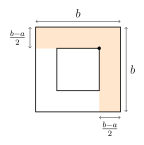
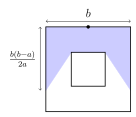
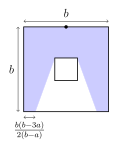
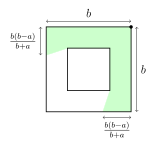
A prison consists of a square courtyard of side \(b\) bounded by a perimeter wall and a square building of side \(a\) placed centrally within the courtyard. The sides of the building are parallel to the perimeter walls. Guards can stand either at the middle of a perimeter wall or in a corner of the courtyard. If the guards wish to see as great a length of the perimeter wall as possible, determine which of these positions is preferable. You should consider separately the cases \(b<3a\) and \(b>3a\,\).
Solution:
2015 Paper 1 Q9
A short-barrelled machine gun stands on horizontal ground. The gun fires bullets, from ground level, at speed \(u\) continuously from \(t=0\) to \(t= \dfrac{\pi}{ 6\lambda}\), where \(\lambda\) is a positive constant, but does not fire outside this time period. During this time period, the angle of elevation \(\alpha\) of the barrel decreases from \(\frac13\pi\) to \(\frac16\pi\) and is given at time \(t\) by \[ \alpha =\tfrac13 \pi - \lambda t\,. \] Let \(k = \dfrac{g}{2\lambda u}\). Show that, in the case \(\frac12 \le k \le \frac12 \sqrt3\), the last bullet to hit the ground does so\\[2pt] at a distance \[ \frac{ 2 k u^2 \sqrt{1-k^2}}{g} \] from the gun. What is the corresponding result if \(k<\frac12\)?
Solution: The bullet fired at time \(t\) will hit the ground at time \(t+\frac{2u \sin (\frac13\pi - \lambda t)}{g}\). To find the last time a bullet hits the ground, we can differentiate, noting that \begin{align*} && T(t) &= t + \frac{2u \sin \alpha}{g} \\ \Rightarrow && T'(t) &= 1 - \frac{2u\lambda}{g} \cos \alpha \\ && T''(t) &= \frac{2u \lambda^2}{g} \sin \alpha > 0 \end{align*} If \(k = \frac{g}{2\lambda u} \in [\frac12, \frac12\sqrt{3}]\) then notice that this turning point is always achieved, and will be a maximum. It will be when \(\cos \alpha = k, \sin \alpha = \sqrt{1-k^2}\). The distance will be \(u \cos \alpha \cdot \frac{2 u \sin \alpha}{g} = \frac{2ku^2\sqrt{1-k^2}}{g}\). If \(k < \frac12\) then the last bullet to hit the ground will be the last bullet fired, ie \(\frac{2u^2 \sin \frac16\pi \cos \frac16\pi}{g} = \frac{u^2 \sin \frac13 \pi}{g} = \frac{\sqrt{3}u^2}{2g}\)