Problems
Filters
91 problems found
1999 Paper 2 Q3
Let $$ {\rm S}_n(x)=\mathrm{e}^{x^3}{{\d^n}\over{\d x^n}}{(\mathrm{e}^{-x^3})}.$$ Show that \({\rm S}_2(x)=9x^4-6x\) and find \({\rm S}_3(x)\). Prove by induction on \(n\) that \({\rm S}_n(x)\) is a polynomial. By means of your induction argument, determine the order of this polynomial and the coefficient of the highest power of \(x\). Show also that if \(\displaystyle \frac{\d S_n}{\d x}=0\) for some value \(a\) of \(x\), then \(S_n(a)S_{n+1}(a)\le0\).
Solution: \begin{align*} && S_2(x) &= e^{x^3} \frac{d^2}{\d x^2} \left [e^{-x^3} \right] \\ &&&= e^{x^3} \frac{d}{\d x} \left [e^{-x^3}(-3x^2) \right] \\ &&&= e^{x^3} \left [e^{-x^3}(9x^4-6x) \right] \\ &&&=9x^4-6x \\ \\ && S_3(x) &= e^{x^3} \frac{\d^3}{\d x^3} \left [ e^{-x^3} \right]\\ &&&= e^{x^3} \frac{\d}{\d x} \left [ e^{-x^3}(9x^4-6x) \right ] \\ &&&= e^{x^3} e^{-x^3}\left [ (-3x^2)(9x^4-6x)+(36x^3-6) \right ] \\ &&&= -27x^6 +54x^3-6 \end{align*} Claim: \(S_n\) is a polynomial of degree \(2n\) with leading coefficient \((-3)^n\). Proof: Clearly this is true for \(n = 1, 2, 3\) by demonstration. Suppose it is true for some \(n = k\), then \begin{align*} && S_k(x) &= e^{x^2} \frac{\d^k}{\d x^k} \left [ e^{x^3}\right] \\ && (-3)^kx^{2k} +\cdots &= e^{x^3} \frac{\d^k}{\d x^k} \left [ e^{x^3}\right] \\ \Rightarrow && \frac{\d^k}{\d x^k} \left [ e^{x^3}\right] &= e^{-x^3} \left ( (-3)^kx^{2k} +\cdots\right) \\ \Rightarrow && \frac{\d^k}{\d x^k}\left [ e^{x^3}\right] &= e^{-x^3} (-3x^2)\left ( (-3)^kx^{2k} +\cdots\right) + e^{-x^3} S_k'(x) \\ &&&= e^{-x^3} \left (\underbrace{ (-3)^{k+1}x^{2k+2} + \cdots + S_k'(x)}_{\deg =2k+2}\right) \\ \Rightarrow && S_{k+1}(x) &= (-3)^{k+1}x^{2k+2} + \cdots + S_k'(x) \end{align*} And therefore \(S_{k+1}\) is a polynomial degree \(2(k+1)\) with leading coefficient \((-3)^{k+1}\) so by induction it's true for all \(n\). If \(S'_n(a) = 0\) then \(S_{n+1}(a) = (-3a^2)S_n(a) + S_n'(a) \Rightarrow S_{n+1}(a)S_n(a) = -3 (aS_n(a))^2 \leq 0\)
1999 Paper 2 Q7
The curve \(C\) has equation $$ y = \frac x {\sqrt{x^2-2x+a}}\; , $$ where the square root is positive. Show that, if \(a>1\), then \(C\) has exactly one stationary point. Sketch \(C\) when (i) \(a=2\) and (ii) \(a=1\).
Solution: \begin{align*} && y &= \frac x {\sqrt{x^2-2x+a}} \\ && y' &= \frac{\sqrt{x^2-2x+a} - \frac{x(x-1)}{\sqrt{x^2-2x+a}}}{x^2-2x+a} \\ &&&= \frac{-x+a}{(x^2-2x+a)^{3/2}} \end{align*} Since the denominator is always positive, the only stationary point is when \(x = a\)


1999 Paper 2 Q8
Prove that $$ \sum_{k=0}^n \sin k\theta = \frac { \cos \tfrac12\theta - \cos (n+ \tfrac12) \theta} {2\sin \tfrac12\theta}\;. \tag{*}$$
- Deduce that, when \(n\) is large, \[ \sum_{k=0}^n \sin \left(\frac{k\pi}{n}\right) \approx \frac{2n}\pi\;. \]
- By differentiating \((*)\) with respect to \(\theta\), or otherwise, show that, when \(n\) is large, \[ \sum_{k=0}^n k \sin^2 \left(\frac{k\pi}{2n}\right) \approx \left(\frac{1}4 +\frac{1}{\pi^2} \right)n^2\;. \]
Solution: \begin{align*} && \sum_{k=0}^n \sin k\theta &= \textrm{Im} \left ( \sum_{k=0}^n e^{i k \theta}\right)\\ &&&= \textrm{Im} \left ( \frac{e^{i(n+1)\theta}-1}{e^{i \theta}-1} \right)\\ &&&= \textrm{Im} \left ( \frac{e^{i(n+\tfrac12)\theta}-e^{-i\theta/2}}{e^{i \theta/2}-e^{-i \theta/2}} \right)\\ &&&= \textrm{Im} \left ( \frac{(e^{i(n+\tfrac12)\theta}-e^{-i\theta/2})/2i}{(e^{i \theta/2}-e^{-i \theta/2})/2i} \right)\\ &&&= \textrm{Im} \left ( \frac{(e^{i(n+\tfrac12)\theta}-e^{-i\theta/2})/i}{2\sin \tfrac12 \theta} \right)\\ &&&= \frac{\cos \tfrac12 \theta - \cos(n+ \tfrac12)\theta}{2\sin \tfrac12 \theta} \end{align*}
- When \(n\) is large we have \begin{align*} &&\sum_{k=0}^n \sin \left(\frac{k\pi}{n}\right) &= \frac{\cos \frac{\pi}{2n} - \cos \frac{(2n + 1)\pi}{2n}}{2 \sin \frac{\pi}{2n}} \\ &&&= \frac{\cos \frac{\pi}{2n} +\cos \frac{\pi}{2n}}{2 \sin \frac{\pi}{2n}} \\ &&&\approx \frac{1- \frac{\pi^2}{4n^2}}{\frac{\pi}{2n}} \\ &&&= \frac{2n}{\pi} - \frac{\pi}{2n} \\ &&&\approx \frac{2n}{\pi} \end{align*}
- \(\,\) \begin{align*} && \sum_{k=0}^n \sin k\theta &= \frac { \cos \tfrac12\theta - \cos (n+ \tfrac12) \theta} {2\sin \tfrac12\theta} \\ \frac{\d }{\d \theta}: && \sum_{k=0}^n k\cos k\theta &= \frac { (-\tfrac12\sin\tfrac12\theta +(n+\tfrac12) \sin (n+ \tfrac12) \theta)2 \sin \tfrac12 \theta - (\cos \tfrac12\theta - \cos (n+ \tfrac12) \theta) \cos \tfrac12 \theta} {4\sin^2 \tfrac12\theta} \\ &&&= \frac{-\sin^2 \tfrac12 \theta+(2n+1)\sin(n+\tfrac12)\theta \sin \tfrac12 \theta-\cos^2\tfrac12 \theta+\cos(n+\frac12)\theta \cos\tfrac12 \theta}{4 \sin^2 \tfrac12 \theta} \\ &&&= \frac{(2n+1)\sin(n+\tfrac12)\theta \sin \tfrac12 \theta+\cos(n+\frac12)\theta \cos\tfrac12 \theta-1}{4 \sin^2 \tfrac12 \theta} \\ &&&= \frac{2n\sin(n+\tfrac12)\theta \sin \tfrac12 \theta+\cos n \theta-1}{4 \sin^2 \tfrac12 \theta} \\ \\ \Rightarrow && \sum_{k=0}^n k\left ( 1-2\sin^2 \left ( \frac{k\theta}{2} \right) \right) &= \frac{2n\sin(n+\tfrac12)\theta \sin \tfrac12 \theta+\cos n \theta-1}{4 \sin^2 \tfrac12 \theta} \\ \Rightarrow && \sum_{k=0}^n k\sin^2 \left ( \frac{k\theta}{2} \right) &= \frac{n(n+1)}{4} - \frac{2n\sin(n+\tfrac12)\theta \sin \tfrac12 \theta+\cos n \theta-1}{8 \sin^2 \tfrac12 \theta} \\ \theta = \frac{\pi}{n}: && \sum_{k=0}^n k\sin^2 \left ( \frac{k\pi}{2n} \right) &= \frac{n(n+1)}{4} - \frac{2n\sin(n+\tfrac12)\frac{\pi}{n}\sin \tfrac12 \frac{\pi}{n}+\cos n \frac{\pi}{n}-1}{8 \sin^2 \tfrac12 \frac{\pi}{n}} \\ &&&= \frac{n(n+1)}{4} - \frac{-2n \sin^2 \frac{\pi}{2n}-2}{8 \sin^2 \tfrac12 \frac{\pi}{n}} \\ &&&= \frac{n^2+n}{4} + \frac{n}{4} + \frac{1}{4\sin^2\frac{\pi}{2n}} \\ &&&\approx \frac{n^2}4 + \frac{n}{2}+ \frac{n^2}{\pi^2} \\ &&&= \left ( \frac14 + \frac{1}{\pi^2} \right)n^2 + \frac{n}{4} \\ &&&\approx \left ( \frac14 + \frac{1}{\pi^2} \right)n^2 \end{align*}
1999 Paper 3 Q2
- Let \(\f(x)=(1+x^2)\e^x\). Show that \(\f'(x)\ge 0\) and sketch the graph of \(\f(x)\). Hence, or otherwise, show that the equation \[ (1+x^2)\e^x = k, \] where \(k\) is a constant, has exactly one real root if \(k>0\) and no real roots if \(k\le 0\).
- Determine the number of real roots of the equation $$ (\e^x-1) - k \tan^{-1} x=0 $$ in the cases (a) \(0< k\le 2/\pi\) and (b) \(2/\pi < k < 1\).
Solution:
- \(\,\) \begin{align*}
&& f(x) &= (1+x^2)e^x \\
&& f'(x) &= 2xe^x + (1+x^2)e^x \\
&&&= (1+x)^2e^x \geq 0
\end{align*}
As \(x \to -\infty\), \(f(x) \to 0\) and as \(x \to \infty\), \(f(x) \to +\infty\) and since \(f\) is strictly increasing we have exactly one solution to \(f(x) = k\) on \((0,\infty)\). Since \(f(x) > 0\) there are no solutions if \(k \leq 0\).
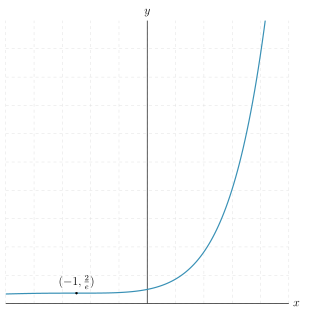
- Considering the function \(g(x) = (e^x-1)-k\tan^{-1} x \) then \(g'(x) = e^x - \frac{k}{1+x^2}\) therefore \(g'(x)\) has exactly one turning point when \(k > 0\) and \(0\) otherwise at the root of \(f(x) = k\) Notice also that \(g(0) = 0\) so we already have one solution, and \(g'(0) = 1 - k > 0\). Notice from our sketch that if \(0 < k < 1\) the root for \(f(x) = k\) has \(x \leq 0\), so our turning point is to the left of the origin and we are interested in the behaviour of \(g(x)\) as \(x \to -\infty\). (ie do we cross the axis again). \(\lim_{x \to -\infty} \left [ e^x - 1 - k \tan^{-1} x \right] = 0 - 1 +k \frac{\pi}{2} = k \frac{\pi}{2} - 1\). if this is positive, ie if \(k > \frac{2}{\pi}\) there are two solutions, otherwise there is only one real root.
1998 Paper 2 Q6
Two curves are given parametrically by \[ x_{1}=(\theta+\sin\theta),\qquad y_{1}=(1+\cos\theta),\tag{1} \]and \[ x_{2}=(\theta-\sin\theta),\qquad y_{1}=-(1+\cos\theta),\tag{2} \] Find the gradients of the tangents to the curves at the points where \(\theta= \pi/2\) and \(\theta=3\pi/2\). Sketch, using the same axes, the curves for \(0\le\theta \le 2\pi\). Find the equation of the normal to the curve (1) at the point with parameter \(\theta\). Show that this normal is a tangent to the curve (2).
1998 Paper 2 Q7
\begin{eqnarray*} {\rm f}(x)&=& \tan x-x,\\ {\rm g}(x)&=& 2-2\cos x-x\sin x,\\ {\rm h}(x)&=& 2x+x\cos 2x-\tfrac{3}{2}\sin 2x,\\ {\rm F}(x)&=& {x(\cos x)^{1/3}\over\sin x}. \end{eqnarray*} \vspace{1mm}
- By considering \(\f(0)\) and \(\f'(x)\), show that \(\f(x)>0\)
for \(0
- Show similarly that \(\g(x)>0\) for \(0
- Show that \(\h(x)>0\) for \(0
- By considering \(\displaystyle {{\rm F}'(x)\over {\rm F}(x)}\), show that \({\rm F}'(x)<0\) for \(0
- Show similarly that \(\g(x)>0\) for \(0
1998 Paper 3 Q1
Let $$ {\rm f}(x)=\sin^2x + 2 \cos x + 1 $$ for \(0 \le x \le 2\pi\). Sketch the curve \(y={\rm f}(x)\), giving the coordinates of the stationary points. Now let $$ \hspace{0.6in}{\rm g}(x)={a{\rm f}(x)+b \over c{\rm f}(x)+d} \hspace{0.8in} ad\neq bc\,,\; d\neq -3c\,,\; d\neq c\;. $$ Show that the stationary points of \(y={\rm g}(x)\) occur at the same values of \(x\) as those of \(y={\rm f}(x)\), and find the corresponding values of \({\rm g}(x)\). Explain why, if \(d/c <-3\) or \(d/c>1\), \(|{\rm g}(x)|\) cannot be arbitrarily large.
1997 Paper 1 Q8
By considering the maximum of \(\ln x-x\ln a\), or otherwise, show that the equation \(x=a^{x}\) has no real roots if \(a > e^{1/e}\). How many real roots does the equation have if \(0 < a < 1\)? Justify your answer.
Solution: \begin{align*} && y &= \ln x - x \ln a \\ \Rightarrow && y' &= \frac1x - \ln a \\ && y'' &= -\frac{1}{x^2} \end{align*} Therefore the maximum is when \(x = \frac{1}{\ln a}\) and \(y_{max} = -\ln \ln a - 1\). If \(y_{max} < 0\) then \(y \neq 0\). But that's equivalent to \(a > e^{1/e}\). \begin{align*} && 0 &> -\ln \ln a - 1 \\ \Leftrightarrow && 1 &> - \ln \ln a \\ \Leftrightarrow && \ln \ln a &>-1 \\ \Leftrightarrow && \ln a &> e^{-1} \\ \Leftrightarrow && a & > e^{1/e} \end{align*} If \(0 < a < 1\) then, when \(x\) is small, \(\ln x - x \ln a\) is large and negative. When \(x\) is large and positive \(\ln x\) is positive and \(-x \ln a\) is positive. We also notice there is no turning point. Hence exactly one solution
1997 Paper 1 Q14
The maximum height \(X\) of flood water each year on a certain river is a random variable with density function \begin{equation*} {\mathrm f}(x)= \begin{cases} \exp(-x)&\text{if \(x\geqslant 0\),}\\ 0&\text{otherwise}. \end{cases} \end{equation*} It costs \(y\) megadollars each year to prepare for flood water of height \(y\) or less. If \(X\leqslant y\) no further costs are incurred but if \(X\geqslant y\) the cost of flood damage is \(r+s(X-y)\) megadollars where \(r,s>0\). The total cost \(T\) megadollars is thus given by \begin{equation*} T= \begin{cases} y&\text{if \(X\leqslant y\)},\\ y+r+s(X-y)&\text{if \(X>y\)}. \end{cases} \end{equation*} Show that we can minimise the expected total cost by taking \[y=\ln(r+s).\]
1996 Paper 1 Q1
A cylindrical biscuit tin has volume \(V\) and surface area \(S\) (including the ends). Show that the minimum possible surface area for a given value of \(V\) is \(S=3(2\pi V^{2})^{1/3}.\) For this value of \(S\) show that the volume of the largest sphere which can fit inside the tin is \(\frac{2}{3}V\), and find the volume of the smallest sphere into which the tin fits.
Solution: Suppose we have height \(h\) and radius \(r\), then: \(V = \pi r^2 h\) and \(S = 2\pi r^2 + 2\pi r h\). \(h = \frac{V}{\pi r^2}\), so \begin{align*} S &= 2 \pi r^2 + 2 \pi r\frac{V}{\pi r^2} \\ &= 2\pi r^2 +V \frac1{r}+V \frac1{r} \\ &\underbrace{ \geq }_{\text{AM-GM}} 3 \sqrt[3]{2\pi r^2 \frac{V^2}{r^2} } = 3 (2 \pi V^2)^{1/3} \end{align*} Equality holds when \(r = \sqrt[3]{\frac{V}{2 \pi}}, h = \frac{V}{\pi (V/2\pi)^{2/3}} = \sqrt[3]{\frac{4V}{\pi}}\) Since \(h > r\) the sphere has a maximum radius of \(r\) and so it's largest volume is \(\frac43 \pi r^3 = \frac43 \pi \frac{V}{2 \pi} = \frac23 V\).

1995 Paper 1 Q5
If \[ \mathrm{f}(x)=nx-\binom{n}{2}\frac{x^{2}}{2}+\binom{n}{3}\frac{x^{3}}{3}-\cdots+(-1)^{r+1}\binom{n}{r}\frac{x^{r}}{r}+\cdots+(-1)^{n+1}\frac{x^{n}}{n}\,, \] show that \[ \mathrm{f}'(x)=\frac{1-(1-x)^{n}}{x}\,. \] Deduce that \[ \mathrm{f}(x)=\int_{1-x}^{1}\frac{1-y^{n}}{1-y}\,\mathrm{d}y. \] Hence show that \[ \mathrm{f}(1)=1+\frac{1}{2}+\frac{1}{3}+\cdots+\frac{1}{n}\,. \]
Solution: \begin{align*} f(x) & =nx-\binom{n}{2}\frac{x^{2}}{2}+\binom{n}{3}\frac{x^{3}}{3}-\cdots+(-1)^{r+1}\binom{n}{r}\frac{x^{r}}{r}+\cdots+(-1)^{n+1}\frac{x^{n}}{n} \\ f'(x) &= n - \binom{n}{2} x + \binom{n}{3}x^2 - \cdots (-1)^{r+1} \binom{n}{r} + \cdots + (-1)^{n+1} x^{n-1} \\ &= \frac{1-(1-x)^n}{x} \end{align*} Therefore, since \(\displaystyle f(x) = \int_0^xf'(t)\,dt\) \begin{align*} f(x) &= \int_0^x \frac{1 - (1-t)^n}{t} \, dt \\ &= \int_{1}^{1-x} \frac{1-y^n}{1-y} (-1)\, dy \tag{Let \(y = 1-t, \frac{dy}{dt} = -1\)} \\ &= \boxed{\int_{1-x}^1 \frac{1-y^n}{1-y} dy} \\ &= \int_{1-x}^1 \l 1 + y + y^2 + \cdots + y^{n-1} \r \, dy \\ &= \left [ y + \frac{y^2}{2} + \frac{y^3}{3} + \cdots + \frac{y^n}{n} \right]_{1-x}^1 \\ \end{align*} So when \(x = 1, 1-x = 0\) so we exactly have the sum required.
1995 Paper 2 Q1
- By considering \((1+x+x^{2}+\cdots+x^{n})(1-x)\) show that, if \(x\neq1\), \[ 1+x+x^{2}+\cdots+x^{n}=\frac{1-x^{n+1}}{1-x}. \]
- By differentiating both sides and setting \(x=-1\) show that \[ 1-2+3-4+\cdots+(-1)^{n-1}n \] takes the value \(-n/2\) is \(n\) is even and the value \((n+1)/2\) if \(n\) is odd.
- Show that \[ 1^{2}-2^{2}+3^{2}-4^{2}+\cdots+(-1)^{n-1}n^{2}=(-1)^{n-1}(An^{2}+Bn) \] where the constants \(A\) and \(B\) are to be determined.
Solution:
- \begin{align*} && (1+x+x^{2}+\cdots+x^{n})(1-x) &= 1-x+x-x^2+\cdots -x^n+x^n-x^{n+1} \\ &&&= 1-x^{n+1} \\ \Rightarrow && 1+x+x^2+\cdots+x^n &= \frac{1-x^{n+1}}{1-x} \tag{dividing by \(1-x\)} \end{align*}
- \begin{align*} \frac{\d}{\d x}: && 0+1+2x+\cdots+nx^{n-1} &= \frac{(n+1)(1-x)x^n+(1-x^{n+1})}{(1-x)^2} \\ \Rightarrow && 1-2x+\cdots+(-1)^n n &= \frac{-(n+1)2(-1)^n+(1-(-1)^{n+1})}{4} \\ &&&= \begin{cases} \frac{-(n+1)\cdot2\cdot1+(1-(-1)}{4} & \text{if }n\text{ is even} \\ \frac{-(n+1)\cdot 2 \cdot(-1)+(1-1)}{4} & \text{if }n\text{ is odd}\end{cases} \\ &&&= \begin{cases} \frac{-n}{2} & \text{if }n\text{ is even}\\ \frac{n+1}{2} & \text{if }n\text{ is odd}\end{cases} \\ \end{align*}
- \begin{align*} x: && x+2x^2+\cdots+nx^{n} &= \frac{(n+1)(1-x)x^{n+1}+x(1-x^{n+1})}{(1-x)^2} \\ &&&= \frac{x+(n+1)x^{n+1}-nx^{n+2}}{(1-x)^2}\\ \frac{\d}{\d x}: && 1^2+2^2x + \cdots + n^2x^{n-1} &= \frac{(1-x)^2(1+(n+1)^2x^{n}-n(n+2)x^{n+1}) +2(1-x)(x+(n+1)x^{n+1}-nx^{n+2})}{(1-x)^4} \\ &&&= \frac{1 + x - (1 + n)^2 x^n + (2 n^2+2n-1) x^{n+1} - n^2 x^{n+2}}{(1-x)^3} \\ \Rightarrow && 1^2-2^2 + \cdots + (-1)^{n-1}n^2 &= \frac{(-1)^n \l - (1 + n)^2- (2 n^2+2n-1) - n^2 \r}{8} \\ &&&= \frac{(-1)^n(-4n^2-4n}{8} \\ &&&= \frac{(-1)^{n-1}(n^2+n)}{2} \end{align*}
1994 Paper 1 Q2
Given that \(a\) is constant, differentiate the following expressions with respect to \(x\):
- \(x^{a}\);
- \(a^{x}\);
- \(x^{x}\);
- \(x^{(x^{x})}\);
- \((x^{x})^{x}.\)
Solution: \begin{align*} && y &= x^a \\ && \frac{\d y}{\d x} &= \begin{cases} ax^{a-1} & a \neq 0 \\ 0 & a = 0 \end{cases} \\ \\ && y &= a^x \\ &&&= e^{(\ln a) \cdot x} \\ && \frac{\d y}{\d x} &= \ln a e^{(\ln a) x} \\ &&&= \ln a \cdot a^ x \\ \\ && y &= x^x \\ &&&= e^{x \ln x}\\ && \frac{\d y}{\d x} &= e^{x \ln x} \cdot \left ( \ln x + x \cdot \frac1x \right) \\ &&&= x^x \left (1 + \ln x \right) \\ \\ && y&= x^{(x^x)} \\ &&&= e^{x^ x \cdot \ln x} \\ && \frac{\d y}{\d x} &= e^{x^x \cdot \ln x} \left ( x^x \left (1 + \ln x \right) \cdot \ln x + x^x \cdot \frac1x\right) \\ &&&= x^{x^x} \left (x^x (1+ \ln x) \ln x +x^{x-1} \right) \\ &&&= x^{x^x+x-1} \left (1 + x \ln x + x (\ln x)^2 \right) \\ \\ && y &= (x^x)^x \\ &&&= x^{2x} \\ &&&= e^{2x \ln x} \\ && \frac{\d y}{\d x} &= e^{2 x \ln x} \left (2 \ln x + 2 \right) \\ &&&= 2(x^x)^x(1 + \ln x) \end{align*}
1992 Paper 1 Q5
Let \(\mathrm{p}_{0}(x)=(1-x)(1-x^{2})(1-x^{4}).\) Show that \((1-x)^{3}\) is a factor of \(\mathrm{p}_{0}(x).\) If \(\mathrm{p}_{1}(x)=x\mathrm{p}_{0}'(x)\) show, by considering factors of the polynomials involved, that \(\mathrm{p}_{0}'(1)=0\) and \(\mathrm{p}_{1}'(1)=0.\) By writing \(\mathrm{p}_{0}(x)\) in the form \[ \mathrm{p}_{0}(x)=c_{0}+c_{1}x+c_{2}x^{2}+c_{3}x^{3}+c_{4}x^{4}+c_{5}x^{5}+c_{6}x^{6}+c_{7}x^{7}, \] deduce that \begin{alignat*}{2} 1+2+4+7 & \quad=\quad & & 3+5+6\\ 1^{2}+2^{2}+4^{2}+7^{2} & \quad=\quad & & 3^{2}+5^{2}+6^{2}. \end{alignat*} Show that we can write the integers \(1,2,\ldots,15\) in some order as \(a_{1},a_{2},\ldots,a_{15}\) in such a way that \[ a_{1}^{r}+a_{2}^{r}+\cdots+a_{8}^{r}=a_{9}^{r}+a_{10}^{r}+\cdots+a_{15}^{r} \] for \(r=1,2,3.\)
Solution: \begin{align*} && p_0(x) &= (1-x)(1-x^2)(1-x^4) \\ &&&= (1-x)(1-x)(1+x)(1-x^2)(1+x^2) \\ &&&= (1-x)^2 (1+x)(1-x)(1+x)(1+x^2) \\ &&&= (1-x)^3 (1+x)^2 (1+x^2) \end{align*} \begin{align*} && p_0'(x) &= 3(1-x)^2(1+x)^2(1+x^2) + (1-x)^3 q(x) \\ \Rightarrow && p_0'(1) &= 3 \cdot 0 \cdots + 0 \cdots \\ &&&= 0 \\ && p_1'(x) &= p_0(x) + xp'_0(x) \\ \Rightarrow && p_1'(1) &= p_0(1) + 1\cdot p_0'(1) \\ &&&= 0 + 1 \cdot 0 \\ &&&= 0 \end{align*} Notice that \(p_0(x) = (1-x-x^2+x^3)(1-x^4) = 1-x-x^2+x^3-x^4+x^5+x^6-x^7\), so: \(p'_0(x) = -1-2x+3x^2-4x^3+5x^4+6x^5-7x^6 \Rightarrow p'_0(1) = 0 = -1 -2 -4 -7 + 3 + 5+6\). \((xp'_1(1))' = 0 = -1^2-2^2-4^2-7^2 + 3^2 + 5^2 + 6^2\). Consider \(q_0(x) = (1-x)(1-x^2)(1-x^4)(1-x^8)\), then \((1-x)^4\) is a factor, so in particular we know \(q_0(1), (xq_0(x))'|_{x=1} = 0,(x(xq_0(x))')'|_{x=1} = 0\), and so: \(q_0(x) = 1-x-x^2+x^3-x^4+x^5+x^6-x^7 - x^8+x^9+x^{10}-x^{11}+x^{12}-x^{13}-x^{14}+x^{15}\), and so: \(1^r+2^r+4^r+7^r+8^r+11^r+13^r+14^r = 3^r+5^r+6^r+9^r+10^r+12^r+15^r\) for \(r = 1,2,3\)
1992 Paper 1 Q6
Explain briefly, by means of a diagram, or otherwise, why \[ \mathrm{f}(\theta+\delta\theta)\approx\mathrm{f}(\theta)+\mathrm{f}'(\theta)\delta\theta, \] when \(\delta\theta\) is small. Two powerful telescopes are placed at points \(A\) and \(B\) which are a distance \(a\) apart. A very distant point \(C\) is such that \(AC\) makes an angle \(\theta\) with \(AB\) and \(BC\) makes an angle \(\theta+\phi\) with \(AB\) produced. (A sketch of the arrangement is given in the diagram.) \noindent