Problems
Filters
107 problems found
1997 Paper 1 Q11
A particle of unit mass is projected vertically upwards in a medium whose resistance is \(k\) times the square of the velocity of the particle. If the initial velocity is \(u\), prove that the velocity \(v\) after rising through a distance \(s\) satisfies \begin{equation*} v^{2}=u^{2}\e^{-2ks}+\frac{g}{k}(\e^{-2ks}-1). \tag{*} \end{equation*} Find an expression for the maximum height of the particle above he point of projection. Does equation \((*)\) still hold on the downward path? Justify your answer.
Solution: \begin{align*} \text{N2}(\uparrow): && 1 \cdot v\frac{\d v}{\d s} &= -g - kv^2 \\ \Rightarrow && \int \frac{v}{g+kv^2} \d v &= \int -1 \d s \\ \Rightarrow && \frac{1}{2k}\ln(g+kv^2) &= -s + C \\ s =0, v = u: && \frac{1}{2k} \ln(g+ku^2) &= C \\ \Rightarrow && s &= \frac{1}{2k} \ln \frac{g+ku^2}{g+kv^2} \\ \Rightarrow && e^{-2ks} &= \frac{g+kv^2}{g+ku^2} \\ \Rightarrow && v^2 &= u^2e^{-2ks} + \frac{g}{k}(e^{-2ks}-1) \end{align*} The maximum height will be when \(v = 0\), ie \(\displaystyle s = \frac{1}{2k}\ln\left(1 + \frac{k}{g}u^2 \right)\). On the downward path the resistance will be going upwards, ie \begin{align*} \text{N2}(\uparrow): && 1 \cdot v\frac{\d v}{\d s} &= -g + kv^2 \end{align*} but our solution is solving a different differential equation, therefore unless \(k=0\) the equation will be different.
1997 Paper 3 Q6
Suppose that \(y_n\) satisfies the equations \[(1-x^2)\frac{{\rm d}^2y_n}{{\rm d}x^2}-x\frac{{\rm d}y_n}{{\rm d}x}+n^2y_n=0,\] \[y_n(1)=1,\quad y_n(x)=(-1)^ny_n(-x).\] If \(x=\cos\theta\), show that \[\frac{{\rm d}^2y_n}{{\rm d}\theta^2}+n^2y_n=0,\] and hence obtain \(y_n\) as a function of \(\theta\). Deduce that for \(|x|\leqslant1\) \[y_0=1,\quad y_1=x,\] \[y_{n+1}-2xy_n+y_{n-1}=0.\]
1996 Paper 1 Q7
- At time \(t=0\) a tank contains one unit of water. Water flows out of the tank at a rate proportional to the amount of water in the tank. The amount of water in the tank at time \(t\) is \(y\). Show that there is a constant \(b < 1\) such that \(y=b^{t}.\)
- Suppose instead that the tank contains one unit of water at time \(t=0,\) but that in addition to water flowing out as described, water is added at a steady rate \(a>0.\) Show that \[ \frac{\mathrm{d}y}{\mathrm{d}t}-y\ln b=a, \] and hence find \(y\) in terms of \(a,b\) and \(t\).
Solution:
- Since water flows out a rate proportional to the water in the tank we must have \(\dot{y} = -ky\), ie \(y = Ae^{-k t}\). Since \(t = 0, y = 1\) we have \(y = e^{-kt} = (e^{-k})^t\), so call \(b = e^{-k}\) and we have the result. (Since \(k > 0 \Rightarrow b < 1\)
- Notice that \begin{align*} && \dot{y} &= -\underbrace{ky}_{\text{flow out}} + \underbrace{a}_{\text{flow in}} \\ &&&= y\ln b + a \\ \Rightarrow && \dot{y} - y \ln b &= a \\ \\ \text{CF}: && y &= Ae^{\ln b t} = Ab^t\\ \text{PI}: && y &= -\frac{a}{\ln b} \\ t = 0, y = 1: && 1 &= A-\frac{a}{\ln b} \\ \Rightarrow && y &= \frac{a}{\ln b} \left ( b^t - 1 \right)+b^t \end{align*}
1996 Paper 2 Q11
A particle hangs in equilibrium from the ceiling of a stationary lift, to which it is attached by an elastic string of natural length \(l\) extended to a length \(l+a\). The lift now descends with constant acceleration \(f\) such that \(0 < f < g/2\). Show that the extension \(y\) of the string from its equilibrium length satisfies the differential equation $$ {{\rm d}^2 y \over {\rm d} t^2} +{g \over a}\, y = g-f. $$ Hence show that the string never becomes slack and the amplitude of the oscillation of the particle is \(af/g\). After a time \(T\) the lift stops accelerating and moves with constant velocity. Show that the string never becomes slack and the amplitude of the oscillation is now \[\frac{2af}{g}|\sin {\textstyle \frac{1}{2}}\omega T|,\] where \(\omega^{2}=g/a\).
1996 Paper 3 Q14
Whenever I go cycling I start with my bike in good working order. However if all is well at time \(t\), the probability that I get a puncture in the small interval \((t,t+\delta t)\) is \(\alpha\,\delta t.\) How many punctures can I expect to get on a journey during which my total cycling time is \(T\)? When I get a puncture I stop immediately to repair it and the probability that, if I am repairing it at time \(t\), the repair will be completed in time \((t,t+\delta t)\) is \(\beta\,\delta t.\) If \(p(t)\) is the probability that I am repairing a puncture at time \(t\), write down an equation relating \(p(t)\) to \(p(t+\delta t)\), and derive from this a differential equation relating \(p'(t)\) and \(p(t).\) Show that \[ p(t)=\frac{\alpha}{\alpha+\beta}(1-\mathrm{e}^{-(\alpha+\beta)t}) \] satisfies this differential equation with the appropriate initial condition. Find an expression, involving \(\alpha,\beta\) and \(T\), for the time expected to be spent mending punctures during a journey of total time \(T\). Hence, or otherwise, show that, the fraction of the journey expected to be spent mending punctures is given approximately by \[ \quad\frac{\alpha T}{2}\quad\ \mbox{ if }(\alpha+\beta)T\text{ is small, } \] and by \[ \frac{\alpha}{\alpha+\beta}\quad\mbox{ if }(\alpha+\beta)T\text{ is large.} \]
1995 Paper 1 Q6
- In the differential equation \[ \frac{1}{y^{2}}\frac{\mathrm{d}y}{\mathrm{d}x}+\frac{1}{y}=\mathrm{e}^{2x} \] make the substitution \(u=1/y,\) and hence show that the general solution of the original equation is \[ y=\frac{1}{A\mathrm{e}^{x}-\mathrm{e}^{2x}}\,. \]
- Use a similar method to solve the equation \[ \frac{1}{y^{3}}\frac{\mathrm{d}y}{\mathrm{d}x}+\frac{1}{y^{2}}=\mathrm{e}^{2x}. \]
Solution:
- \(,\) \begin{align*} u = 1/y, \frac{\d u}{\d x} = -1/y^2 y': && -\frac{\d u}{\d x} + u &= e^{2x} \\ \Rightarrow && \frac{\d}{\d x} \left (e^{-x}u \right) = -e^{x} \\ \Rightarrow && e^{-x}u &= -e^x+C \\ \Rightarrow && u &= Ce^x-e^{2x} \\ \Rightarrow && y &= \frac{1}{Ce^x-e^{2x}} \end{align*}
- \(\,\) \begin{align*} u = 1/y^2, u' = -2/y^3 y': && -2u'+u &= e^{2x} \\ \Rightarrow && \frac{\d}{\d x} \left (e^{-1/2x}u\right) &= -\frac12e^{\frac32x} \\ \Rightarrow && e^{-\frac12x}u &= -\frac13e^{\frac32x}+C \\ \Rightarrow && u &= -\frac13e^{2x}+Ce^{\frac12x} \\ \Rightarrow && y &= \left ( \frac{1}{Ce^{\frac12x}-\frac13e^{2x}}\right)^{\frac12} \end{align*}
1995 Paper 2 Q8
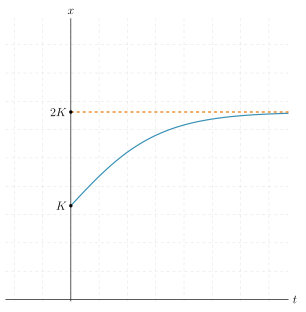
If there are \(x\) micrograms of bacteria in a nutrient medium, the population of bacteria will grow at the rate \((2K-x)x\) micrograms per hour. Show that, if \(x=K\) when \(t=0\), the population at time \(t\) is given by \[ x(t)=K+K\frac{1-\mathrm{e}^{-2Kt}}{1+\mathrm{e}^{-2Kt}}. \] Sketch, for \(t\geqslant0\), the graph of \(x\) against \(t\). What happens to \(x(t)\) as \(t\rightarrow\infty\)? Now suppose that the situation is as described in the first paragraph, except that we remove the bacteria from the nutrient medium at a rate \(L\) micrograms per hour where \(K^{2}>L\). We set \(\alpha=\sqrt{K^{2}-L}.\) Write down the new differential equation for \(x\). By considering a new variable \(y=x-K+\alpha,\) or otherwise, show that, if \(x(0)=K\) then \(x(t)\rightarrow K+\alpha\) as \(t\rightarrow\infty\).
Solution: \begin{align*} && \dot{x} &= (2K-x)x \\ \Rightarrow && \int \d t &= \int \frac{1}{(2K-x)x} \d x \\ &&&= \int \frac1{2K}\left ( \frac{1}{2K-x} + \frac{1}{x} \right) \d x \\ &&&= \frac{1}{2K} \left (\ln x - \ln (2K-x) \right) \\ \Rightarrow && 2Kt+C &= \ln \frac{x}{2K-x} \\ t = 0, x = K: && C &= \ln \frac{K}{2K-K} = 0 \\ \Rightarrow && e^{2Kt} &= \frac{x}{2K-x} \\ \Rightarrow && e^{-2Kt} &= \frac{2K}{x} -1 \\ \Rightarrow && x &= \frac{2K}{1+e^{-2Kt}} \\ &&&= K + K \frac{1-e^{-2Kt}}{1+e^{-2Kt}} \end{align*}
1995 Paper 2 Q11
Two identical particles of unit mass move under gravity in a medium for which the magnitude of the retarding force on a particle is \(k\) times its speed. The first particle is allowed to fall from rest at a point \(A\) whilst, at the same time, the second is projected upwards with speed \(u\) from a point \(B\) a positive distance \(d\) vertically above \(A\). Find their distance apart after a time \(t\) and show that this distance tends to the value \[ d+\frac{u}{k} \] as \(t\rightarrow\infty.\)
Solution: Both particles have equations of motion, \(\ddot{x} = -g-k\dot{x}\), so we can note that the distance between them has the equation of motion: \(\ddot{x} = -k \ddot{x} \Rightarrow x = Ae^{-kt} + B\) \begin{align*} && x(0) &= d \\ \Rightarrow && A+B &= d \\ && x'(0) &= u \\ \Rightarrow && -kA &= u \\ \Rightarrow && A &= -\frac{u}{k} \\ \Rightarrow && B &= d+\frac{u}{k} \\ \Rightarrow && x(t) &= -\frac{u}{k}e^{-kt} + d + \frac{u}{k} \to d + \frac{u}{k} \end{align*} as required.
1995 Paper 3 Q3
What is the general solution of the differential equation \[ \frac{\mathrm{d}^{2}x}{\mathrm{d}t^{2}}+2k\frac{\mathrm{d}x}{\mathrm{d}t}+x=0 \] for each of the cases: (i) \(k>1;\) (ii) \(k=1\); (iii) \(0 < x < 1\)? In case (iii) the equation represents damped simple harmonic motion with damping factor \(k\). Let \(x(0)=0\) and let \(x_{1},x_{2},\ldots,x_{n},\ldots\) be the sequence of successive maxima and minima, so that if \(x_{n}\) is a maximum then \(x_{n+1}\) is the next minimum. Show that \(\left|x_{n+1}/x_{n}\right|\) takes a value \(\alpha\) which is independent of \(n\), and that \[ k^{2}=\frac{(\ln\alpha)^{2}}{\pi^{2}+(\ln\alpha)^{2}}. \]
Solution: The auxiliary equation is \(\lambda^2 + 2k\lambda + 1 = (\lambda + k)^2+1-k^2 = 0\) (i) If \(k > 1\) then the solution is \(A\exp \left ({(-k + \sqrt{k^2-1})t} \right)+B\exp\left((-k-\sqrt{k^2-1})t \right)\). (ii) If \(k = 1\) then the solution is \(x = (A+Bt)e^{-kt}\) (iii) If \(k < 1\) then the solution is \(x = Ae^{-kt} \sin \left ( \sqrt{1-k^2} t \right)+Be^{-kt} \cos \left ( \sqrt{1-k^2} t \right)\) If \(x(0) = 0\) then \begin{align*} && x &= Ae^{-kt} \sin(\sqrt{1-k^2}t)\\ && \dot{x} &= Ae^{-kt} \left (-k \sin(\sqrt{1-k^2}t)+\sqrt{1-k^2} \cos(\sqrt{1-k^2}t) \right) \\ (\dot{x} =0): && \tan (\sqrt{1-k^2}t) &= \frac{\sqrt{1-k^2}}{k}\\ \end{align*} Therefore maxima and minima occur every \(\frac{\pi}{\sqrt{1-k^2}}\), so \begin{align*} && \frac{x_{n+1}}{x_n} &= \exp\left ( -\frac{k\pi}{\sqrt{1-k^2}} \right) \frac{\sin\left (\sqrt{1-k^2}\left(t+\frac{\pi}{\sqrt{1-k^2}}\right)\right)}{\sin(\sqrt{1-k^2}t)} \\ &&&= \exp\left ( -\frac{k\pi}{\sqrt{1-k^2}} \right) \left (-1+0 \right)\\ &&&= -\exp\left ( -\frac{k\pi}{\sqrt{1-k^2}} \right) \\ \Rightarrow && \ln \alpha &= - \frac{k\pi}{\sqrt{1-k^2}} \\ \Rightarrow && (\ln \alpha)^2 &= \frac{k^2\pi^2}{1-k^2} \\ \Rightarrow && (1-k^2)(\ln \alpha)^2 &= k^2 \pi^2 \\ \Rightarrow && k^2(\pi^2+(\ln \alpha)^2) &= (\ln \alpha)^2 \\ \Rightarrow && k^2 &= \frac{(\ln \alpha)^2}{\pi^2 + (\ln \alpha)^2} \end{align*}
1995 Paper 3 Q5
Show that \(y=\sin^{2}(m\sin^{-1}x)\) satisfies the differential equation \[ (1-x^{2})y^{(2)}=xy^{(1)}+2m^{2}(1-2y), \] and deduce that, for all \(n\geqslant1,\) \[ (1-x^{2})y^{(n+2)}=(2n+1)xy^{(n+1)}+(n^{2}-4m^{2})y^{(n)}, \] where \(y^{(n)}\) denotes the \(n\)th derivative of \(y\). Derive the Maclaurin series for \(y\), making it clear what the general term is.
Solution: \begin{align*} && y &= \sin^2 (m \sin^{-1} x) \\ \Rightarrow && y' &= 2 \sin (m \sin^{-1} x) \cdot \cos (m \sin^{-1} x) \cdot m \cdot \frac1{\sqrt{1-x^2}} \\ \Rightarrow && y'' &= 2 \cos^2(m \sin^{-1} x) \cdot m^2 \cdot \frac{1}{1-x^2} + \\ &&&\quad\quad-2\sin^2(m \sin^{-1} x) m^2 \frac{1}{1-x^2} + \\ &&&\quad\quad\quad-\sin(m \sin^{-1} x) \cdot \cos(m \sin^{-1} x) \cdot m \cdot (1-x^2)^{-\frac32} \cdot (-2x) \\ \Rightarrow && (1-x^2)y^{(2)} &= 2m^2-4m^2y+xy' \\ &&&= xy^{(1)} + 2m^2(1-2y) \\ \\ \Rightarrow && (1-x^2)y^{(n+2)}-2nxy^{(n+1)}-2\binom{n}{2}y^{(n)} &= xy^{(n+1)}+ny^{(n)} -4m^2y^{(n)} \\ \Rightarrow && (1-x^2)y^{(n+2)} &= (2n+1)xy^{(n+1)}+(n(n-1)+n-4m^2)y^{(n)} \\ &&&= (2n+1)xy^{(n+1)}+(n^2-4m^2)y^{(n)} \\ \end{align*} \begin{align*} && y(0) &= \sin^2(m \sin^{-1} 0) \\ &&&= \sin^2 0 = 0 \\ \\ && y'(0) &= 0 \\ && (1-0^2)y^{(2)}(0) &= 2m^2(1-2y(0)) \\ \Rightarrow && y^{(2)}(0) &= 2m^2 \\ \\ && y^{(n+2)} (0) &= (2n+1) \cdot 0 \cdot y^{(n+1)} +(n^2-4m^2)y^{(n)}(0) \\ &&&= (n^2-4m^2)y^{(n)}(0) \\ \\ && y^{(2)}(0) &= 2m^2 \\ && y^{(4)}(0) &= (4-4m^2) \cdot 2m^2 \\ &&&= -8m(m+1)m(m-1) \\ && y^{(6)}(0) &= 32m(m+2)(m+1)m(m-1)(m-2) \\ && y^{(2k)}(0) &= (-1)^{k+1}2^{2k-1}m (m+k)\cdots(m-k) \text{ if }k < m \\ \\ && y &= m^2x^2 -2m\binom{m+1}{3} x^4 + \frac{16}{3}m\binom{m+2}{5}x^6 - \cdots \\ &&&+ (-1)^{k}\frac{2^{2k}}{k+1} m \binom{m+k}{2k+1}x^{2k+2}+\cdots \\ &&&= mx^2\sum_{k=0}^{m-1} \frac{(-1)^k2^{2k}}{k+1}\binom{m+k}{2k+1}x^{2k} \end{align*}
1994 Paper 2 Q10
A truck is towing a trailer of mass \(m\) across level ground by means of an elastic rope of natural length \(l\) whose modulus of elasticity is \(\lambda.\) At first the rope is slack and the trailer stationary. The truck then accelerates until the rope becomes taut and thereafter the truck travels in a straight line at a constant speed \(u\). Assuming that the effect of friction on the trailer is negligible, show that the trailer will collide with the truck at a time \[ \pi\left(\frac{lm}{\lambda}\right)^{\frac{1}{2}}+\frac{l}{u} \] after the rope first becomes taut.
1994 Paper 3 Q4
Find the two solutions of the differential equation \[ \left(\frac{\mathrm{d}y}{\mathrm{d}x}\right)^{2}=4y \] which pass through the point \((a,b^{2}),\) where \(b\neq0.\) Find two distinct points \((a_{1},1)\) and \((a_{2},1)\) such that one of the solutions through each of them also passes through the origin. Show that the graphs of these two solutions coincide and sketch their common graph, together with the other solutions through \((a_{1},1)\) and \((a_{2},1)\). Now sketch sufficient members of the family of solutions (for varying \(a\) and \(b\)) to indicate the general behaviour. Use your sketch to identify a common tangent, and comment briefly on its relevance to the differential equation.
1994 Paper 3 Q5
The function \(\mathrm{f}\) is given by \(\mathrm{f}(x)=\sin^{-1}x\) for \(-1 < x < 1.\) Prove that \[ (1-x^{2})\mathrm{f}''(x)-x\mathrm{f}'(x)=0. \] Prove also that \[ (1-x^{2})\mathrm{f}^{(n+2)}(x)-(2n+1)x\mathrm{f}^{(n+1)}(x)-n^{2}\mathrm{f}^{(n)}(x)=0, \] for all \(n>0\), where \(\mathrm{f}^{(n)}\) denotes the \(n\)th derivative of \(\mathrm{f}\). Hence express \(\mathrm{f}(x)\) as a Maclaurin series. The function \(\mathrm{g}\) is given by \[ \mathrm{g}(x)=\ln\sqrt{\frac{1+x}{1-x}}, \] for \(-1 < x < 1.\) Write down a power series expression for \(\mathrm{g}(x),\) and show that the coefficient of \(x^{2n+1}\) is greater than that in the expansion of \(\mathrm{f},\) for each \(n > 0\).
1993 Paper 1 Q9
In the manufacture of Grandma's Home Made Ice-cream, chemicals \(A\) and \(B\) pour at constant rates \(a\) and \(b-a\) litres per second (\(0 < a < b\)) into a mixing vat which mixes the chemicals rapidly and empties at a rate \(b\) litres per second into a second mixing vat. At time \(t=0\) the first vat contains \(K\) litres of chemical \(B\) only. Show that the volume \(V(t)\) (in litres) of the chemical \(A\) in the first vat is governed by the differential equation \[ \dot{V}(t)=-\frac{bV(t)}{K}+a, \] and that \[ V(t)=\frac{aK}{b}(1-\mathrm{e}^{-bt/K}) \] for \(t\geqslant0.\) The second vat also mixes chemicals rapidly and empties at the rate of \(b\) litres per second. If at time \(t=0\) it contains \(L\) litres of chemical \(C\) only (where \(L\neq K\)), how many litres of chemical \(A\) will it contain at a later time \(t\)?
Solution: The total volume in the first vat at time \(t\) is always \(K\), since \(b\) litres per second are coming in and \(b\) litres per second are going out. \begin{align*} &&\frac{\d V}{\d t} &= \underbrace{a}_{\text{incoming chemical }A} - \underbrace{b}_{\text{outgoing volume}} \cdot \underbrace{\frac{V(t)}{K}}_{\text{fraction of outgoing which is }A} \\ &&&= a - b \frac{V}{K} \\ \Rightarrow && \int \frac{1}{a-b\frac{V}{K}}\d V &= \int \d t \\ && - \frac{K}{b} \ln |a - b \frac{V}{K}| &= t +C\\ (t,V) = (0,0): && -\frac{K}{b} \ln a &= C \\ \Rightarrow && 1-\frac{b}{a} \frac{V}{K} &= e^{-bt/K} \\ \Rightarrow && V &= \frac{aK}{b} (1 - e^{-bt/K}) \end{align*} \begin{align*} &&\frac{\d W}{\d t} &= \underbrace{b}_{\text{incoming volume}} \cdot \underbrace{\frac{a}{b} (1 - e^{-bt/K})}_{\text{incoming fraction }A} - \underbrace{b}_{\text{outgoing volume}} \cdot \underbrace{ \frac{W(t)}{L}}_{\text{fraction of outgoing which is }A} \\ &&&= a (1 - e^{-bt/K}) - b \frac{W}{L} \\ \Rightarrow && \frac{\d W}{\d t} + \frac{b}{L} W &= a (1-e^{-bt/K}) \\ && \frac{\d}{\d t} \left ( e^{b/L t} W\right) &= ae^{b/L t}(1-e^{-bt/K}) \\ \Rightarrow && W &= e^{-bt/L} \left ( \frac{aL}{b}e^{b/Lt} - \frac{a}{\frac{b}{L} - \frac{b}{K}}e^{b/L t - b/K} \right) + Ce^{-bt/L} \\ &&&= \frac{aL}{b} \left (1 - \frac{K}{K-L}e^{-b/Kt} \right)+ Ce^{-bt/L} \\ (t,W) = (0,0): && 0 &= \frac{aL}{b} \frac{-L}{K-L} + C \\ \Rightarrow && C &= \frac{aL^2}{b(K-L)} \\ \Rightarrow && W &= \frac{aL}{b} \left (1 - \frac{K}{K-L} e^{-bt/K} + \frac{L}{K-L} e^{-bt/L} \right) \end{align*}
1993 Paper 2 Q3
- Solve the differential equation \[ \frac{\mathrm{d}y}{\mathrm{d}x}-y-3y^{2}=-2 \] by making the substitution \(y=-\dfrac{1}{3u}\dfrac{\mathrm{d}u}{\mathrm{d}x}.\)
- Solve the differential equation \[ x^{2}\frac{\mathrm{d}y}{\mathrm{d}x}+xy+x^{2}y^{2}=1 \] by making the substitution \[ y=\frac{1}{x}+\frac{1}{v}, \] where \(v\) is a function of \(x\).