Problems
Filters
74 problems found
1995 Paper 3 Q2
If \[ \mathrm{I}_{n}=\int_{0}^{a}x^{n+\frac{1}{2}}(a-x)^{\frac{1}{2}}\,\mathrm{d}x, \] show that \(\mathrm{I}_{0}=\pi a^{2}/8.\) Show that \((2n+4)\mathrm{I}_{n}=(2n+1)a\mathrm{I}_{n-1}\) and hence evaluate \(\mathrm{I}_{n}\).
Solution: \begin{align*} && I_n &= \int_{0}^{a}x^{n+\frac{1}{2}}(a-x)^{\frac{1}{2}}\,\mathrm{d}x\\ && I_0 &= \int_0^a x^{\frac12}(a-x)^{\frac12} \d x \\ x = a \sin^2 \theta, \d x = 2a \sin \theta \cos \theta \d \theta &&&= \int_{\theta =0}^{\theta = \pi/2} \sqrt{a}\sin \theta\sqrt{a} \cos \theta 2a \sin \theta \cos \theta \d \theta \\ &&&= \frac{a^2}{2} \int_0^{\pi/2} \sin^2 2 \theta \d \theta \\ &&&= \frac{a^2}{4} \int_0^{\pi/2}(1- \underbrace{\cos 4\theta}_{\text{runs round the whole unit circle}}) \d \theta \\ &&&= \frac{\pi a^2}{8} \\ \\ && I_n &= \int_0^a x^{n+\frac12}(a-x)^{\frac12} \d x \\ &&&=\underbrace{\left [-\frac23x^{n+\frac12}(a-x)^\frac32 \right]_0^a}_{=0} + \frac23 \left(n+\frac12\right) \int_0^ax^{n-1+\frac12}(a-x)^\frac32 \d x \\ &&&= \frac23 \left(n+\frac12\right) \int_0^ax^{n-1+\frac12}(a-x)(a-x)^\frac12 \d x \\ &&&= \frac23 \left(n+\frac12\right)aI_{n-1}-\frac23 \left(n+\frac12\right)I_{n} \\ \Rightarrow && \left(n+\frac12+\frac32\right)I_{n} &= \left(n+\frac12\right)aI_{n-1}\\ \Rightarrow && (2n+4)I_n &= (2n+1)aI_{n-1} \\ \\ \Rightarrow && I_n &= \frac{2n+1}{2n+4}a I_{n-1} \\ &&&=\frac{2n+1}{2n+4}\frac{2n-1}{2n+2}a^2 I_{n-2} \\ &&&= \frac{(2n+1)!!}{(2n+4)!!} \pi a^{n+2} \end{align*}
1994 Paper 1 Q4
Show that
- \(\dfrac{1-\cos\alpha}{\sin\alpha}=\tan\frac{1}{2}\alpha,\)
- if \(\left|k\right|<1\) then \({\displaystyle \int\frac{\mathrm{d}x}{1-2kx+x^{2}}=\frac{1}{\sqrt{1-k^{2}}}\tan^{-1}\left(\frac{x-k}{\sqrt{1-k^{2}}}\right)+C,}\) where \(C\) is a constant of integration.
Solution:
- \begin{align*} \frac{1-\cos \alpha}{\sin \alpha} &= \frac{1-(1-2\sin^2 \frac{\alpha}{2})}{2 \sin \frac \alpha2 \cos \frac\alpha2} \\ &= \frac{2 \sin^2 \frac \alpha2}{2 \sin \frac \alpha2 \cos \frac\alpha2} \\ &= \frac{\sin \frac \alpha2}{ \cos \frac\alpha2} \\ &= \tan \tfrac{\alpha}{2} \end{align*}
- \begin{align*} \int\frac{\mathrm{d}x}{1-2kx+x^{2}} &= \int \frac{\d x}{(x-k)^2+1-k^2} \\ &= \frac{1}{1-k^2}\int \frac{\d x}{\left (\frac{x-k}{\sqrt{1-k^2}} \right)^2+1} \\ &= \frac{1}{\sqrt{1-k^2}} \tan^{-1} \left (\frac{x-k}{\sqrt{1-k^2}} \right)+C \end{align*}
1994 Paper 1 Q8
By means of the change of variable \(\theta=\frac{1}{4}\pi-\phi,\) or otherwise, show that \[ \int_{0}^{\frac{1}{4}\pi}\ln(1+\tan\theta)\,\mathrm{d}\theta=\tfrac{1}{8}\pi\ln2. \] Evaluate \[ {\displaystyle \int_{0}^{1}\frac{\ln(1+x)}{1+x^{2}}\,\mathrm{d}x}\qquad\mbox{ and }\qquad{\displaystyle \int_{0}^{\frac{1}{2}\pi}\ln\left(\frac{1+\sin x}{1+\cos x}\right)\,\mathrm{d}x}. \]
Solution: \begin{align*} && I &= \int_0^{\frac14\pi} \ln (1 + \tan \theta) \d \theta \\ \theta = \tfrac14\pi - \phi, \d \theta = -\d\phi: &&&= \int_0^{\frac14 \pi} \ln ( 1 + \tan (\tfrac14\pi - \phi)) \d \phi \\ &&&= \int_0^{\frac14 \pi} \ln \left ( 1 + \frac{1 - \tan \phi}{1+\tan \phi} \right) \d \phi \\ &&&= \int_0^{\frac14 \pi} \ln \left ( \frac{2}{1+\tan \phi} \right) \d \phi \\ &&&= \tfrac14 \pi \ln 2 - I \\ \Rightarrow && I &= \tfrac18\pi \ln 2 \end{align*} \begin{align*} && J &= \int_0^1 \frac{\ln(1+x)}{1+x^2} \d x \\ x= \tan \theta \d \theta, \d \theta = \frac{\d x}{1+x^2} &&&= \int_0^{\frac14 \pi} \ln(1 + \tan \theta) \d \theta \\ &&&= \tfrac18 \pi \ln 2 \end{align*} \begin{align*} && K &= \int_0^{\frac12 \pi} \ln \left ( \frac{1 + \sin x}{1 + \cos x} \right) \d x \\ y = \tfrac12\pi - x, \d y = -\d x: &&&= \int_0^{\frac12\pi} \ln \left ( \frac{1+\cos y}{1+\sin y}\right) \d y \\ &&&= -K \\ \Rightarrow && K &= 0 \end{align*}
1994 Paper 3 Q1
Calculate \[ \int_{0}^{x}\mathrm{sech}\, t\,\mathrm{d}t. \] Find the reduction formula involving \(I_{n}\) and \(I_{n-2}\), where \[ I_{n}=\int_{0}^{x}\mathrm{sech}^{n}t\,\mathrm{d}t \] and, hence or otherwise, find \(I_{5}\) and \(I_{6}.\)
Solution: \begin{align*} && \int_0^x \mathrm{sech}\, t \d t &= \int_0^x \frac{2}{e^t+e^{-t}} \d t \\ &&&= \int_0^x \frac{2e^t}{e^{2t}+1} \d t \\ &&&= \left [2 \arctan e^t \right ]_0^x \\ &&&= 2\tan^{-1}e^x- \frac{\pi}{2} \end{align*} \begin{align*} && I_n &= \int_0^x \mathrm{sech}^n\, t \d t \\ &&&= \int_0^x \mathrm{sech}^{n-2}\, t \mathrm{sech}^2\, t \d t \\ &&&= \left [ \mathrm{sech}^{n-2}\, t \cdot \tanh t\right ]_0^x - \int_0^x (n-2) \mathrm{sech}^{n-3} \, t \cdot (- \tanh t \mathrm{sech}\, t) \tanh t \d t \\ &&&= \mathrm{sech}^{n-2}\, x \cdot \tanh x+(n-2)\int_0^x \mathrm{sech}^{n-2} t \tanh^2 t \d t \\ &&&= \mathrm{sech}^{n-2}\, x \cdot \tanh x+(n-2)\int_0^x \mathrm{sech}^{n-2} t (1-\mathrm{sech}^2 \, t) \d t \\ &&&= \mathrm{sech}^{n-2}\, x \cdot \tanh x+(n-2)I_{n-2}-(n-2)I_n \\ \Rightarrow && (n-1)I_n &= \mathrm{sech}^{n-2}\, x \cdot \tanh x+(n-2)I_{n-2} \\ \Rightarrow && I_n &= \frac{1}{n-1} \left ( \mathrm{sech}^{n-2}\, x \cdot \tanh x+(n-2)I_{n-2} \right) \\ \end{align*} \begin{align*} I_1 &= 2\tan^{-1}e^x- \frac{\pi}{2} \\ I_3 &= \frac12 \left ( \mathrm{sech}\, x \cdot \tanh x+ 2\tan^{-1}e^x- \frac{\pi}{2}\right) \\ &= \frac12 \mathrm{sech}\, x \cdot \tanh x+ \tan^{-1}e^x- \frac{\pi}{4} \\ I_5 &= \frac14 \left (\mathrm{sech}^3\, x \cdot \tanh x + 3 \left ( \frac12 \mathrm{sech}\, x \cdot \tanh x+ \tan^{-1}e^x- \frac{\pi}{4} \right) \right) \\ &= \frac14 \mathrm{sech}^3\, x \cdot \tanh x +\frac38 \mathrm{sech}\, x \cdot \tanh x+\frac34 \tan^{-1}e^x- \frac{3\pi}{16} \\ \\ I_2 &= \tanh x \\ I_4 &= \frac13 \left ( \mathrm{sech}^2 x\tanh x +2\tanh x\right) \\ &= \frac13 \mathrm{sech}^2 x\tanh x +\frac23 \tanh x \\ I_6 &= \frac15 \left ( \mathrm{sech}^4 x \tanh x+4\left ( \frac13 \mathrm{sech}^2 x\tanh x +\frac23 \tanh x \right) \right) \\ &= \frac15 \mathrm{sech}^4 x \tanh x + \frac4{15}\mathrm{sech}^2 x\tanh x + \frac{8}{15} \tanh x \end{align*}
1993 Paper 1 Q4
By making the change of variable \(t=\pi-x\) in the integral \[ \int_{0}^{\pi}x\mathrm{f}(\sin x)\,\mathrm{d}x, \] or otherwise, show that, for any function \(\mathrm{f},\) \[ \int_{0}^{\pi}x\mathrm{f}(\sin x)\,\mathrm{d}x=\frac{\pi}{2}\int_{0}^{\pi}\mathrm{f}(\sin x)\,\mathrm{d}x\,. \] Evaluate \[ \int_{0}^{\pi}\frac{x\sin x}{1+\cos^{2}x}\,\mathrm{d}x\quad\mbox{ and }\quad\int_{0}^{2\pi}\frac{x\sin x}{1+\cos^{2}x}\,\mathrm{d}x\,. \]
Solution: \begin{align*} && I &= \int_0^{\pi} x f(\sin x) \d x \\ t = \pi - x, \d t = -\d t : &&&= \int_{t = \pi}^{t = 0} (\pi - t) f(\sin (\pi - t)) -\d t \\ &&&= \int_0^{\pi} (\pi - t) f(\sin t) \d t \\ \Rightarrow && 2 I &= \pi \int_0^\pi f(\sin t) \d t \\ \Rightarrow && I &= \frac{\pi}{2} \int_0^{\pi} f(\sin x) \d x \end{align*} \begin{align*} && I &= \int_{0}^{\pi}\frac{x\sin x}{1+\cos^{2}x}\,\mathrm{d}x \\ &&&= \frac{\pi}{2}\int_0^\pi \frac{\sin x}{1 + \cos^2 x} \d x \\ &&&= \frac{\pi}{2}\left [ -\tan^{-1} \cos x\right]_0^{\pi} \\ &&&= \tan 1 - \tan (-1) = \frac{\pi^2}{4} \\ \\ && I &= \int_{0}^{2\pi}\frac{x\sin x}{1+\cos^{2}x}\,\mathrm{d}x \\ &&&= \int_{0}^{\pi}\frac{x\sin x}{1+\cos^{2}x}\,\mathrm{d}x + \int_{\pi}^{2\pi} \frac{x\sin x}{1+\cos^{2}x}\,\mathrm{d}x \\ u = x - \pi, \d u = \d x: &&&= \frac{\pi^2}{4} + \int_{0}^{\pi} \frac{(u+\pi)(-\sin u)}{1 + \cos^2 u}\d u \\ &&&= \frac{\pi^2}{4} -\frac{3\pi}{2} \int_0^{\pi} \frac{\sin u}{1+\cos^2 u} \d u \\ &&&= - \frac{\pi^2}2 \end{align*}
1993 Paper 2 Q2
- Evaluate \[ \int_{0}^{2\pi}\cos(mx)\cos(nx)\,\mathrm{d}x, \] where \(m,n\) are integers, taking into account any special cases that arise.
- Find \({\displaystyle \int\sqrt{1+\frac{1}{x}}\,\mathrm{d}x}.\)
1991 Paper 1 Q8
- By a substitution of the form \(y=k-x\) for suitable \(k\), prove that, for any function \(\mathrm{f}\), \[ \int_{0}^{\pi}x\mathrm{f}(\sin x)\,\mathrm{d}x=\pi\int_{0}^{\frac{1}{2}\pi}\mathrm{f}(\sin x)\,\mathrm{d}x. \] Hence or otherwise evaluate \[ \int_{0}^{\pi}\frac{x}{2+\sin x}\,\mathrm{d}x. \]
- Evaluate \[ \int_{0}^{1}\frac{(\sin^{-1}t)\cos\left[(\sin^{-1}t)^{2}\right]}{\sqrt{1-t^{2}}}\,\mathrm{d}t. \] {[}No credit will be given for numerical answers obtained by use of a calculator.{]}
Solution:
- \begin{align*} y = \pi - x, \d y = -\d x: && \int_0^{\pi} x f(\sin x) &= \int_{y = \pi}^{y = 0}(\pi - y) f(\sin(\pi-y))- \d y \\ &&&= \int_0^{\pi} (\pi -y) f(\sin y) \d y \\ \Rightarrow && 2 \int_0^{\pi} x f(\sin x)\d x &= \pi \int_0^{\pi} f(\sin x) \d x \\ &&&= \pi \int_0^{\pi/2} f(\sin x ) \d x + \pi \int_{\pi/2}^{\pi} f(\sin x ) \d x \\ &&&= \pi \int_0^{\pi/2} f(\sin x ) \d x +\pi \int_{y=\pi/2}^{y=0} f(\sin (\pi-y) ) (-\d y) \\ &&&= 2 \pi \int_0^{\pi/2} f(\sin x) \d x \\ \Rightarrow && \int_0^{\pi} x f(\sin x)\d x &= \pi \int_0^{\pi/2} f(\sin x) \d x \end{align*} Therefore if \(f(x) = \frac1{2+\sin x}\), letting \(t = \tan \frac{x}{2}\) we have \(\sin x = \frac{2 t}{1+t^2}, \frac{dt}{\d x} = \frac12 (1+t^2)\) \begin{align*} && \int_0^{\pi} \frac{x}{2 + \sin x } \d x &= \pi \int_0^{\pi/2} \frac{1}{2 + \sin x} \d x \\ &&&= \pi \int_{t = 0}^{t = 1} \frac{1}{2+\frac{2t}{1+t^2}} \frac{2}{1+t^2} \d t \\ &&&=\pi \int_0^1 \frac{2}{2t^2+2t+2} \d t\\ &&&=\pi \int_0^1 \frac{1}{(t+\tfrac12)^2 + \tfrac34} \d t\\ &&&= \pi \left [\frac{1}{\sqrt{3/4}} \tan^{-1} \frac{u}{\sqrt{3/4}} \right ]_{u=1/2}^{3/2} \\ &&&= \frac{2 \pi}{\sqrt{3}} \left ( \tan^{-1} \sqrt{3} - \tan^{-1} \frac1{\sqrt{3}} \right) \\ &&&= \frac{2 \pi}{\sqrt{3}} \left ( \frac{\pi}{3} - \frac{\pi}{6} \right) \\ &&&= \frac{\pi^2}{3\sqrt{3}} \end{align*}
- Let \(u = (\sin^{-1} t)^2, \frac{\d u}{\d t} = 2(\sin^{-1} t) \frac{1}{\sqrt{1-t^2}}\) \begin{align*} \int_{0}^{1}\frac{(\sin^{-1}t)\cos\left[(\sin^{-1}t)^{2}\right]}{\sqrt{1-t^{2}}}\,\mathrm{d}t &= \int_{u=0}^{\pi^2/4} \frac12 \cos u \d u \\ &= \frac12 \sin \frac{\pi^2}{4} \end{align*}
1990 Paper 1 Q5
- Evaluate \[ \int_{1}^{3}\frac{1}{6x^{2}+19x+15}\,\mathrm{d}x\,. \]
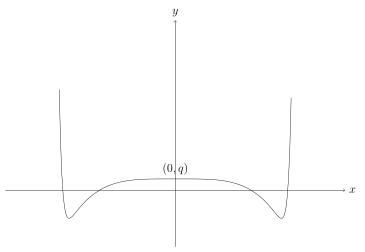
- Sketch the graph of the function \(\mathrm{f}\), where \(\mathrm{f}(x)=x^{1760}-x^{220}+q\), and \(q\) is a constant. Find the possible numbers of \textit{distinct }roots of the equation \(\mathrm{f}(x)=0\), and state the inequalities satisfied by \(q\).
Solution:
- \begin{align*} \int_{1}^{3}\frac{1}{6x^{2}+19x+15}\,\mathrm{d}x &= \int_1^3 \frac1{(2x+3)(3x+5)} \d x \\ &= \int_1^3 \l \frac{2}{2x+3} - \frac{3}{3x+5} \r \d x \\ &= \left [\ln(2x+3) - \ln(3x+5) \right ]_1^3 \\ &= \l \ln9 - \ln14 \r - \l \ln 5 - \ln 8 \r \\ &= \ln \frac{72}{70} \\ &= \ln \frac{36}{35} \end{align*}
- When \(q = 0\) the roots are \(-1, 0, 1\) There can be \(0, 2, 3, 4\) roots. There will be no roots if \(q > -\min (x^{1760} - x^{220})\) since the whole graph will be above the axis. There will be \(2\) roots if \(q = -\min (x^{1760} - x^{220})\) or \(q > 0\) There will be \(4\) roots if \(0 > q > -\min (x^{1760} - x^{220})\). There will be \(3\) roots if \(q =0\)
1988 Paper 1 Q9
Find the following integrals:
- \(\ {\displaystyle \int_{1}^{\mathrm{e}}\frac{\ln x}{x^{2}}\,\mathrm{d}x}\,,\)
- \(\ {\displaystyle \int\frac{\cos x}{\sin x\sqrt{1+\sin x}}\,\mathrm{d}x.}\)
Solution:
- \begin{align*} \int_{1}^{\mathrm{e}}\frac{\ln x}{x^{2}}\,\mathrm{d}x &= \left [-\frac{\ln x}{x} \right]_1^e + \int_1^e \frac{1}{x^2} \, \d x \\ &= -\frac{1}{e} + \left [ -\frac{1}{x} \right]_1^e \\ &= 1 - \frac{2}{e} \end{align*}
- \begin{align*} \int\frac{\cos x}{\sin x\sqrt{1+\sin x}}\,\mathrm{d}x &= \int \frac{2u}{(u^2-1)u} \d u \tag{\(u^2 = 1+\sin x\)} \\ &= \int \frac{1}{u-1} - \frac{1}{u+1} \d u \\ &= \ln(u-1) - \ln (u+1) + C \\ &= \ln \l \frac{u-1}{u+1} \r + C \\ &= \ln \l \frac{\sqrt{\sin x + 1} + 1}{\sqrt{\sin x + 1} -1} \r + C \end{align*}
1988 Paper 2 Q7
The integral \(I\) is defined by \[ I=\int_{1}^{2}\frac{(2-2x+x^{2})^{k}}{x^{k+1}}\,\mathrm{d}x \] where \(k\) is a constant. Show that \[ I=\int_{0}^{1}\frac{(1+x^{2})^{k}}{(1+x)^{k+1}}\,\mathrm{d}x=\int_{0}^{\frac{1}{4}\pi}\frac{\mathrm{d}\theta}{\left[\sqrt{2}\cos\theta\cos\left(\frac{1}{4}\pi-\theta\right)\right]^{k+1}}=2\int_{0}^{\frac{1}{8}\pi}\frac{\mathrm{d}\theta}{\left[\sqrt{2}\cos\theta\cos\left(\frac{1}{4}\pi-\theta\right)\right]^{k+1}}. \] Hence show that \[ I=2\int_{0}^{\sqrt{2}-1}\frac{(1+x^{2})^{k}}{(1+x)^{k+1}}\,\mathrm{d}x \] Deduce that \[ \int_{1}^{\sqrt{2}}\left(\frac{2-2x^{2}+x^{4}}{x^{2}}\right)^{k}\frac{1}{x}\,\mathrm{d}x=\int_{1}^{\sqrt{2}}\left(\frac{2-2x+x^{2}}{x}\right)^{k}\frac{1}{x}\,\mathrm{d}x \]
Solution: \begin{align*} I &=\int_{1}^{2}\frac{(2-2x+x^{2})^{k}}{x^{k+1}}\,\mathrm{d}x \\ u = x-1 &, \quad \d u = \d x \\ &= \int_{u = 0}^{u=1} \frac{(u^2+1)^k}{(u+1)^{k+1}} \d u \\ &= \boxed{\int_0^1 \frac{(1+x^2)^k}{(1+x)^{k+1}} \d x} \\ x = \tan \theta &, \quad \d x = \sec^2 \theta \d \theta \\ &= \int_{\theta = 0}^{\theta = \pi/4} \frac{\sec^{2k+2} \theta }{(1 + \tan \theta)^{k+1}} \d \theta \\ &= \int_0^{\pi/4} \frac{\d \theta}{\cos^{2k+2} \theta (\frac{\sin \theta + \cos \theta}{\cos \theta})^{k+1}} \\ &= \int_0^{\pi/4} \frac{\d \theta}{\cos^{k+1} \theta ({\sin \theta + \cos \theta})^{k+1}} \\ &= \int_0^{\pi/4} \frac{\d \theta}{\cos^{k+1} \theta (\sqrt{2} \cos (\frac{\pi}{4} - \theta))^{k+1}} \\ I &= \boxed{ \int_0^{\pi/4} \frac{\d \theta}{(\sqrt{2}\cos \theta \cos (\frac{\pi}{4} - \theta))^{k+1}}} \\ \end{align*} Since \(f(\theta) = \cos \theta \cos (\frac{\pi}{4} - \theta)\) is symmetric about \(\frac{\pi}{8}\) this integral is twice the integral to \(\frac{\pi}{8}\). \(\tan 2 \theta = \frac{2\tan \theta}{1 - \tan^2 \theta} \Rightarrow 1 = \frac{2 \tan \frac{\pi}{8}}{1 - \tan^2 \frac{\pi}{8}} \Rightarrow \tan \frac{\pi}{8} = \sqrt{2}-1\). Therefore, using the same substitution we must have: \[ I=2\int_{0}^{\sqrt{2}-1}\frac{(1+x^{2})^{k}}{(1+x)^{k+1}}\,\mathrm{d}x \] Let \(u = x^2\), then \(\d u = 2 x\d x\) \begin{align*} \int_{1}^{\sqrt{2}}\left(\frac{2-2x^{2}+x^{4}}{x^{2}}\right)^{k}\frac{1}{x}\,\mathrm{d}x &= \int_{u = 1}^{u = 2} \l \frac{2-2u+u^2}{u}\r^k \frac{1}{2u} \d u \\ &= \frac12 I \\ &= \int_{0}^{\sqrt{2}-1}\frac{(1+x^{2})^{k}}{(1+x)^{k+1}}\,\mathrm{d}x \\ u = 1+x & \quad \d u = \d x \\ &= \int_1^{\sqrt{2}} \frac{(1+(u-1)^2)^k}{u^{k+1}} \d u \\ &= \int_{1}^{\sqrt{2}}\left(\frac{2-2u+u^{2}}{u}\right)^{k}\frac{1}{u}\,\mathrm{d}x \\ &= \int_{1}^{\sqrt{2}}\left(\frac{2-2x+x^{2}}{x}\right)^{k}\frac{1}{x}\,\mathrm{d}x \end{align*}
1987 Paper 1 Q5
Using the substitution \(x=\alpha\cos^{2}\theta+\beta\sin^{2}\theta,\) show that, if \(\alpha<\beta\), \[ \int_{\alpha}^{\beta}\frac{1}{\sqrt{(x-\alpha)(\beta-x)}}\,\mathrm{d}x=\pi. \] What is the value of the above integral if \(\alpha>\beta\)? Show also that, if \(0<\alpha<\beta\), \[ \int_{\alpha}^{\beta}\frac{1}{x\sqrt{(x-\alpha)(\beta-x)}}\,\mathrm{d}x=\frac{\pi}{\sqrt{\alpha\beta}}. \]
Solution: Using the suggested substitution, we can find. \begin{align*} && x &=\alpha\cos^{2}\theta+\beta\sin^{2}\theta \\ && x-\alpha &=\alpha(\cos^{2}\theta-1)+\beta\sin^{2}\theta \\ &&& = (\beta - \alpha) \sin^2 \theta \\ && \beta - x &= -\alpha\cos^{2}\theta+\beta(1-\sin^{2}\theta) \\ &&&= (\beta-\alpha)\cos^2 \theta \\ && x &=\alpha\cos^{2}\theta+\beta\sin^{2}\theta \\ \Rightarrow && \frac{dx}{d\theta} &= (\beta - \alpha) 2 \cos \theta \sin\theta \\ \\ &&\int_{\alpha}^{\beta}\frac{1}{\sqrt{(x-\alpha)(\beta-x)}}\,\mathrm{d}x &= \int_0^{\pi/2} \frac{1}{(\beta - \alpha)\sin\theta \cos \theta} (\beta - \alpha) 2 \cos \theta \sin \theta \, d \theta \\ &&&= \int_0^{\pi/2} \frac{1}{\bcancel{(\beta - \alpha)}\bcancel{\sin\theta \cos \theta}} \bcancel{(\beta - \alpha)} 2 \bcancel{\cos \theta \sin \theta} \, d \theta \\ &&&= \int_0^{\pi/2} 2 d \theta \\ && &= 2 \frac{\pi}{2} = \boxed{\pi} \end{align*} If \(\alpha > \beta\) we can rewrite the integral as: \begin{align*} \int_{\alpha}^{\beta}\frac{1}{\sqrt{(x-\alpha)(\beta-x)}}\,\mathrm{d}x &= \int_{\alpha}^{\beta}\frac{1}{\sqrt{(x-\beta)(\alpha-x)}}\,\mathrm{d}x \\ &= -\int_{\beta}^{\alpha}\frac{1}{\sqrt{(x-\beta)(\alpha-x)}}\,\mathrm{d}x \\ &= -\pi \end{align*} Where the last step we are directly using the first integral with the use of \(\alpha\) and \(\beta\) reversed. Finally, using the substitution \(xt = 1\), we fortunately lose the \(\frac1{x}\) term: \begin{align*} && x &= \frac{1}{t} \\ && \frac{dx}{dt} &= -\frac1{t^2} \\ \\ && \int_{\alpha}^{\beta}\frac{1}{x\sqrt{(x-\alpha)(\beta-x)}}\,\mathrm{d}x &= \int_{\alpha}^{\beta}\frac{t}{\sqrt{(\frac{1}{t}-\alpha)(\beta-\frac{1}{t})}} \frac{-1}{t^2}\,\mathrm{d}t \\ && &= \int_{\frac1{\alpha}}^{\frac1\beta}\frac{-1}{\sqrt{(1-t\alpha)(t\beta-1)}}\,\mathrm{d}t \\ && &= \int_{\frac1{\alpha}}^{\frac1\beta}\frac{-1}{\sqrt{\alpha\beta}\sqrt{(\frac1{\alpha}-t)(t-\frac1{\beta})}}\,\mathrm{d}t \\ && &= \frac1{\sqrt{\alpha\beta}}\int_{\frac1{\alpha}}^{\frac1\beta}\frac{-1}{\sqrt{(\frac1{\alpha}-t)(t-\frac1{\beta})}}\,\mathrm{d}t \\ &&&= \boxed{\frac{\pi}{\sqrt{\alpha\beta}}} \end{align*} Where again the last step we are using the intermediate integral, with the roles of \(\alpha\) and \(\beta\) replaced with \(\frac{1}{\beta}\) and \(\frac1{\alpha}\)
1987 Paper 1 Q8
Explain why the use of the substitution \(x=\dfrac{1}{t}\) does not demonstrate that the integrals \[ \int_{-1}^{1}\frac{1}{(1+x^{2})^{2}}\,\mathrm{d}x\quad\mbox{ and }\quad\int_{-1}^{1}\frac{-t^{2}}{(1+t^{2})^{2}}\,\mathrm{d}t \] are equal. Evaluate both integrals correctly.
Solution: When we apply the substitution \(x = \frac1{t}\), \(t\) runs from \(-1 \to -\infty\) as \(x\) goes from \(-1 \to 0\). Then it runs from \(\infty \to 1\) as \(x\) runs from \(0 \to 1\). So we would be able to show that: \[ \int_{-1}^{1}\frac{1}{(1+x^{2})^{2}}\,\mathrm{d}x = \int_{-1}^{-\infty}\frac{-t^{2}}{(1+t^{2})^{2}}\,\mathrm{d}t + \int_{\infty}^1 \frac{-t^{2}}{(1+t^{2})^{2}}\,\mathrm{d}t \] Let \(x = \tan u, \d x = \sec^2 u \d u\) \begin{align*} \int_{-1}^1 \frac1{(1+x^2)^2} \d x &= \int_{u = -\pi/4}^{u = \pi/4} \frac{\sec^2 u}{(1+\tan^2 u)^2} \d u \\ &= \int_{u = -\pi/4}^{u = \pi/4} \frac{1}{\sec^2 u} \d u \\ &= \int_{-\pi/4}^{\pi/4} \cos^2 u \d u \\ &= \int_{-\pi/4}^{\pi/4} \frac{1 + \cos 2 u}{2} \d u \\ &= \left [ \frac{2u + \sin 2u}{4} \right]_{-\pi/4}^{\pi/4} \\ &= \frac{\pi}{4} + \frac{1}{2} \end{align*} Let \(t = \tan u, \d t = \sec^2 u \d u\) \begin{align*} \int_{-1}^1 \frac{-t^2}{(1+t^2)^2} \d x &= \int_{u = -\pi/4}^{u = \pi/4} \frac{-\tan^2 u \sec^2 u}{(1+\tan^2 u)^2} \d u \\ &= -\int_{u = -\pi/4}^{u = \pi/4} \frac{\tan^2 u}{\sec^2 u} \d u \\ &= -\int_{-\pi/4}^{\pi/4} \sin^2 u \d u \\ &= -\int_{-\pi/4}^{\pi/4} \frac{1 - \cos 2 u}{2} \d u \\ &= -\left [ \frac{2u - \sin 2u}{4} \right]_{-\pi/4}^{\pi/4} \\ &= \frac{1}{2}-\frac{\pi}{4} \end{align*}
1987 Paper 2 Q6
Let \[ I=\int_{-\frac{1}{2}\pi}^{\frac{1}{2}\pi}\frac{\cos^{2}\theta}{1-\sin\theta\sin2\alpha}\,\mathrm{d}\theta\, , \] where \(0<\alpha<\frac{1}{4}\pi\). Show that \[ I=\int_{-\frac{1}{2}\pi}^{\frac{1}{2}\pi}\frac{\cos^{2}\theta}{1+\sin\theta\sin2\alpha}\,\mathrm{d}\theta\, , \] and hence that \[ I=\frac{\pi}{\sin^{2}2\alpha}-\cot^{2}2\alpha\int_{-\frac{1}{2}\pi}^{\frac{1}{2}\pi}\frac{\sec^{2}\theta}{1+\cos^{2}2\alpha\tan^{2}\theta}\,\mathrm{d}\theta. \] Show that \(I=\frac{1}{2}\pi\sec^{2}\alpha\), and state the value of \(I\) if \(\frac{1}{4}\pi<\alpha<\frac{1}{2}\pi\).
Solution: \begin{align*} \int_{-\frac{1}{2}\pi}^{\frac{1}{2}\pi}\frac{\cos^{2}\theta}{1-\sin\theta\sin2\alpha}\,\mathrm{d}\theta &= \int_{u = \frac12 \pi}^{u = -\frac12 \pi} \frac{\cos^2 (-u)}{1-\sin(-u) \sin 2 \alpha} -\d u \tag{\(u = -\theta\)} \\ &= \int_{\frac12 \pi}^{-\frac12 \pi} \frac{\cos^2 u}{1+\sin u \sin 2 \alpha} -\d u \\ &= \int_{-\frac12 \pi}^{\frac12 \pi} \frac{\cos^2 u}{1+\sin u \sin 2 \alpha} \d u \\ &= \int_{-\frac12 \pi}^{\frac12 \pi} \frac{\cos^2 \theta}{1+\sin \theta \sin 2 \alpha} \d \theta \\ \end{align*} Since \(\displaystyle \frac{1}{(1-a^2u^2)} = \frac12 \l \frac{1}{1+au} + \frac1{1-au} \r\) \begin{align*} \int_{-\frac12 \pi}^{\frac12 \pi} \frac{\cos^2 \theta}{1+\sin \theta \sin 2 \alpha} \d \theta &= \int_{-\frac12 \pi}^{\frac12 \pi} \frac{\cos^2 \theta}{1-\sin ^2\theta \sin^2 2 \alpha} \d \theta \\ &= \int_{-\frac12 \pi}^{\frac12 \pi} \frac{1-\sin^2 \theta}{1-\sin ^2\theta \sin^2 2 \alpha} \d \theta \\ &= \int_{-\frac12 \pi}^{\frac12 \pi} \frac{(1-\sin ^2\theta \sin^2 2 \alpha) \frac{1}{\sin^2 2\alpha} + 1 - \cosec^2 2\alpha}{1-\sin ^2\theta \sin^2 2 \alpha} \d \theta \\ &= \frac{\pi}{\sin^2 2\alpha} -\cot^2 2\alpha \int_{-\frac{\pi}2}^{\frac{\pi}2} \frac{1}{1 - \sin^2 \theta \sin^2 2 \alpha} \d \theta \\ &= \frac{\pi}{\sin^2 2\alpha} -\cot^2 2\alpha \int_{-\frac{\pi}2}^{\frac{\pi}2} \frac{1}{1 - \sin^2 \theta (1-\cos^2 2 \alpha)} \d \theta \\ &= \frac{\pi}{\sin^2 2\alpha} -\cot^2 2\alpha \int_{-\frac{\pi}2}^{\frac{\pi}2} \frac{1}{\cos^2 \theta +\sin^2 \theta \cos^2 2 \alpha} \d \theta \\ &= \frac{\pi}{\sin^2 2\alpha} -\cot^2 2\alpha \int_{-\frac{\pi}2}^{\frac{\pi}2} \frac{\sec^2 \theta}{1 +\tan^2 \theta \cos^2 2 \alpha} \d \theta \\ \end{align*} Finally, using the substitution \(u =|\cos 2 \alpha | \tan \theta, \d u = |\cos 2 \alpha |\sec^2 \theta \d \theta\) \begin{align*} \int_{-\frac{\pi}2}^{\frac{\pi}2} \frac{\sec^2 \theta}{1 +\tan^2 \theta \cos^2 2 \alpha} \d \theta &= |\sec 2\alpha|\int_{u = -\infty}^{u = \infty} \frac{1}{1 + u^2} \d u \\ &= |\sec 2 \alpha|\pi \end{align*} and so \begin{align*} I &= \frac{\pi}{\sin^2 2\alpha} -\cot^2 2\alpha |\sec 2 \alpha|\pi \\ &= \frac{\pi}{\sin^2 2\alpha} \l 1-\cos 2\alpha \r \\ &= \frac{\pi}{4\sin^2 \alpha\cos^2 \alpha} \l 2 \sin^2 \alpha \r \\ &= \frac{\pi}{2 \cos^2 \alpha} = \frac{\pi}{2} \sec^2 \alpha \end{align*} When \(\alpha\) small enough that the modulus doesn't flip the sign. When if \(\frac{1}{4}\pi<\alpha<\frac{1}{2}\pi\) we have: \begin{align*} I &= \frac{\pi}{\sin^2 2\alpha} -\cot^2 2\alpha |\sec 2 \alpha|\pi \\ &= \frac{\pi}{\sin^2 2\alpha} \l 1+\cos 2\alpha \r \\ &= \frac{\pi}{4\sin^2 \alpha\cos^2 \alpha} \l 2 \cos^2 \alpha \r \\ &= \frac{\pi}{2 \sin^2 \alpha} = \frac{\pi}{2} \cosec^2 \alpha \end{align*}
1987 Paper 3 Q2
Let \({\displaystyle I_{m,n}=\int\cos^{m}x\sin nx\,\mathrm{d}x,}\) where \(m\) and \(n\) are non-negative integers. Prove that for \(m,n\geqslant1,\) \[ (m+n)I_{m,n}=-\cos^{m}x\cos nx+mI_{m-1,n-1}. \]
- Show that \({\displaystyle \int_{0}^{\pi}\cos^{m}x\sin nx\,\mathrm{d}x=0}\) whenever \(m,n\) are both even or both odd.
- Evaluate \({\displaystyle \int_{0}^{\frac{\pi}{2}}\sin^{2}x\sin3x\,\mathrm{d}x.}\)
Solution: Let \({\displaystyle I_{m,n}=\int\cos^{m}x\sin nx\,\mathrm{d}x,}\) Then \begin{align*} && I_{m,n} &= \int\cos^{m}x\sin nx\,\mathrm{d}x \\ &&&= \left [ -\frac1n \cos^m x \cos n x \right] - \frac{m}{n} \int \sin^{m-1} x \cos x \cos n x \d x \\ &&&= \left [ -\frac1n \cos^m x \cos n x \right] + \frac{m}{n} \int \sin^{m-1} x (\cos (n-1)x -\sin x \sin nx) \d x\\ &&&= \left [ -\frac1n \cos^m x \cos n x \right] + \frac{m}{n} \int \sin^{m-1} x \cos (n-1)x \d x-\frac{m}{n} I_{m,n} \\ &&&= \left [ -\frac1n \cos^m x \cos n x \right] + \frac{m}{n} I_{m-1,n-1} -\frac{m}{n} I_{m,n} \\ \Rightarrow && nI_{m,n} &= -\cos^m x \cos n x + mI_{m-1,n-1} -mI_{m,n}\\ \Rightarrow && (m+n)I_{m,n} &= -\cos^m x \cos n x + mI_{m-1,n-1} \end{align*}
- Note that \(I_{2m,0} = 0\) (the integrand is 0) and \(I_{0, 2m} = 0\) (symmetry for our limits). \(\displaystyle \left [-\cos^m x \cos n x \right]_0^\pi = \l - (-1)^m (-1)^n \r - \l -1 \r = 1 - (-1)^{m+n} = 0\) since \(m+n\) is even. Therefore all reductions are \(I_{m,n} = \frac{I_{m-1,n-1}}{m+n}\) terminating at \(0\), so all values are zero
- \begin{align*} \int_{0}^{\frac{\pi}{2}}\sin^{2}x\sin3x\,\mathrm{d}x &= \int_{0}^{\frac{\pi}{2}}(1-\cos^2x)\sin3x\,\mathrm{d}x \\ &= I_{0,3} - I_{2,3} \\ &= \frac13 - \frac15 \l \left [-\cos^2 x \cos 3 x \right]_0^{\pi/2} + 2 \cdot I_{1,2} \r \\ &= \frac13 - \frac15 \l 1 + \frac23 \l \left [-\cos x \cos 2 x \right]_0^{\pi/2} + 1\cdot I_{0,1} \r \r \\ &= \frac13 - \frac15 -\frac2{15} - \frac2{15} \\ &= \frac{5}{15} - \frac{3}{15} - \frac{4}{15} \\ &= -\frac2{15} \end{align*}